Tag Archives: review

A very short review of “Blair Witch” (2016)

I fully understand the reasonable popular criticisms of “Blair Witch” (2016).  But I’d be lying if I said I didn’t really enjoy it — I’d give it an 8 out of 10.

Yes, it’s largely a retread of the first film in 1999.  This putative sequel is effectively a remake, given how closely it parallels the original.  (And there are a lot of people who hated that movie to start with.)

There are other problems too.  A subplot’s non sequitur segue into body horror is entirely out of place, for example, and we have at least two characters who are so irritating that we can’t care much about their fate.  And then there are some missed opportunities involving technology.  (Much attention is paid to a drone that the ill-fated protagonists bring along in their trek into the woods, but it is underused later in the story.)

Still … this still worked for me.  I have always really liked found-footage horror movies, and I also like stories featuring local legends.  (They’re just more engaging to me than yet another slasher film or third-rate, no-budget zombie movie.)  And there are a couple of moments of brilliance.  The scariest has already been spoiled by the film’s trailer (seriously, f*** you,  Lionsgate marketing department).  But there are other nice touches … one is the dread-inducing, reality-bending story arc of the two locals who accompany the main protagonists.  (And weren’t these two supporting characters the most fun and interesting, anyway?)

And we indeed finally get glimpses of the titular Blair Witch!  They are brief and few, but they’re a damned effective, scary payoff.

All in all, this is still an offbeat horror outing in the same vein as the original, and I think the better parts made it a decent viewing.


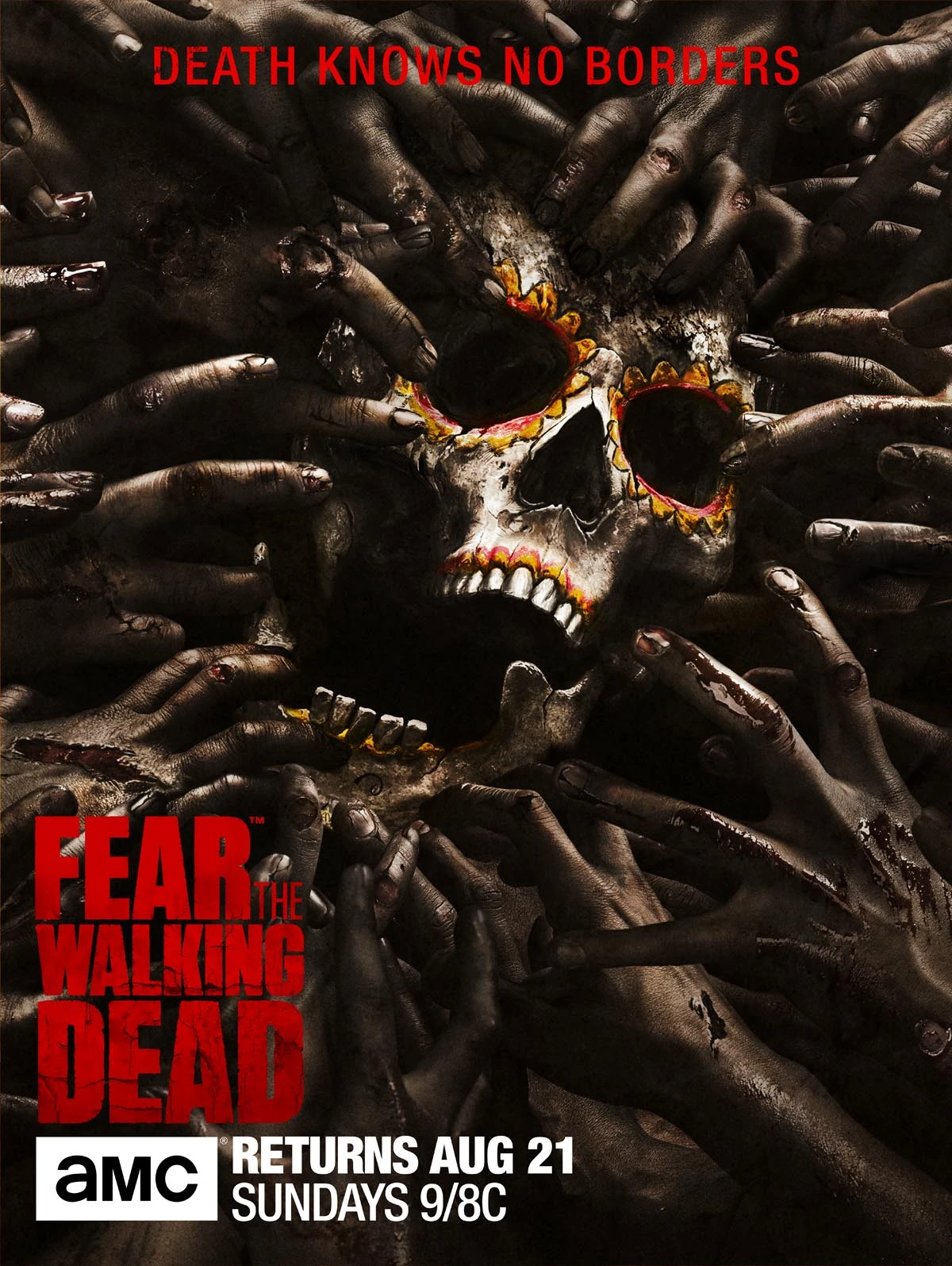
A short review of “Fear the Walking Dead” Season 2

I realize that “Fear the Walking Dead” is the show that so many people love to hate.  But I myself am just thrilled with it.  I’d give the second season a 9 out of 10 for being the show to which I looked forward to the most all week, and for arguably being more enjoyable than … that other zombie show.  (Its name escapes me at the moment.)

I suppose it feels smarter than it really is.  The pace is slower, there is far more background and context for the story, and I personally feel that there is far better characterization than in its predecessor.  (My fellow horror zombie fans strongly disagree, but I always thought that consistent characterization was a problem with “The Walking Dead.”)

As friends and reviewers have pointed out to me, though, it isn’t as smart as it feels.  People do dumb things; I’m not sure if it is laziness on the part of the screenwriters or just a lack of good judgement.  A typically egregious example is when our seafaring heroes deploy an unwieldy landing party to the beach while literally waiting to be attacked by pirates.  Another is the characters’ general apathy about the possibility of infection from blood splatters, from surfaces or from skin-to-dead-skin contact.  (We actually see a hero destroy a zombie by inserting his thumbs through its eye sockets into its brains.)

But the show is still damned enjoyable.  It has an epic feel.  Season 2 opens with a sweeping panorama of a ravaged Los Angeles, seen by a departing boat.  We have action by sea and by land, and show visits Mexico.  Radio transmissions and the accounts of minor characters further paint the apocalypse broadly.

I actually found the characters identifiable, if not always likable.  They just seemed more like real people than their counterparts on “The Walking Dead,” who lean closer to recognizable tropes (the good cop, the kid, the biker-with-a-heart-of-gold, the ninja).  The grounded, real-world drama among average, mundane people just made the show’s horror story context more real, and therefore more frightening.  (Let’s face it — you and I would probably be far more similar to “Fear’s” Travis, Madison or Alicia than to “The Walking Dead’s” Rick, Daryl or Michonne.)

And I think the subplots and story devices are often just genuinely creepy.  The hazards at sea, the boat-to-boat conflict, the outcome of the lighthouse storyline on the dock … a few of the show’s story arcs seemed like they were inspired by the kind of short stories you’d find in the best zombie anthologies.  Maybe I enjoyed “Fear” more than other viewers because I like the kind of varying, “situational” horror tales it served up every week.  This appealed to me more than the standard colony-vs.-colony stories seen that have grown routine on the show’s progenitor.

All in all, “Fear the Walking Dead” isn’t perfect, but its still a a great horror show.


A review of “Damnation Alley” (1977)

I’m not sure how to review “Damnation Alley” (1977).  I can’t call it a classic.  Portions of it are just too poorly made for that — even to the point where it deserves the “Mystery Science Theater 3000” treatment.  But it is an extremely enjoyable 1970’s end-of-the-world flick, it has some notably successful key scenes and it’s nothing less than venerated by people who love 70’s science fiction.

The movie’s story sounds as though it were conceived by scientifically illiterate teenagers who were passing a joint around … and the joint was laced with hallucinogens, and it was the crazy 70’s.  A nuclear war with Russia has actually tilted the earth on its axis, so it’s spinning askew.  This (and apparently not radiation or nuclear winter) has caused all sorts of cataclysms, and mankind’s best hope is that, through an act of God or something, the correct axis just sort of … reasserts itself.  In the meantime, the same threats you’d usually expect are inhabiting 70’s cinema’s postapocalyptic America: sick hillbillies and mutant fauna.

A trio of United States Air Force servicemen are forced to leave a protected California missile silo that has allowed them to survive the holocaust.  (It burns down after a drunk commanding officer passes out and drops a lit cigarette.  Seriously.)  Our heroes embark across America in the desperate hope to reach the one city that has apparently survived the nuclear fire.  And that’s Albany, for some reason.

I’m pretty sure Roger Zelazny’s 1967 novel, upon which this is ostensibly based, has little to do with this simplistic and head-scratching screenplay.  The book sounds much smarter and more interesting.

The movie gets off to a rocky start, in an ineptly blocked scene in which the director can’t even manage to get the three principal actors to make their faces visible during their conversation with one another.  (These would be a pre-“The A-Team” George Peppard, a pre-“Airwolf” Jan Michael Vincent, and a pre-“Terminator” Paul Winfield.”)  Just after this is an action sequence with “giant” scorpions that are composited onto the action via blue-screen.  The special effects here are embarrassingly bad; for a frame of reference, consider that this is the same year that the studio, 20th Century Fox, also released “Star Wars.”

Still, this ridiculous movie rises above its failings with some elements that were damn good.  For starters, I inexplicably found myself liking Peppard’s stern, laconic, Southern-drawled leader, and Winfield’s likable sidekick.  Even Vincent’s mimbo antics weren’t too grating.  He must have been a fan-favorite heartthrob back in the 70’s; the writer and director keep him front and center — saving girls, cracking jokes and riding a dirtbike.  (His character, “Hell Tanner,” was actually the main protagonist of Zelazny’s book.)

Here is where “Damnation Alley” actually reminded me of some of the better George A. Romero films.  Despite thin and slightly offbeat characterizations, the protagonists still managed to turn out cool and likable.  I identified with them.  (Is it just because this and the “Dead” movies seem to portray real, regular people instead common tropes?)

Second, certain scenes worked beautifully.  A no-budget scene depicting the inside of a casino was perfectly atmospheric and haunting.  The abandoned-town-with-a-secret scene was perfect, horrifying and unforgettable.  (And it had some nicely conceived antagonists.)  What should have been a by-the-numbers, cliched, post-apocalyptic hillbilly gang turned out to be genuinely frightening.  (The actors in these minor roles were quite competent.)  Don’t these prosaically characterized evildoers menace us more effectively than the clownish supervillains of the “Mad Max” films?

And, crappy scorpions notwithstanding, some of the period special effects actually worked.  The centerpiece of “Damnation Alley,” for a lot of fans, is the “Landmaster” — the  quite genuine 12-wheel, seven-ton, futuristic amphibious armored personnel carrier constructed specifically for the movie.  (That’s it in the second photo below.)  Seeing the actual (badass) vehicle instead of a model for the film should appeal to the kid in a lot of filmgoers, even today.  (I’m not even a gearhead, and I had fun with it.)  The custom vehicle cost $350,000 to build in 1976, and it’s still a legend in the 70’s science fiction fan community.

Another “special effect” that strangely holds up over time is the movie’s depiction of “radioactive skies.”  It’s a gaudy visual effect that would be cheap and low-tech by today’s standards, and it absolutely screams “1970’s cheese.”  Yet, as a modern movie fan, I loved it.  It’s perfect for setting the film’s unintentional clumsy-yet-creepy mood; it sets the tone for a beloved vintage B-movie classic, and it’s just neat to look at.  Wikipedia has some interesting information on the back ground for “Damnation Alley” — the radioactive skies effect actually took up 10 months of post-production, despite a final result that paled in comparison to “Star Wars.”  It was a troubled production, and its story is interesting reading.

Seriously, I had fun with “Damnation Alley.”  If it isn’t quite a “classic,” then it’s at least a really fun movie to which I’m sure I’ll return.  I’d give it an 8 out of 10, and I’m going to label it a Triple F — it’s a Forgivably Flawed Favorite.

Image result for damnation alley

Landmaster.jpg

A tiny review of “Independence Day: Resurgence” (2016).

They had 20 years to develop a sequel for “Independence Day: Resurgence” (2016) — 20 years after the original “Independence Day” exploded into theaters, defining the 1990’s summer blockbuster.  You figure that’d be enough time to come up with a really cool script.

Maybe there was one — maybe they had a really great screenplay that was thrown out for some reason at the very last minute. (Political correctness?  Copyright issues?  Internal studio politics?)  Then this by-the-numbers, live-action “G.I. Joe” cartoon was hastily thrust in front of the cameras.  What we’ve got here is really just a lot of common tropes strung together by a thin story, performed by cliche stock characters.  The charm, surprises, humor and impact of the (admittedly silly) original film are entirely absent here.

Don’t get me wrong.  “Independence Day: Resurgence” isn’t quite as bad as some other reviewers might make it seem.  There’s some fun to be had, especially if the kid in you still gets a kick out of gooey aliens.  (The ending sequence was enjoyable.)

It’s just disappointing because it’s quite average.  I’d give it a 6 out of 10, and I’d caution you to wait until you pay a dollar for it at Redbox.

Postscript: given what the movie reveals as their goal, why don’t the aliens just nuke us from orbit?  Ellen Ripley is smarter than an entire alien race.


A few quick words on “Train to Busan” (2016)

Everything you’ve heard about “Train to Busan” (2016) is indeed correct; it’s a first-rate South Korean zombie film that fans of the genre won’t want to miss.  I’d give it a 9 out of 10.

It’s maybe a little campier than I expected, with some over-the-top zombies that feel more reminiscent of the “Evil Dead” films than George A. Romero’s movies or Robert Kirkman’s work.  It’s also a bit long at nearly two hours — if I were editing it, I would have swapped out some of the time devoted to car-to-car melees with additional scenes showing what’s transpired beyond the train.  Imagine how a skilled screenwriter could further expand on the (really cool) train station plot points we already see … what if the train was forced to stop at every station?  What if it couldn’t stop?  What if its passengers were turned away at safe areas?  What if desperate stragglers tried to board the train?

This was a good one, people.  Check it out.


A short review of the Season 3 premiere of “The Strain.”

“The Strain” is zany, over-the-top, serialized comic book horror that often veers too close to high camp.  I keep waiting for either “South Park” of “Family Guy” to lampoon it.  It’s  sometimes pretty brainless, and it often seems like the product of a group of hyperactive 14 year old boys sitting down to imagine a vampire apocalypse.

But what the hell?  The damn thing works.  It isn’t as smart or as grown up as the moody “The Walking Dead,” “Fear the Walking Dead” or “Stranger Things.”  But it’s got a fast pace, a kinetic energy and an unpredictability that all of those shows lack.  It’s just … more fun.  I’d be lying if I said I didn’t love it.  And, as my interest in slow-moving zombie dramas starts to wane, this might become my favorite horror show currently on television.

It’s damned ambitious.  The writers here desperately want to show a full scale monster armageddon, and they don’t seem to care much that they’ve got a limited budget or a finite number of extras.  (We are told, now, that the vampire plague is spreading throughout the country, and is no longer confined to New York City.)

And it’s still scary.  Guillermo del Toro’s screeching, leopard-fast vampire baddies are still unnerving.  They’re goddam albino apex predators and they’re repulsive.  And I think their appeal is surprising after two seasons of audience exposure.  I predicted a while back that this show’s horror elements would lose their momentum, and I’ve pleasantly been proven wrong.  (Hey, if you’re a horror fan who loves monsters, you eventually crave story antagonists other than doomed, pitiful zombies.)

Last night’s Season 3 premiere offered little that was new.  But it did offer Navy Seals fighting vampires in the NYC sewers, and that was frikkin’ sweet.  I’d give it a 9 out of 10.


Image result for the strain season 3

A review of “Special Bulletin” (1983), with link

There’s a pretty damn interesting chestnut from from 80’s-era nuclear nightmare films available on Youtube — 1983’s “Special Bulletin.”  (The link is below.)  I was surprised I hadn’t heard of it.  I think most 80’s kids remember ABC’s “The Day After.”  That infamous television movie was a cultural touchstone that scared a generation of kids.  “Special Bulletin” was produced by NBC the same year, actually preceding “The Day After” by nine months.  Instead of a world-ending war with Russia, the feature-length special imagined a single incident of nuclear terrorism in Charleston, South Carolina.  (I myself had no idea that Charleston was the strategic military nexus that the movie explains it to be.)

“Special Bulletin” was filmed as a “War of the Worlds”-type narrative, consisting exclusively of faux news coverage, and it’s pretty damned good.  (It won a handful of Emmys.)  It’s just as frightening today — or maybe more so, given the increased threat of precisely this kind of terrorism from stateless groups.

The acting is mostly good, the directing successfully captures the feel of live news coverage, and the absence of a musical score further lends the movie a sense of realism.  The story has a few surprises for us, too — the plot setup is creative and interesting, and much more thought went in the the teleplay than I would have expected.  The film asks some difficult questions about the role of the media in affecting the outcome of high-profile crimes like the one depicted.  (Would such questions be more or less relevant in the age of camera-phones, uploaded ISIS executions and Facebook Live?  I’m not sure.)

I was also quite impressed with some of “Special Bulletin’s” thriller elements.  (I’d say more, but I will avoid spoilers for anyone who wants to watch it below.)

One thing that detracts from the format’s realism is the fact that some of this movie’s actors are easily recognizable from other roles in the 80’s (although it’s fun spotting them as an 80’s movie fan).

Most viewers my age, for example, will recognize Ed Flanders and Lane Smith.  The utterly sexy female reporter who arrives on location at Charleston Harbor is Roxanne Hart, who later played Brenda in “Highlander” (1986).  (She’s still quite beautiful, guys, and she’s still making movies.)  Most jarring of all, however, is a prominent role played by David Clennon, who any fan of horror-science fiction will recognize as Palmer from John Carpenter’s 1982 masterpiece, “The Thing.”  This is still fun, though — he has that same disarrayed hair.  Was it his trademark back in the day?


https://www.youtube.com/watch?v=NKY-2zkWJuo

A very short review of “The Shallows” (2016)

“The Shallows” (2016) is a pretty good beach-themed horror thriller — it’s just overrated.  I’d give it an 8 out of 10, and I’d easily recommend it to somebody looking for a decent, conventional scary movie.  But I don’t think it lives up to the hype.

The movie works.  The scares are there and, for the most part, they are stylishly and artistically rendered.  I jumped a couple of times.  My friends keep comparing it with “Jaws” (1975) or “Deep Blue Sea” (1999), but it really has more in common with the “Open Water” films of the early 2000’s.  It’s a competently made, slow-burn horror movie with a man-vs.-nature plot setup that could happen in real life.

But I doubt that “The Shallows” truly belongs on anyone’s must-see list, and I don’t plan on watching it twice.  The story is a little thin.  The movie feels padded with lengthy establishing shots and surfing sequences, and a belabored emotional backstory that feels tacked on.  (I think this easily could have been an hour-long film.)  The final action sequence is a little cartoonish, too.  (C’mon.)

I’m also perplexed by critics’ praise for lead actress Blake Lively’s performance.  To me, it seemed really poor.  (The exception is her reaction shots — she shined when she was reacting to offscreen threats.)

Anyway, do check it out.


A few quick words on “Game of Thrones” Season 3

To avoid spoilers, my review of “Game of Thrones” Season 3 will be necessarily brief, dependent as this show so often is on the key betrayals that affect its plot.  In short, I loved it, and I’d give it a 10 out of 10.  I don’t know why I’ve felt so reluctant to do that … maybe because I used to view it as too mainstream, given its zealous and seemingly universal fandom?  This would be a dishonest review if I didn’t admit that I was hooked on the show I used to make fun of.

It has some of the best acting and dialogue in recent memory.  The show might be worth watching for Peter Dinklage and Charles Dance’s verbal sparring, alone, for example.  Now, in this third season, Jon Snow and Daenerys finally evolved into heroes that I could actually root for.  (They seemed a bit thinly rendered up until now.)  I actually cheered when she wiggled that deal to purchase “The Unsullied” slave army.  And there was just more … fun stuff — dragons, White Walkers, melees, surprise attacks, etc.

At times the show feels slow to me — its is still pretty chatty, and neither the White Walkers nor Daenerys’ forces will ever win a war by moving swiftly.  After three years of the show, they’re … still moving south and north, respectively.  Rommel would have routed them easily.

And, at times, “Game of Thrones” is too dark even for me.  The scenes of torture and the bloody betrayals among allies’ sometimes make me think that the writers (or George R. R. Martin himself) simply wish to depress their audience.

Those things can’t prevent me from being just as hooked on this as everyone else, though.  Great stuff.


A very short review of “Cell” (2016)

The lower-budget “Cell” (2016) wasn’t quite the spectacular horror movie that I was hoping for.  (A Stephen King zombie film?!)  But it was still pretty good — I’d give it an 8 out of 10.

The screenwriting and directing are average.  The acting seems uneven too.  And, yes, that includes its curiously low-key performances by John Cusack and Samuel L. Jackson.  But the opening action set piece was well done, and it succeeds in capturing the creepiness and originality of King’s 2006 novel.  What a neat genre-buster too — this is zombie movie meets sci-fi film meets supernatural horror epic meets art-house road movie.  It really is an interesting (and quite divergent) variation of the zombie subgenre.

I’ll go ahead and answer the million dollar question for those who have read the book.  Yes, that widely unpopular ambiguous ending has been changed, and what we are shown is far more conclusive and satisfying.

By the way, this isn’t King’s first venture into zombie horror.  He wrote an excellent short story entitled “Home Delivery,” which I cheerfully recommend.  It’s far closer to mainstream zombie horror, and I think it would appeal to “The Walking Dead” fans.  I first read it in a worn copy of 1989’s “Book of the Dead” zombie anthology; it also appears in 1993’s “Nightmares & Dreamscapes.”