Tag Archives: Throwback Thursday

Throwback Thursday: Tim Conway on “The Carol Burnett Show”

Rest easy, Tim Conway (1933-2019).


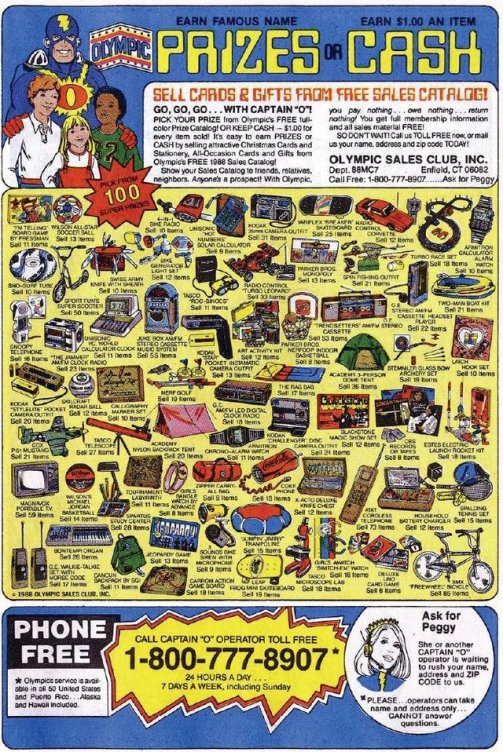
Throwback Thursday: Olympic Prizes or Cash!

Here’s another ad that was a permanent fixture of comic books in the 1980’s.  I myself was never interested in joining the advertised “Olympic Sales Club;” nor did I want to “GO, GO, GO WITH CAPTAIN “O”!” [sic].

I found this ad pretty patronizing, with its generic champion hugging his demographically diverse charges in the upper left-hand corner.  What kind of superhero was “Captain O” supposed to be, anyway?  Was he the protector of the company?  The guardian of the kids who went door to door selling its wares? The hero of … salespeople generally?  To me, this was really just an example of adults pandering to kids as though they were idiots.

But ads like this fueled a lot of conversation among grade-school boys.  It really made it seem like you could earn some cool prizes for selling only a moderate amount of greeting cards or stationary.  (The radio-controlled cars and planes were what all the boys eyed most eagerly.)

And 80’s kids often prided ourselves on our sales skills.  Most of us had sold things door-to-door for school-related fundraisers — it was just a very common practice at the time, even if it seems needlessly dangerous to me as an adult.  When I was in second and third grade at Catholic school, we annually sold candy bars door-to-door.  If memory serves, we weren’t even required to do that for any particular fundraising purpose, like a school trip or a sports team.  I think it we were just turning a profit for the school, in addition to what our parents were paying them in tuition.

I also remember seeing ads in my older comics that recruited kids to sell “Grit,” which was some sort of periodical that was oddly billed as a “family newspaper.”  But I think that was primarily a 1970’s thing, and was just before my time.


4BHeRXx12ibMWVWbVFQS0O_6mzEpxbe5uUl5Y-nfUkI

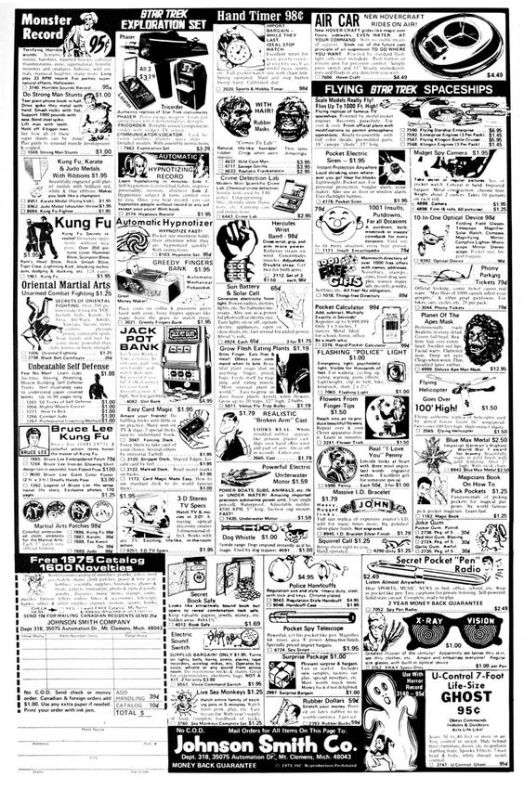
Throwback Thursday: The Johnson Smith Company Catalog!

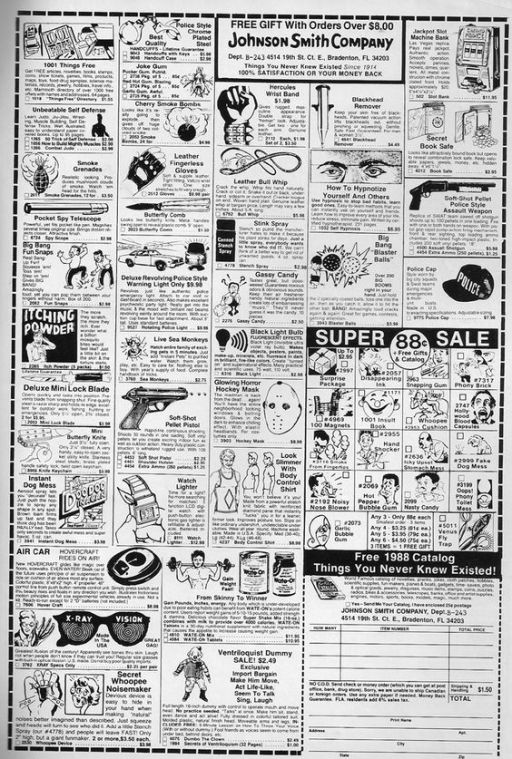
Ah, The Johnson Smith Company Catalog — the Holy Bible for little boy pranksters, magicians, spies, collectors and monster lovers everywhere.  The goofy novelties I’ve written about here at the blog could all be found among its fabled pages — even if they frequently lay outside the limits of what my boyhood allowance could buy.  (Note the “Greedy Fingers Bank” top left in the third picture below, for example.  This is the same wind-up toy that was occasionally advertised as the “Novelty Coffin Bank.”)

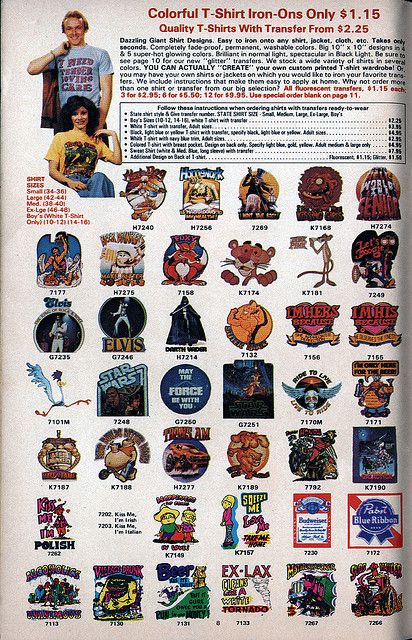
As the pages below show, you could buy anything from “X-Rays Specs” to smoke grenades to itching powder to Halloween masks to “Whoopee Cushions” to “Joy Buzzers.”   There were dozens of dubious “how-to” books as well, for would-be practitioners of such arcane pursuits as Kung-Fu or hypnosis.  And there were some risque items aimed clearly at adults — primarily decals and clothing.  (Does anyone under 40 remember “iron-ons” for t-shirts?  That was actually more of a 1970’s thing than a 1980’s thing.)  The Halloween masks, especially, were the stuff of legend among me and my friends.  But the “deluxe” masks cost $25, if memory serves, which was well outside my grade-school price range.

Goddam, but this catalog stimulated a kid’s imagination.  When it arrived in my mailbox, it seemed like a magical, exotic tome from some parallel universe where everything was made up exclusively of monsters and ninjas and gadgets.  Adding to its mystique was the fact that I never actually sent away for it — I wound up on the company’s mailing list around 1979 after buying something from the back of a comic book.  I forget what that fateful inaugural purchase was.  It might have been the “Sea Monkeys” that I wrote about two weeks ago, but I have a feeling it might have been stamps.  (I fetishized stamp collecting for a lengthy period of my early childhood, and was elated by those 500-stamps-for-$5-type offers that you sometimes found in comics.)

The scans below were downloaded from Pinterest; it looks like the first two are from the 70’s and the third one is from the 80’s.  But they’re both representative of any catalog that I received from 1979 through the early part of the next decade.  The small pages were crowded with random ads, mostly in little black-and-white boxes.  The pictures of the products were frequently just drawings, and often did not convey the real value of what you were buying.  (Remember, this was a vendor that sold “X Ray Specs.”)

The Johnson Smith Company is still around, too.  (They’ve been a thing since 1914 … I have no idea how the modern Internet marketplace either helps or hurts a company like this.)  But you can find them online right here.  I just ordered a catalog.


6f2b19ec616a7b1926f39cf244fa694b

31f9ef0e34a552228376682fa6c23646

d4ff161c511785705d29900ce4500885

Throwback Thursday: “Sea Monkeys!!!”

Yeah, you know the drill.  “Sea Monkeys” were a complete ripoff, because they were nothing like the charming humanoids featured in the ad below, which most of found towards the back of our comic books in the 1970’s and 1980’s.  They were some variation of “brine shrimp” — tiny crustaceans that looked more like bugs than little nuclear families of smiling mer-men.

I was a little less disappointed than most kids upon receiving my “Sea Monkeys,” and adding water to discover the barely visible creepy-crawlies.  I’d developed an obsessive fascination with all of the oddities advertised in comic books — not to mention those in the fabled Johnson-Smith Company catalog — and my father had patiently endeavored to teach me about false advertising.  (He debunked the legendary “X-Ray Specs” for me, for example, and explained to me that the term “genuine replica” meant that a coin was fake.)

Although he warned me beforehand, Sea Monkeys were something he thought I should also see firsthand, as a learning experience.  So I sent away for them.  (My father might have given me the money; I can’t remember.)  And they were indeed underwhelming, after the kit arrived at my household weeks later.  Rural Long Island had plenty of ponds — I could have just snatched up a bunch of water bugs and brought them home and called them “Sea Monkeys” with equal plausibility.  (I brought home some tadpoles once to discover a #$%^ing terrifying species of water spiders or something had hitchhiked along in the jar.  I arrived at that discovery at night in my room — it was one of those things I didn’t tell my mother about.)

The story of Sea Monkeys gets a hundred times stranger when you read up about their bizarre creator — the dubious “inventor” Harold Braunhut.  He appears to have been some kind of cross between P. T. Barnum and “Jurassic Park’s” John Hammond, along with … maybe a little Richard Spencer?

Braunhut “invented” the infamously nonfunctional “X-Ray Specs” that I mentioned above, for example, along with novelty pet kits like “Crazy Crabs” (they were simple hermit crabs) and “Invisible Goldfish.”  (The latter were less substantive than the “pet rock” of the 1970’s; Braunhut simply sold you an empty fishbowl and fish food.)  He raced motorcycles under the name, “The Green Hornet,” according to his Wikipedia entry, and he turned his home into a wildlife conservation.  And he’d gotten the idea for marketing “Sea Monkeys” from the popularity of ant farms.  (I suppose that makes a strange kind of sense.)  Seriously, the guy’s life was full of weirdness.

He was also a neo-nazi.  And that was especially odd, because … he himself was Jewish.  He even legally changed his name at one point to the more Germanic-sounding Harold von Braunhut to fool his unlikely Aryan pals.  (There are a few interesting articles out there about the man; here’s a great one by Evan Hughes over at The Awl.)

I really want to believe that Braunhut’s (well-documented) involvement with white supremacy groups was one of his many cons.  Surely he was simply trying to swindle them somehow.  He had, after all, sold weapons to the Ku Klux Klan.  Couldn’t he simply be hobnobbing with the Nazis as an undercover inventor trying trick them out of their money?  Why would the marketer of “Invisible Goldfish” be above such a thing?

I’m not sure why I am unconsciously going to such great lengths to exonerate the inventor of “Sea Monkeys.”  After all, he ripped me off when I was nine.  Yet here we are.


9190bcb829369a0c2d7c68caea74427f

Throwback Thursday: “YOU CAN FLOAT ON AIR!”

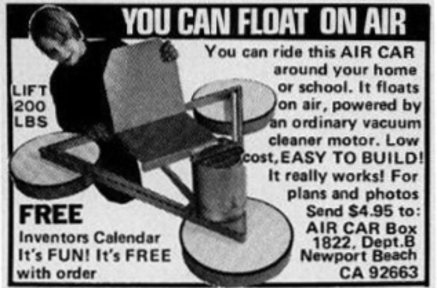
Here’s another bizarre relic of Boys’ Life magazine in the 1980’s — an ad for what was apparently a $4.95 do-it-yourself hovercraft.  (Kids needed to read that entire ad to understand that what this company was selling you was not the “AIR CAR” itself, or even its parts, but only “plans and photos.”)

A pal of mine in the Cub Scouts had his heart set on this, but  I wisely cautioned him that you couldn’t always trust advertisers.  (I’d learned my own lesson a couple of years prior from the duplicitous marketers of “Sea Monkeys.”)  You’ve gotta read the whole thing through, I told him.  Pretend that you’re dealing with the least trustworthy kid on the school bus.  It was one of those truly rare moments in my life when I counseled circumspection to others instead of vice versa.

He was pretty zealous in his desire for this thing.  For some reason, he really wanted to take it out over the Long Island Sound (to … Connecticut, presumably?)  I’m still not sure why he didn’t want a jet ski. We indeed had those in the 80’s.  Oh, well.  As dreams go, it wasn’t the worst that a kid could have.

He never wound up sending away for it.  I’m not sure if that’s because I talked him out of it or not.

But here’s the stunning O’Henry-style postscript — I’ve read a few Reddit and Twitter posts from men in their 40’s who also remember this Boys Life ad, and who actually sent away for the plans.  A couple of them claim that they successfully built this device, and that the damned thing actually worked.  (Cue the theme music for Christopher Nolan’s 2006 “The Prestige.”)  It certainly couldn’t hold 100 pounds, they qualified, but it technically still worked.

I guess if I ever run into my old friend from the Cub Scouts after 40 years, I owe him a hovercraft.


DHj7kMZXsAEtw1M

Throwback Thursday: “The Tripods” comic strip in “Boys’ Life” magazine!

I had a subscription to Boys’ Life magazine for a couple of years when I was a Cub Scout in the early 1980’s.  My parents canceled it after a year or two, and I can’t blame them — I just wasn’t reading it.  Boys’ Life was the official magazine of the Boy Scouts of America, and it was pretty wholesome stuff … it just didn’t offer the excitement of my comic books or the occasional copy of Fangoria that I manged to get my hands on.

But there was one feature of Boys’ Life that I followed religiously — the serialized comic strip adaptation of John Christopher’s The Tripods book trilogy.  (Christopher published the first three of his books in the late 1960’s; he added a prequel novel in 1988, but that was long after the Boy Scouts and Boys’ Life was behind me.)

The Tripods was cool, dark dystopian stuff.  The story opened with the first book, The White Mountains, to find humanity settled into an agrarian, pre-industrial age in which their overlords were the titular “tripods” — massive three-legged vehicles piloted by unknown beings.  Humans were ritualistically “capped” with a brain-altering device when they reached age 14 — thereafter becoming docile and conformist and easier for the mysterious machines to subjugate.

The White Mountains followed a trio of 13-year-old boys who escaped the “capping” to seek out a human resistance movement; the second book, The City of Gold and Lead, shows two of these protagonists infiltrate the city of the tripods’ operators.  (Spoiler — they’re grotesque aliens.)  The third book, The Pool of Fire, presumably picks up from there, but my Boys’ Life subscription ran out before the magazine got to that.

I recently, however, used this Interwebs thingamajig to discover what looks like a real gem of a find — a 1984 BBC mini-series adaptation of the books.  I started the first episode and it looks quite good.  If I get around to watching the whole thing, I’ll review it here.


40da7d9da25e489860f6e1bc7bccf65a7112394a

3

4

5

2

Throwback Thursday: 80’s-era Scouting handbooks.

If you were a Scout in the 1980’s, then I’m sure you remember these.  Yes, I was a Scout for a while too, and I fully realize that will amuse a lot of people who know me.

I’m pretty sure I aced that whole Cub Scout gig, as its only real requirement was being polite to adults, along with maybe doing good deeds every now and then.  I did just fine at the “Webelos” stage too.  Being a Boy Scout, however, had many more requirements — they included, among other things, not dying of exposure.  And here was where the expectations of scouting at last exceeded my natural aptitudes.

So I wasn’t exactly John Rambo out there.  If the Boy Scouts had voted on superlative awards, then I’m pretty sure I would have won “Most Likely to Die in the Wilderness,” or maybe “Most Likely to Perish in a Fire He Inadvertently Started,” or maybe even “Most Likely to Arrive at a Girl Scout Meeting by Mistake.”

Oh, well. I had fun with it.

The painting on the Bot Scout Handbook below, by the way, is “Come and Get It” by Norman Rockwell.  Here’s some trivia for you — if you’re ever surprised by the sheer volume of the man’s paintings, that’s because he completed more than 4,000 in his lifetime.

[Update: I see that I misspelled “Boy Scout” as “Bot Scout” above, but I’m leaving it there because it’s funny.]


bshb9b

boy scout book cover

s-l1600

Throwback Thursday: “The Velveteen Rabbit,” by Margery Williams, 1922

Margery Williams’ “The Velveteen Rabbit” was another book that made a big impression on me when I was a young kid; I think I was given this when I was in kindergarten or the first grade.  It’s funny how memories can be bizarrely specific about some things, but silent about others — I know this was a birthday present, but I cannot remember from whom.

You can find the whole book online, complete with the original illustrations right here at the University of Pennsylvania Digital Library.


covers_9777

Throwback Thursday: “Just So Stories,” by Rudyard Kipling, 1902

Rudyard Kipling’s “Just So Stories” was one of my favorite childhood books — a gem I found in my elementary school library.  (I seem to remember the nuns just sort of setting us loose there during reading class with the instructions to find something we liked.  It was the kind of unstructured activity that I don’t often remember from Catholic School.)

It’s basically a short collection of fables that Kipling concocted for his daughter about how certain animals got their key traits (“How the Elephant Got His Trunk,” “How the Leopard Got His Spots,” etc.).  This was one of two favorite books that were consistently a magnet for me in the tiny, tidy library beside the principal’s office.  The other was the collection of Arabian folktales, “One Thousand and One Nights.”

Growing up, I never realized that Kipling was the same author who wrote “Gunga Din” — both the 1890 poem and the eponymous 1939 war film with Cary Grant and Douglas Fairbanks, Jr.  (That movie was beloved by my father and brother, and later by me.)  I just never made the connection.


Just_So_Stories_Kipling_1902

Justso_rhino

Illustration_at_p._73_in_Just_So_Stories_(c1912)

Throwback Thursday: “I’m Gonna Wash that Gray Right Outta My Hair”

These early 80’s Clairol ads, of all things, came up on Facebook — after I lamented the waves of gray that have flourished across my head with astonishing suddenness.  (I swear this seems like something that happened overnight.  I honestly thought that there something wrong with my eyes, or maybe the bathroom light.)

I remember this little jingle quite well — it’s catchy, and there were a few variations of the 1980 TV spot that you see below.  I never knew that it was a send-up of a number from Rodgers and Hammerstein’s “South Pacific” — “I’m Gonna Wash that Man Right Outa My Hair.”  For some reason, my friends thought that was really funny.