Tag Archives: Throwback Thursday

Throwback Thursday: “Sea Monkeys!!!”

Yeah, you know the drill.  “Sea Monkeys” were a complete ripoff, because they were nothing like the charming humanoids featured in the ad below, which most of found towards the back of our comic books in the 1970’s and 1980’s.  They were some variation of “brine shrimp” — tiny crustaceans that looked more like bugs than little nuclear families of smiling mer-men.

I was a little less disappointed than most kids upon receiving my “Sea Monkeys,” and adding water to discover the barely visible creepy-crawlies.  I’d developed an obsessive fascination with all of the oddities advertised in comic books — not to mention those in the fabled Johnson-Smith Company catalog — and my father had patiently endeavored to teach me about false advertising.  (He debunked the legendary “X-Ray Specs” for me, for example, and explained to me that the term “genuine replica” meant that a coin was fake.)

Although he warned me beforehand, Sea Monkeys were something he thought I should also see firsthand, as a learning experience.  So I sent away for them.  (My father might have given me the money; I can’t remember.)  And they were indeed underwhelming, after the kit arrived at my household weeks later.  Rural Long Island had plenty of ponds — I could have just snatched up a bunch of water bugs and brought them home and called them “Sea Monkeys” with equal plausibility.  (I brought home some tadpoles once to discover a #$%^ing terrifying species of water spiders or something had hitchhiked along in the jar.  I arrived at that discovery at night in my room — it was one of those things I didn’t tell my mother about.)

The story of Sea Monkeys gets a hundred times stranger when you read up about their bizarre creator — the dubious “inventor” Harold Braunhut.  He appears to have been some kind of cross between P. T. Barnum and “Jurassic Park’s” John Hammond, along with … maybe a little Richard Spencer?

Braunhut “invented” the infamously nonfunctional “X-Ray Specs” that I mentioned above, for example, along with novelty pet kits like “Crazy Crabs” (they were simple hermit crabs) and “Invisible Goldfish.”  (The latter were less substantive than the “pet rock” of the 1970’s; Braunhut simply sold you an empty fishbowl and fish food.)  He raced motorcycles under the name, “The Green Hornet,” according to his Wikipedia entry, and he turned his home into a wildlife conservation.  And he’d gotten the idea for marketing “Sea Monkeys” from the popularity of ant farms.  (I suppose that makes a strange kind of sense.)  Seriously, the guy’s life was full of weirdness.

He was also a neo-nazi.  And that was especially odd, because … he himself was Jewish.  He even legally changed his name at one point to the more Germanic-sounding Harold von Braunhut to fool his unlikely Aryan pals.  (There are a few interesting articles out there about the man; here’s a great one by Evan Hughes over at The Awl.)

I really want to believe that Braunhut’s (well-documented) involvement with white supremacy groups was one of his many cons.  Surely he was simply trying to swindle them somehow.  He had, after all, sold weapons to the Ku Klux Klan.  Couldn’t he simply be hobnobbing with the Nazis as an undercover inventor trying trick them out of their money?  Why would the marketer of “Invisible Goldfish” be above such a thing?

I’m not sure why I am unconsciously going to such great lengths to exonerate the inventor of “Sea Monkeys.”  After all, he ripped me off when I was nine.  Yet here we are.


9190bcb829369a0c2d7c68caea74427f

Throwback Thursday: “YOU CAN FLOAT ON AIR!”

Here’s another bizarre relic of Boys’ Life magazine in the 1980’s — an ad for what was apparently a $4.95 do-it-yourself hovercraft.  (Kids needed to read that entire ad to understand that what this company was selling you was not the “AIR CAR” itself, or even its parts, but only “plans and photos.”)

A pal of mine in the Cub Scouts had his heart set on this, but  I wisely cautioned him that you couldn’t always trust advertisers.  (I’d learned my own lesson a couple of years prior from the duplicitous marketers of “Sea Monkeys.”)  You’ve gotta read the whole thing through, I told him.  Pretend that you’re dealing with the least trustworthy kid on the school bus.  It was one of those truly rare moments in my life when I counseled circumspection to others instead of vice versa.

He was pretty zealous in his desire for this thing.  For some reason, he really wanted to take it out over the Long Island Sound (to … Connecticut, presumably?)  I’m still not sure why he didn’t want a jet ski. We indeed had those in the 80’s.  Oh, well.  As dreams go, it wasn’t the worst that a kid could have.

He never wound up sending away for it.  I’m not sure if that’s because I talked him out of it or not.

But here’s the stunning O’Henry-style postscript — I’ve read a few Reddit and Twitter posts from men in their 40’s who also remember this Boys Life ad, and who actually sent away for the plans.  A couple of them claim that they successfully built this device, and that the damned thing actually worked.  (Cue the theme music for Christopher Nolan’s 2006 “The Prestige.”)  It certainly couldn’t hold 100 pounds, they qualified, but it technically still worked.

I guess if I ever run into my old friend from the Cub Scouts after 40 years, I owe him a hovercraft.


DHj7kMZXsAEtw1M

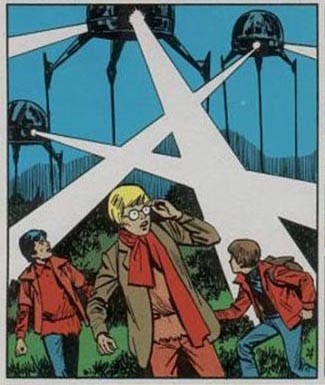
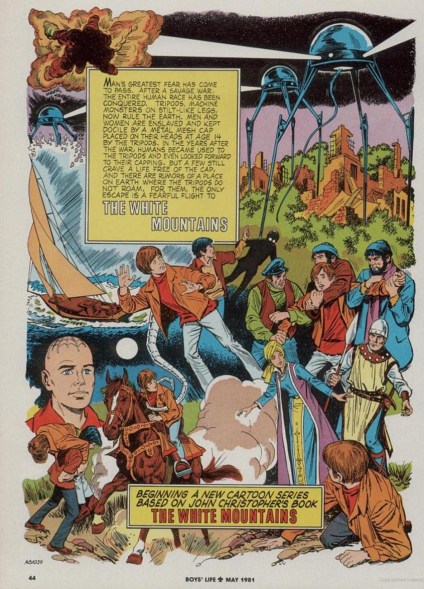
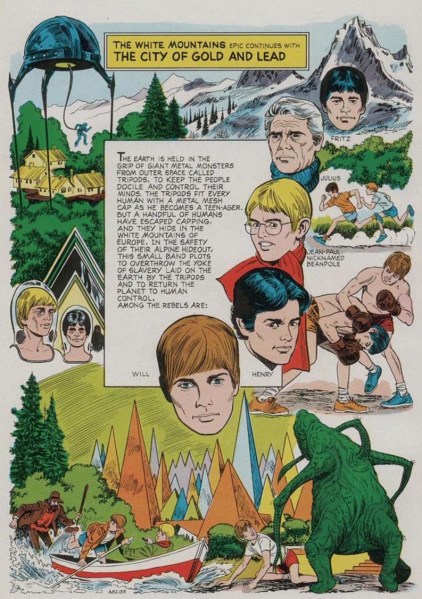
Throwback Thursday: “The Tripods” comic strip in “Boys’ Life” magazine!

I had a subscription to Boys’ Life magazine for a couple of years when I was a Cub Scout in the early 1980’s.  My parents canceled it after a year or two, and I can’t blame them — I just wasn’t reading it.  Boys’ Life was the official magazine of the Boy Scouts of America, and it was pretty wholesome stuff … it just didn’t offer the excitement of my comic books or the occasional copy of Fangoria that I manged to get my hands on.

But there was one feature of Boys’ Life that I followed religiously — the serialized comic strip adaptation of John Christopher’s The Tripods book trilogy.  (Christopher published the first three of his books in the late 1960’s; he added a prequel novel in 1988, but that was long after the Boy Scouts and Boys’ Life was behind me.)

The Tripods was cool, dark dystopian stuff.  The story opened with the first book, The White Mountains, to find humanity settled into an agrarian, pre-industrial age in which their overlords were the titular “tripods” — massive three-legged vehicles piloted by unknown beings.  Humans were ritualistically “capped” with a brain-altering device when they reached age 14 — thereafter becoming docile and conformist and easier for the mysterious machines to subjugate.

The White Mountains followed a trio of 13-year-old boys who escaped the “capping” to seek out a human resistance movement; the second book, The City of Gold and Lead, shows two of these protagonists infiltrate the city of the tripods’ operators.  (Spoiler — they’re grotesque aliens.)  The third book, The Pool of Fire, presumably picks up from there, but my Boys’ Life subscription ran out before the magazine got to that.

I recently, however, used this Interwebs thingamajig to discover what looks like a real gem of a find — a 1984 BBC mini-series adaptation of the books.  I started the first episode and it looks quite good.  If I get around to watching the whole thing, I’ll review it here.


40da7d9da25e489860f6e1bc7bccf65a7112394a

3

4

5

2

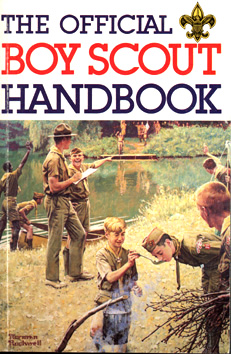
Throwback Thursday: 80’s-era Scouting handbooks.

If you were a Scout in the 1980’s, then I’m sure you remember these.  Yes, I was a Scout for a while too, and I fully realize that will amuse a lot of people who know me.

I’m pretty sure I aced that whole Cub Scout gig, as its only real requirement was being polite to adults, along with maybe doing good deeds every now and then.  I did just fine at the “Webelos” stage too.  Being a Boy Scout, however, had many more requirements — they included, among other things, not dying of exposure.  And here was where the expectations of scouting at last exceeded my natural aptitudes.

So I wasn’t exactly John Rambo out there.  If the Boy Scouts had voted on superlative awards, then I’m pretty sure I would have won “Most Likely to Die in the Wilderness,” or maybe “Most Likely to Perish in a Fire He Inadvertently Started,” or maybe even “Most Likely to Arrive at a Girl Scout Meeting by Mistake.”

Oh, well. I had fun with it.

The painting on the Bot Scout Handbook below, by the way, is “Come and Get It” by Norman Rockwell.  Here’s some trivia for you — if you’re ever surprised by the sheer volume of the man’s paintings, that’s because he completed more than 4,000 in his lifetime.

[Update: I see that I misspelled “Boy Scout” as “Bot Scout” above, but I’m leaving it there because it’s funny.]


bshb9b

boy scout book cover

s-l1600

Throwback Thursday: “The Velveteen Rabbit,” by Margery Williams, 1922

Margery Williams’ “The Velveteen Rabbit” was another book that made a big impression on me when I was a young kid; I think I was given this when I was in kindergarten or the first grade.  It’s funny how memories can be bizarrely specific about some things, but silent about others — I know this was a birthday present, but I cannot remember from whom.

You can find the whole book online, complete with the original illustrations right here at the University of Pennsylvania Digital Library.


covers_9777

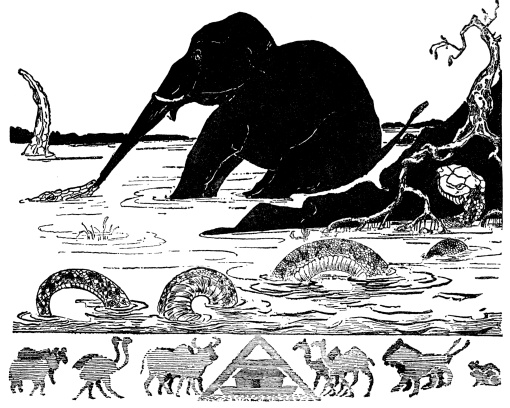
Throwback Thursday: “Just So Stories,” by Rudyard Kipling, 1902

Rudyard Kipling’s “Just So Stories” was one of my favorite childhood books — a gem I found in my elementary school library.  (I seem to remember the nuns just sort of setting us loose there during reading class with the instructions to find something we liked.  It was the kind of unstructured activity that I don’t often remember from Catholic School.)

It’s basically a short collection of fables that Kipling concocted for his daughter about how certain animals got their key traits (“How the Elephant Got His Trunk,” “How the Leopard Got His Spots,” etc.).  This was one of two favorite books that were consistently a magnet for me in the tiny, tidy library beside the principal’s office.  The other was the collection of Arabian folktales, “One Thousand and One Nights.”

Growing up, I never realized that Kipling was the same author who wrote “Gunga Din” — both the 1890 poem and the eponymous 1939 war film with Cary Grant and Douglas Fairbanks, Jr.  (That movie was beloved by my father and brother, and later by me.)  I just never made the connection.


Just_So_Stories_Kipling_1902

Justso_rhino

Illustration_at_p._73_in_Just_So_Stories_(c1912)

Throwback Thursday: “I’m Gonna Wash that Gray Right Outta My Hair”

These early 80’s Clairol ads, of all things, came up on Facebook — after I lamented the waves of gray that have flourished across my head with astonishing suddenness.  (I swear this seems like something that happened overnight.  I honestly thought that there something wrong with my eyes, or maybe the bathroom light.)

I remember this little jingle quite well — it’s catchy, and there were a few variations of the 1980 TV spot that you see below.  I never knew that it was a send-up of a number from Rodgers and Hammerstein’s “South Pacific” — “I’m Gonna Wash that Man Right Outa My Hair.”  For some reason, my friends thought that was really funny.


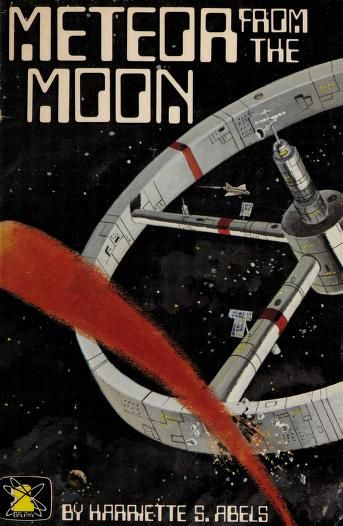
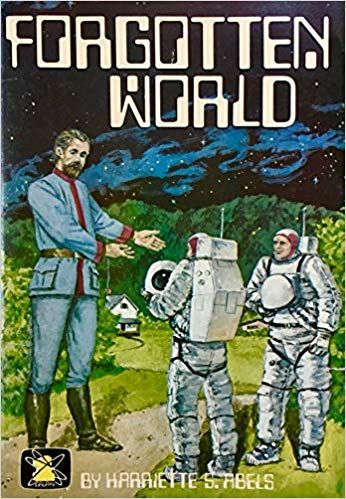
Throwback Thursday: the “Galaxy 1” children’s science fiction books

Harriette Sheffer Abels’ “Galaxy 1” books appear to be fully consigned to obscurity — I don’t have a single friend who remembers them.  They were published by Crestwood House in 1979; I certainly loved the ones I found in my elementary school library in the 1980’s.  And that says a lot, because I was a kid who loved the fantasy genre far more than science fiction.  (I had an older brother who played “Dungeons & Dragons,” and Ralph Bakshi’s animated take on “The Lord of the Rings” had captured a lot of kids’ imaginations since 1978.)  I remember how pleased I was to discover anthology-style books that featured the same cast of characters on different space-based adventures.

I’m pretty sure that “Mystery on Mars,” “Medical Emergency,” and “Silent Invaders” were among those that I read.  My favorite, however, was “Green Invasion,” which featured alien vines that grew uncontrollably and crushed anything they could ensnare and tangle.  Lord knows that was a scenario I re-created with my G.I. Joes at home.


813fM9GzBaL

56d8297e0889de967a8c66d296cc9da0

888f65288cc0cbdec9a89bd684e00a7b

bd695351d25956e26ad74dc9cc567fb9

c1f4d00c96e214f3663407f144dcc805

e81ae9bff2fdcdf3b45480987ab1a3d2

6c18eedc36cb5fa38c61260f86d5cd37

Throwback Thursday: “The Singing Cave,” by Eilis Dillon

Eilis Dillon’s “The Singing Cave” was another favorite childhood book of mine for the obvious reasons — a young boy explores a seaside cave and discovers a Viking skeleton, complete with a sword and armor.  That pretty much hit all the right notes for me when I was in early gradeschool in the 1980’s.  (Some sort of age-appropriate young-adult mystery unfolded after the skeleton disappeared, possibly involving the townspeople, but I don’t even remember that very well.  What thrilled me and stayed with me was the kid finding a armored Viking skeleton in a cave.)

The book was published first in 1959 in the United Kingdom by Faber & Faber; Dillon was Irish and the story was set in Ireland.  It was released here in America the following year by the now defunct Funk & Wagnalls — the same company that produced those huge reference books that Gen X’ers remember lugging around before the arrival of CD-Roms.  (Funk & Wagnalls is a name I haven’t heard in a very long time.  It turns out they quite bein’ a thing in 1997.)

I went through one hell of a Viking Phase when I was a kid.  (I suppose it wasn’t too different from other kids wanting to be pirates.)  I was thrilled with stories about Leif Erikson, and I was pretty happy that his last name sounded like my first.  It would be years later when my parents told me that I was actually named after another Viking, Erik the Red, albeit very indirectly.  (My parents like the name featured in the “Erik” cigars television commercial.)

I might have talked about this at the blog before, but I even constructed my own “Viking ship” with the kid next door when I was very young.  It probably wasn’t seaworthy; it was really just a wooden pallet with some two-by-fours nailed together as a mast, and a white sheet for a sail.  (Where had we gotten that sheet?  It seems to me that if I’d stolen it from the laundry, I’d have gotten into some trouble for that with my Mom.)  Bizarrely, my friend and I etched a bright red Spanish Cross on the sail  — even though that emblem had nothing to do with the Vikings.  You kinda can’t excuse our stupidity because we were kids … we’d seen plenty of pictures of the Nina, the Pinta, and the Santa Maria in school.

My Dad also cautioned me and my buddy that our Viking ship might not float.  (The hindsight of adulthood assures me that it definitely wouldn’t have floated, but my Dad didn’t want to dash our hopes too abruptly.)  He explained to us patiently in the backyard that in order for something to float, it had to “displace its own weight in water.”  And … I actually understood that, surprisingly enough.  It’s probably the only physics lesson I’ve understood in my life.

In fact … I don’t think we even had a plan in place for moving that boat from the backyard to the water.  We were so enamored with the concept of shipbuilding that we kinda didn’t think things through very far at all.


thesingingcave

So I smack-talked Donny Osmond in a recent “Throwback Thursday” post.

(I was talking about ABC’s “Donny & Marie” show from the late 70’s, which I really enjoyed as a tot.)  At the time I suggested they the Osmond siblings were immortal vampires because they are still performing in Las Vegas.

I take it all back.  I was just reminded that Osmond is the unnamed dancing man in the 2008 “first take” video for “Weird Al” Yankovic’s “White & Nerdy.”  Have you seen the way this guy mugs and dances for three minutes straight?  He’s hilarious.  And he’s a goddam force of nature.  He’s like Spider-Man 2099.  He’s cooler in that three minutes of video than I will ever be.

Besides, I’m old too.  I feel certain I was told at some point years ago that the guy was Osmond, yet I completely forgot about that when I discussed the show.  I also don’t know if “throwing shade” has fully replaced “smack-talking” in the vernacular, or even if the term should be hyphenated.