Tag Archives: Throwback Thursday

Throwback Thursday: skipping church!

Here’s a vivid summer memory — and it comes to me courtesy of my dear old friend Sarah in New York, who posted this picture on Facebook not too long ago.  Below is the very beach on Long Island where my older brother and I would park in the early 1980’s when we were supposed to be at church on Sunday morning.

We would eat Entenmann’s donuts and we would listen to WBLI on the radio.  (If you are from Suffolk County, you can’t not hear the chipper WBLI jingle every time you read those four letters.)  If memory serves, the station played Casey Kasem’s countdown on Sunday mornings.

I was pretty young, and I was awed that my brother deemed me cool enough and trustworthy enough to conspire with him in playing hooky from the service.  I was fully complicit, too.  It was my job to run in and out of the church quickly before the service started, in order to grab the Sunday bulletin, with which my mother had instructed us to return every week.

The first time I colluded with my brother this way, I overdid it a little.  Upon our return and gave my mom a lot of unrequested detail about the priest’s sermon, and what it had meant to be.  My brother later pulled me aside in the room we shared, and gave me some sage coaching: “You don’t need to make up a whole big story.”  That was the first time in my life that I learned not to over-embellish a lie.

You see that?  You can learn a lot from a religious upbringing.


18698027_10209260136606466_3872560922703083942_n

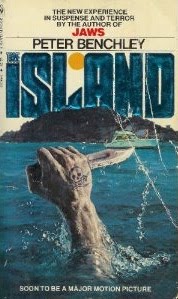
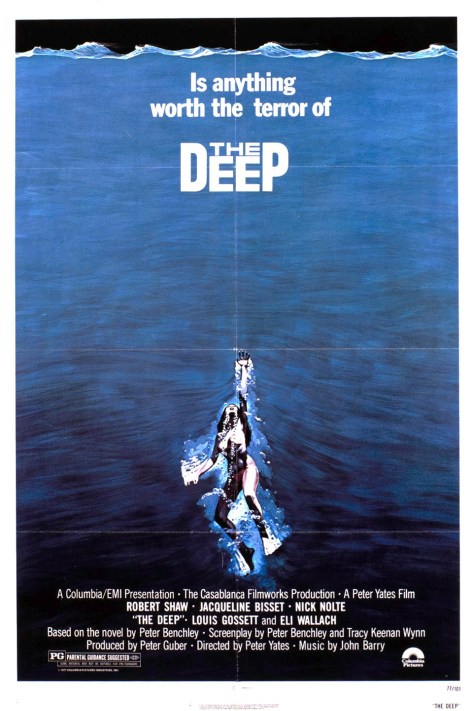
Throwback Thursday: Peter Benchley’s “The Deep” and “The Island”

I mentioned these late-1970’s seafaring novels last week — they could be considered the “other” Peter Benchley classics.  Neither “The Deep” nor “The Island” had nearly the broad-based cultural impact of “Jaws,” of course.  But they were still pretty damned good.

I got my hands on the paperbacks in the 1980’s, after my Dad left them lying around the house.  (It’s funny how much of my reading material I inherited from my father or older brother during my formative years.  I wonder how many kids grew up like that and were thus influenced.)  Both books leaned toward being horror-thrillers, as “Jaws” did.

I saw the the 1980 film adaptation of “The Island” on broadcast television when I was in early gradeschool, and it freaked me the hell out.  It’s actually a pretty bizarre tale about a colony of throwbacks who murder modern boatgoers in the manner of 18th Century pirates.  (Check out the trailer below.)  It stars none other than Michael Caine, and also an Australian actress Angela Punch MacGregor.  (If that isn’t a badass Australian name for a lady, I don’t know what is.)

I read the original book when I was older — in some ways, it was even freakier.  There were some weird sexual undercurrents and potty humor that weren’t even necessary for the plot; Benchley was a little more out there than you might gather from the more traditional thriller that “Jaws” was.

“The Deep” was a scuba diving thriller; the book and the 1977 movie filled my adolescent head with ambitions of becoming a professional treasure-hunter.  I remember devoting a lot of thought around age 13 or so to trying to figure out if that was a realistic career aspiration.  (I supposed it all depended on what I found.)  There is a moray eel in the movie, and it is unpleasant.  It prompted me to adopt the neurotic habit of bringing a knife along on the summer snorkeling expeditions behind my friend Brian’s house.

Interestingly enough, Wikipedia informs me that Benchley returned to writing books in the late 1980’s; his last two novels in the early 1990’s sound pretty damn cool.  They’re both seafaring monster stories — “The Beast” and “White Shark.”  The latter even selects its victims from my native Long Island, New York.  Maybe I’ll pick those up this summer.


DeepCover

2344832

p1883_p_v8_aa

Throwback Thursday: I WAS A TEENAGE NINJA.

As an adult, I am absolutely not prone to fads.  (I bought that fidget spinner last week IRONICALLY, people.)  But, as an adolescent, I was truly swept up in the 1980’s ninja craze.

I mentioned “Ninja” magazine here not too long ago — this was precisely the sort of periodical that fueled the misguided ambitions of tweens and young teenage boys everywhere.  (We also had movies like “Enter The Ninja,” “Revenge of the Ninja” and the “American Ninja” series.  If you’re a Mystery Science Theater 3000 fan, and you’ve seen the show skewer Lee Van Cleef’s “The Master” TV movie, that was an unfortunate product of the 1980’s ninja obsession.)

“Ninja” magazine was published by Condor Books between 1983 and 1995.  I had a bunch of issues, including all those shown below, if memory serves.  They were fun.  Those covers you see doubled as pullout posters at the middle of each magazine.  There were a lot of martial arts magazines like this.  (I seem to remember a rival entitled “Ninjamania,” but Google isn’t much help with that.)

It must have been tough for the writers here to generate ideas.  (They were writing a periodical magazine about what was basically supposed to be “an ancient art form.”)  One of the go-to story ideas was to portray different kinds of historically dubious theme-ninjas.  Hence the “Earth Ninja” and the “Fire Ninja” headlines you see on the covers below.  There was even a modern “Rainbow Ninja” — some real, enterprising martial artist had emblazoned his traditional black outfit with rainbows across his chest.   Even an impressionable kid liked me knew that was pretty dopey.  It looked like something you would see today in a pride parade, and I can’t imagine it helped the ninja “blend into the shadows.”

I … wanted to become a ninja, when I was 12 or so.  I figured I would have to eventually travel to Japan to do it.  In the meantime, I studied my magazines, and constructed what weapons I could — including a pretty nifty crossbow (which I’m pretty sure historical ninja never used) and some surprisingly workable nun-chucks.  (My “nunchaku” were crafted by two sawed-off lengths of broomstick, connected by a short chain.)  My mother had forbidden me to purchase any of the ninja knives (“tanto”) or throwing stars (“shuriken”) from the ads at the back of every magazine, so I had to improvise.  She did allow me to have a ninja mask, though.

Hey — I wasn’t the only one doing this.  I had a lot of company — as evidenced by the demand for these products. The fellow members of my “ninja clan,” “The Nightcrawlers,” lived right on my suburban street.  And the fad lasted a lot longer than parachute pants or hacky sacks, people.  It actually lasted longer than Atari.  And it arguably helped get kids reading or (God forbid) outside exercising.

Anyway, not all of “Ninja” magazine’s content was pure cheese.  I actually remember reading a quite decent short story in one issue.  It was called “The Sparrow that Feeds on Hawks.”  It featured, perhaps predictably, a young boy who became a ninja in order to defeat a cruel group of adult samurai.  But it was surprisingly thoughtful and well constructed for a what was essentially the 80’s equivalent of the 1950’s pulp magazines.   If I ever find it on the Internet, I’ll link to it here.


6457330933_a748f99253


Throwback Thursday: the “WKRP in Cincinnati” theme song!

I didn’t watch “WKRP in Cincinnati” (1978 – 1982) when I was a kid; it was a show for adults.  I loved the theme song just as much as anyone else, though.

This was just meant as a catchy tune for the show’s opener — but it was such a cool and popular soft-rock number (performed by Steve Carlisle), that a full-length version was released as a singe in 1979.  It reached number 65 on the Billboard Hot 100 Chart in 1982.


Throwback Thursday: The Allman Brothers Band

Rest in peace, Gregg Allman.

I first got acquainted with music of The Allman Brothers Band as a first-semester freshman at Mary Washington College in 1990.  My cultural illiteracy as an 18-year-old was embarrassing — especially where music was concerned.  I’d arrived at the small, fairly conservative Virginia state school listening to … well, very little other than what I’d heard on the MTV countdown.  (I started loving Richard Wagner as a high school senior — but that niche interest was rare for someone my age, so far as I was aware.)  It was an ongoing issue when I was a college freshman that upperclassmen would roll their eyes or even occasionally hiss when I told them what music I was into.

Alumnus Steve Miller and his friends were the exception.  They showed me far more patience at their parties in “The Tunnel” between Mason and Randolph Halls — they exposed me to tons of The Allman Brothers, Pink Floyd, The Steve Miller Band, and The Beatles.  (No, the irony of a guy named Steve Miller coincidentally loving The Steve Miller Band was not lost on us.)  Steve and his friends were each, in varying degrees, an amalgam of Obi-Wan and a far mellower version one of the guys from “Animal House” (1978).

The Allman Brothers were really my first extended exposure to Southern rock.  (And, hey, you can’t get much more Southern than a band made up of guys named Berry Oakley or Butch Trucks.)  I listened to them whenever there was a party at Steve’s, even after he started hosting his soirees out of his apartment on Sunken Road. Everyone there loved The Allman Brothers.  I think “Ramblin’ Man” was probably the group’s favorite.

Today, “Midnight Rider” is by far and away my favorite Allman Brothers song.  Curiously enough, though, for the life of me, I do not remember hearing that one in college.  I actually started jamming to it after I heard Rob Zombie include it in the score for the opening montage of “The Devil’s Rejects” horror film in 2005.

Anyway … “The Tunnel” at “Mary Washington College” has apparently now been remodeled into the above-ground “The Link” at “The University of Mary Washington.”

Well la-dee-DA.


Throwback Thursday: Steve Perry’s “Oh Sherrie.”

This is the 80’s-est 80’s song that ever 80’s-ed.  This is more of an 80’s song than “99 Red Balloons,” “Take On Me” or even the goddam “Ghostbusters” theme.

I remember hearing this play on the school bus radio on the way to school in the morning.


Throwback Thursday: early 1990’s “Aliens” and “Predator” comics.

I was chatting here with a friend last week about the “Aliens,” “Predator” and “Aliens vs. Predator” comics produced by Dark Horse Comics in the 1990’s.  While Marvel, DC and Image Comics all specialized in their superhero universes, Dark Horse tended to corner the market on hot properties in science fiction and horror.  (The company actually did try to compete by launching its own superhero line, but its unsuccessful “Comics’ Greatest World” universe lasted a mere three years.)

Dark Horse acquired the rights to the biggest science fiction movie characters of the first half of the decade, including “Aliens,” “Predator,” “Terminator,” “Robocop,” and “The Thing.”  It also produced great books in other genres too, like Frank Miller’s legendary “Sin City” series, Matt Wagner’s brilliant “Grendel,” and “Indiana Jones” comics.   (I never actually saw “Indiana Jones” on the shelves; the two retailers in my smallish Virginia college town never carried it.)

Perhaps strangely, I don’t remember any regular ongoing series for “Aliens,” “Predator” or “Aliens vs. Predator.”  Instead, the company published limited series on an ongoing basis.

Dark Horse had been a young company back then — it had started only four years earlier, in 1986.  But I’ll be damned if the people running the company didn’t know their stuff.  Not only did they snatch up big-name properties, they did a great job in producing consistently high-quality “Alien” and “Predator” books.  (Maybe “Aliens: Genocide” wasn’t as good as the other series, but it was really more average than flat-out bad.)  I honestly don’t know how they managed to publish such uniformly excellent comics that drew from a variety of creative teams.  The “Big Two,” Marvel and DC, produced their share of mediocre comics — even for tentpole characters or major storylines.  (See the “Batman” chapters of DC’s “Knightfall,” for example, or Marvel’s “Maximum Carnage” storyline for Spider-Man.)

Was Dark Horse’s track record better because their target audience was adults?  Did they just have really good editorial oversight?  Or did they maybe share such oversight with 20th Century Fox, which had a vested interest in its characters being capably handled?  I’m only guessing here.

I’ve already blathered on at this blog about how I loved “Aliens: Hive,” so I won’t bend your ear yet again.  An example of another terrific limited series was “Predator: Race War,” which saw the title baddie hunting the inmates of a maximum security prison.  And yet another that I tried to collect was “Aliens vs. Predator: the Deadliest of the Species.”  The series had a slightly annoying title because of it was a lengthy tongue twister, but, God, was it fantastic.  I think I only managed to lay hands on four or five issues, but the art and writing were just incredibly good.

Take a gander at the covers below — all except the first are from “The Deadliest of the Species.”  I think they are some of the most gorgeous comic covers I’ve ever seen, due in no small part to their composition and their contrasting images.  And I’ve seen a lot of comic covers.  I think the very last cover you see here, for Issue 3, is my favorite.

I would have loved to collect all 12 issues … I still don’t know how the story ended.  (It was partly a mystery, too.)  But at age 19, I absolutely did not have the organizational skills to seek out any given limited series over the course of a full year.

In fact, this title may well have taken longer than that to be released … Dark Horse did have an Achilles’ heel as a company, and that was its unreliable production schedule.  Books were frequently delayed.  To make matters worse, these were a little harder to find in the back issues bins.  (I don’t know if retailers purchased them in fewer numbers or if fans were just buying them out more quickly.)

I suppose I could easily hunt down all 12 issues of “The Deadliest of the Species” with this newfangled Internet thingy.  But part of being an adult is not spending a lot of money on comic books.  Maybe I’ll give myself a congratulatory present if I ever manage to get a book of poetry published.  Yeah … I can totally rationalize it like that.


Aliens-Predator_The_Deadliest_of_the_Species_Vol_1_2

Aliens Predator 10

Aliens-Predator_The_Deadliest_of_the_Species_Vol_1_11

avp_deadliest_of_the_species_3


Throwback Thursday: the Launch of Image Comics (1992)

I talked about Todd McFarlane’s “Spawn” in last week’s Throwback Thursday post; these are some very early issues of a few of Image Comics’ other titles when the company launched in 1992.  I remember snapping them up in earnest when I was 19 years old — as I said last week, it was exciting for a comics fan to see a new company challenge the “Big Two,” Marvel Comics and DC Comics, with a new superhero universe.

I and other ambitious collectors also grabbed these off the shelves because we naively expected they all would one day be very valuable.  (Investing in comic books is a little more complicated than that — they’ve generally got to be in extremely good condition to fetch high prices.)

The first Image comics were a mix of good and bad.  If memory serves, Jim Lee’s “WildC.A.T.s” was very good; Rob Liefeld’s “Youngblood” was less so, but was at least interesting.  The art and writing for Jim Valentino’s “Shadowhawk” was truly mediocre.  That didn’t stop me from buying a few issues, though — the novelty of these new books just gave them too much appeal.

There were a lot of creative things going on with early Image titles.  Some of the new characters were pretty neat.  I remember being partial to Youngblood’s “Diehard” for some reason, along with the WildC.A.T.s’ “Grifter.”  (The former has the red, white, and blue full bodysuit; the latter has the trenchcoat and pistols.)  And I definitely liked WildC.A.T.s’ “Warblade.”  He’s the guy below with the ponytail and the shape-changing, liquid-metal hands.  He was a favorite of mine despite the fact that he seemed to borrow a trick or two from the newly iconic liquid-metal terminator.  (“Terminator 2: Judgement Day” had hit theaters a year earlier.)

Image comics were quite different than those produced by Marvel and DC.  (As I explained last week, Image was formed by artists who revolted against their prior employers’ unfair, work-for-hire payment policies — their new company gave them complete creative control over their characters.)  Despite the popularity of Image’s new books, however, they sometimes appeared to have been developed without some needed editorial oversight.

The violence and gore was often far more graphic.  And Image’s creative decisions ranged from the inspired to the strange to just being in questionable taste.  (It all depended on your disposition, I guess.)  WildC.A.T.s, for example, portrayed Vice President Dan Quayle as being possessed by an unearthly “Daemonite.”  (Damn, those Daemonites were wicked-cool bad guys, and Lee Illustrated them beautifully.)  Shadowhawk’s signature move was breaking the spines of criminals.  He was also HIV-positive, the result of some gangsters’ reprisal — they captured him and injected him with infected blood.  The character thereafter spent some of his history trying in vain to locate a cure for AIDS.  (This was 1992, just after the epidemic became fully entrenched in the public’s anxieties in the 1980’s.)

My interest in these titles eventually waned, though I did still pick “Spawn” up when I had the money.  The Image universe was densely crowded with new characters, and it was just too much information to sustain my interest.  (Seriously, look at the first couple of covers below.)  I spent far more money on DC’s various “Batman” and “Green Lantern” titles.  And if I wanted edgy comics, I had discovered the various incarnations of Matt Wagner’s “Grendel” that were available through Dark Horse Comics.  Those boggled the mind.

But Image comics did burgeon into a great success, even if these early titles have since been retired.  “Spawn,” of course, is still being produced.  And today the company’s wide range of books includes Robert Kirkman’s “The Walking Dead.”  It’s hard to imagine either of the Big Two picking up Kirkman’s gory epic masterpiece … so I suppose we have Image to thank for the TV show.

1618179-wildcats_covert_action_teams__1992__01a

ibc25b64d2961mh92d73z

726109

559443

shadowhawk1992series3

61zpMu6Im+L._SY550_

Throwback Thursday: the Debut of “Spawn” Comics (1992)

I remember greedily snapping up the first two issues of Todd McFarlane’s “Spawn” comic in the spring of 1992.  Comics fans were excited about it — it was the de facto flagship title of the newly created Image Comics, which was bringing its own ambitious interconnected comic book universe to the shelves to compete with “the Big Two,” Marvel and DC.

There already was a competitive third major comic publisher — Dark Horse Comics.  But it had no successful superhero titles or shared universe; it instead was known for science fiction and horror comics.  I also remember seeing comics back then from the short-lived Valiant here and there — or maybe it was mostly ads in the Comic Shop News.  I didn’t know a single soul who read them, though.

McFarlane was nothing short of famous in the comic book fan community, after his broadly popular work on “Spider-Man.”  (I still love his unique style.)  And “Spawn” had an absolutely subversive flavor to it.  Its title anti-hero was nothing less than an agent of hell, and the comic revolved around hell, sin, damnation and various demons.  There was also far more violence and gore.

“Spawn” felt subversive, too, because of the impetus behind its creation.  Image Comics was launched by a group of artists who were unhappy with Marvel’s failure to grant them creative control over their work (or, according to the artists, proper merchandising royalties).  They included McFarlane, and fan-favorite artists Rob Liefeld, Jim Lee and Marc Silvestri, among others.

I don’t pretend to know how justified their complaints were, as I was only a fan and not an industry insider.  But they sound right … I’ve always heard that major comic companies have historically screwed over their creative talent with restrictive “work-for-hire” payment arrangements.  (This is why Stan Lee, creator of so many of Marvel’s first heroes, is not absurdly wealthy.)  The start of Image seemed to fans like their favorite artists rebelling against the status quo, and that was kind of exciting.

Some of McFarlane’s acrimony with Marvel was pretty overtly expressed in the pages of “Spawn.”  There was a weird, slightly confusing plot digression early on in which McFarlane editorialized heavily about creator-owned characters … Spawn actually visited a kind of purgatory where various leading Marvel and DC heroes were imprisoned.  It seems in retrospect like a labored and self-indulgent metaphor, and it detracted from the title’s story.  But the college kids then reading “Spawn” had never seen anything like it.  It was interesting at the time.  (Bear in mind, please, that this was before the Internet.)

I started picking it up regularly.  I was going to the comic shop that was on … George Street, I think, in downtown Fredericksburg, Virginia.  There were only two comic shops in the downtown area in the early 1990’s — this one, and a seedy shop across from the Hardee’s on northern Princess Anne Street, in a tiny corner of a ramshackle, abandoned hotel.  There was a categorically unpleasant, batshit-insane woman staffing the latter – she was nasty to everyone who entered, and accused them of touching the merchandise.  (That part of Princess Anne Street has since been improved – I think the huge hotel building has since been renovated.)

As the “Spawn” title progressed, its fandom became firmly entrenched.  The art truly was fantastic, and of course it remains an incredibly successful group of comic properties today.  Over time, McFarlane’s critics also grew in number … no matter how gifted he was as an artist, fans said he wasn’t a terrific writer.  (And I do get what they’re saying.)  I will say this — the “Spawn” comics I was reading were a thousand times better than that weird movie adaptation in 1997.  I’ve only seen bits and pieces of that, but they were terrible bits and pieces.

I still think I’d have a great time perusing my back issues.


Spawn-1

41xEvucyk-L._SL500_SX319_BO1,204,203,200_

7df869d110ee2fcf1af64d8f9f1fa8a4

aad31586d7576e942f6eafba618445f4

Throwback Thursday: “ENCORE”

What sort of uber-nerd can actually remember a reading textbook from grade-school?

This kind, Ladies and Gentlemen.  This kind.


15531723571