Tag Archives: Throwback Thursday

Throwback Thursday: the Launch of Image Comics (1992)

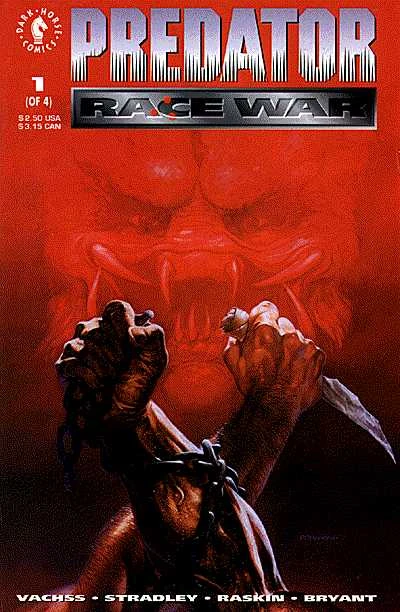
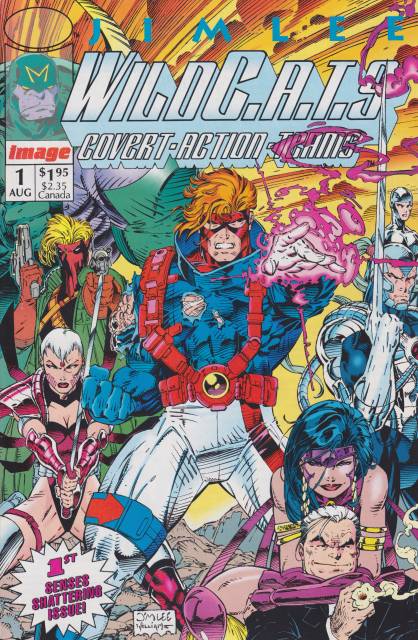
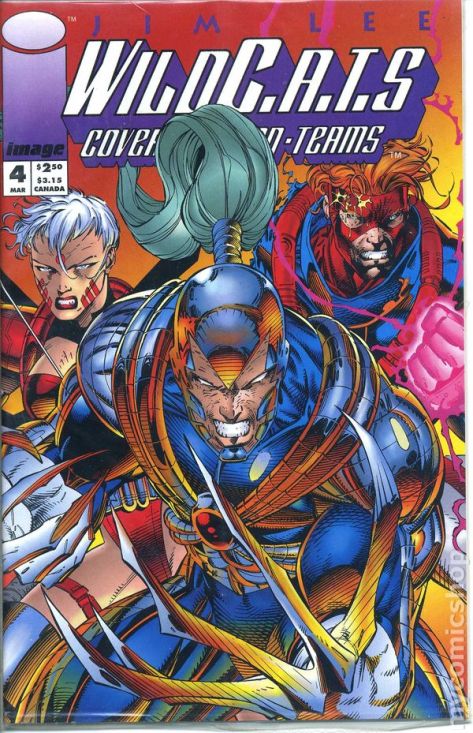
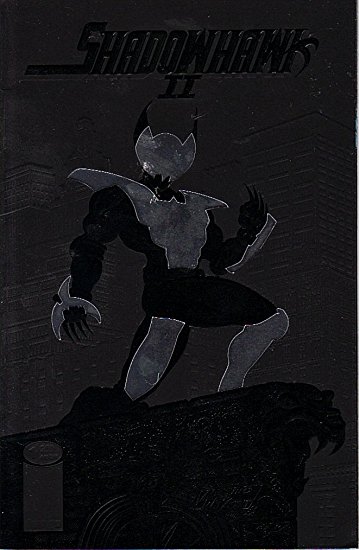
I talked about Todd McFarlane’s “Spawn” in last week’s Throwback Thursday post; these are some very early issues of a few of Image Comics’ other titles when the company launched in 1992.  I remember snapping them up in earnest when I was 19 years old — as I said last week, it was exciting for a comics fan to see a new company challenge the “Big Two,” Marvel Comics and DC Comics, with a new superhero universe.

I and other ambitious collectors also grabbed these off the shelves because we naively expected they all would one day be very valuable.  (Investing in comic books is a little more complicated than that — they’ve generally got to be in extremely good condition to fetch high prices.)

The first Image comics were a mix of good and bad.  If memory serves, Jim Lee’s “WildC.A.T.s” was very good; Rob Liefeld’s “Youngblood” was less so, but was at least interesting.  The art and writing for Jim Valentino’s “Shadowhawk” was truly mediocre.  That didn’t stop me from buying a few issues, though — the novelty of these new books just gave them too much appeal.

There were a lot of creative things going on with early Image titles.  Some of the new characters were pretty neat.  I remember being partial to Youngblood’s “Diehard” for some reason, along with the WildC.A.T.s’ “Grifter.”  (The former has the red, white, and blue full bodysuit; the latter has the trenchcoat and pistols.)  And I definitely liked WildC.A.T.s’ “Warblade.”  He’s the guy below with the ponytail and the shape-changing, liquid-metal hands.  He was a favorite of mine despite the fact that he seemed to borrow a trick or two from the newly iconic liquid-metal terminator.  (“Terminator 2: Judgement Day” had hit theaters a year earlier.)

Image comics were quite different than those produced by Marvel and DC.  (As I explained last week, Image was formed by artists who revolted against their prior employers’ unfair, work-for-hire payment policies — their new company gave them complete creative control over their characters.)  Despite the popularity of Image’s new books, however, they sometimes appeared to have been developed without some needed editorial oversight.

The violence and gore was often far more graphic.  And Image’s creative decisions ranged from the inspired to the strange to just being in questionable taste.  (It all depended on your disposition, I guess.)  WildC.A.T.s, for example, portrayed Vice President Dan Quayle as being possessed by an unearthly “Daemonite.”  (Damn, those Daemonites were wicked-cool bad guys, and Lee Illustrated them beautifully.)  Shadowhawk’s signature move was breaking the spines of criminals.  He was also HIV-positive, the result of some gangsters’ reprisal — they captured him and injected him with infected blood.  The character thereafter spent some of his history trying in vain to locate a cure for AIDS.  (This was 1992, just after the epidemic became fully entrenched in the public’s anxieties in the 1980’s.)

My interest in these titles eventually waned, though I did still pick “Spawn” up when I had the money.  The Image universe was densely crowded with new characters, and it was just too much information to sustain my interest.  (Seriously, look at the first couple of covers below.)  I spent far more money on DC’s various “Batman” and “Green Lantern” titles.  And if I wanted edgy comics, I had discovered the various incarnations of Matt Wagner’s “Grendel” that were available through Dark Horse Comics.  Those boggled the mind.

But Image comics did burgeon into a great success, even if these early titles have since been retired.  “Spawn,” of course, is still being produced.  And today the company’s wide range of books includes Robert Kirkman’s “The Walking Dead.”  It’s hard to imagine either of the Big Two picking up Kirkman’s gory epic masterpiece … so I suppose we have Image to thank for the TV show.

1618179-wildcats_covert_action_teams__1992__01a

ibc25b64d2961mh92d73z

726109

559443

shadowhawk1992series3

61zpMu6Im+L._SY550_

Throwback Thursday: the Debut of “Spawn” Comics (1992)

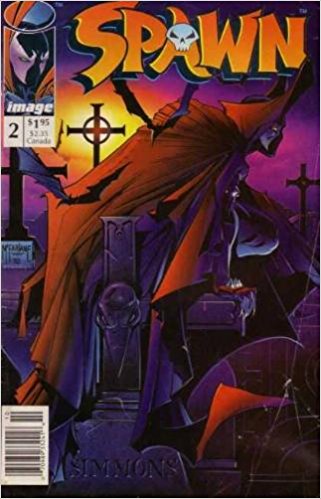
I remember greedily snapping up the first two issues of Todd McFarlane’s “Spawn” comic in the spring of 1992.  Comics fans were excited about it — it was the de facto flagship title of the newly created Image Comics, which was bringing its own ambitious interconnected comic book universe to the shelves to compete with “the Big Two,” Marvel and DC.

There already was a competitive third major comic publisher — Dark Horse Comics.  But it had no successful superhero titles or shared universe; it instead was known for science fiction and horror comics.  I also remember seeing comics back then from the short-lived Valiant here and there — or maybe it was mostly ads in the Comic Shop News.  I didn’t know a single soul who read them, though.

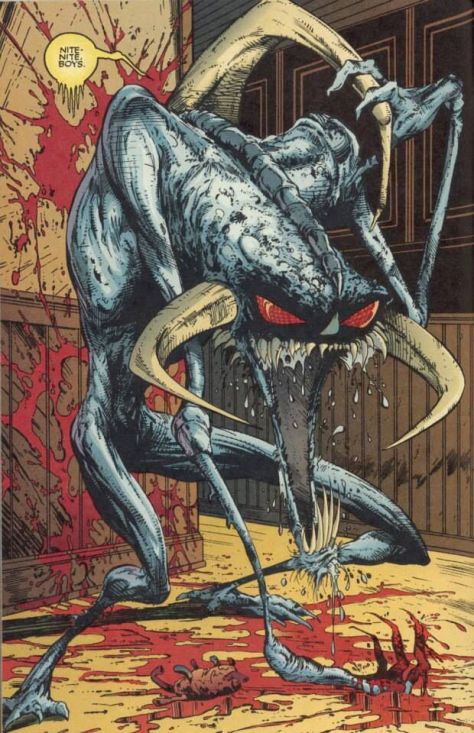
McFarlane was nothing short of famous in the comic book fan community, after his broadly popular work on “Spider-Man.”  (I still love his unique style.)  And “Spawn” had an absolutely subversive flavor to it.  Its title anti-hero was nothing less than an agent of hell, and the comic revolved around hell, sin, damnation and various demons.  There was also far more violence and gore.

“Spawn” felt subversive, too, because of the impetus behind its creation.  Image Comics was launched by a group of artists who were unhappy with Marvel’s failure to grant them creative control over their work (or, according to the artists, proper merchandising royalties).  They included McFarlane, and fan-favorite artists Rob Liefeld, Jim Lee and Marc Silvestri, among others.

I don’t pretend to know how justified their complaints were, as I was only a fan and not an industry insider.  But they sound right … I’ve always heard that major comic companies have historically screwed over their creative talent with restrictive “work-for-hire” payment arrangements.  (This is why Stan Lee, creator of so many of Marvel’s first heroes, is not absurdly wealthy.)  The start of Image seemed to fans like their favorite artists rebelling against the status quo, and that was kind of exciting.

Some of McFarlane’s acrimony with Marvel was pretty overtly expressed in the pages of “Spawn.”  There was a weird, slightly confusing plot digression early on in which McFarlane editorialized heavily about creator-owned characters … Spawn actually visited a kind of purgatory where various leading Marvel and DC heroes were imprisoned.  It seems in retrospect like a labored and self-indulgent metaphor, and it detracted from the title’s story.  But the college kids then reading “Spawn” had never seen anything like it.  It was interesting at the time.  (Bear in mind, please, that this was before the Internet.)

I started picking it up regularly.  I was going to the comic shop that was on … George Street, I think, in downtown Fredericksburg, Virginia.  There were only two comic shops in the downtown area in the early 1990’s — this one, and a seedy shop across from the Hardee’s on northern Princess Anne Street, in a tiny corner of a ramshackle, abandoned hotel.  There was a categorically unpleasant, batshit-insane woman staffing the latter – she was nasty to everyone who entered, and accused them of touching the merchandise.  (That part of Princess Anne Street has since been improved – I think the huge hotel building has since been renovated.)

As the “Spawn” title progressed, its fandom became firmly entrenched.  The art truly was fantastic, and of course it remains an incredibly successful group of comic properties today.  Over time, McFarlane’s critics also grew in number … no matter how gifted he was as an artist, fans said he wasn’t a terrific writer.  (And I do get what they’re saying.)  I will say this — the “Spawn” comics I was reading were a thousand times better than that weird movie adaptation in 1997.  I’ve only seen bits and pieces of that, but they were terrible bits and pieces.

I still think I’d have a great time perusing my back issues.


Spawn-1

41xEvucyk-L._SL500_SX319_BO1,204,203,200_

7df869d110ee2fcf1af64d8f9f1fa8a4

aad31586d7576e942f6eafba618445f4

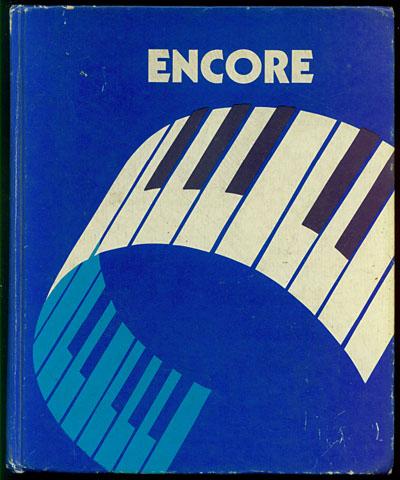
Throwback Thursday: “ENCORE”

What sort of uber-nerd can actually remember a reading textbook from grade-school?

This kind, Ladies and Gentlemen.  This kind.


15531723571

Throwback Thursday: THIS PEN.

Simply put, these pens were fun as hell.  Remember how cool it was to click the different colors, even if you weren’t writing or drawing anything?

Why don’t they make them anymore?  iPhones be damned — I know kids these days would love these things.


13880161_1127478660677379_1400701496312748987_n

Throwback Thursday: Rough Riders!

These were powered by a single AA battery, and made little boys everywhere quite happy on early 80’s Christmas mornings.  I always thought that the nearly identical “Stompers” were a ripoff of Rough Riders.   But, as it turns out, Stompers came first, in 1980.

Do NOT play the commercial below unless you want the Rough Riders jingle stuck in your head.  It’s a hell of an earworm, especially if you remember it from childhood.


Throwback Thursday: “Handmade” Turkeys!

First grade memories … every kid in America made one of these at least once.

Happy Thanksgiving!!


Throwback Thursday: the WOR-9 Thanksgiving Monster Movie Marathon!!!

If you were a little kid on Long Island in the late 1970’s and early 1980’s, then you remember Channel 9’s annual Thanksgiving monster movie marathon.  Dear God, did I love watching it with my Dad.  It was an EVENT.  I loved it far more than any Thanksgiving turkey — if they played monster movies all day, I think I’d cheerfully just enjoy Cocoa Puffs nonstop in front of the color TV in the family’s living room.

The Holy Trinity of monster movies, of course, consisted of “King Kong” (1933), “Son of Kong” (1933) and “Mighty Joe Young” (1949).  It’s a testament to these films’ staying power that they could still appeal to both children and adults roughly a half century after they were made.  Retrospect suggests it was probably a nice little father-son bonding exercise … my Dad was watching me thrill to the same monster action he enjoyed as a boy.  Special effects legend Ray Harryhausen truly blessed my childhood.

The DVD Drive-In website has a neat little nostalgic rundown right here:

https://www.youtube.com/watch?v=aTuHnzGSNOs


Throwback Thursday: Erik Cigars!!!

This is just NUTS.  No, I am not quite old enough to remember this late-1960’s advertisement for “Erik” cigars — I happened along a few years later.  But I was named for it.

My father told me when I was growing up that he named me after hearing the name “Eric” in a cigar commercial … I guess I was just never 100 percent sure if he was kidding or not.  (My parents also came very close to naming me “Christian.”)  Just a few days ago, through the magic of the Internet, I finally discovered the ad itself.  (Thanks to Youtube user “blegume” for uploading the vintage commercial and solving this longstanding personal mystery.)

The ad itself is actually kind of funny.  It makes smoking look entirely slick and telegenic and badass, and it underscores the point metaphorically with footage of a goddam viking ship sailing around Manhattan.  (That’s the Brooklyn Bridge you see in the background.)

And, in this politically correct age, the ad manages to be at least mildly offensive to two groups: women and … Scandinavians.  (Its product, it boasts, is “the most interesting idea from Scandinavia since the blonde.”)

My self-esteem would be incredibly high if people started proudly proclaiming “ERIK” in the same manner as the robust male narrator.  I might try to create a wav. file of that and program my laptop to belt that out randomly like twice a day.  Besides, I figure it could be worse — my father could have named me “Newport Menthols” or something.  (Maybe it would be fitting; I’m slim and smooth, yet ultimately hazardous to your health.)

The Kirk Douglas lookalike you see in square-jawed profile is actually a Scandinavian named “Erik,” the video’s comments section informs me.  He is none other than Norwegian Erik Silju, and his credits include episodes of both “Route 66” and “Murder, She Wrote.”

Here’s the kicker, though — I found four other guys, in the first page of the comments section alone, who were also named “Erik” after their parents saw this ad.  That’s gotta be some kind of record.

Life is so weird.


Throwback Thursday: “Star Trek,” the Original Series

I really missed the boat with last week’s Throwback Thursday — it was the 50th anniversary of the entire “Star Trek” franchise, with the first episode of the original series airing on September 8, 1966.  (And even the term “franchise” seems way too narrow to describe “Star Trek” in all of its incarnations — it’s really more like a permanent part of western popular culture.)  I’m not old enough to remember the show’s original run, which was a surprisingly scant three years.  But I remember it in syndication when I was not much more than a baby in the mid- to late 1970’s.

“Star Trek” was something that my older brother and maybe my father watched.  (I was fixated on programming that was more comprehensible for young kids, like “Land of the Lost” and reruns of “The Lone Ranger.”  Seriously, the original black-and-white serial western was still in reruns back then.)

But “Star Trek” was definitely something I was attracted to as a tot, doubtlessly resulting, in part, from the contagious ardor for it that I saw in my older brother.  (He might not admit it today, but he was a bit of a hard-core science fiction fan long before I was.)  The show was on at our tiny house in Woodhaven, Queens, quite a lot.  He also had toys and posters connected with it.  (And anything my older brother owned was something I endeavored to play with when he wasn’t looking.)

He had that Captain Kirk toy among the figures produced by Mego that you see in the bottom photo.  (Again, 1970’s “action figures” were often pretty much indistinguishable from dolls.)  In the early 1980’s, he had a totally sweet giant poster depicting diagrammed schematics for The Enterprise in surprising detail.  I’ve Google-searched for it, but found only similar pinups.  The one hanging in the room we shared was blue.

I remember him annoyedly correcting me because I called it “Star Track.”  (I did not yet know the word “trek.”  I myself was confused by my own mistake; I knew that there could be no “train tracks” in space, even if I studied the opening credits one time just to make sure.)

I was precisely the sort of pain-in-the-ass kid who fired off an incessant barrage of questions when I saw something on TV that I didn’t understand.  My father was patient to a fault when I punctuated his World War II movies with inane questions.  (I’m willing to bet I eventually acquired more knowledge of the war’s European theater than the average six-year-old.)  My brother was not always so forbearing.  I actually remember him changing the channel away from shows he was watching, like “Star Trek” or “MASH,” if I joined him at the little black-and-white television we had in our room.  (The poor guy needed me to lose interest and go away, so that he could at least hear the damn show.)

Certain “Star Trek” episodes remain memorable to this day, even if I understood maybe 15 percent of what transpired onscreen.  The was The One With The Domino-Face Men, which the Internet now tells me was actually titled “Let That Be Your Last Battlefield.”  Then there was The One Where Kids Ruled Themselves on a Deserted World, which made a really big impression on me.  (The Internet tells me this one was “Miri.”)

As I grew up, the show faded from prominence in my child’s psyche.  It was just never my fandom of choice.  Nor was it for many other kids I knew … by the 1980’s, it was already considered “an old TV show.”  The kids on my street were always excited about the feature films; even if we were underwhelmed by the “slow” first film in 1979.  Blockbuster movies were major events back then, and fewer, and they were enigmatic in a way that is impossible after the Internet’s arrival.  (I think that Millennials will never be able to understand that, in the same way that you and I can never appreciate the vintage “serials” that our parents watched before the main feature at a Saturday matinee.)

In the 1980’s, just about every boy I knew was preoccupied with the space-fantasy of “Star Wars.”  On television, we had cheesefests like the original “Battlestar Galactica” and “V.”  As we got older, we gravitated toward the “Alien” and “Predator” film franchises.  At home, I read Orson Scott Card and Harry Harrison, and as I approached college toward the end of the decade, I’d discovered Arthur C. Clarke.  If we’d known another kid who was really into “Star Trek,” I’m not sure we would have considered it “nerdy.”  It would just have been very weird, because it we viewed it as a campy tv show from maybe two decades prior, like “Bonanza” or something.  I don’t think I ever even thought of the franchise as really relevant or popular until I was at Mary Washington College in the 1990’s.  “Star Trek: the Next Generation” would regularly draw kids out of their dorm rooms into the lobby at New Hall.

Still, it’s hard not to develop an emotional attachment to something that stimulated your sense of wonder as a tot.  I … felt pretty damn sad when Captain Kirk died in 1994’s “Star Trek: Generations.”  I saw it in a theater in Manassas, Virginia, I think, with my girlfriend at the time.  She actually felt she had to console me after seeing how doleful I was on the drive home.


leonard_nimoy_william_shatner_spocks_brain_star_trek_1968

250fd1893dd8cc218f526b588ec00502

Throwback Thursday: Olivia Newton John’s “Xanadu” (1980)

No, I was never a fan of Olivia Newton John, nor am I old enough to recall her stardom in any great detail.  I need to mention “Xanadu” at least once here at this blog, however, as it is forever linked in my mind with the summer of 1980.

This song was played endlessly at the beach by sunbathing teenage girls.  They mostly went unnoticed by me, as this was the summer before I entered the third grade, and I hadn’t developed much interest in girls just yet.  But thinking of this song immediately returns me to the beach again as a little boy.  (My parents sent me there with my siblings a lot, something for which retrospect has taught me to feel thankful.)

I have a lot of memories of going to the beach in the early 80’s — burning sand, screaming for the ice cream man, and sidestepping endless arrays of discarded bottlecaps in the gravel parking lot.  (The local teenagers must have done a hell of a lot of drinking there; upturned bottlecaps hurt when you stepped on them.)  This was also the summer that my friend Brian’s little brother, Brad, erroneously told me that Han Solo died in “The Empire Strikes Back.”  (There were no “Episode” prefixes when the first Star Wars films came out.)

There was another hit by John that can transport me back the early 80’s.  That would be “Physical,” which was played and sang ubiquitously in 1981 by the girls in my fourth grade class.  (I still remember Linda, who lived on the next street, talking about John in awed tones: “A looooot of people think she is beautiful.”)

But I’d prefer not to think of that song, if I can help it.  While “Xanadu” is arguably still fun and catchy, “Physical” is best left forgotten.