Eric Robert Nolan graduated from Mary Washington College in 1994 with a Bachelor of Science in Psychology. He spent several years a news reporter and editorial writer for the Culpeper Star Exponent in Culpeper, Virginia. His work has also appeared on the front pages of numerous newspapers in Virginia, including The Free Lance – Star and The Daily Progress. Eric entered the field of philanthropy in 1996, as a grant writer for nonprofit healthcare organizations.
Eric’s poetry has been featured by Dead Beats Literary Blog, Dagda Publishing, The International War Veterans’ Poetry Archive, and elsewhere. His poetry will also be published by Illumen Magazine in its Spring 2014 issue.
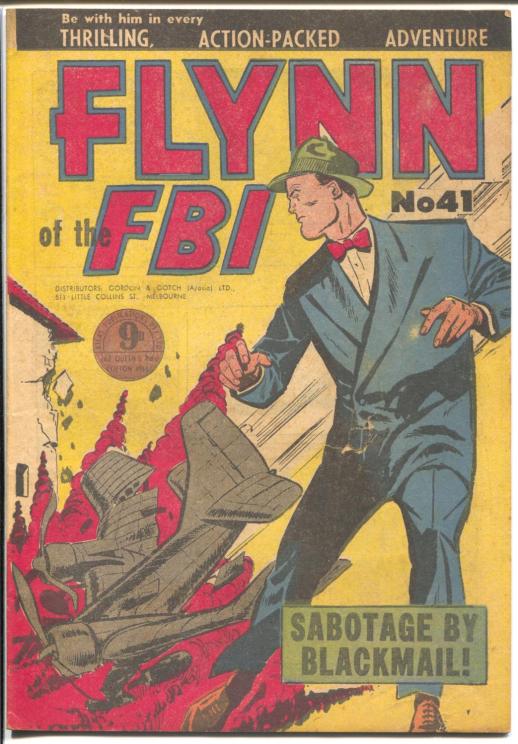
I am unable to determine the artist for this cover, the publisher, or even the issue’s date. My best guess is that artist Arthur Mather designed the cover for Atlas Publications in Australia in the 1950’s.
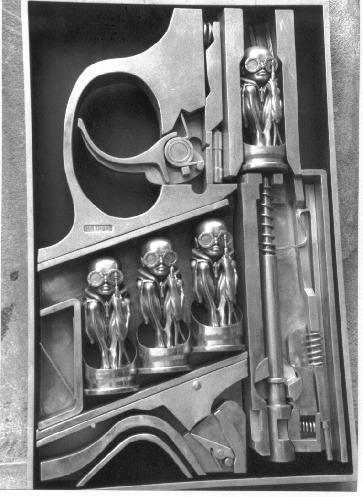
Why not “The Greek Horse?” The Greeks constructed it. Suppose you have an artist friend in Greece, and he or she mails a traditional Hellenic sculpture to you here in America (and hopefully with nothing all cunning and stabby and murdery inside of it). You wouldn’t call it an American sculpture. It would be a Greek sculpture, right?
“Troy” is a masculine name. But does it ever occur to guys named “Troy” that they were named for an archetypal conquered city?
Why is “Trojan” a desirable brand name for a condom? A small group of Greeks penetrated their city’s defenses with regrettable surprise consequences.
This is the $#/+ I think about when I wake up at 2:35 am and can’t get back to sleep. I swear I can’t turn it off.
Then Credence Clearwater Revival starts playing in my head and things get worse from there.
This is one of only a handful of TV shows that I can remember watching as a tot in the late 1970’s. “Laverne and Shirley” (1976-1983) was the kind of of thing I’d see in my older sisters’ room. My Dad and older brother watched war movies, westerns and monster movies, but my two sisters preferred considerably lighter fare. Two that they watched a lot at the time, if I recall, were this show and “Donnie & Marie” (1976-1979) — about the scariest thing you could find playing on their black-and-white TV was “The Hardy Boys/Nancy Drew Mysteries” (1977-1979). (One of my sisters had a crush on actor Shaun Cassidy; I think there was a poster of him in their room.)
I loved “Laverne and Shirley” when I was that young. Lenny and Squiggy were my favorite highlight of any episode, even if I was sometimes confused about whether they were meant to be “good guys” or “bad guys.” I was in kindergarten, and not altogether bright, and I thought that men who wore black leather jackets (Fonzie notwithstanding) were usually “bad guys.” I also remember thinking that hippies and motorcyclists were the same group of “bad guys” because they disobeyed God or something … my confusion at the time resulted from some vaguely moraled born-again Christian comic books I’d happened across somewhere.
I also remember recognizing “Laverne and Shirley” as being related to another show that a lot of kids back then loved — “Happy Days” (1974-1984), of which it was a spin-off. This might have been the first time in my life that I was aware of two live-action television properties occupying the same fictional universe; I’d already seen it happen in the movies with the various incarnations of “King Kong” and “Godzilla.”
Here’s what makes me feel old — for both “Laverne and Shirley” and “Happy Days,” I probably watched a lot of the episodes when they were first broadcast, and not just in re-runs (although “Happy Days” was also played in syndication endlessly throughout the 1980’s — it remained a fixture of daytime television).
And I only just realized writing this that Lenny was played by the priceless Michael McKean. As an adult, I know him primarily from his brilliant turns in “This Is Spinal Tap” (1984) and “The X-Files” (1998-2018). He’s 71 now. Wow.
I’d be lying to you if I told you that “Patient Zero” (2018) is an especially good movie. It isn’t. It plays a lot like the classic “28 Days Later” (2002) would play if it were produced by the SyFy Channel, and by that I mean it generally is a poorly written, low-budget cheese-fest. (This is one of those movies where even the score was kinda bad.) Still, there were some hints of greatness hidden within this lackluster zombie movie — enough to save it from being a complete failure — and I would reluctantly rate it a 5 out of 10. (Most other reviewers are not even that kind.)
First, it has some fine performers. These include two “Game of Thrones” actors who are always fun to watch — the mesmerizing Natalie Dormer and the consistently likable John Bradley. (The latter seems to specialize in winning audiences over as the “hero’s-affable-friend” role.) “Doctor Who” fans will of course recognize Matt Smith in the lead role. But by far and away, they’re overshadowed by a fantastic performance by Stanley Tucci as the zombies’ surprisingly eloquent leader. (More on that in a moment.) Tucci is truly a great actor and he makes a perfectly menacing bad guy; his voice, diction and line delivery are goddam perfect. His talent for voicing a magnetic, highly intelligent antagonist reminds me of Jeffrey Dean Morgan’s portrayal of Negan on “The Walking Dead,” or one of the better “big bads” seen on “24” (2001 – 2014).
Second, there are some really clever ideas hiding under this thin, hasty script. (I strongly get the sense that “Patient Zero” was a rush job for screenwriter Mike Le and director Vincent Newman.) The hyper-kinetic zombies here are afflicted with “super-rabies” and are reminiscent of their ilk from “28 Days Later.” But there is a truly intriguing plot conceit — their roars and screams are perfectly intelligible to Smith’s protagonist. He speaks their “language” because he’s infected, but also mysteriously asymptomatic. When he interrogates the zombies for the military, their interaction is filmed as normal dialogue (creating the opportunity for Tucci’s terrific turn here). Then things get even more interesting when it’s demonstrated that the ostensibly mindless zombies are quite proficient at planning an attack.
I … might be treating this movie a bit charitably simply because I liked some of its ingredients. Again, I don’t actually recommend it. But your mileage may vary.