“Black Mirror” seems to me to be the best science fiction show on television; I’d rate Season 2 (2013) a 9 out of 10. (I’m never quite certain whether to group British shows by “season” or by “series,” as they do. I’m also a little uncertain why the fourth and final episode here, “White Christmas,” is included in Season 2, as it aired nearly two years later as a 2014 holiday special.)
I commented to a friend of mine after seeing “White Christmas” the other night that the show was “brave” — it just isn’t afraid to alienate mainstream audiences by being too dark. Not all of “Black Mirror’s” episodes have “twists,” but they typically have an unexpected plot development, and their outcomes and implications are arguably depressing.
It’s just such a damned good show, though, in terms of its writing and acting. My friend told me she wasn’t aware of anyone who had seen it and disliked it.
“White Christmas,” for example, was one of the best hours of science fiction television I’ve ever seen. It consists of three blackly tragic vignettes seamlessly woven withing a wraparound story, and it employs a sci-fi plot device that is mind-bending and brutal. I believe this is the first time I’ve seen its lead actor, Jon Hamm, and I was extremely impressed with his performance.
My only quibbles with the program are extremely minor. As with the first season, I think that not every episode truly requires a 44-minute running length. I thought two episodes (“Be Right Back” and “The Waldo Moment”) seemed like they could have been tightened up into one, maybe with tighter writing allowing for shorter segments.
I’ve noticed another minor relative weakness with “Black Mirror” in general as well — the show does not always present the viewer with likable protagonists. Occasionally, the various characters we’re asked to identify with are either slightly off-putting or even annoying. Again, “Be Right Back” and “The Waldo Moment” spring to mind. This wasn’t enough to greatly affect my enjoyment of the episodes, though.
[THIS REVIEW CONTAINS SPOILERS FOR THE FILM.] “Spectre” (2015) was an impressive James Bond film, if not an unforgettable one. I’d rate it an 8 out of 10. It’s got style, terrific action sequences and absolutely gorgeous shooting locations. Daniel Craig is still a decent Bond, too, even if I always find him a little understated in the role. And Dave Bautista makes a sufficiently intimidating henchman. (The man looks gigantic, too.)
It brings little new to the franchise, however, and it doesn’t rise above being a standard action film in the same manner as its predecessor, 2012’s nuanced and surprisingly emotional “Skyfall.” (I’ve gained a greater appreciation for that movie after having watched it a second time.)
It occurs to me, too, that “Spectre” seems a little easy to nitpick — at least to someone who’s enjoyed a lot of spy films and novels that are intended as procedural thrillers. We watch Bond gain easy access to a super-secret meeting of the titular cabal, for instance — he just kinda bluffs his way in. Then the organization’s Big Bad calls him out, after apparently feeling his presence, as Darth Vader felt the presence of Luke on a passing ship in “Return of the Jedi” (1983). Later, we watch Bond employ incredibly risky and haphazard tactics to rescue a kidnap victim — it seems to me that the consequent random vehicle crashes, explosions and gunshots could just as easily kill her as they might free her.
Still, this was a fun movie. I’d recommend it if you’re looking for an enjoyable action flick.
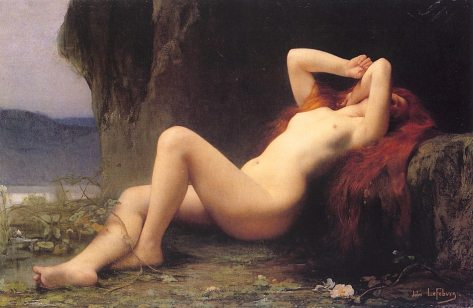
A dear friend introduced me just yesterday to the art of “Nausicaa.” If I understand correctly, it was a French illustrated interpretation of the character’s story from Homer’s “Odyssey.”
“Bigfoot and Wildboy” (1977 – 1979) is another obscure TV show that is perhaps best forgotten. It was a segment on something called “The Krofft Supershow” in 1977, I think, before the segments were re-edited into a half-hour program. I became a fan of it as second grader in the fall of 1979. (Or maybe I watched its reruns in third grade, in 1980 — to be honest, this was so long ago that I hardly remember.)
They don’t make TV shows like they used to. And that’s a good thing. “Bigfoot and Wildboy” seemed to rely heavily on three ingredients: an utra-cheesy 70’s score; truly terrible special effects (even for the time); and lots of shots of its two title characters either jumping, or running at the camera in slow motion. (I actually just watched a few minutes of the full episode you see posted below.)
I was pretty preoccupied with “Bigfoot and Wildboy” when I was very young. I remember having to make journal entries in the classroom, in which we could write and illustrate anything we wanted. (It was precisely the sort of open-ended journal writing exercise with little academic value to which I’d be subjected, occasionally, throughout my school career — even in my college poetry class.) But we were allowed to select our own topic in the second grade, and that was at least some fun for an imaginative kid. The nuns (it was a Catholic school) sometimes prodded us to write about real-world events; 1979’s Space Shuttle Columbia, for example, was high on their list of suggestions.
Given a blank slate, though, I tended to write almost exclusively about imaginary characters and monsters — peppered, perhaps, with intermittent entries about dogs. I distinctly remember drawing Bigfoot and Wildboy one day. (If memory serves, we wrote and drew in our journals after recess, maybe to get us refocused.) I drew them leaping over a fence and running toward the viewer. (Seriously, the show had a lot of shots like that. Check out the opening credits below.)
I remember a nun looking over my shoulder and inquiring delicately about the giant hairy humanoid and the half-naked boy … when I explained the characters to her, she suggested with (uncharacteristic) patience, “Tomorrow, let’s try to write about something from the real world.”