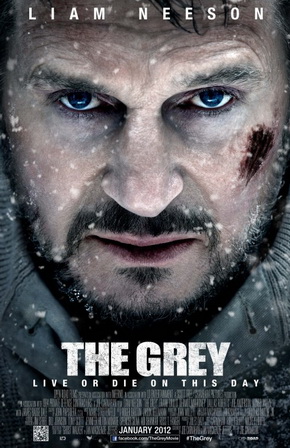
For a few reasons, I’m finding “The Grey” (2012) a difficult movie to review. For one, I think it’s a little hard to do without spoilers – especially with respect to the fact that this movie is absolutely NOT what viewers are expecting. For another, this appears to be a very thoughtful movie, and I’m pretty sure I didn’t understand it as well as other viewers. Finally, certain aspects of this movie really are just a matter of taste, and what some viewers like, others will abhor – especially the ending.
It was very good – I’ll tell you that much. I’d give it 8 out of 10.
If you read reviews of “The Grey” online – which I’d advise you not to do because of spoilers – you can see that many people are downright angry about this movie. There’s a good reason for that. This film’s marketers absolutely did mislead audiences with its trailer – especially with one climactic scene that DOES NOT APPEAR IN THE MOVIE.
This isn’t an action-adventure movie at all. We really don’t see “Liam Neeson kick ass.” Nor is it a survival horror movie. You could describe it as a thriller, but it’s actually very slow in some places, and has offers no “payoff” or climax. I think it’s an existential drama, and it’s heavy with symbolism. An online review from The Guardian informs me that the wolves are a metaphor for death, and I’m embarrassed to admit I never picked up on that. I thought they were an arbitrary plot device set up to explore the characters’ coping abilities. Maybe they were that too?
This film is very dark, and sometimes even depressing. I almost found it too much. That statement says a lot coming from me, because I’ve seen a lot of horror movies and war movies. When, near the end, my favorite character drowned in a particularly frustrating way, I started to feel that the screenwriter simply wanted to depress me.
I remain just a little confused about this movie’s themes. I was surprised to learn that this was marketed as a movie with Christian messages. That befuddles me. Characters express faith and are not rewarded for it. Fate deals out miserable ends to good people. At one point, Liam Neeson literally curses God and appears to renounce his faith. Neeson’s character does draw strength from his past experiences in order to fight and survive. But is this necessarily a Christian message? To me, that sounds like Freudian sublimation. There also appear to be some pretty questionable messages. Characters try their hardest and show character and courage – then fail. One character gives up entirely and resigns himself to certain death … and this choice seems to be represented quite favorably. Huh?
Finally, the ending is extremely ambiguous and open-ended. You really don’t find out “what happens at the end.” You don’t. Many people don’t know that there is a “cookie,” or post-credits sequence, in which we see more of the final scene. But this sequence is also ambiguous, and offers no clear ending to the story.
With all of that said, I actually would recommend this. It just happens to be a very well made movie. The directing was generally good. (This is despite the fact that I think we see way too little of the wolves; I’m the type of guy who actually wants to “see the monster” and not have all of it left to my imagination.) There’s one scene in which one character sees another after falling from a tree that is rendered just beautifully. (You kind of have to see it to get what I’m talking about.)
The characters and dialogue are extremely well written. To a man, the acting is top-notch. Liam Neeson is fantastic. And yet even he is nearly upstaged by Dallas Roberts, whose performance in a supporting role was flawless.
Even the sound effects and editing were great. Among many other things, the sounds of the animals were superbly rendered. At one point, the roar of the “alpha wolf” sounds like a@#$% tiger, and it scares the *&^% at of you at a key moment.
If anyone really liked this movie, as I did, there are two even better movies that incorporate similar settings and plots. The first is “The Edge” (1997), which parallels this movie perfectly and is much more satisfying. The second is the incredibly underrated “Frozen” (2010), which is one of the scariest movies I’ve ever seen. There are also two famous short stories that have a lot in common with this movie: Jack London’s “To Build a Fire,” and Saki’s “The Interlopers.”
All in all, this was a well made film, but it still might disappoint those who were expecting something else.


 Eric Robert Nolan, Author