Tag Archives: 1980

Throwback Thursday: “Willard” (1971) and “Ben” (1972)!

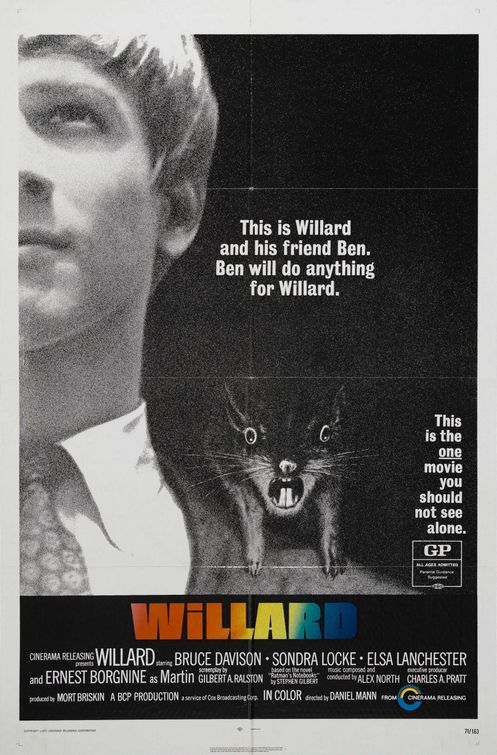
“Willard” (1971) and its sequel, “Ben” (1972), were another pair of 1970’s movies that got plenty of airtime on 1980’s television.  I read both books when I was a kid too.

First I picked up Stephen Gilbert’s Ratman’s Notebooks at a yard sale, because that’s how you found cool horror books during summer vacations when you were too young to drive.  (Sometimes adults had few compunctions about what they sold to minors too.  I bought a vampire book in gradeschool that was full of nude photos, for some reason, and that led to what I’m sure was an interesting conversation between my parents and the neighbor-proprietor down the street.)

Anyway, I absolutely loved Ratman’s Notebooks (despite its lamentable absence of nude photos) and I finished it in a day or two.  The novelization of the “Ben” film by Gilbert A. Ralston was somewhat less impressive, but I still enjoyed it.

If you’re a comics fan, like I am, then it might occur you that “Willard” and his army of trained rats seem to inspire a villain in Batman’s rogue’s gallery — Ratcatcher.  Ratcatcher has been a minor league villain since he debuted in DC Comics in 1988, but he’s a pretty neat bad guy when placed in the hands of the right writer.

I feel certain that anyone will recognize Ernest Borgnine in the first trailer below– his  face and voice are impossible to confuse with those of another man.  If the disaffected, spooky, eponymous Willard looks familiar to you, that’s none other than a young Bruce Davison.  He’s a good actor who’s been in a lot of films, but I think a plurality of my friends will know him as Senator Kelly from the first two “X-Men” movies (2000, 2003).

You’ll note the presence of flamethrowers in the trailer for “Ben.”  Flamethrowers were a staple of 70’s and 80’s horror films; it was just part of  the zeitgeist.  They were handy for heroes fighting any nigh-unstoppable nonhuman baddie — think of “The Swarm” (1978), “The Thing” (1982), “C.H.U.D.” (1984), “Aliens” (1986), and “The Blob” (1988), for example.  Hell, 1980’s “The Exterminator” featured a vigilante using a flamethrower to kill criminals.   It was a weird time.
 

willard

ben_ver2

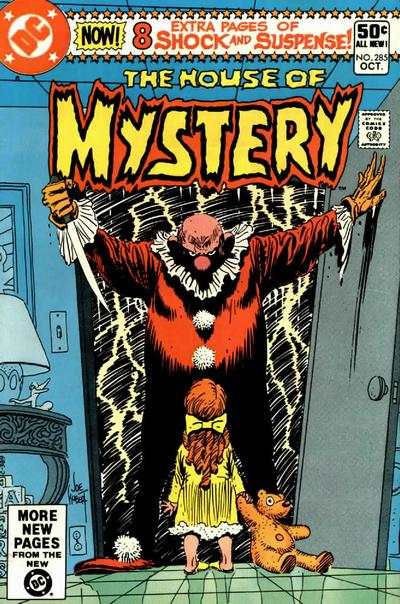
Cover to “House of Mystery” #285, Joe Kubert, 1980

DC Comics.

af83e8b016230d0192d42ec141f20254

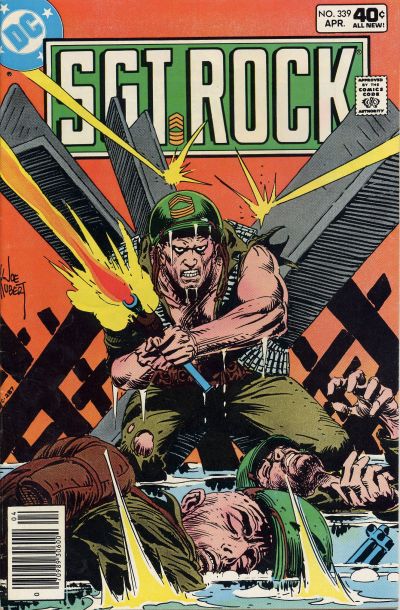
Cover to “Sgt. Rock” # 339, Joe Kubert, 1980

DC Comics.

Sgt._Rock_Vol_1_339

Throwback Thursday: “The Poseidon Adventure” (1972) and “The Towering Inferno” (1974)!

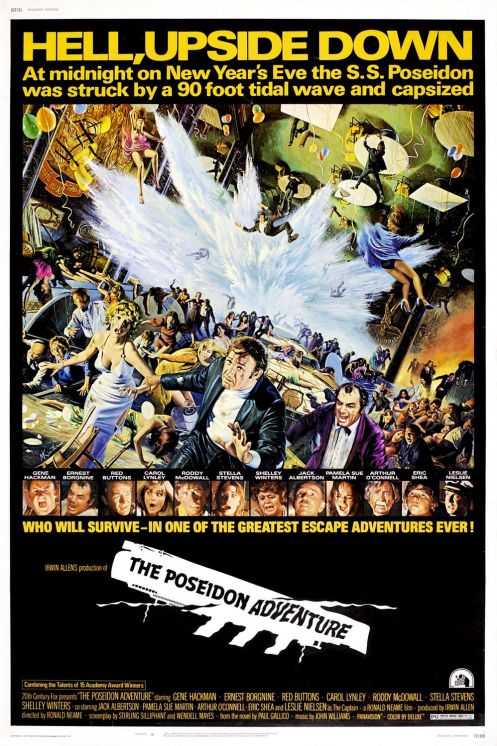
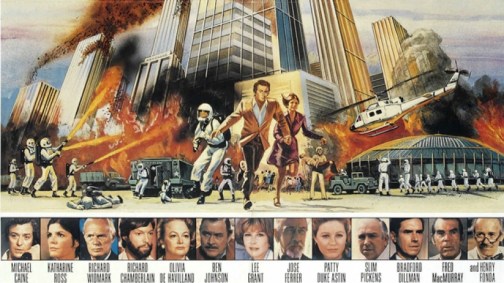
“The Poseidon Adventure” (1972) and “The Towering Inferno” (1974) were two seminal big-budget disaster action flicks produced by Irwin Allen.  They were both based on popular novels, they both had all-star ensemble casts, and they both found their way to network television fairly quickly.  They were both pretty decent flicks, too, I think … although I admittedly only saw them broadcast when I was very young.  (My best guess is that I caught them sometime around 1979 or 1980; I’d have been in the second or third grade.)

They both made a big impression on me.  Although “The Poseidon Adventure” is probably the better known of the two, it was “The Towering Inferno” that truly got under my skin.  It had its share of frightening sequences — at least by 1970’s standards.

The one I remember the most is one of its two famous “elevator scenes.”  After the plot-driving fire breaks out to create the titular burning high-rise, some panicking partygoers try to take an elevator directly to the street, past the burning floors — even after they’re warned not to try such an escape route.  The result (which you can see in the third video below) was pretty scary stuff, at least to a kid my age, just before 1980’s action films would thoroughly desensitize me to this sort of thing.  (It was not a decade known for nonviolent movies.)  The outcome of the scene sent a pretty big message to me about the importance of following the authorities’ instructions during a disaster.

Both “The Poseidon Adventure” and “The Towering Inferno” were also among the paperbacks that littered the backseat of my father’s car.  (Cars and closets and coffee tables in the house where I grew up were veritable small libraries; my father wasn’t reading Joyce or Dostoevsky, but lord knows that man read a lot.)  In the case of the latter film, “The Glass Inferno” was the name of the original book by Thomas N. Scortia and Frank M. Robinson.  Believe it or not, I can remember asking my Dad what the word “inferno” meant.  And I remember being fascinated, for some reason, by the idea that filmmakers could change the name of a story when adapting it.  (The people who made movies could do anything they wanted!)

They actually remade “The Poseidon Adventure” a few years back … I saw it, and I might have even reviewed it for this blog.  I can’t say that it was memorable, though.  Indeed, the only thing I can recall about it was the presence of the priceless Kurt Russell.

Or maybe it was terrific, and I just don’t remember that.  I am getting old — after all, I was a second grader in 1979.


poseidon_adventure_ver2_xlg

91Ok9aAMQaL._SL1500_

Throwback Thursday: “The Swarm” (1978)!

I was surprised when I recently discovered that “The Swarm” (1978) was a feature film; I remembered it as a made-for-television movie from my childhood.  (After its theatrical release, it debuted on NBC with a hell of a lot of fanfare in February 1980.)  I was also surprised to read that it was both a critical and a commercial flop, and is often named as one of the worst films ever made.  I was in the second grade at the time, and — let me assure you — this was THE movie the kids in school talked about.  We were in awe of it.

The people behind “The Swarm” had high hopes for it in 1978.  The internet informs me that it was based on a best-seller by famed novelist Arthur Herzog. And it was helmed by director Irwin Allen, who gave us two classic 70’s film adaptations of disaster novels — “The Poseidon Adventure” in 1972, and “The Towering Inferno” in 1974.  (Those were a pretty big deal back in the day.)  And just look at the cast named in the trailer below.  It’s like a who’s who of 1970’s cinema.  Yet it all apparently just didn’t pan out … contrary to my memories of second grade, “The Swarm” went down in pop culture history as a train wreck.

Check out the bee-proof suits worn by the guys with the flamethrowers.  Talk about an excellent G.I. Joe toy that was never made.  (Of course we had “Blowtorch,” but he was 80’s rad, and these guys in white are 70’s kitsch.)


swarm-main


Cover to “Avengers” #196, George Perez, 1980

Marvel Comics.

Avengers_Vol_1_196

Throwback Thursday: “Bosom Buddies” (1980-1982)!

Here’s some more early Tom Hanks weirdness …  he starred in ABC’s cross-dressing comedy “Bosom Buddies” between 1980 and 1982.  The show ran for just two scant seasons.  I’m surprised at that, because I seem to remember it being a much bigger deal in the 1980’s — maybe just because it was a big hit at my house, when I was in second and third grade.  I wanted to be like the guys in the show, albeit without the cross-dressing.  I wanted to be grow up to live in New York City with my best friend and a beautiful blond girlfriend name “Sunny,” and get into zany hijinks.

I remember thinking that Hanks’ co-star, Peter Scolari, was the cool and funny one.  I thought Hanks was annoying, even if he did look like Billy Joel, whose music my older sister had taught me to really like.  (Joel’s “Glass Houses” album was stacked vertically with the others beside the living room record player, not far from where I watched this show on the family’s color television.)  And that is indeed Billy Joel’s “My Life” playing as the show’s theme song — but it had a different vocalist, for some reason.  (No matter how many times I hear it, that song will always take me back to the 80’s.)

Scolari’s career following the short-lived “Bosom Buddies” certainly hasn’t paralleled Hanks, but he’s still done a hell of a lot of television.  (Among many other things, he surprisingly starred as Commissoner Loeb in “Gotham” in 2015.  I didn’t see that one coming.)

As you can see from the opening credits below, the central plot device for “Bosom Buddies” was that the two guys had to pretend to be women in order to live at an all-women’s apartment building.  It only occurs to me now as I’m writing this that the show’s title was a double entendre.  I actually asked my Dad what the word “bosom” meant when I was a kid, and he gave me an answer that was accurate, if incomplete.  (He explained the colloquial meaning of the expression — a “bosom buddy” was a best friend, who you figuratively held close to you.  I subsequently told my best friend next door that he was my “bosom buddy” at one point.)

Yeah, I know it’s strange that I can remember a conversation from 39 years ago about an obscure TV show.  It’s weird what people remember.


https://www.youtube.com/watch?v=3UI_JwF3cnA

Throwback Thursday: “The Tripods” comic strip in “Boys’ Life” magazine!

I had a subscription to Boys’ Life magazine for a couple of years when I was a Cub Scout in the early 1980’s.  My parents canceled it after a year or two, and I can’t blame them — I just wasn’t reading it.  Boys’ Life was the official magazine of the Boy Scouts of America, and it was pretty wholesome stuff … it just didn’t offer the excitement of my comic books or the occasional copy of Fangoria that I manged to get my hands on.

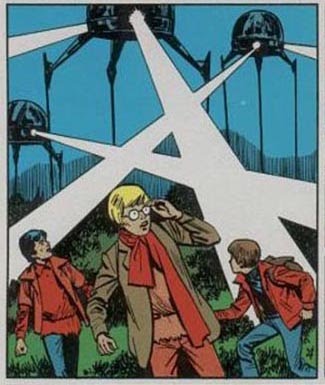
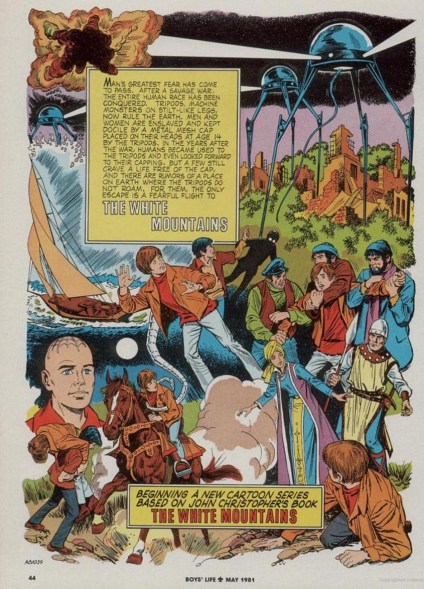
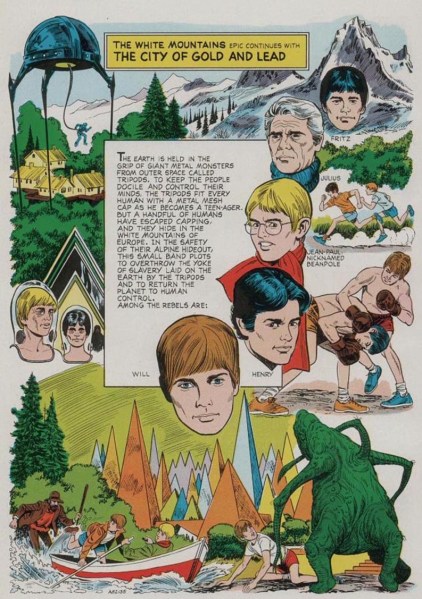
But there was one feature of Boys’ Life that I followed religiously — the serialized comic strip adaptation of John Christopher’s The Tripods book trilogy.  (Christopher published the first three of his books in the late 1960’s; he added a prequel novel in 1988, but that was long after the Boy Scouts and Boys’ Life was behind me.)

The Tripods was cool, dark dystopian stuff.  The story opened with the first book, The White Mountains, to find humanity settled into an agrarian, pre-industrial age in which their overlords were the titular “tripods” — massive three-legged vehicles piloted by unknown beings.  Humans were ritualistically “capped” with a brain-altering device when they reached age 14 — thereafter becoming docile and conformist and easier for the mysterious machines to subjugate.

The White Mountains followed a trio of 13-year-old boys who escaped the “capping” to seek out a human resistance movement; the second book, The City of Gold and Lead, shows two of these protagonists infiltrate the city of the tripods’ operators.  (Spoiler — they’re grotesque aliens.)  The third book, The Pool of Fire, presumably picks up from there, but my Boys’ Life subscription ran out before the magazine got to that.

I recently, however, used this Interwebs thingamajig to discover what looks like a real gem of a find — a 1984 BBC mini-series adaptation of the books.  I started the first episode and it looks quite good.  If I get around to watching the whole thing, I’ll review it here.


40da7d9da25e489860f6e1bc7bccf65a7112394a

3

4

5

2

Throwback Thursday: “I’m Gonna Wash that Gray Right Outta My Hair”

These early 80’s Clairol ads, of all things, came up on Facebook — after I lamented the waves of gray that have flourished across my head with astonishing suddenness.  (I swear this seems like something that happened overnight.  I honestly thought that there something wrong with my eyes, or maybe the bathroom light.)

I remember this little jingle quite well — it’s catchy, and there were a few variations of the 1980 TV spot that you see below.  I never knew that it was a send-up of a number from Rodgers and Hammerstein’s “South Pacific” — “I’m Gonna Wash that Man Right Outa My Hair.”  For some reason, my friends thought that was really funny.


Throwback Thursday: “The Gong Show” (1976-1980)!

Chuck Barris’ “The Gong Show” (1976-1980) was another show I remember vaguely (but quite fondly) from when I was in kindergarten or the first grade.  (It aired its original run between 1976 and 1978, and then was syndicated the latter two years.)  I still remember laughing uproariously at its weird acts, and it might have been one of those shows that ended just before my 8 PM bedtime.

The idea was this — a panel of three celebrity judges would view a handful of amateur talent acts, and would bang the titular gong if an act was so bad that they decided they couldn’t allow it to continue.  (Along with legitimate talent, the program deliberately fielded acts that were weird or just plain bad.)  What’s interesting is that this seems like a very tame precursor of contentious current reality shows like “American Idol” or “Britain’s Got Talent,” which are still going strong since their advent in the early 21st Century.  “The Gong Show” was a lot more laid back.