Tag Archives: 1980

Throwback Thursday: “I’m Gonna Wash that Gray Right Outta My Hair”

These early 80’s Clairol ads, of all things, came up on Facebook — after I lamented the waves of gray that have flourished across my head with astonishing suddenness.  (I swear this seems like something that happened overnight.  I honestly thought that there something wrong with my eyes, or maybe the bathroom light.)

I remember this little jingle quite well — it’s catchy, and there were a few variations of the 1980 TV spot that you see below.  I never knew that it was a send-up of a number from Rodgers and Hammerstein’s “South Pacific” — “I’m Gonna Wash that Man Right Outa My Hair.”  For some reason, my friends thought that was really funny.


Throwback Thursday: “The Gong Show” (1976-1980)!

Chuck Barris’ “The Gong Show” (1976-1980) was another show I remember vaguely (but quite fondly) from when I was in kindergarten or the first grade.  (It aired its original run between 1976 and 1978, and then was syndicated the latter two years.)  I still remember laughing uproariously at its weird acts, and it might have been one of those shows that ended just before my 8 PM bedtime.

The idea was this — a panel of three celebrity judges would view a handful of amateur talent acts, and would bang the titular gong if an act was so bad that they decided they couldn’t allow it to continue.  (Along with legitimate talent, the program deliberately fielded acts that were weird or just plain bad.)  What’s interesting is that this seems like a very tame precursor of contentious current reality shows like “American Idol” or “Britain’s Got Talent,” which are still going strong since their advent in the early 21st Century.  “The Gong Show” was a lot more laid back.


A review of Season 1 of “The Haunting of Hill House” (2018)

Ghosts seldom scare me, because I’m never 100 percent clear on what sort of threat they present to the protagonists of a horror film or TV show.  They’re not like zombies, vampires, werewolves or serial killers, all of which will do predictably horrible things to their victims.

Can ghosts … kill you?  Injure you?  That usually doesn’t make sense, given their non-corporeal nature.  Can they … scare you to death?  How would that work?  Would they cause a heart attack?  Or drive you mad?  That’s fine, I suppose, but here they’ve taken a back seat to the demons of horror films since 1973’s “The Exorcist” spawned a sub-genre with far more frightening supernatural baddies.  Are ghosts supposed to inspire existential dread, by reminding the viewers of their own mortality?  For me, that backfires — their existence would strongly suggest the existence of an afterlife, which would be paradoxically reassuring.

It’s therefore a testament to the quality of Netflix’ “The Haunting of Hill House” (2018) that it’s frequently so scary, even to me.  We find out in the first episode that its ghosts indeed do more than frighten the story’s protagonists, but it’s the show’s writing, directing and acting that make it so memorable.  It’s an a superb viewing experience, and I’d rate it a 10 out of 10.

The cast roundly shines — but especially Carla Gugino and Timothy Hutton (even if his performance was a little understated).  Catherine Parker is deliciously evil in a supporting role as the house’s most outwardly vicious spirit.  The best performance, for me, however, was the young Victoria Pedretti as the traumatized Nell — she was goddam amazing, and deserves an Emmy nomination.

Mike Flanagan’s directing was perfect — his use of long angles and colors to make lavish interiors disorienting reminded me of Stanley Kubrick’s similar sensory trickery in “The Shining” (1980).  Michael Fimognari’s cinematography was beautiful.  Even the makeup effects were damned good.  (Nothing beats Greg Nicotero’s work in “The Walking Dead” universe, but the work here is sometimes horrifying.)

I’m not the only one who loved this show either.  It is broadly praised in online horror fan circles (though I’d recommend avoiding most of those for spoilers).  I haven’t read Shirley Jackson’s 1959 novel that is its source material, but a bibliophile who I trust assured me that the show is even better.

Sure, there were some things that didn’t work for me.  “The Haunting of Hill House” actually does take a while to get where it’s going; it favors in-depth, flashback-heavy character development over advancing its plot, in much the same manner as “Lost” (2004 – 2010) once did.  And some viewers might feel the same frustration here as they would for that show.

Its story and supernatural adversaries are also distinctly Gothic.  (Your mileage may vary as to what’s a comfortably familiar trope and what’s an archaic cliche.  I myself was more interested the more modern and three-dimensional interpretation of ghost characters seen in 1999’s “The Sixth Sense.”)  I’d even go so far as the say that the first ghost that we see in any detail is actually disappointing — the otherworldly figure connected with the bowler hat felt too cartoonish for me, like something we’d see on Walt Disney World’s “The Haunted Mansion” ride.  (Trust me, they get more intimidating after that.)

Give this show a chance — and stay with it if you think it’s too slow, or if you find its characters a little unlikable at first.  You’ll be glad you did.

Weird world: if the diffident, sometimes off-putting character of Steven looks familiar to you, it might be because that’s none other than Michiel Huisman, who plays the charismatic Daario on “Game of Thrones.”


HauntingHillHouse-tp0004c_Double_Gate_Cover_houseback

Cover to William Golding’s “Lord of the Flies,” by artist Barron Storey, 1980

Perigree.

18ernjkqn7zkgjpg

Dennis Villelmi interviews the Woman in Room 237!

If you are a horror fan, you’re in for a rare treat.  Stop over at The Bees Are Dead to read Dennis Villelmi’s interview with Lia Beldam, who portrayed the woman in Room 237 in Stanley Kubrick’s 1980 adaptation of Stephen King’s “The Shining.”  (Fans of the 1977 novel and its 2013 sequel, “Doctor Sleep,” may recognize the character as the ghost of Lorraine Massey.)

Dennis chatted with Ms. Beldam about a few different aspects of filming — including her experiences with Kubrick and Jack Nicholson.  It’s great stuff.


doorsixteen_mintgreenbathrooms_theshining

“Throwback Thursday: “Bigfoot and Wildboy” (1977 – 1979)

“Bigfoot and Wildboy” (1977 – 1979) is another obscure TV show that is perhaps best forgotten.  It was a segment on something called “The Krofft Supershow” in 1977, I think, before the segments were re-edited into a half-hour program.  I became a fan of it as second grader in the fall of 1979.  (Or maybe I watched its reruns in third grade, in 1980 — to be honest, this was so long ago that I hardly remember.)

They don’t make TV shows like they used to.  And that’s a good thing.  “Bigfoot and Wildboy” seemed to rely heavily on three ingredients: an utra-cheesy 70’s score; truly terrible special effects (even for the time); and lots of shots of its two title characters either jumping, or running at the camera in slow motion.  (I actually just watched a few minutes of the full episode you see posted below.)

I was pretty preoccupied with “Bigfoot and Wildboy” when I was very young.  I remember having to make journal entries in the classroom, in which we could write and illustrate anything we wanted.  (It was precisely the sort of open-ended journal writing exercise with little academic value to which I’d be subjected, occasionally, throughout my school career — even in my college poetry class.)  But we were allowed to select our own topic in the second grade, and that was at least some fun for an imaginative kid.  The nuns (it was a Catholic school) sometimes prodded us to write about real-world events; 1979’s Space Shuttle Columbia, for example, was high on their list of suggestions.

Given a blank slate, though, I tended to write almost exclusively about imaginary characters and monsters — peppered, perhaps, with intermittent entries about dogs.  I distinctly remember drawing Bigfoot and Wildboy one day.  (If memory serves, we wrote and drew in our journals after recess, maybe to get us refocused.)  I drew them leaping over a fence and running toward the viewer.  (Seriously, the show had a lot of shots like that.  Check out the opening credits below.)

I remember a nun looking over my shoulder and inquiring delicately about the giant hairy humanoid and the half-naked boy … when I explained the characters to her, she suggested with (uncharacteristic) patience, “Tomorrow, let’s try to write about something from the real world.”


Evolution stinks sometimes.

Soooooo, I finally gained a true appreciation earlier tonight of how bad a skunk could smell.  I’ve smelled them before … I’ve been in Virginia for a while now, and I actually spotted my first skunk in upstate New York when I was a kid.  (They’re not pretty.)  But this is the first time I’ve encountered a full dose from an animal that was evidently nearby.

Dear Lord.

This was the olfactory equivalent of Dante Alighieri’s worst visions of hell.  The odor was at once strangely metallic, horribly organic and chemically toxic.   If one of Michael Bay’s “Transformers” were possessed by the demon from William Peter Blatty’s “The Exorcist,” and it wielded flatulence to punish the damned, this would be it.  If the three Kryptonian villains from 1980’s “Superman II” had been poisoned by chili laced with spoiled pork and Ex-Lax, this would be it.

Skunks might now top my list of hated animals, were it not for my enduring abhorrence of alligators.

Earwigs are moving up on that list, too — at least since I spotted one at 7:15 tonight in my kitchen.  Earwigs look like God tried to make a proper beetle while on acid.


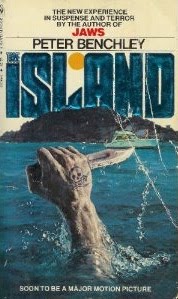
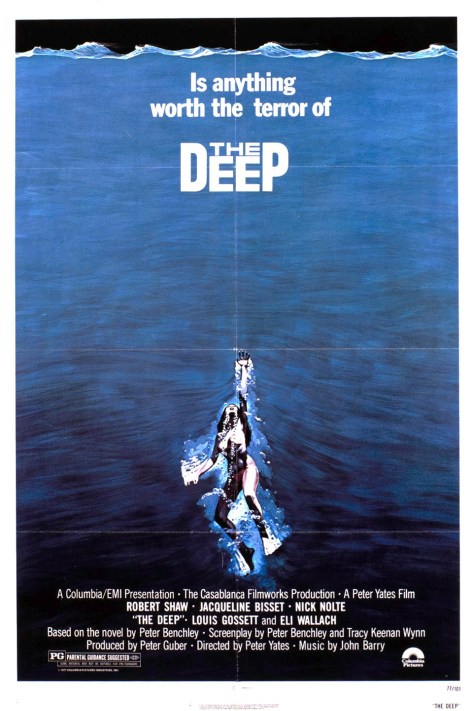
Throwback Thursday: Peter Benchley’s “The Deep” and “The Island”

I mentioned these late-1970’s seafaring novels last week — they could be considered the “other” Peter Benchley classics.  Neither “The Deep” nor “The Island” had nearly the broad-based cultural impact of “Jaws,” of course.  But they were still pretty damned good.

I got my hands on the paperbacks in the 1980’s, after my Dad left them lying around the house.  (It’s funny how much of my reading material I inherited from my father or older brother during my formative years.  I wonder how many kids grew up like that and were thus influenced.)  Both books leaned toward being horror-thrillers, as “Jaws” did.

I saw the the 1980 film adaptation of “The Island” on broadcast television when I was in early gradeschool, and it freaked me the hell out.  It’s actually a pretty bizarre tale about a colony of throwbacks who murder modern boatgoers in the manner of 18th Century pirates.  (Check out the trailer below.)  It stars none other than Michael Caine, and also an Australian actress Angela Punch MacGregor.  (If that isn’t a badass Australian name for a lady, I don’t know what is.)

I read the original book when I was older — in some ways, it was even freakier.  There were some weird sexual undercurrents and potty humor that weren’t even necessary for the plot; Benchley was a little more out there than you might gather from the more traditional thriller that “Jaws” was.

“The Deep” was a scuba diving thriller; the book and the 1977 movie filled my adolescent head with ambitions of becoming a professional treasure-hunter.  I remember devoting a lot of thought around age 13 or so to trying to figure out if that was a realistic career aspiration.  (I supposed it all depended on what I found.)  There is a moray eel in the movie, and it is unpleasant.  It prompted me to adopt the neurotic habit of bringing a knife along on the summer snorkeling expeditions behind my friend Brian’s house.

Interestingly enough, Wikipedia informs me that Benchley returned to writing books in the late 1980’s; his last two novels in the early 1990’s sound pretty damn cool.  They’re both seafaring monster stories — “The Beast” and “White Shark.”  The latter even selects its victims from my native Long Island, New York.  Maybe I’ll pick those up this summer.


DeepCover

2344832

p1883_p_v8_aa

A short review of “Rogue One: A Star Wars Story” (2016)

“Rogue One: A Star Wars Story” is every bit as good as you’ve heard; even this non-“Star Wars” geek had great fun with it.  I’d cheerfully give it a 9 out of 10, and I’d recommend you give it a try even if you don’t typically enjoy the franchise.

Die-hard fans are currently noting all of the things that make this film unique in the series: it’s the first “Star Wars” movie without a Jedi, the first without the trademark opening text-crawl, the first one without a lightsaber duel.

Casual fans might be more impressed with more general differences.  Two stood out for me.

One, this is the first Star Wars film since “The Empire Strikes Back” (1980) that seems aimed mainly at adults.  Yes, the fairy tale elements are still there — we have an underdog orphan searching for her father, the requisite anthropomorphic aliens, and a humorous robot mascot (which surprisingly worked quite well).  But those elements are absolutely upstaged by a bona fide war film, complete with tactics, strategy, panic, collateral damage and casualties.  I remember thinking during a surprisingly gritty urban warfare scene that it was as though some filmmakers had taken a scene from a film like “The Hurt Locker” (2008) and set it within the “Star Wars” universe.

Two, I think that this is the most human Star Wars movie we’ve had since “Empire.”  It wouldn’t be “Star Wars” without the aforementioned aliens and robots, and plenty of references are made to the Force and the Jedi.  But this is a movie about ordinary people.  Yes, there is one larger-than-life character who appears … force-sensitive?  This universe’s equivalent of Marvel’s “Daredevil?”  (This was a confusing story element that didn’t always work for me.)  But we are presented primarily with all-too-human anti-heroes who feel fear, suffer, and die.

Isn’t that more exciting than watching cartoonish aliens fight armies of equally cute battle-droids?  In this film’s better moments, it made me feel like a was watching a “real” war with “real” people, and I was surprised to find myself actually rooting for the good guys in a “Star Wars” film — this has been a series that I’ve long half-dismissed as being essentially children’s stories.

Seriously, this was a good movie.  Check it out.


Throwback Thursday: Olivia Newton John’s “Xanadu” (1980)

No, I was never a fan of Olivia Newton John, nor am I old enough to recall her stardom in any great detail.  I need to mention “Xanadu” at least once here at this blog, however, as it is forever linked in my mind with the summer of 1980.

This song was played endlessly at the beach by sunbathing teenage girls.  They mostly went unnoticed by me, as this was the summer before I entered the third grade, and I hadn’t developed much interest in girls just yet.  But thinking of this song immediately returns me to the beach again as a little boy.  (My parents sent me there with my siblings a lot, something for which retrospect has taught me to feel thankful.)

I have a lot of memories of going to the beach in the early 80’s — burning sand, screaming for the ice cream man, and sidestepping endless arrays of discarded bottlecaps in the gravel parking lot.  (The local teenagers must have done a hell of a lot of drinking there; upturned bottlecaps hurt when you stepped on them.)  This was also the summer that my friend Brian’s little brother, Brad, erroneously told me that Han Solo died in “The Empire Strikes Back.”  (There were no “Episode” prefixes when the first Star Wars films came out.)

There was another hit by John that can transport me back the early 80’s.  That would be “Physical,” which was played and sang ubiquitously in 1981 by the girls in my fourth grade class.  (I still remember Linda, who lived on the next street, talking about John in awed tones: “A looooot of people think she is beautiful.”)

But I’d prefer not to think of that song, if I can help it.  While “Xanadu” is arguably still fun and catchy, “Physical” is best left forgotten.