Tag Archives: 2011

A tiny review of “Dead Rush” (2016)

“Dead Rush” (2016) isn’t quite as bad as other reviewers have made it out to be; it’s a passably entertaining zombie feature that I’d rate a 6 out of 10.  It occasionally rises above its central gimmick to create a few moments of suspense and emotion.  (The gimmick here is that the entire film is shot from the point-of-view of one man in the middle of a zombie apocalypse.)

That point-of-view device does wear a little thin by the end of this feature-length film … and I’m a found-footage horror movie fan who usually doesn’t mind that sort of thing.  This movie might have been better overall if the viewer weren’t required to follow those “shaky-cam”-type visuals for quite so long; my understanding is that it was adapted from a well received short film.

If there was one thing that bothered me the most, though, it wasn’t the POV.  There is a recurring shot in “Dead Rush” that I liked a hell of a lot, involving the main character’s memory of a loved one.  It’s made even better when it is rather creatively used as a framing device at the film’s end.  A little reflection, though, made me remember that this shot seems to crib a little too much from a similar effective recurring shot in 2011’s “The Grey.”

What the hell … if you need a zombie horror fix, you could do worse than “Dead Rush.”


dead-rush-poster-768x1084

A baffled review of “Lucy” (2014)

Everything you’ve heard about “Lucy” (2014) is correct — it’s exactly as trite and nonsensical as its multitude of unfavorable reviews have described it.  Maybe this was intended as some sort of weird, meta, inside joke by writer and director Luc Besson … after all, it’s a movie about increased “brain capacity” that is, ironically, really dumb.

I can’t imagine why Scarlett Johansson and Morgan Freeman would sully their reputations by starring in this film.  Although, sadly, even the wonderful Johansson is not at her best here.  She seems to try to portray increased intelligence by delivering some of her lines like a robot.  (Seriously, she reads some of her lines like a speedy automaton, and it’s a bad creative decision for her performance.)

I could go on and on about the silly things in this movie.  So could you, if you’ve seen it.  But it’s a lot more fun listening to the surly wise-asses over at Cinema Sins.  Their trademark “Everything Wrong With” video for “Lucy” is particularly harsh.  At one point they call it “an aggressive dickhead of a movie.”  Here’s the link:

https://www.youtube.com/watch?v=i3rZmnJ66Po

There is one overriding problem I need to address myself … and that’s how its premise seems to relate so little to the events of the story.  We begin by understanding that the titular Lucy is affected by a drug that increases her brain capacity.  Before the movie reaches its halfway mark, she appears to gain omniscience.  (She doesn’t need to actually learn anything — she simply knows virtually everything already.  This is evinced by her ability to translate foreign languages instantly, with no books or instruction at all.)  She also appears omnipotent by the film’s end.  Her powers become literally godlike.  And I’m not talking about Thor or Odin from the Marvel Cinematic Universe — we’re talking the all-powerful,  Old Testament God of Abraham.

Why?  Why should increased intelligence, no matter how incredibly vast, give her power of matter, space and even time?  If she were as smart as a thousand Stephen Hawkings, she still shouldn’t be able to do the things she does in the movie.

Believe it or not, I’d rate this movie a 4 out of 10.  (That’s far kinder than the other reviews I’ve read.)  I managed to have fun with this movie by rewriting some of it in my head while I watched.  Instead of Lucy benefiting from a drug that increases her brain capacity (which borrows a bit from 2011’s excellent “Limitless,” anyway), I pretended that I was watching a movie in which Scarlett Johansson became God.  (Think of 2003’s “Bruce Almighty.”)  Honestly.  I swapped out the plot device in my head, and imagined a different movie.  That made it fun — watching Scarlett Johansson as a wrathful God was strangely satisfying, especially when she wreaks havoc on the bad guys.

And speaking of bad guys … that is actually one thing that this otherwise clueless movie manages to get right.  No, I’m not kidding — the Taipei gangsters that serve as the story’s antagonists were performed to perfection by their actors.  The villains were repulsive and terrifying, and they aroused more interest in me than the good guys.  Min-sik Choi was terrific as the homicidal patriarch of the Taiwanese crime syndicate.  Even better, though, was Nicolas Phongbeth as the cherubic-faced, vaguely androgynous, sociopathic lieutenant.  If they were vanquished in this brainless movie, it’d be nice to see them resurrected in a James Bond film or a season of Fox’s “24.”  It’s weird seeing a movie so bad do one important thing so successfully.

There are really only two reasons why anybody should see “Lucy.”  One is morbid curiosity.  Two is if they are a learning to be a screenwriter, and are looking for a feature-length example of what NOT to do.


Lucy_(2014_film)_poster

A few quick words on The CW’s “Containment” (2016)

The poster for The CW’s new “Containment” seems like a ripoff for some exceptional poster art for 2007’s outstanding horror movie, “28 Weeks Later.”  That is just one of a few offhand references that the TV pilot seems to make to the film.  At one point, a panicked character blurts out the phrase “zombie apocalypse,” even though that has nothing to do with the plot.

Whatever.  Judging from the pilot, the new sci-fi thriller seems like a more or less average outing.  It isn’t bad, exactly, but it’s got plenty of room to grow.  Right now it seems like a undistinguished, mainstream television treatment of “Contagion” (2011).  I’d give it a 6 out of 10.

And, hey … just to add to the confusion, last year there was a really good British independent sci-fi-thriller, also entitled “Containment,” that also portrays a fatal disease outbreak.  I reviewed it here at the blog.  It almost seems like The CW is adopting the “mockbuster” strategy of capitalizing on viewers’ confusion of their show with superior properties.

Oh, well.


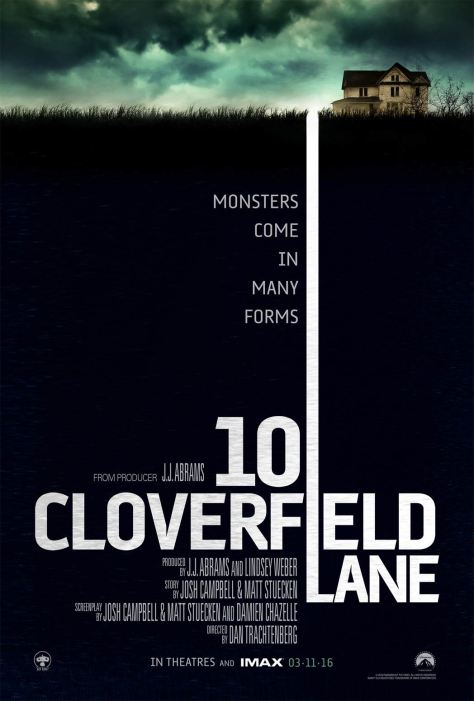
A very short review of “10 Cloverfield Lane” (2016)

“10 Cloverfield Lane” (2016) is a capably written and well performed thriller; it might not be quite worth the high praise it seems to be receiving elsewhere, but I’d still give it an 8 out of 10.

Mary Elizabeth Winstead actually is terrific actress.  She has far more to do here than her one-note heroine in 2011’s underrated “The  Thing” prequel, and she performs beautifully.  John Goodman is perfect as a mentally ill, dubious savior.  John Gallagher, Jr. does just fine as a good-natured everyman in over his head.

I did think that “10 Cloverfield Lane” ran a little long for its content.  This could have easily been an especially well executed episode of a one-hour show like “The Outer Limits” or “The Twilight Zone.”  It’s feature-length format felt a little padded.  We don’t need the prologue explaining why Winstead’s character is traveling.  Nor do we need the movie’s slowly building character arc for Goodman’s “Howard.”  (We know to suspect his stability from the trailer.)

This appears to have very little to do with “Cloverfield” (2008).


10cl_poster (1)22

“Emilie” (2015) is a superb, gut-wrenching thriller.

I’ll come straight to the point — “Emilie” is an exceptional horror-thriller that belongs on your list of films to see, provided you can stomach some disturbing content.  This movie hooked me in under a minute, even before its title appeared on screen.  Then it kept me glued to it throughout most of its running length.  It could have been an even better film — a classic on par with “Psycho” (1960) or “Fatal Attraction”(1987), were it not for some key creative choices about halfway through.

I’d give this movie a 9 out of 10.  It succeeds for two reasons — great acting and a script that perfectly employs dialogue that is at first subtle and nuanced, and then increasingly frightening.  The title character is a babysitter who is not what the parents expected, in more ways than one.  After some deliberately awkward character interaction with the departing parents, she proceeds to subject the children to a series of progressively more demented psychological games.  What follows is a thriller brimming with pathos.  The movie reminded me a lot of the critically acclaimed and controversial “Funny Games” (2007). That film also showed ostensibly innocent adversaries entering a family’s home after gaining their trust, and then doing awful things.

Emilie is played to perfection by Sarah Bolger, who has a beautiful, kind face, which only makes the character’s incongruous psychopathy even more unsettling for the viewer.  It took me a while to place the actress’ face, until I recognized her as the somewhat feckless protagonist of 2011’s “The Moth Diaries.”  I was impressed with her talent then as a hapless good guy, and I think her performance here was phenomenal.  She plays the innocent-looking, yet icy antagonist here with subtle, unnerving malice.  The rest of the cast is also uniformly quite good.  This is true even of the young child actors, but most especially of Joshua Rush.

The movie is briskly paced, but its sparing dialogue still manages to rattle and then shock.  It’s a sometimes obscene story of imperiled children that really gets under your skin.  Most of its directing is clean and clear.  Combined with the unusual score, it gives the story a dreamlike quality.

The movie loses its way just a little at about the 40-minute mark, when its perverse, moody dialogue and strictly psychological horror give way to the familiar elements of a boilerplate thriller.  An unnecessary backstory is given for our antagonist, delivered by an overly convenient, standard flashback sequence that feels out of place and that disrupts the pacing.  (“Her mind was shattered.”)  Then, other plot points also feel just a little by-the-numbers, moving “Emilie” away from true cinematic greatness and toward just being a very good horror flick.

Finally, Bolger’s villain is defanged a little when the script calls for her to lose her calm demeanor after the plucky, oldest child (Rush) defies her, in a well executed but entirely predictable David and Goliath story.  And her character’s reliance on a nameless, voiceless and superfluous confederate here also makes her a little less enigmatic.

How much greater would this movie have been if Emilie’s motivations remained a mystery?  What if, like “Funny Games” or “The Strangers” (2008), all we knew is that she was an highly intelligent sociopath acting for no discernible reason?  What if she were acting entirely alone?

And what if the horror remained strictly psychological, with no actual violence to up the ante until the closing minutes?  The most disturbing scenario I can think of is this — what if she were able to psychologically manipulate the children to violently turn against one another, or against their parents upon their return?  That could be an ambiguous, darker and far more thematic story than the second half of the film we see here.

Still, this was a damned effective scary movie, and that’s good enough.  I recommend it.

One more thing — there actually is a famous, heartwarming French romantic comedy entitled “Amelie” (2001), which I have not seen.  I think it would be blackly funny if some sentimental filmgoers wanted to rent that and accidentally picked up “Emilie.”


wjjgzh7t


1280x720-cOf


“Berlin Undead” is playing for free over at Hulu.

There’s a German zombie movie over at Hulu that I highly recommend.  Its name is “Rammbock” (2011); the somewhat unimaginative Americanized title is “Berlin Undead.”  (And that’s also inaccurate, because the baddies chasing us are infected people, a la “28 Days Later.”  A Hulu membership isn’t required.  The film is in German, with English subtitles.

I’m surprised I don’t hear more praise for this movie among zombie horror fans.  It’s nicely made, and it’s scary in parts.  Its lovelorn, likeable oaf of a protagonist (Michael Fuith) is such an everyman that he’s easy to identify with.  And his cunning high school-age companion (Theo Trebs) seems like he would be the coolest foreign exchange student ever.

Check it out:

http://www.hulu.com/watch/398201

maxresdefault

http://www.hulu.com/watch/398201

A short review of “The Gift” (2015)

I guess the formula for “The Gift” (2015) is pretty simple — hand a superb script to three superb actors.  Here, they are Jason Bateman, Rebecca Hall and Joel Edgerton, and the dark drama they bring to life is driven by dialogue and unexpected character development, instead of jump scares and dark hallways and other conventional thriller conventions.  (Edgerton, who I last saw as a boilerplate good guy in 2011’s “The Thing” prequel, is also the director here.)  The three actors are magic together.  I became uncomfortable (as was the filmmaker’s intention) even during the first apparently innocuous conversation when the three interact for the first time at a chance meeting in a department store.

In fact, I’m not sure that “The  Gift”  is even a thriller instead of a particularly disturbing drama.  Like other viewers, I’d suggest that what filmgoers see is not what the movie’s trailer suggests.  This is yet another film that reviewers can’t describe in detail for fear of spoilers.

I’d give this a 9 out of 10.  My only criticisms are very mild.  I think Bateman underplayed the distress his character ought to have felt in the last 10 minutes or so.  Also, I found myself wanting more closure and less ambiguity in the ending, as well more of a standard climax.   But that probably just reflects my expectations as a traditional horror-thriller fan, and not any real failings of the movie.

The-Gift-Movie-Poster-Simon

“Annabelle” (2014) scared the $#@& out of me!!

“Annabelle” seems like precisely the sort of horror film that shouldn’t work.  Thinly drawn characters wind their way through a series of overly familiar tropes, including, of course, the titular possessed doll.  These characters make the same baffling decisions that only people in horror movies are stupid enough to make, and cavalierly remain in dangerous situations long after you and I would have gotten the hell out of there.  The film is so reminiscent of “Rosemary’s Baby” (1968) that for a while I actually wondered if it was a remake.  And the script is pretty clunky — especially the coda at the church.

Yet … “Annabelle” still works.  This is a frikkin’ scary movie.  I’d give it a 9 out of 10.

There are a couple of reasons for the movie’s success, I think.  First, it’s beautifully shot and directed throughout an especially creepy apartment building. Our supernatural antagonists are (at first) wisely seen down long corridors and stairwells.  There are some static shots of the doll but none of the silly cut-and-cut-back tricks to explain that it is moving on its own.

Second, there is no ham-handed CGI to make the action cartoonish; there are only sparsely placed practical effects, and they work quite well.  This felt like an effective old-fashioned 1970’s horror movie about the devil.

Third, Annabelle Wallis does well in her role as the wife in the young married couple targeted by Satan. She underplays it quite a bit, but she’s still a good actress.  (The beautiful Wallis is none other than the college student that young Charles Xavier tried to pick up in 2011’s “X-Men: First Class.”  And, yes, she does have the same first name as the demonic doll.  Weird world.)

I was confused at first about the awkward and confusing bookends to the film; they’re distracting and unnecessary.  Wikipedia informs me that these are intended to remind viewers that this movie is a spinoff of “The Conjuring” (2013), which is regarded by horror fans as superior to this film.  I guess I’ll need to watch that soon.


a11da6bd58b95b334f8cd49f00918f16_500x735

Oh! Just one more Thing tonight!!

1245878_orig

You’re glad I reminded you, aren’t you?

I told Pete Harrison the other night that I watched the 2011 prequel to John Carpenter’s 1982 masterpiece, “The Thing.”

He simply responded, “Why?”

To me and undoubtedly many others, the 80’s classic will always be the paradigmatic horror – science fiction movie.  Because I admire a well made house as much as anyone, but AIN’T NO CARPENTER LIKE JOHN CARPENTER.  (Nobody repeat that, I want to copyright it and sell bumper stickers at horror conventions.)

Yes, the recent prequel inexplicably has the exact same title as the 1982 movie, and I have no frikkin’ idea why.  That just seems … deliberately stupid.  Nor is that the 2011 film’s only flaw … it’s universally maligned.

Does the 2011 outing really deserve all its bad press?  I say no.  Among other things, it delivered some fine goopity-gloppity monster goodness, delivered by an archetypal flying saucer, no less.  That’s something that I find refreshing in a horror movie marketplace that just seems inundated with demons and ghosts.  (I loved “Insidious,” but enough already.)

C’mon, Hollywood.  There are plenty of horror fans out there who grew up loving giant ants, Marine-baiting “Aliens,” werewolves, swarms of spiders troubling William Shatner, and the adversaries of Godzilla.  It’s why I gave a positive review to this year’s “Jurassic World,” despite a script of the same quality as that of “Gilligan’s Island.”  I want to see velociraptors chase a speeding truck.  I will ALWAYS want to see velociraptors chase a speeding truck.

And … I liked the 2011 movie’s protagonist!  Trying to mimic MacReady’s cunning anti-hero would have redundant!  This story featured a smart, young lady scientist who turned out to be tough under pressure.  That kinda worked for me.

I actually have seen 1951’s “The Thing From Another World,” but that was 30 years ago on VHS, with my “Movie Uncle,” John Muth.  I have NOT read “Who Goes There?,” John W. Campbell, Jr.’s 1938 novella upon which all of these films were based.  But I’m planning to.  (Last time I checked, it was floating around online somewhere.)

I’m just waiting for the first big blizzard to hit next winter.  Because ATMOSPHERE.

A review of “Sinister” (2012). (With a caveat.)

It’s easy to see why “Sinister” (2012) came so highly recommended; this is a startlingly scary horror movie to which I’d give an 8 out of 10.  I was tempted to give it a 9, but some subjective personal tastes prevent me from giving this unusually disturbing film a higher rating.

It’s frightening.  The design of the supernatural Big Bad is quite good, despite its simplicity.  This film succeeds in giving us an intimidating bogeyman.  Far worse is his choice of victims and his modus operandi.  I won’t say much here … this is a movie where we learn about the story’s antagonist because the protagonist is an investigator — true-crime writer “Ellison Oswalt,” wonderfully played by Ethan Hawke.  I also won’t go into precisely how the baddie operates, because it’s just a little too dark to contemplate here.

It’s shot and scripted quite well … there are a number of nice touches, and the basic story is unsettling even by horror movie standards.  A late twist about how the violence is perpetrated is telegraphed in advance, but it still gets under your skin.  The directing by Scott Derrickson is spot on — the “jump moments” are cheap, but they still work.  Derrickson’s and C. Robert Cargill’s script is smartly unnerving — especially with respect to how these crimes are perpetrated.  (Yeesh.)  And the use of unusual and disturbing music is quite effective.  This film was the result of a lot of thought and effort.

Still, a few things suggested to me that this falls short of being a perfect horror movie:

  1.  Common tropes abound.  The most tired, to me, was the use of a horror writer as an ironic protagonist.  That’s an overused device.  The master himself, Stephen King, for example, has used this in no fewer than four novels and their subsequent film treatments, by my count.  (Yes, Hawke here is a nonfiction writer instead of a novelist, but the principle is the same.)
  2. Hawke’s protagonist, as scripted, is pretty damned unlikable.  “Deputy So-and-So” is his most important source, not to mention someone who shows him compassion when things get really tough.  Yet he sticks with that insulting appellation, and even screens his calls, throughout the entire movie.
  3. The bestselling nonfiction writer here has no idea how to cultivate a source.  (See above.)  I’ve been a writer, in some capacity, for my entire adult life, and I started out as a paper jockey.  You treat every source as important, even the crazy ones.  It’s both good manners and proper professional conduct.  And when you deal with any police officer, you’re especially conscientious if you’re smart — people in law enforcement are often (understandably) very sensitive about how they are portrayed in writing.
  4. Ellison Oswalt feels the need to move into a home where a multiple homicide was committed, in order to write about the crime?  That’s just nuts, even by eccentric writer standards.
  5. He chooses not to tell his wife?  I have never been married, but I know from both my personal and professional life that women get really, really pissed off when you neglect to tell them things that they think are important.
  6. Is Oswalt’s wife a Luddite who never googles anything?  I moved to Virginia a year ago, and I STILL google my address because I keep forgetting my zip code.
  7. Oswalt expects no neighbors to share such information with his wife?  (This is lampshaded a bit, as a child brings home the information from his school.)

Finally, there is one subjective matter that kept me from loving this movie — and it is admittedly a matter of taste.  Even as a devoted lover of dark stories, my enjoyment is sometimes affected by films in which children are victimized.  (I am referring here to the children depicted in the 8 MM (“Super 8”) film strips that are discovered by the main character.)

Yes, these are horror movies, and they are intended for adults, and we ourselves should be adult enough to recognize fiction as such.  (Otherwise we can buy a different ticket or click elsewhere among Netflix’ options.)  And plenty of great horror films feature imperiled children.  “28 Weeks Later” (2007) immediately springs to mind for me, probably because it is a favorite.  I think most other genre devotees would point to the universally recognized “The Exorcist” (1973).  But in those films and most others, things were depicted … differently.  (I’m being vague here for fear of spoilers all around.)

I’m a veteran horror-hound; I’ve routinely enjoyed films in which zombies or vampires wipe out humanity.  But what I saw in “Sinister” was too dark even for my taste.  This sort of reaction is rare on my part, but not unprecedented.  “The Devil’s Rejects” (2005) and “Wolf Creek” (2005) both took violence against the innocent too far for me to really enjoy or recommend them.  (Strangely, 1980’s legendary “Cannibal Holocaust” affected me little.)  Yes, zombie apocalypses tend to be gory affairs, but they are almost always faced by grownups, who are unbound, and armed, and generally able to fight back.

I would really  think twice recommending this to the casual filmgoer without a spoilerish hint about its content.  Your mileage may vary.

Hey … if you really want a scary story, check out The Internet Movie Database’s trivia section for “Sinister” after you see the movie.  Read how the “Pool Party” scene was filmed.  That’s … that’s nuts.  Nobody wants a director that committed.  Somebody should have called OSHA.  Seriously.

And here’s a joke for you.  Given the “Super 8” films we see in this movie, wouldn’t it be blackly funny if this film were  sequel to Steven Spielberg’s heartwarming “Super 8” (2011)?  It’s all about the kids, right?

Sinister