Standing by the side of the road, and a raven leaves its perch on the power lines to overfly me.
If you are a fan of “28 Days Later” (2002), then you know that this is a setup for a BAD situation.
Standing by the side of the road, and a raven leaves its perch on the power lines to overfly me.
If you are a fan of “28 Days Later” (2002), then you know that this is a setup for a BAD situation.
You guys know I love “28 Days Later,” but I’ve seen it multiple times and Sandra Bullock is NOT in the movie.
Perhaps predictably, I truly enjoyed “28 Years Later” (2025). It wasn’t a perfect film, but it was damned good; I’d rate it a 9 out of 10 on the Nolan scale. Screenwriter Alex Garland and director Danny Boyle are still the dream team for stylish, breakneck-paced action-horror. (It was their incendiary creative alchemy gave us the classic 2002 original film, “28 Days Later.”)
The movie has beautiful acting across the board, kinetic action sequences, decent makeup effects, convincing sets, a resonant theme and some gorgeous cinematography. (I keep reading that the film was shot with … iPhones? All of it? Really?)
Jodie Comer and Ralph Fiennes absolutely shine; Aaron Taylor-Johnson is also quite good. But I particularly enjoyed the performance of 14-year-old Alfie Williams, whose character’s coming-of-age comprises the human story of the film.
On the downside, “28 Years Later” has some problems with pacing and structure — although things like those are especially subjective, and other viewers will hardly notice.
Several characters make decisions that are … baffling. (Yes, I do realize that Williams’ character is supposed to be 12 years old, and that this is a horror movie. But … seriously, wtf, kiddo?) And there are some larger plot questions that I can’t really expand upon for fear of spoilers.
Finally, an abrupt change of tone at the end of the film left me feeling a little nonplussed. It might make sense in a larger context — the next “28” installment is due out in only six months, and the hard left turn we see in the final moments might be validated where the next movie picks up. For now, though, I have mixed feelings about this ending. (I want to know why a lengthy, somber meditation on mortality should end like a Saturday morning cartoon.)
I cheerfully recommend this! It is obviously not for the faint of heart, but it is highly effective action-horror that still manages to catch the viewer off guard. And Boyle delivers it with oddball, feverish finesse.

Watching Alex Garland’s “Civil War” (2024) is a lot like watching an hour-and-forty-nine-minute train wreck — except it’s even more horrifying because the accident happens right outside your hometown, and its casualties might easily be people you know.
It isn’t an “entertaining” movie; it’s hard to imagine anyone “having a good time” seeing it. It’s disturbing enough that I wouldn’t even recommend it to many people I know. I’m probably showing my age when the movie I keep wanting to compare it to is Oliver Stone’s “Platoon” (1986).
But it is definitely a well made film. In a nutshell, it combines the best elements of two of Garland’s previous movies. It has the breakneck, street-level, frightening, kinetic action of 2002’s “28 Days Later” and the thoughtful dialogue of 2015’s “Ex Machina.” (But viewers who are wary of Garland’s sometimes ponderous and lengthy dialogue scenes should rest assured that this is definitely an action movie.)
It’s surprisingly apolitical. (Garland himself stated it was intentionally “opaque.”) When we see random factions and individuals committing revolting acts of violence, we’re often given little information about which side they are actually on. Viewers hoping to see America’s contemporary left/right divide depicted will be disappointed. (Hence the part of the plot setup that readers laughed at before the movie’s release — California and Texas join forces against the federal government.) While Nick Offerman’s cruel and feckless American president is obviously “a bad guy,” his political party is never named.
The cast is roundly excellent, even if everyone is outshined by Kirsten Dunst’s hollow-eyed photojournalist who is in the midst of a traumatized existential crisis. And if you’re a fan of creepy “that guy” actor Jesse Plemmons, as I am, you’ll see that he is at his finest here.
I know that there have been a spate of negative reviews since the film opened yesterday, accusing it of being “pointless” or without a meaningful story. I disagree.
This is a milieu-type story in which the catastrophic war itself is the primary antagonist. It kills both the culpable and the innocent indiscriminately.
And Garland’s message is clear: “Kids, don’t try this at home.”


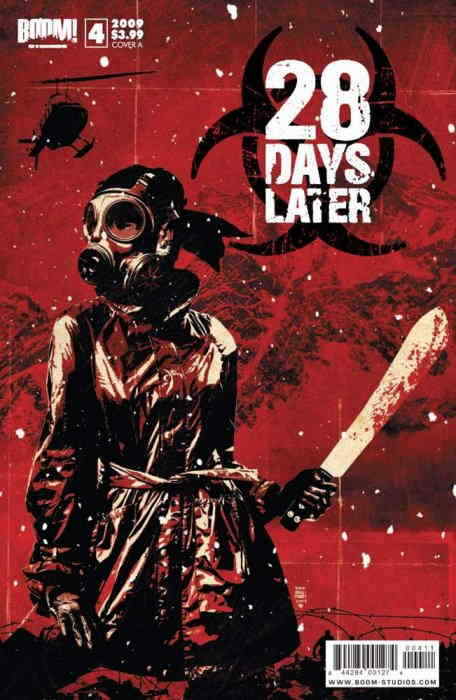
Boom! Studios. Variant cover.

Boom! Studios. Trade paperback.
I had genuine, serious, grownup responsibilities to meet yesterday.
And I was up sleepless at 2:21 AM the prior evening pondering what would happen if a group of Terminators fought John Carpenter’s “The Thing.”
I am 47 years old, people.
And I’ve got two more for you:
What would happen if The Blob fought The Thing? I suppose it all boils down to which has the fastest, most successful cellular-level method of attack. What about the baddie from Dean Koontz’ “Phantoms?”
And what would happen if the vampires from “30 Days of Night” fought the infected from “28 Days Later?” Sort of a … “30 Days of Night Later” kinda scenario?
There needs to be a name for this disorder I have. There needs to be hope for a treatment.

So I’m introducing a dear friend tonight to “28 Days Later” (2002). It is possibly my favorite horror film of all time, maybe even narrowly beating out “Aliens” (1986), “Alien 3” (1992), John Carpenter’s “The Thing” (1982), the Sutherland-tacular 1978 version of “Invasion of the Body Snatchers,” and George A. Romero’s first three “Dead” films (1968, 1978, 1985). (Whenever “Star Wars” fans refer to their “Holy Trilogy,” I muse inwardly that those last three are its equivalent for zombie horror fans.)
My friend thinks it’s funny that I refer to “28 Days Later” as “my sacred cow.” I’ll be crestfallen if she does not like it, and I told her as much. And that’s weird for me … I usually don’t feel let down when someone doesn’t enjoy the same books, movies or music that I do. Not everything is for everyone. Art would lose its mystique if it weren’t subjective. If all art appealed to all people, it would lose all its appeal altogether.
Part of me feels, unconsciously perhaps, that “28 Days Later” is the kind of film that “redeems” the horror genre (even though no genre needs such redemption — if art is well made or if it affects people, then it’s just fine).
Most comic book fans of my generation can tell you how people can occasionally roll their eyes at their favorite medium. (Comics have far greater mainstream acceptance today than when I started reading them in the 1990’s.) For horror fans, it’s sometimes worse. Horror is a genre that is easily pathologized — and sometimes with good reason, because a portion of what it produces is indeed cheap or exploitative. I wish I could accurately describe for you the looks I’ve gotten when acquaintances find out that I’m a horror fan. They aren’t charitable.
“28 Days Later” and movies like it are so good that they elevate horror to a level that demands respect from the uninitiated. It is an intrinsically excellent film — it just happens to have a sci-f-/horror plot setup and setting. It’s beautifully directed by Danny Boyle, it’s perfectly scored and it’s masterfully performed by its cast — most notably by Cillian Murphy and Brendan Gleeson.
Moo.
 Eric Robert Nolan, Author