What am I, an entomologist? You people tell ME what it is.
[Update : Blog Correspondent Pete Harrison just informed that this is Atteva aurea, or the Ailanthus Webworm Moth. No … I have no idea how he knows these things either.]
I am honored today to share with you three recordings of me reading from Dennis Villelmi’s Fretensis: In the Image of a Blind God. The Bees Are Dead has graciously published the readings over at its website; you can find them right here.
Thank you, Dennis, for allowing me to interpret your outstanding poetic work.
Anyone here in their 40’s? Anyone remember the material excesses of the 1980’s, and how people thought THAT was proof of America’s declining moral fiber?
Bring back cocaine and parachute pants, and we’ll cheerfully surrender our neo-nazis and child detention centers.
The weed of crime bears bitter fruit. Crime does not pay.
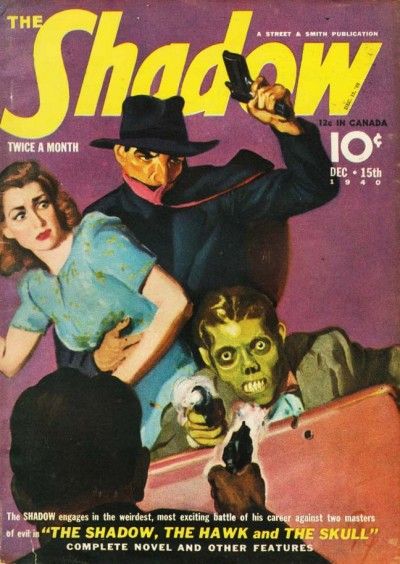
Dabbling in old time radio inevitably brought me to “The Shadow” — a character I’d heard about periodically when I was growing up. My Dad had been a fan of the radio program and film serials when he was a kid, and he was fond of rattling off that tagline you see in this blog post’s headline. (The radio shows were broadcast in to the mid-1950’s, long after they started in 1937.) I also remember the character from the truly unfortunate 1994 feature film with Alec Baldwin, which I actually saw in the theater with my college girlfriend. (The less said, the better. About the movie, I mean.) The Shadow is also cited periodically as an influence in the creation of my own favorite iconic dark detective, Batman.
The Shadow has a loooooooong, varied and occasionally confusing history – spanning radio, pulp magazines, comic books, television and film. He’s still being portrayed in comics. DC Comics released a crossover with Batman last year that looks interesting, and the incomparable Matt Wagner produced a couple of books in 2015 and 2016 that I’d love to get my hands on. (He fights Grendel!!!)
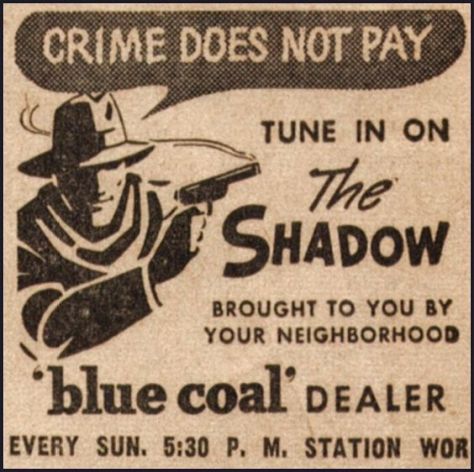
The radio shows are a lot if fun, just like the antique horror and mystery programs that I’ve linked to here at the blog. And, just like those, they’re easily found on Internet. (How my Dad might have marveled at that!) They’re definitely more campy. And I suppose that makes sense, as they seem aimed at children, whereas the horror shows seem intended for general audiences or just adults. The period commercials for Blue Coal are a weird glimpse into the past, too. If I had to name one thing that I found annoying about all of the old time radio shows I’ve found, it’s the omnipresence of that damned organ music. (Was it just a cultural staple of the time?)
If “The Shadow’s” stories are a bit hokey, the show’s voice acting and production are just terrific. I particularly like the actor performing The Shadow for the episode in the first link below — “Death is a Colored Dream” (1948). I believe it is Bret Morrison. (And I was surprised to learn that the famous Orson Welles only voiced the character for a year or so a decade earlier.)
But what’s most interesting is the character’s inception. He didn’t start out as a character in a story at all … “The Shadow” was simply the name of the generic host for a series of unrelated mystery stories comprising “The Detective Story Hour” in 1930. After a surprising fanbase developed around the creepy-sounding host (voiced at the time by Frank Readick, Jr.), people started asking for stories featuring “The Shadow” at the news stand. Street & Smith commissioned writer Walter B. Gibson to write up some tales featuring a supernatural detective; the first came out in 1931. The iconic character was just sort of made-to-order for confused customers who might have thought he already existed. That “Shadow” later arrived at the airwaves in 1937, with Welles voicing him.
Seriously, though, I totally need to get my hands on “Grendel vs. The Shadow.”
That awkward, recurring moment when people write “follow the money” in online political discussions, but I keep reading “follow the monkey” because I’m old and easily confused and I need new reading glasses.
I WANT it to be “follow the monkey.” That suggests a less depressing outcome than most political discussions.
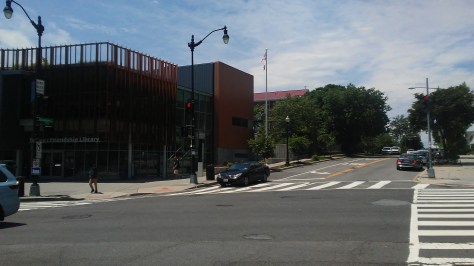
This is Tenleytown, in Washington, D.C.’s Northwest, just a couple of blocks from a campus of American University — where I almost went to school, instead of Mary Washington College in Virginia. I even (somewhat hilariously) received “honors admission” there. (I was never actually a true “honor student,” even in high school, because my grades in math and science were fair at best — and anyone who knew me at age 18 could tell you that I was not exactly the brightest bulb in the socket.)
I remember being pretty excited as a high school senior at that admission letter. American U. was my first choice; I was only seduced away to small-town Virginia by a generous financial aid package from the good people at Mary Washington. (Yes, young people, Fredericksburg was indeed a small town in 1990, even if it now looks like downtown frikkin’ Fairfax.)
It was freaky sipping coffee in Tenleytown and pondering some other parallel-universe me who lived and studied and partied there as a kid. (Where would I have bought my comic books?) Most people don’t think about string theory when they travel, but I am both a science fiction fan and a really weird guy with a lot of time on his hands. (Where is that other Eric right now? Is he married? Is he writing? Is he equally irritated by Star Wars obsessives, the religious right, Orwellian language, people who push “healthy snacks,” the dumbing down of America, “fun-sized” candy, and the gradual decline of “The Walking Dead?”)
Anyway, Tenleytown a pleasant neighborhood with a brisk, college-town vibe to it. DC consistently surprises me by how friendly its people can be.
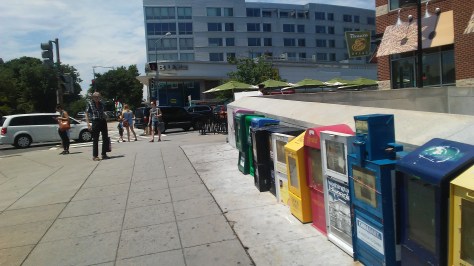
I left some poetry mini-books beside some news-stands on Albemarle Street, a cross-street with Wisconsin Avenue. The stands alternately inform readers in Greek, Spanish, Chinese and English about how DC’s most deplorable resident has most recently embarrassed our country. (I admire the Spanish-language papers’ predictable special antipathy for the president.) No matter how sad the news is, this town will not let you hide behind a language barrier.
Am I nuts, or does that Best Buy look like it was designed with the Watergate in mind? I keep wondering if that is someone’s idea of an obscure joke.
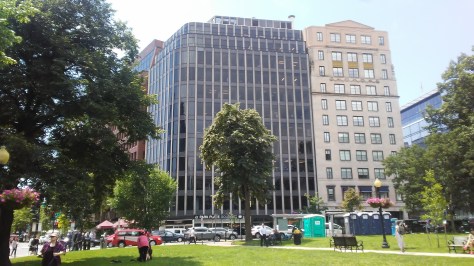
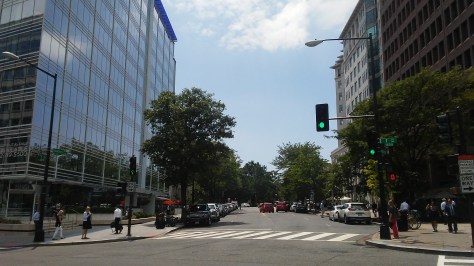
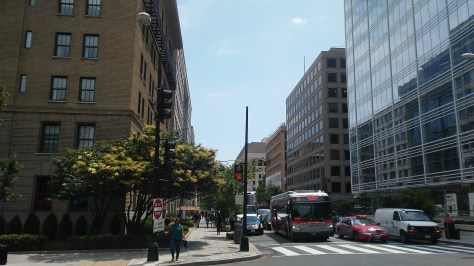
June 2018. This is the only part of Washington, D.C. that can truly remind me of New York City. (The diverse array of “food trucks” help quite a bit.) The people there, however, seem far more likely to make eye contact and begin a conversation. (I briefly chatted with a nice photographer who took a couple of poetry mini-books home with her.)
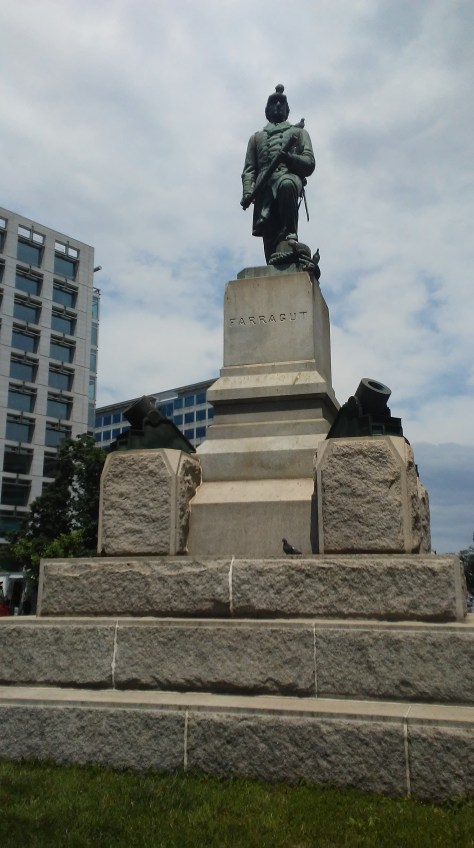
I’m proud of that last shot you see of pigeons alighting the park’s namesake — even if it is a little fuzzy and even if I only snapped it by chance. David G. Farragut was a Southerner who nevertheless served heroically as an admiral in the Union navy during the Civil War. He coined the famous phrase, “Damn the torpedoes, full speed ahead!” Maybe I’m only demonstrating my ignorance here, but I didn’t even realize that torpedoes were really a thing during the Civil War, even after seeing the C.S.S. Hunley at Charleston, South Carolina as a kid.