Tag Archives: The Walking Dead

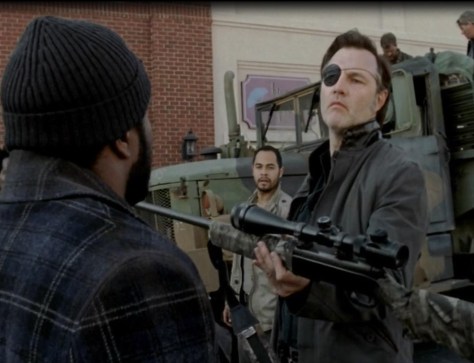
That time “The Governor” performed William Shakespeare’s “Richard III”

“Now is the winter of our discontent … RICK.”

“The Walking Dead’s” David Morrissey actually is a damn fine actor.

At any rate, here’s a brain twister for you — David Morrissey looks a lot like … Morrissey, from The Smiths.  Morrissey from The Smiths looks a lot like Quentin Tarantino.  Yet David Morrissey and Quentin Tarantino look nothing alike.

You figure it out.


It’s why they call him “The Governor” and not “The General.”

AMC’s “The Walking Dead” marathon helpfully reminds us tonight that people will be really stupid in a zombie apocalypse.

I have no military experience whatsoever, but I know that an invading force should disperse, seek cover and to try to present an opposing force with moving targets instead of stationary targets.

I also have a pretty good idea that I would not send the entirety of my forces through a single entrance and down a single corridor, and then congregate them in what looks like one enclosed space.

However, I could never make an eye-patch (or batshit crazy, for that matter) look as good as he does.


twd

ScreenShot011

A quick review of “Re-Kill” (2015)

I want to give “Re-Kill” (2015) more than a 5 out of 10 rating.  I do.  It’s an ambitious post-apocalyptic independent zombie film that earnestly and unpretentiously tries to give fans of the subgenre everything they’re asking for: great action, decent makeup effects, gore, good scares and lots of creative world-building, all culminating in a nifty little sci-fi subplot that isn’t stupid and isn’t too forced.

There’s a wealth of fun ideas here — the original story was obviously developed by people with a love for zombie tales.  We follow a “COPS”-style reality-TV program documenting a”Re-Kill” unit, a squad of specially trained commandos who repel brushfire outbreaks during a global, stalemated war between the living and the dead.  They “rekill” the “re-ans,” this universe’s slang for re-animated dead.

We see the entire program, complete with commercials from this fictional world: PSA’s to encourage people to have sex (in order to repopulate the world), and drug companies opportunistically pushing drugs for PTSD and depression.  My favorite was an ad for a Desert Eagle sidearm marketed to protective mothers, “for the children.”  We get wicked-cool peeks into a fairly detailed fictional world, including the activities of the police, the military, the media and civilians.

This would have made a fine book series, in the manner of Max Brooks’ “World War Z.”  Or it would make a terrific TV series … like a far faster paced and more expansive equivalent of “The Walking Dead.”

Tragically, though, this movie’s execution is too often lacking.  The acting is sometimes poor (but not from the always awesome Roger Cross, who you and I know as Curtis Manning from “24.”)  The script has problems.  And worst of all is the absolutely unnecessary shaky-cam directing.  This movie could have been a fantastic action-horror flick … if only we were able to see the action a little better.  The style of shooting here was a disastrous creative decision.

Oh, well.  It’s still a fun watch for hardcore zombie fans.


ReKill_poster


Free online zombie short stories from “The Living Dead 2” anthology

This was too fun not to share — a handful of free online short stories from “The Living Dead 2” anthology.  There’s some great stuff here, including an entry by David Wellington, one of my favorite zombie storytellers.  But, of all of the free stories here, I think I am most partial to Genevieve Valentine’s “And the Next, and the Next.”

Here’s the link:

http://www.johnjosephadams.com/the-living-dead-2/free-fiction/

Anyway, on a related subject, I have NOT yet seen the entirety of last night’s episode of “The Walking Dead.”  So PLEASE no spoilers here or on Facebook about the “major death,” even though I think the first half of the episode clearly broadcasts which character would be leaving us.

[UPDATE: I just watched “The Walking Dead.”  Dear Lord.]

1597801909sm

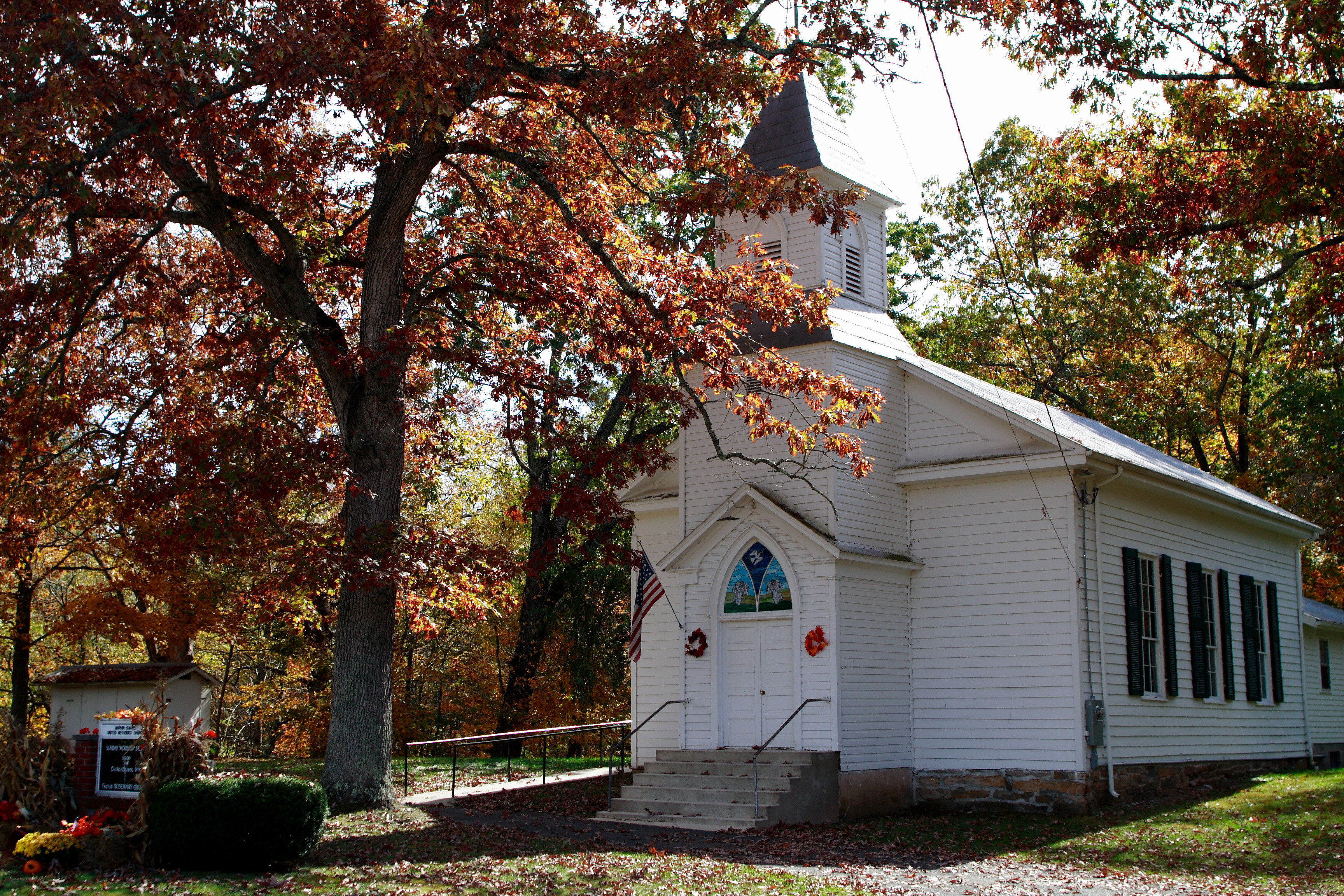
Photo, West Virginia Church in Autumn

Am I nuts, or does this look a hell of a lot like Father Gabriel’s church in Season 5 of “The Walking Dead?”

http://www.forestwander.com

Photo credit: http://www.ForestWander.com [CC BY-SA 3.0 us (http://creativecommons.org/licenses/by-sa/3.0/us/deed.en)%5D, via Wikimedia Commons

A quick review of “The Green Inferno” (2015)

There is one special effects sequence in Eli Roth’s “The Green Inferno” (2015) that is technically very well done.  I won’t describe it, for fear of spoilers here, but if you know that Greg Nicotero was in charge of effects for this movie, and you know the TV show with which he’s associated, then you have a pretty good idea of what this sequence entails.  (Hint: it’s “The Walking Dead.”)

This movie also makes excellent use of its Peruvian location, and the real tribe employed as extras.

Beyond those two things … this really is a rather mediocre horror-thriller, folks.  It’s nothing to write home about.  In fact, it seems amateurishly made on a few levels, especially considering the creative talent Roth exhibited with films like “Hostel” (2005), “Hostel 2” (2007) and “Cabin Fever” (2002).

This movie held my attention, and it does serve up a disturbing horror film that’s weird and different — which is what I think Roth is known for.  But, regrettably, it just wasn’t especially well scripted, performed or directed.  I’d give it a 4 out of 10.

the_green_inferno-2

A quick review of the Season 6 premiere of “The Walking Dead.” And is a major death hinted at?

I tend to obsess a little about spoilers, so I’m reluctant even to describe the plot of the Season 6 opener for “The Walking Dead.”  The story I thought we’d see absolutely wasn’t the story we saw, and the very first scene should be a terrific surprise for the viewer.  Suffice to say, this episode was fantastic — I’d give it a 9 out of 10.

After five seasons, even a diehard fan of the program can ask about its screenwriters, “How long can they keep this up?”  This is a horror subgenre that’s hard to keep fresh.  But the show still succeeds.

The writers are trying, and it shows.  I suggest that this actually is sometimes a pretty smart show.  A nice amount of thought has gone into the major action set-pieces since the start of Season 5 — everything from strategy, tactics, terrain, diversion, leadership, and even differing levels of training for new or seasoned combatants.  When one protagonist refers to our heroes’ adversaries as “an army,” I began looking at this episode as … “military horror?”  Is that even a thing?  Anyway, it’s a refreshing change for fans of zombie horror who are tired of the spate of second-rate movies on Netflix — those typically show attractive twenty-somethings in vague battles, cheerfully rattling off dry one-liners while swinging impact weapons, despite their lack of any training or experience.  This episode offered horror fans both exploding zombie heads and an intelligently staged battle to follow.  Nice stuff!

Also present were the other things that people love about the show — great character moments, surprise character development, and terrific dialogue.  The exchange between Morgan and Carol was goddam beautiful, and it makes me rethink my longstanding (and unpopular) criticism that this show sometimes struggles with characterization.

The suspense and tension tonight were absolutely perfect.  I was on the edge of my seat until the end of story.  And the final surprise development and cliffhanger there really drove me nuts, even if I have a pretty good idea why it occurred.

There is one question here that I am embarrassed to ask.  I’m afraid I’m going senile.  Am I the only fan who absolutely does NOT remember the character of Ron?!  I … I thought that Alexandria’s Hester Prynne here had only ONE son, young Sam!

Hey, one more thing — if I’m onto something here, I’m going to be damn proud … and I don’t think this counts as a spoiler, as it is only an unconfirmed suspicion on my part.  We see an erratic Abraham manically and cavalierly battle some zombies here.  When asked why he was behaving strangely, he replies that he’s “taking the bull by the balls.”

He sounded a hell of a lot to me like the erratic Roger manically and cavalierly battling zombies during a fateful scene in George A. Romero’s “Dawn of the Dead” (1978).  He keeps blurting, “We got this by the balls, we got this by the balls!”  And both scenes involve people getting in and out of vehicles.  The 1978 sequence ends poorly for Roger because of his carelessness.  Does this mean that Abraham is likewise doomed?

cf43d0c11dcbb85457b9fe4f7282c11c

A review of “Fear the Walking Dead,” Season 1 (2015)

I know that love for “Fear the Walking Dead” (2015) is not universal, but I needed to pipe in at least once to say that I thought that “Season 1” was terrific.  (I feel funny calling six episodes a “season,” but I’ve heard that de facto miniseries like this are a new trend in television.)  I’d give this apocalypse story a 9 out of 10.

For me, “Fear the Walking Dead” satisfied a longstanding itch.  If you grow up a fan of post-apocalyptic horror, you are constantly exposed to the aftermath of the end of the world.  In the vast majority of films and fiction, horror fans are treated to flashbacks, at best, of how it all went down.  Here we (partly, at least) get to see it all go down.

I’ll bet that stories so expansive in scope are a little harder to conceive and write convincingly.  Very few writers of prose or screenplays have expertise in disaster management, disease control, mass psychology or homeland security.  How much easier is it to have protagonists roam a landscape of burned out buildings, with only graffiti, snippets of conversation, and occasionally a blown newspaper offering hints of exactly how the end came about?

“Fear” deserves a hell of a lot of credit just for trying (as does “The Strain” over at FX).  It’s also why the globally plotted “Contagion” (2011) was such a frighteningly interesting thriller, and why Max Brooks’ stage-by-stage zombie pandemic easily made “World War Z” the greatest zombie novel ever written.  Through the eyes of an average family, “Fear” at least tries to show us meaningful glimpses into how police, emergency and military authorities would react.  The result is some interesting stories.  A nerdy high school student is the first to prepare, for example, due to his attention to the Internet’s alternative media.  And a doomed compact between a civilian neighborhood and their putative military protectors concludes in a particularly horrifying way.

Soooooo many viewers complained that there were “no zombies.”  Well, there were always a couple, at least — we got a great one in the first episode’s earliest minutes.  But that wasn’t the point.  The creators of “Fear” told us that this would be a different type of show, with a “slow burn” -type horror.  For me, that worked.  Look at it this way — we routinely see “zombie swarms” over at that other show (what was its name again?).  We’ve been seeing them for five whole seasons — the first repelled Rick Grimes’ ill advised solitary horseback exploration of Atlanta.  That’s fun for a zombie horror fan, but it’s nothing new.

“Fear” offers us something much different — a kind of “creeping horror.”  This seemed like the “Psycho” (1960) of onscreen zombie tales.  No, we don’t see zombies everywhere, but watching even one episode of “The Walking Dead” (2010) lets us know that these lackadaisical everyday people are in for a hell of a ride.  We, the viewers, know what they do not.  That’s what our high school English teachers taught us was “dramatic irony,” and it makes this a nice little companion show to “The Walking Dead.”  In fact, ALL the characters we see are probably doomed to die, given what we know of the statistics established by “The Walking Dead.”  That’s pretty dark stuff.

Other viewers complained about the characters being boring or unlikable.  I do get that.  Nobody here, I think, will ever gain the same viewer loyalty as Rick, Michonne or Daryl Dixon.  (If it were put to a vote among the women of the world, I’m pretty sure they’d rename “The Walking Dead” as “The Norman Reedus Show.”)  But “Fear’s” average (and, yes, sometimes boring) people seemed far more “real” to me — I think they functioned better as viewer surrogates, and better allowed me to imagine how I might react in a world like this.  I almost started viewing this as an end-of-the-world docudrama in the same manner as the BBC’s little known “End Day” (2005).

Besides, two characters in particular do show great promise.  I just can’t say who or why without spoiling that they survived.  Yet another character who appears suicidal in the final episode is one that I thought was pretty interesting, and we do not actually see this person’s death.

Sure, I had my own quibbles.  Los Angeles is remarkably empty for a city of nearly 4 million people.  I’m inclined to think that, even after an unlikely evacuation attempt, it would still be swamped either with people who still needed help, or with zombies.

Also … the sparse information we’re given about the zombie phenomenon here seems disappointingly contradictory.  We’ve established that a universal, invisible illness means people will return into undeath, regardless of how they died.  But we also see a flu-like illness affect some people (who are doomed to die shortly thereafter), but not all people.  Are these two different manifestations of the same disease?  Is it even technically a contagion, or is it an environmental illness?  (I know my questions here are absurdly silly, but this is precisely the sort of thing that horror nerds argue about over at the Internet Movie Database.)

Oh, well.  My recommendation here is to give this a chance, with the caveat that it definitely isn’t “The Walking Dead.”  It’s damn good.

Oh!  One more thing!  Keep an eye out for occasional homages to “28 Days Later” (2002).  And watch closely — one such plot arc is devilishly turned on its head in a subtle thematic twist.

tumblr_ntb25ok2ex1t7b5qro1_1280

Season 1 of Netflix’ “Daredevil” was downright superb!

Throughout the entire first season of Netflix’ “Daredevil,” the obsessive comic book nerd in me kept scanning outdoor scenes for The Avengers Tower.  I don’t think I saw it once.  But that didn’t affect my enjoyment of a serial crime thriller that was so often fantastic.

And I think that sums up the program nicely.  This is only a putative part of the Marvel Cinematic Universe.  References to the fantastical larger universe of Marvel’s comic book movies are perfunctory and vague.  The intergalactic invasion of the Chitauri lizard-men, engineered by the Norse God Loki, is referred to only as “the event” — even though the destruction in New York is part of this season’s plot setup.  Characters like Iron Man and Thor are referred to dryly by a secondary bad guy who doesn’t even mention their names.  And other “comic book connections” tend to be minor, obscure, and sparing for a 13-episode season.  I actually gained the suspicion here that the screenwriters for this brutal crime drama were unconsciously embarrassed that their show was part of the MCU.  Yes, I do know that Netflix will soon launch other related shows, for less iconic comic book characters such as Luke Cage and Iron Fist, and that this incarnation of Daredevil seems fated to join something called “The Defenders.”  (Ugh.)  But that thankfully hasn’t happened yet.

Even the comic book elements of the Daredevil mythos seemed to me to be underplayed here.  His unusual powers (they don’t even feel like “superpowers”) rarely take center stage.  His villains aren’t garish. He’s only nicknamed “Daredevil” via a news article in the final episode; nor does he don anything approaching his trademark costume until then.  Wilson Fisk, our Big Bad, is never once referred to by his comic book appellation, “The Kingpin.”

And you know what?  All of that works just fine.  The Hell’s Kitchen we see in “Daredevil” might seem like a universe unto itself.  But, given this show’s quality, even a diehard comic book fan like me can concede, “if it ain’t broke, don’t fix it.”

It ain’t broke.  I’d rate Season 1 at a 9 out of 10.  In many ways, “Daredevil” is far superior to anything else in the MCU.  This show’s distinguishing characteristic isn’t that it’s dark.  It’s that it’s a well written, well directed, and usually quite well performed crime-thriller.

It has surprisingly three-dimensional, truly interesting characters who are rendered in depth and detail.  This includes a few bad guys, by the way, who might have a knack for winning over viewer loyalty just by being so good at being bad.  (Most people would point to Fisk, but for me, Wesley was the guy you hate to love.)  Many characters are so well written and played by their actors that they seem 100 percent “real” — particularly Ben Urich and Karen Page.  This is the single MCU property with the most compelling characterization and, yes, I am including the “Iron Man” films in this comparison.

Yes, everything you’ve heard about this being Marvels darkest onscreen outing is correct … and THEN some.  The story is not just thematically dark; the story is itself brutal.  This seems to be a corner of the MCU in which the harshest consequences result for characters at every level.  Daredevil doesn’t just “take a hit” here; he gets cut up, bloodied and scarred — so much at several points that he requires the services of a (regrettably plot convenient) off-duty emergency room nurse.

Far worse is what happens to ordinary people who are heroic themselves.  No good deed goes unpunished in this nasty niche of Marvel’s world.  Defenseless people are shown no mercy by the story’s stronger protagonists.  The murder of one beloved character is all the more chilling because we witness their fruitless attempts to defend themselves despite a complete absence of special powers or training.  It’s … actually a bit worse than what we saw in that paragon of gritty superhero films, Christopher Nolan’s “Dark Knight” trilogy.

And the crimes and criminals themselves?  Yeesh.  An early scene in the very first episode gives us a chilling little glimpse of human trafficking, with sobbing, kidnapped women loaded into the back of a dockside shipping container.  Not long after, we witness a father being beaten in the street before his son’s eyes; the child is then snatched.  The running theme here is that ordinary human evil can be more terrifying than dimension-hopping lizard-man armies or tyrannical Norse gods.  Sure, this theme is something we’ve seen plenty of times before.  But here, it’s just done so damn WELL.

The fight choreography was frikkin’ SWEET.  It was fantastic enough to be comic book violence, but gritty and consequential enough to be real-world violence.  I kept trying to figure out where a stunt double might be filling in for Charlie Cox, who portrayed Daredevil.  I couldn’t.  He’s … not doing his own stunts, is he?

The acting was usually quite good.  Deborah Ann Woll consistently stole the show as Karen Page — the script here beautifully elevates Karen beyond her pretty pathetic comic book incarnation.  (A caveat — I was reading the “Daredevil” comics in the 1990’s, and am using those as a frame of reference here; of course they might have changed significantly since then.)  Karen often seems to emerge as much of a primary protagonist here as Daredevil himself.  She’s got far more at stake, personally, and Woll expertly gets that across to the audience.  And she’s a complex character, playing the fool for Foggy Nelson, being the the darkly driven de facto apprentice to Ben Urich, and occasionally being manipulative and ruthless in ways that our other protagonists never could.  What a great improvement on the original source material.  (Hint — comics are not a medium known for its feminist sensibilities.)  Woll, who I remember hitting it out of the park in her psychopathic role in HBO’s “True Blood” (2008) outshines every co-star.

Nearly every other cast member was perfect or near perfect.  Vondie Curtis-Hall needs special mention here for truly bringing Ben Urich to life on the big screen for the first time.  His turn as the aging, jaded newspaper reporter was flawless.  Urich, to me, will always be the greatest reporter in comics.  (F&*$ Peter Parker and those Daily Planet pretty people; Ben was the real deal.  Who cares if he was past mid-life?  He was the only character in the comic books who spoke and proceeded like a real journalist.)

There were really only a couple of forgivable weaknesses that affected my enjoyment of Season 1.

First, the narrative structure … seemed “off” somehow.  I see the basic underlying story here as ultimately being an deeply personal battle between two men: Daredevil and the Kingpin.  (This is despite the way that Karen and Ben delightfully distinguish themselves as prime movers in the plot.)  I …. never really sensed any momentum here.  For a while, Daredevil and Fisk have minimal information about each other.  We see Matt Murdoch in skirmishes with many underlings; these seem episodic and without greater consequence.  Then … Matt quite accidentally meets Fisk for the first time, when he tries to “get a sense of” his enemy by … meeting his girlfriend?  Huh?  I never really got a sense of these two primary characters moving toward each other until the last episodes.  Oh, well … the comics were kinda like that.  But I do hope that future seasons are more tightly plotted, with more consistent tension.

Second, there really seemed to be multiple problems connected with the character of Foggy Nelson.  I do think that Eldon Henson performed quite poorly in the role.  Maybe he was just miscast.  He doesn’t once come close to the performances of his co-stars.  I also think the script did absolutely nothing to make Foggy a likable character.  He’s immature, self-absorbed, and ethically rickety.  His jokes fall flat; his flat “banter” with Karen is grating (and makes her look like an idiot).  He’s … downright irritating.  Why would Matt want him as a “best friend” or business partner?  Why would anybody?

Third, I occasionally would like a more specific nod in Hell’s Kitchen to the larger Marvel universe.  Maybe a truck passes by with the Stark Industries log.  Maybe a kid passes by with a Captain America t-shirt.  Maybe a couple of S.H.I.E.L.D. agents investigate Fisk’s employees in connection with offshore partners who are alleged to have super-powered henchman.  Just something small — it wouldn’t spoil the “real” feel of our dark drama, and it would place our protagonists’ lives in a larger context.

All in all, though, “Daredevil” was surprisingly superior to what I thought it would be, even with all of its glowing press.  See it.

One final note — if you’re a fan of both superhero comics and AMC’s “The Walking Dead,” then Season 2’s casting has a wicked cool surprise, if you haven’t already heard about it.  Head on over to The Internet Movie Database to see who is playing whom.  You’ll smile.

Poster-Season-One-daredevil-netflix-38398364-680-1000

I have the PERFECT tagline for Season 6 of “The Walking Dead!”

“I’M RICK GRIMES, BITCH!!”

(Young people absolutely will not get this joke.)

S5_Rick_Close-Up