Down in the startled valley
Two lovers break apart:
He hears the roaring oven
Of a witch’s heart;
Behind his murmur of her name
She sees a marksman taking aim.
(1952)

Down in the startled valley
Two lovers break apart:
He hears the roaring oven
Of a witch’s heart;
Behind his murmur of her name
She sees a marksman taking aim.
(1952)


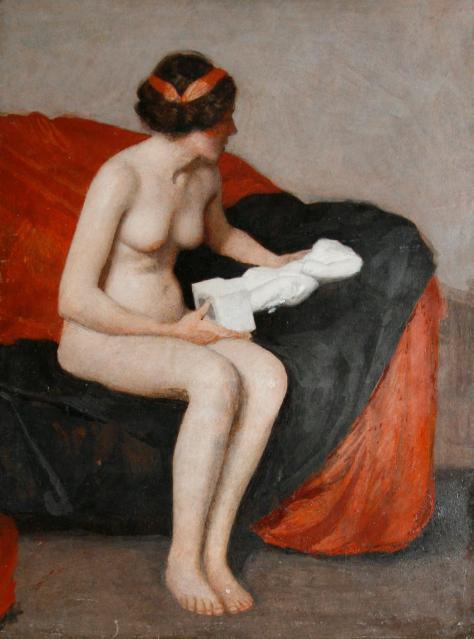
Oil on canvas.

R.J. Davey’s “Panthalassa” is only 99 cents over at Amazon. It’s a wonderful small collection of poetry that I cheerfully recommend.
You can find it here: “Panthalassa” at Amazon.com.

That sounds like a hand for a children’s card game.
I encountered all of these during just a six-minute walk outside my friend’s house yesterday. The jackrabbit, the deer and one of the baby groundhogs were all too fast for me to get a shot of.
The baby groundhogs were adorable – they’re just nervous little balls of brown fur. The trick is sneaking up behind them. (Watch your six, groundhogs.)


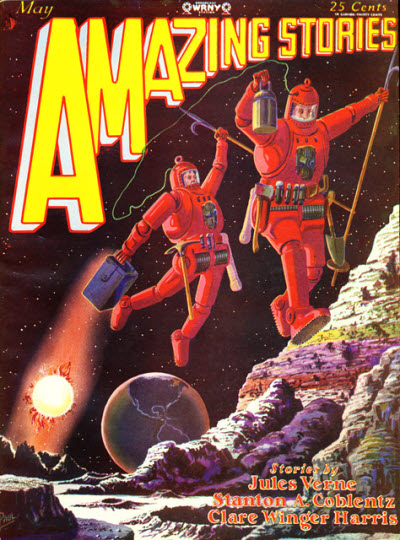
“The Woman with the Wolves, A Novelette of Mystery.” The illustrator’s surname is “Bracker(?)” His or her first name is illegible.

Let’s take this viral.
Just take a selfie hiding in the bushes.
And try to look reeeeeeeeaally pissed — as though your boss had the mind of a five-year-old, and it was your job to present his “positions” to the world on television.

You are really getting old if you can remember when MTV was cool. In the first half of the 1990’s, MTV had it all: weird, varying animated logos; Tabitha Soren; “MTV Unplugged,” which I still enjoy via Youtube today; “Liquid Television;” the sometimes priceless “Beavis and Butthead;” the always priceless “Aeon Flux;” and the bizarre promos featuring “Jimmy the Cab Driver.” (The date on the embedded video below is incorrect; Jimmy was annoying his fares in the 90’s — not the 80’s.)
This was the age when non-music-video programming more or less began for the channel. But it didn’t suck — it was actually quite good.
I think MTV’s greatness lasted until 1994 or 1995, around the time when my college career drew to a close. We didn’t have cable in our dorm rooms at Mary Washington College … except when we did. During my junior year, some intrepid, subversive genius had gotten into the vicinity of the Resident Director’s cable connection, and “split” it or something, in order to provide our entire floor with basic cable. He was an anonymous hero … like Batman, except probably a lot more chill, we figured. (He wasn’t the hero that Alvey Hall deserved, but he was the hero that Alvey Hall needed just then.)
God, did we all love it. Frederickburg, VA, was a small, quiet town, and we didn’t have the Internet, or even cell phones. We didn’t even have landlines in our room; we had two shared “hall phones” for local calls and a pay phone to call anywhere outside town. (And I guess college kids today might be unfamiliar with the concept of “local” and “long-distance” calls.)
Here’s what I can’t figure out in retrospect, after 24 years … I understand that cable can be “split;” New Yorkers do it all the time. But … wouldn’t Batman need to lay cable down throughout the length of our dorm? And wouldn’t he need to install cable jacks in each of our rooms? Did he do it on a Saturday night, when we were all drunk? How did he get in?
Maybe he came in the window. Godspeed, Batman.


“Turning and turning in the widening gyre,
Sean Spicer cannot find the teleprompter;
Things fall apart; the White House cannot hold;
Pure incompetence is loosed upon the world,
The bungling tide is loosed, and everywhere
The ceremony of sanity is drowned;
The best lack all conviction, while the amateurs
Are full of Trumpian intensity.”
— William Butler Jørgen (Jørgen Laursen)

Oil on canvas.