All posts by Eric Robert Nolan

Eric Robert Nolan graduated from Mary Washington College in 1994 with a Bachelor of Science in Psychology. He spent several years a news reporter and editorial writer for the Culpeper Star Exponent in Culpeper, Virginia. His work has also appeared on the front pages of numerous newspapers in Virginia, including The Free Lance – Star and The Daily Progress. Eric entered the field of philanthropy in 1996, as a grant writer for nonprofit healthcare organizations. Eric’s poetry has been featured by Dead Beats Literary Blog, Dagda Publishing, The International War Veterans’ Poetry Archive, and elsewhere. His poetry will also be published by Illumen Magazine in its Spring 2014 issue.

Throwback Thursday: “Star Trek,” the Original Series

I really missed the boat with last week’s Throwback Thursday — it was the 50th anniversary of the entire “Star Trek” franchise, with the first episode of the original series airing on September 8, 1966.  (And even the term “franchise” seems way too narrow to describe “Star Trek” in all of its incarnations — it’s really more like a permanent part of western popular culture.)  I’m not old enough to remember the show’s original run, which was a surprisingly scant three years.  But I remember it in syndication when I was not much more than a baby in the mid- to late 1970’s.

“Star Trek” was something that my older brother and maybe my father watched.  (I was fixated on programming that was more comprehensible for young kids, like “Land of the Lost” and reruns of “The Lone Ranger.”  Seriously, the original black-and-white serial western was still in reruns back then.)

But “Star Trek” was definitely something I was attracted to as a tot, doubtlessly resulting, in part, from the contagious ardor for it that I saw in my older brother.  (He might not admit it today, but he was a bit of a hard-core science fiction fan long before I was.)  The show was on at our tiny house in Woodhaven, Queens, quite a lot.  He also had toys and posters connected with it.  (And anything my older brother owned was something I endeavored to play with when he wasn’t looking.)

He had that Captain Kirk toy among the figures produced by Mego that you see in the bottom photo.  (Again, 1970’s “action figures” were often pretty much indistinguishable from dolls.)  In the early 1980’s, he had a totally sweet giant poster depicting diagrammed schematics for The Enterprise in surprising detail.  I’ve Google-searched for it, but found only similar pinups.  The one hanging in the room we shared was blue.

I remember him annoyedly correcting me because I called it “Star Track.”  (I did not yet know the word “trek.”  I myself was confused by my own mistake; I knew that there could be no “train tracks” in space, even if I studied the opening credits one time just to make sure.)

I was precisely the sort of pain-in-the-ass kid who fired off an incessant barrage of questions when I saw something on TV that I didn’t understand.  My father was patient to a fault when I punctuated his World War II movies with inane questions.  (I’m willing to bet I eventually acquired more knowledge of the war’s European theater than the average six-year-old.)  My brother was not always so forbearing.  I actually remember him changing the channel away from shows he was watching, like “Star Trek” or “MASH,” if I joined him at the little black-and-white television we had in our room.  (The poor guy needed me to lose interest and go away, so that he could at least hear the damn show.)

Certain “Star Trek” episodes remain memorable to this day, even if I understood maybe 15 percent of what transpired onscreen.  The was The One With The Domino-Face Men, which the Internet now tells me was actually titled “Let That Be Your Last Battlefield.”  Then there was The One Where Kids Ruled Themselves on a Deserted World, which made a really big impression on me.  (The Internet tells me this one was “Miri.”)

As I grew up, the show faded from prominence in my child’s psyche.  It was just never my fandom of choice.  Nor was it for many other kids I knew … by the 1980’s, it was already considered “an old TV show.”  The kids on my street were always excited about the feature films; even if we were underwhelmed by the “slow” first film in 1979.  Blockbuster movies were major events back then, and fewer, and they were enigmatic in a way that is impossible after the Internet’s arrival.  (I think that Millennials will never be able to understand that, in the same way that you and I can never appreciate the vintage “serials” that our parents watched before the main feature at a Saturday matinee.)

In the 1980’s, just about every boy I knew was preoccupied with the space-fantasy of “Star Wars.”  On television, we had cheesefests like the original “Battlestar Galactica” and “V.”  As we got older, we gravitated toward the “Alien” and “Predator” film franchises.  At home, I read Orson Scott Card and Harry Harrison, and as I approached college toward the end of the decade, I’d discovered Arthur C. Clarke.  If we’d known another kid who was really into “Star Trek,” I’m not sure we would have considered it “nerdy.”  It would just have been very weird, because it we viewed it as a campy tv show from maybe two decades prior, like “Bonanza” or something.  I don’t think I ever even thought of the franchise as really relevant or popular until I was at Mary Washington College in the 1990’s.  “Star Trek: the Next Generation” would regularly draw kids out of their dorm rooms into the lobby at New Hall.

Still, it’s hard not to develop an emotional attachment to something that stimulated your sense of wonder as a tot.  I … felt pretty damn sad when Captain Kirk died in 1994’s “Star Trek: Generations.”  I saw it in a theater in Manassas, Virginia, I think, with my girlfriend at the time.  She actually felt she had to console me after seeing how doleful I was on the drive home.


leonard_nimoy_william_shatner_spocks_brain_star_trek_1968

250fd1893dd8cc218f526b588ec00502

Check out Lade Saint’s interview over at Book Goodies!

My dear friend Lade Saint gave a terrific interview over at Book Goodies about “Window To The Soul: Light, Darkness and Paranormal Gifts.”  You can find the interview right here:

Interview with Author Lade Saint

And her book is available at Amazon right here:

“Window To The Soul: Light, Darkness and Paranormal Gifts

If you’re in the mood for some unnerving late-night reading, then check it out!


Vote … Neptune, I guess?

Donald Trump is basically the planet Jupiter — a bright orange, cold, gassy giant.


(I worked hard on this joke. Because science and stuff. Somebody please do better than the Hillary-is-Uranus rebuttal we’re all expecting.)


[UPDATE From author Jeremy Ghea: “Bernie is Pluto. Everybody loves Pluto and the ruling body tried to deny him.”  😀 ]  


You can’t spell “ennui” without “EN.”

This was placed on my Facebook wall, courtesy of a Mary Washington College Alumnus.  Why did he select ME for this?

I am occasionally surprised at the weird or dark material that people send me with messages like, “Only you would get this,” “Seems like your thing,” or, the grandest caveat of all, “I can’t put this on my wall — maybe you can put it on yours.”

I’m just not sure what that says about how I am perceived by others.


“Ironic points of light/ Flash out wherever the Just/ Exchange their messages.”

There is no such thing as the State
And no one exists alone;
Hunger allows no choice
To the citizen or the police;
We must love one another or die.

Defenceless under the night
Our world in stupor lies;
Yet, dotted everywhere,
Ironic points of light
Flash out wherever the Just
Exchange their messages:
May I, composed like them
Of Eros and of dust,
Beleaguered by the same
Negation and despair,
Show an affirming flame.

— excerpt from W.H. Auden’s “September 1, 1939”


“The Binch,” by Rob Suggs

“The Binch,” by Rob Suggs

Every U down in Uville liked the U.S. a lot,
But the Binch, who lived Far East of Uville, did not.
The Binch hated U.S! The whole U.S. way!
Now don’t ask me why, for nobody can say,
It could be his turban was screwed on too tight.
Or the sun from the desert had beaten too bright
But I think that the most likely reason of all
May have been that his heart was two sizes too small.

But, Whatever the reason, his heart or his turban,
He stood facing Uville, the part that was urban.
“They’re doing their business,” he snarled from his perch.
“They’re raising their families! They’re going to church!
They’re leading the world, and their empire is thriving,
I MUST keep the S’s and U’s from surviving!”
Tomorrow, he knew, all the U’s and the S’s,
Would put on their pants and their shirts and their dresses,
They’d go to their offices, playgrounds and schools,
And abide by their U and S values and rules.

And then they’d do something he liked least of all,
Every U down in Uville, the tall and the small,
Would stand all united, each U and each S,
And they’d sing Uville’s anthem, “God bless us! God bless!”
All around their Twin Towers of Uville, they’d stand,
and their voices would drown every sound in the land.

“I must stop that singing,” Binch said with a smirk,
And he had an idea–an idea that might work!
The Binch stole some U airplanes in U morning hours,
And crashed them right into the Uville Twin Towers.
“They’ll wake to disaster!” he snickered, so sour,
“And how can they sing when they can’t find a tower?”

The Binch cocked his ear as they woke from their sleeping,
All set to enjoy their U-wailing and weeping,
Instead he heard something that started quite low,
And it built up quite slow, but it started to grow —
And the Binch heard the most unpredictable thing . . .
And he couldn’t believe it–they started to sing!

He stared down at U-ville, not trusting his eyes,
What he saw was a shocking, disgusting surprise!
Every U down in U-ville, the tall and the small,
Was singing! Without any towers at all!

He HADN’T stopped U-Ville from singing! It sung!
For down deep in the hearts of the old and the young,
Those Twin Towers were standing, called Hope and called Pride,
And you can’t smash the towers we hold deep inside.

So we circle the sites where our heroes did fall,
With a hand in each hand of the tall and the small,
And we mourn for our losses while knowing we’ll cope,
For we still have inside that U-Pride and U-Hope.

For America means a bit more than tall towers,
It means more than wealth or political powers,
It’s more than our enemies ever could guess,
So may God bless America! Bless us! God bless!


Image result for september 11 never forget

“Things You Don’t Write About 9/11/2001” by Stanley Anne Zane Latham

Christina's Words's avatarWords ... for the Time Being

It was an ordinary train ride
You, me, Leita, and Dan
We didn’t mean to get separated.

We didn’t mean anything
in those days. We were
in college. It seemed

like we were rebels. Our parents
ate cabbage; our parents. Gosh,
we thought, what happened to them?

We simply got on a train. We didn’t
tell them. We were skipping school,
old enough to be our own.

I have to tell them, you loved me.
Dan loved Leita. I loved you.
We all kind of loved.

It was supposed to be
a simple day in New York.
It was supposed to be

A simple day in New York.

You don’t want me to bring
our life after this back
to this. Moment. There

is nothing like an almost.
In the aftermath, when the train
stopped, when no one was

ever the same again; i mean
the conductor said – Do…

View original post 124 more words

The Pentagon on September 11, 2001 (photo)

Photo credit: By U.S. Navy Photo by Photographer’s Mate 2nd Class Lisa Borges – [1], Public Domain, https://commons.wikimedia.org/w/index.php?curid=4012891

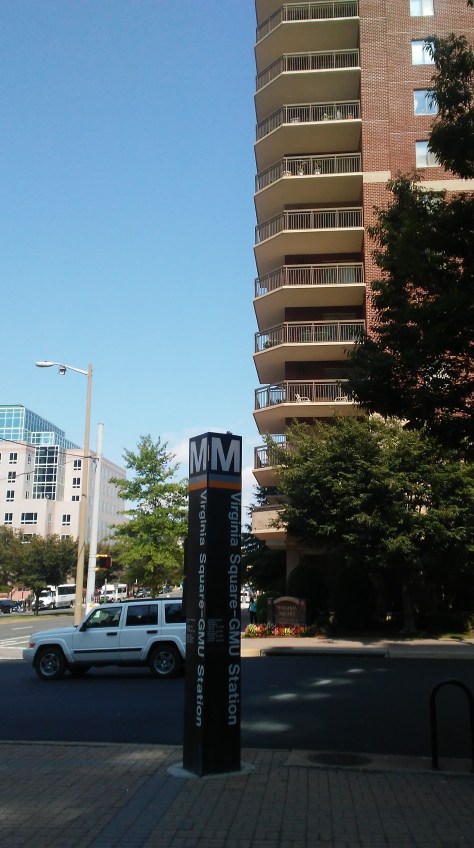
Ballston, Virginia, September 2016

This is the major professional and commercial area of Ballston, an affluent section of Arlington, Virginia.  These were taken near the Virginia Square Metro Station; just north of George Mason University.  (Do college students eat frequently at these upscale cages and gourmet delis?  When I was going to school in Fredericksburg, we splurged when we went to Olive Garden after a formal.)

Also just a few blocks away is the Defense Advanced Research Projects Agency (DARPA).


20160907_151019_burst01

20160907_145704

20160907_145650

20160907_151252_burst01


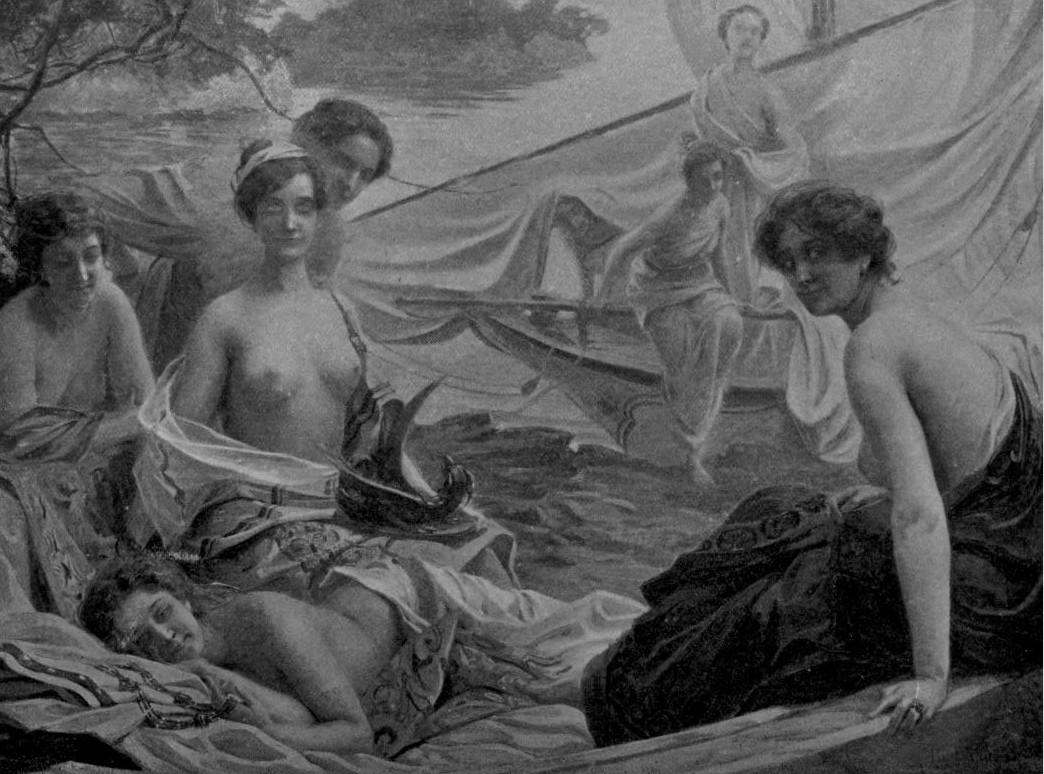
Paul Emile Chabas’ “La Marchande de Reves,” 1897

“The Dream Seller.”