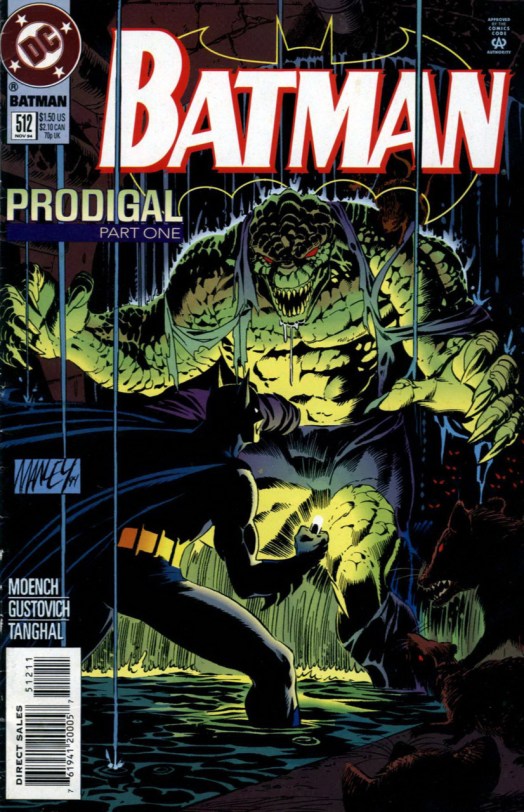
Cover to “Green Lantern: Emerald Dawn” #1, Mark Bright and Klaus Janson, 1989

DC Comics.

5b1f236341649_copyOfFirstPage

“In brightest day, in blackest night …”

… no evil shall escape my sight!

Let those who worship evil’s might

beware my power–Green Lantern’s light!”

Pictured is one flippin’ AWESOME 40th birthday present!!  (And thank you again to the amazing pal who got it for me.)  To quote Guy Gardner, “I could kick ol’ Goldface’s butt with this!”  (C’mon … you all know I am Hal Jordan guy and not a … Guy guy.”  Even if that Ice was always a lot cuter than Carol Ferris.)

46th.  It was my 46th birthday.  No matter how many times I type that, I’ll never get used to it.


20180914_112736b


20180914_120450

Poster for “Shane” (1953)

Paramount Pictures.

Shane

Throwback Thursday: WOR-TV Channel 9’s “Million Dollar Movie” intro!

This will probably be a pretty obscure Throwback Thursday post, but the segment below should be recognized by people who grew up in the New York metropolitan area in the late 1970’s and early 1980’s.  It’s none other than the intro for WOR-TV Channel 9’s “Million Dollar Movie.”  (That music you hear is a particularly brassy rendition of Max Steiner’s “Tara’s Theme” from 1939’s “Gone With the Wind.”)

If you were in the New York area at that time, it ought to bring back memories of the old days of broadcast television.  (It’s actually surprising how much nostalgia people online report at seeing this 44-second clip.  And it’s amazing what you can find on the Internet.)  A few commenters note sardonically that the clip makes Manhattan look like a nighttime paradise — while The Big Apple in the 1970’s was not always an easy place to be.  (The city if far cleaner and safer today.)

Some of the comments I read were befuddling.  There is one blogger who wrote that he remembers this intro from as far back as the 1950’s.  (Had they really used it for more than two decades?)  And a populous minority of commenters remember being unsettled by the clip.  (They describe it as ominous, and the music as creepy, which mystifies the rest of us who remember “Million Dollar Movie.”)

This intro had an indelible effect on me.  While it recalls monster movies like “King Kong” (1939) and “Godzilla” (1954) for a lot of others, it will always remind me of my father watching war films and cowboy movies on his days off — along with the occasional Charles Bronson flick.   “The Great Escape” (1963), “A Bridge Too Far” (1977) and “Shane” (1953) all spring to mind.

When I was in the first or second grade, I habitually enhanced my Dad’s enjoyment of the “Million Dollar Movie” by peppering him endlessly with questions about whatever was playing — even if I had only wandered into the room for a few minutes.  “Why did they call it ‘a bridge too far?'” “Why did they fight World War II?” “The British and French were good guys in the war, right?” “Why did the cowboy drop his gun on purpose?”  “Why did the guy fake his death?”  (Bear in mind, folks, this was broadcast television — long before the days of Netflix and DVD’s.)

If any kid did that to me when I was watching my favorite movies, I’d go nuts — even if I had a pause button.  My father was a saint.


Illustration from “Die Sichtbare Welt,” Johann Amos Comenius, 1658

(“The Visible World.”)  Woodcut.


OrbisPictus_b_232 (1)

“A Rose for Emily,” by William Faulkner

I.

When Miss Emily Grierson died, our whole town went to her funeral: the men through a sort of respectful affection for a fallen monument, the women mostly out of curiosity to see the inside of her house, which no one save an old man-servant–a combined gardener and cook–had seen in at least ten years.

It was a big, squarish frame house that had once been white, decorated with cupolas and spires and scrolled balconies in the heavily lightsome style of the seventies, set on what had once been our most select street. But garages and cotton gins had encroached and obliterated even the august names of that neighborhood; only Miss Emily’s house was left, lifting its stubborn and coquettish decay above the cotton wagons and the gasoline pumps-an eyesore among eyesores. And now Miss Emily had gone to join the representatives of those august names where they lay in the cedar-bemused cemetery among the ranked and anonymous graves of Union and Confederate soldiers who fell at the battle of Jefferson.

Alive, Miss Emily had been a tradition, a duty, and a care; a sort of hereditary obligation upon the town, dating from that day in 1894 when Colonel Sartoris, the mayor–he who fathered the edict that no Negro woman should appear on the streets without an apron-remitted her taxes, the dispensation dating from the death of her father on into perpetuity. Not that Miss Emily would have accepted charity. Colonel Sartoris invented an involved tale to the effect that Miss Emily’s father had loaned money to the town, which the town, as a matter of business, preferred this way of repaying. Only a man of Colonel Sartoris’ generation and thought could have invented it, and only a woman could have believed it.

When the next generation, with its more modern ideas, became mayors and aldermen, this arrangement created some little dissatisfaction. On the first of the year they mailed her a tax notice. February came, and there was no reply. They wrote her a formal letter, asking her to call at the sheriff’s office at her convenience. A week later the mayor wrote her himself, offering to call or to send his car for her, and received in reply a note on paper of an archaic shape, in a thin, flowing calligraphy in faded ink, to the effect that she no longer went out at all. The tax notice was also enclosed, without comment.

They called a special meeting of the Board of Aldermen. A deputation waited upon her, knocked at the door through which no visitor had passed since she ceased giving china-painting lessons eight or ten years earlier. They were admitted by the old Negro into a dim hall from which a stairway mounted into still more shadow. It smelled of dust and disuse–a close, dank smell. The Negro led them into the parlor. It was furnished in heavy, leather-covered furniture. When the Negro opened the blinds of one window, they could see that the leather was cracked; and when they sat down, a faint dust rose sluggishly about their thighs, spinning with slow motes in the single sun-ray. On a tarnished gilt easel before the fireplace stood a crayon portrait of Miss Emily’s father.

They rose when she entered–a small, fat woman in black, with a thin gold chain descending to her waist and vanishing into her belt, leaning on an ebony cane with a tarnished gold head. Her skeleton was small and spare; perhaps that was why what would have been merely plumpness in another was obesity in her. She looked bloated, like a body long submerged in motionless water, and of that pallid hue. Her eyes, lost in the fatty ridges of her face, looked like two small pieces of coal pressed into a lump of dough as they moved from one face to another while the visitors stated their errand.

She did not ask them to sit. She just stood in the door and listened quietly until the spokesman came to a stumbling halt. Then they could hear the invisible watch ticking at the end of the gold chain.

Her voice was dry and cold. “I have no taxes in Jefferson. Colonel Sartoris explained it to me. Perhaps one of you can gain access to the city records and satisfy yourselves.”

“But we have. We are the city authorities, Miss Emily. Didn’t you get a notice from the sheriff, signed by him?”

“I received a paper, yes,” Miss Emily said. “Perhaps he considers himself the sheriff . . . I have no taxes in Jefferson.”

“But there is nothing on the books to show that, you see We must go by the–”

“See Colonel Sartoris. I have no taxes in Jefferson.”

“But, Miss Emily–”

“See Colonel Sartoris.” (Colonel Sartoris had been dead almost ten years.) “I have no taxes in Jefferson. Tobe!” The Negro appeared. “Show these gentlemen out.”


Continue reading “A Rose for Emily,” by William Faulkner

Cover to “9-11: The World’s Finest Comic Book Writers and Artists Tell Stories to Remember,” Alex Ross, 2002

DC Comics.

9-11_2

Never forget.

Between the towers of the World Trade Center as a cloud passes between them.  November 1998.


World_Trade_Center_fog

By Flickr user Beija (https://www.flickr.com/photos/beija/243997357) [CC BY-SA 2.0 (https://creativecommons.org/licenses/by-sa/2.0)%5D, via Wikimedia Commons

“Human Contentments,” Edgard Farasijn, circa 1938

Edgard_Farasijn_Human_contentments

Perhaps predictably, Obama has them apoplectic.

“Barack Obama your an Ass clown. Sit down and shut up!! You [expletive] traitor!!!” — seen on a Trump supporter’s wall.

I have four thoughts:

1) He may be an ass clown, but I’ll bet he knows the difference between “your” and “you’re.”

2) You can tell he’s a traitor because he uses full sentences. THAT’S THE CODE THAT THE LIBERAL INTELLECTUALS USE.

3) Snowflake.

4) Wouldn’t it be amazing if he could run against Trump in 2020 and defeat him?  (Yes, I realize the Constitution prohibits it.)  Imagine the mileage we could get out of the inevitable “Black is the new orange” joke.


Nurse Your Favorite Heresies in Whispers