A young man, named Giovanni Guasconti, came, very long ago, from the more southern region of Italy, to pursue his studies at the University of Padua. Giovanni, who had but a scanty supply of gold ducats in his pocket, took lodgings in a high and gloomy chamber of an old edifice, which looked not unworthy to have been the palace of a Paduan noble, and which, in fact, exhibited over its entrance the armorial bearings of a family long since extinct. The young stranger, who was not unstudied in the great poem of his country, recollected that one of the ancestors of this family, and perhaps an occupant of this very mansion, had been pictured by Dante as a partaker of the immortal agonies of his Inferno. These reminiscences and associations, together with the tendency to heart-break natural to a young man for the first time out of his native sphere, caused Giovanni to sigh heavily, as he looked around the desolate and ill-furnished apartment.
“Holy Virgin, signor,” cried old dame Lisabetta, who, won by the youth’s remarkable beauty of person, was kindly endeavoring to give the chamber a habitable air, “what a sigh was that to come out of a young man’s heart! Do you find this old mansion gloomy? For the love of heaven, then, put your head out of the window, and you will see as bright sunshine as you have left in Naples.”
Guasconti mechanically did as the old woman advised, but could not quite agree with her that the Lombard sunshine was as cheerful as that of southern Italy. Such as it was, however, it fell upon a garden beneath the window, and expended its fostering influences on a variety of plants, which seemed to have been cultivated with exceeding care.
“Does this garden belong to the house?” asked Giovanni.
“Heaven forbid, signor! — unless it were fruitful of better pot-herbs than any that grow there now,” answered old Lisabetta. “No; that garden is cultivated by the own hands of Signor Giacomo Rappaccini, the famous Doctor, who, I warrant him, has been heard of as far as Naples. It is said he distils these plants into medicines that are as potent as a charm. Oftentimes you may see the Signor Doctor at work, and perchance the Signora his daughter, too, gathering the strange flowers that grow in the garden.”
The old woman had now done what she could for the aspect of the chamber, and, commending the young man to the protection of the saints, took her departure.
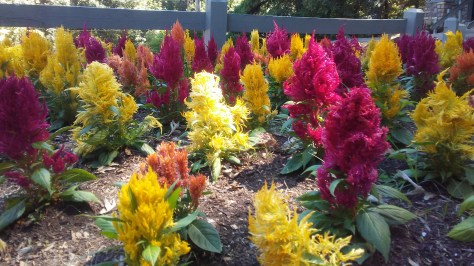
Giovanni still found no better occupation than to look down into the garden beneath his window. From its appearance, he judged it to be one of those botanic gardens, which were of earlier date in Padua than elsewhere in Italy, or in the world. Or, not improbably, it might once have been the pleasure-place of an opulent family; for there was the ruin of a marble fountain in the centre, sculptured with rare art, but so wofully shattered that it was impossible to trace the original design from the chaos of remaining fragments. The water, however, continued to gush and sparkle into the sunbeams as cheerfully as ever. A little gurgling sound ascended to the young man’s window, and made him feel as if a fountain were an immortal spirit, that sung its song unceasingly, and without heeding the vicissitudes around it; while one century embodied it in marble, and another scattered the perishable garniture on the soil. All about the pool into which the water subsided, grew various plants, that seemed to require a plentiful supply of moisture for the nourishment of gigantic leaves, and, in some instances, flowers gorgeously magnificent. There was one shrub in particular, set in a marble vase in the midst of the pool, that bore a profusion of purple blossoms, each of which had the lustre and richness of a gem; and the whole together made a show so resplendent that it seemed enough to illuminate the garden, even had there been no sunshine. Every portion of the soil was peopled with plants and herbs, which, if less beautiful, still bore tokens of assiduous care; as if all had their individual virtues, known to the scientific mind that fostered them. Some were placed in urns, rich with old carving, and others in common garden-pots; some crept serpent-like along the ground, or climbed on high, using whatever means of ascent was offered them. One plant had wreathed itself round a statue of Vertumnus, which was thus quite veiled and shrouded in a drapery of hanging foliage, so happily arranged that it might have served a sculptor for a study.
Continue reading “Rappaccini’s Daughter,” By Nathaniel Hawthorne →