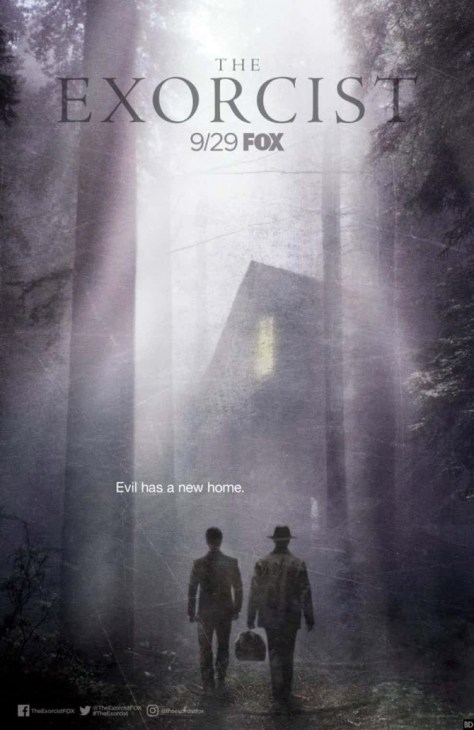
A show like “The Exorcist” must be difficult to write. It stands in the shadow of some of horror’s greatest films (William Friedkin’s 1973 original and the third movie in 1990). Its plot device is inevitably redundant. (How many possessed innocents can we see strapped to beds while priests pray at them?) It seems easy to stray into camp. And it seems like a story concept that is tough to structure into a serialized format.
But the second season of “The Exorcist” was … fantastic. It surpassed the first season, and I’d rate it a 9 out of 10.
The ten-episode arc wisely changes things up a bit from Season 1, which was maybe a bit too reminiscent of the films. Our priestly dynamic duo are on the road in America’s northwest, and on the run from a Vatican that has been infiltrated by followers of the demon Pazuzu. (As stupid as all of that sounds, the show actually depicts it quite well.) As the story proceeds, there are a couple of surprise plot developments that will contradict most viewers’ expectations. (I won’t spoil them here.)
The characters are all likable and all well played. Ben Daniels remains possibly the show’s strongest asset as the senior priest; he’s just a superb actor. John Cho also gives a fine performance as the head of a foster home where a demon runs amok. Alfonso Herrera is quite good as the apprentice priest — his character is better written this time around, and isn’t saccharine to the point of annoyance. And Herrera himself seems more comfortable in the role. The kids are damned cool — all of them, and their interaction with their foster father was surprisingly sweet and funny — which raises the stakes emotionally when the entire household is besieged by a sadistic force.
The weaknesses here were minor. I think the ten episodes could have been shortened to seven or eight, to make them tighter. (I realize I write that about a lot of shows, and I’m not sure why.) The first five episodes were tightly plotted, while the second five were a little loose. I think better editing would have entirely excised the flashback scenes depicting Daniels’ character and this season’s new female exorcist, played by Zuleikha Robinson. (Yes, that is indeed Yves Adele Harlow from “The Lone Gunmen” and “The X-Files.”)
The flashbacks were cheesy, even if they gave Daniels a chance to show his range. They depict his tutelage of Robinson’s character decades prior, complete with some cliche pulp novel stuff. (Ugh.) We’re shown that the priest is younger because of his blond, surfer-esque haircut. (Really?) The flashbacks were out of place, and a little too campy. They reminded me of the comic book style of the “Highlander” films and TV series — this show could have done without them.
I also found myself slightly annoyed by a dearth of exposition about the process of exorcism itself. After the films and now two seasons of the show, I wanted to know more about the key actions here that affect the story’s resolution. Do some prayers or methods work better than others? Then why not use them all the time? Why are some interventions more lengthy or difficult? We are told that the demon attacking this family is different than Pazuzu, who we’ve seen in the past (though Pazuzu still puts in an appearance this season). Can the demons coordinate their efforts, or at least communicate with each other? If not, why not? These seem like logical questions to ask, both for the characters and the viewers.
But there is something more that bothered me. If a demon is intelligent and wants to harm people, then why make its presence known — and why torment or kill only a few people? Why not remain undetected until it can commit a mass murder? Or even perpetrate an act of terrorism, and harm far greater numbers of people by causing riots or wars? That would suit evil’s purposes far more than the garish individual spectacles we find them performing in horror tales like these. (Maybe I’m just analyzing too much.)
Anyway, I cheerfully recommend “The Exorcist.” It might be the most grownup horror show on television.
And one more thing — there’s some fun to be had here recognizing actors from other roles. Daniels was a member of the Rebel Alliance in “Rogue One: A Star Wars Story” (2016). And there is actually another “The X-Files” alum here — even if it was only a small role. I thought that Harper’s mother looked familiar — the actress playing her was Rochelle Greenwood. She’s none other than the teenage waitress who witnessed Walter Skinner getting shot waaaaay back in 1996’s classic episode, “Piper Maru.” (Can I remember faces or what?)