I just cannot be partial to slasher films. It’s never been my preferred horror sub-genre to start with, and, at this point in my life, these movies have become so predictable and devoid of story that I often find them boring. There are exceptions — some of the the original “A Nightmare on Elm Street” films (1984- 2003) and “Child’s Play” (1988) were grotesquely creative and had terrific supernatural setups that were well executed. But even the attraction of John Carpenter’s original “Halloween” films (1978, 1981) is still mostly lost on me.
With all of that said, I’ll still say that my horror fan friends were right when they told me that 2018’s “Halloween” was a superior sequel. It looks a lot better than the segments I’ve seen of of the campier followups in the 1980’s and 1990’s.
It’s far better filmed and directed, it’s occasionally scary and it benefits from a very good cast. (Jamie Lee Curtis is of course quite good as the film’s heroine and perennial “final girl.” I’m also always happy to see Will Patton on screen, and I like Judy Greer a lot.) The script occasionally shines unexpectedly, too — the screenwriters have a truly impressive talent for making minor characters vivid with funny throwaway dialogue. (One of the three screenwriters is actor-writer-comedian Danny McBride, who I liked quite a bit in 2017’s “Alien: Covenant.”)
I’d be lying, however, if I told you that I wasn’t occasionally bored by this latest “Halloween” — simply because its basic, boilerplate plot and conclusion seem endlessly redundant with those of other slasher films. There are few surprises toward the end — one “gotcha” moment was especially nice — but the overall story is just too tired. I’d rate this film a 7 out of 10 for its merits, but I can’t actually get excited enough about it to recommend it.
Legit question for rural Australians — how do I kill the 30 to 50 feral hogs that run into my yard within 3 to 5 mins while my small kids play?
If you’re anything like me, you’re endlessly regaled by all the viral jokes this past week referencing “30 to 50 feral hogs.” (And if you’re nothing like me, then you’re an intelligent adult and I congratulate you. But you can google the new trope, which I have paraphrased above, if you want to. It is the very height of preposterous predatory animal political humor.)
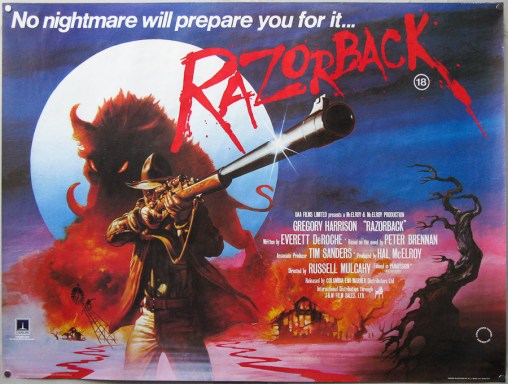
The jokes made me remember this little disappointment from the 1980’s — the Aussies’ own feral hog horror movie, 1984’s somewhat lethargic “Razorback.” If memory serves, I rented this sometime around 1986, I suppose. I got it on VHS from my nearest shopping center’s sole mom-and-pop video store, before Blockbuster Video’s invasion reached my area.
There are people out there who fondly remember “Razorback.” You can find some nice compliments about it over at Rotten Tomatoes. People enjoy its “atmosphere.” People like Gregory Harrison a lot.
I didn’t like it. Sure, it had a pretty neat electronic score that seemed trippy and cool to me as a young high school student. But that was its only redeeming quality. It started off with its depressing plot setup, which you can see in the first video below — the titular wild boar absconds with a baby boy. (The boar also thoughtfully burns the child’s house down as it departs, to underscore that fact that it is an asshole.)
The rest of the movie is boring, because it’s yet another one of those monster movies where you never get to see much of the monster — right up until the movie’s poorly lit climax, which takes place in a slaughterhouse, I think? Which is supposed to be ironic or something? Don’t quote me on this stuff; 1986 was a long time ago. For comparison, think of the legion zombie “thrillers” always available on Netflix where the zombies are always outside, and the movie just follows the indoors arguments among three very-much-alive people inside a windowless warehouse. I want to invoke the inevitable “wild bore movie” pun, but I’m holding back, because my friends tell me that they have enough of that sort of thing.
I used my own money to rent “Razorback,” probably earned from either my confusing stint at McDonald’s (they just didn’t get me there) or my summer job cleaning boats and lobster traps. (I lived on an island, people.) I remember being slightly disgruntled that I’d wasted my hard-earned cash.
Honestly, though, I was a credulous kid when it came to a movie’s marketing. When I read the back of the VHS boxes, I took things at face value. I also had my heart set on something called “The Alien’s Deadly Spawn” (1983), which I realize now was just a no-budget early mockbuster ripping off Ridley Scott’s “Alien” (1979). (It was always out. I finally caught snatches of it on Youtube this past spring, and it looks pretty unwatchable.)
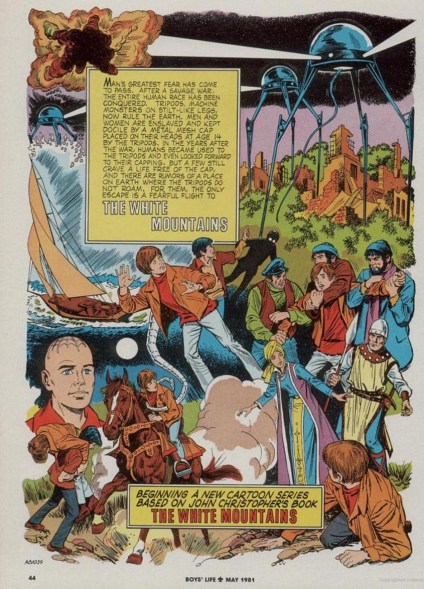
I had a subscription to Boys’ Life magazine for a couple of years when I was a Cub Scout in the early 1980’s. My parents canceled it after a year or two, and I can’t blame them — I just wasn’t reading it. Boys’ Life was the official magazine of the Boy Scouts of America, and it was pretty wholesome stuff … it just didn’t offer the excitement of my comic books or the occasional copy of Fangoria that I manged to get my hands on.
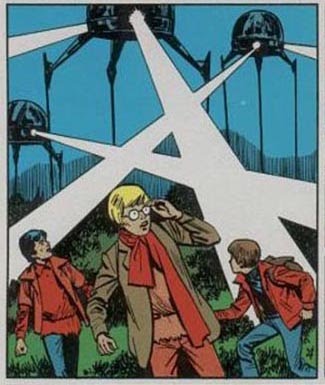
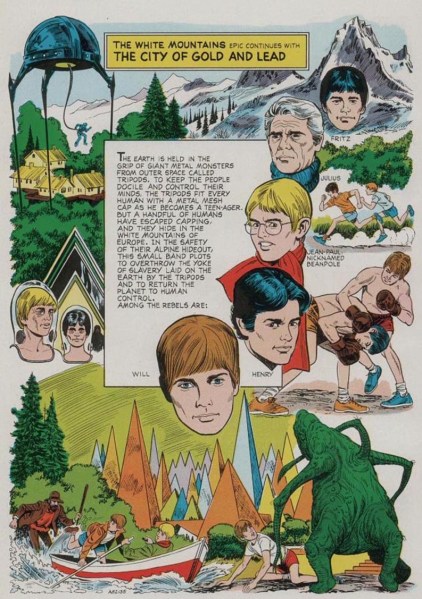
But there was one feature of Boys’ Life that I followed religiously — the serialized comic strip adaptation of John Christopher’s The Tripods book trilogy. (Christopher published the first three of his books in the late 1960’s; he added a prequel novel in 1988, but that was long after the Boy Scouts and Boys’ Life was behind me.)
The Tripods was cool, dark dystopian stuff. The story opened with the first book, The White Mountains, to find humanity settled into an agrarian, pre-industrial age in which their overlords were the titular “tripods” — massive three-legged vehicles piloted by unknown beings. Humans were ritualistically “capped” with a brain-altering device when they reached age 14 — thereafter becoming docile and conformist and easier for the mysterious machines to subjugate.
The White Mountains followed a trio of 13-year-old boys who escaped the “capping” to seek out a human resistance movement; the second book, The City of Gold and Lead, shows two of these protagonists infiltrate the city of the tripods’ operators. (Spoiler — they’re grotesque aliens.) The third book, The Pool of Fire, presumably picks up from there, but my Boys’ Life subscription ran out before the magazine got to that.
I recently, however, used this Interwebs thingamajig to discover what looks like a real gem of a find — a 1984 BBC mini-series adaptation of the books. I started the first episode and it looks quite good. If I get around to watching the whole thing, I’ll review it here.
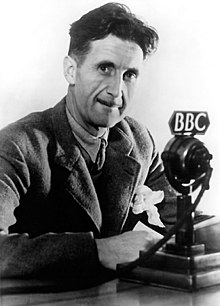
“The past was alterable. The past never had been altered.
“Oceania was at war with Eastasia. Oceania had always been at war with Eastasia. A large part of the political literature of five years was now completely obsolete. Reports and records of all kinds, newspapers, books, pamphlets, films, sound-tracks, photographs — all had to be rectified at lightning speed. Although no directive was ever issued, it was known that the chiefs of the Department intended that within one week no reference to the war with Eurasia, or the alliance with Eastasia, should remain in existence anywhere. ”
This is one of only a handful of TV shows that I can remember watching as a tot in the late 1970’s. “Laverne and Shirley” (1976-1983) was the kind of of thing I’d see in my older sisters’ room. My Dad and older brother watched war movies, westerns and monster movies, but my two sisters preferred considerably lighter fare. Two that they watched a lot at the time, if I recall, were this show and “Donnie & Marie” (1976-1979) — about the scariest thing you could find playing on their black-and-white TV was “The Hardy Boys/Nancy Drew Mysteries” (1977-1979). (One of my sisters had a crush on actor Shaun Cassidy; I think there was a poster of him in their room.)
I loved “Laverne and Shirley” when I was that young. Lenny and Squiggy were my favorite highlight of any episode, even if I was sometimes confused about whether they were meant to be “good guys” or “bad guys.” I was in kindergarten, and not altogether bright, and I thought that men who wore black leather jackets (Fonzie notwithstanding) were usually “bad guys.” I also remember thinking that hippies and motorcyclists were the same group of “bad guys” because they disobeyed God or something … my confusion at the time resulted from some vaguely moraled born-again Christian comic books I’d happened across somewhere.
I also remember recognizing “Laverne and Shirley” as being related to another show that a lot of kids back then loved — “Happy Days” (1974-1984), of which it was a spin-off. This might have been the first time in my life that I was aware of two live-action television properties occupying the same fictional universe; I’d already seen it happen in the movies with the various incarnations of “King Kong” and “Godzilla.”
Here’s what makes me feel old — for both “Laverne and Shirley” and “Happy Days,” I probably watched a lot of the episodes when they were first broadcast, and not just in re-runs (although “Happy Days” was also played in syndication endlessly throughout the 1980’s — it remained a fixture of daytime television).
And I only just realized writing this that Lenny was played by the priceless Michael McKean. As an adult, I know him primarily from his brilliant turns in “This Is Spinal Tap” (1984) and “The X-Files” (1998-2018). He’s 71 now. Wow.