Tag Archives: 1986

Poster for “Reform School Girls,” 1986

New World Pictures.

MV5BOTY4YTM0NDQtMTQyMy00Yzk5LTgwZWQtM2FkNDIyZmI0MDEwL2ltYWdlL2ltYWdlXkEyXkFqcGdeQXVyNzc5MjA3OA@@._V1_SY1000_CR0,0,658,1000_AL_

Throwback Thursday: NBC’s “Knight Rider” (1982 – 1986)

NBC’s “Knight Rider” might be the granddaddy of all 1980’s high-tech super-vehicle shows — if I had to guess which one was the most popular or most fondly remembered, this would be it.  (I suppose the other leading contender would be “Airwolf,” which we talked about a couple of months ago — but that was aimed at an older audience.)

“Knight Rider” was cheesy.  But most 80’s action shows were cheesy, and I still remember it as being decent enough.  Lord knows I and Mikey Wagner, the kid on the next block, were fascinated by it.

As anyone who remembers this show can attest, there is a key character that isn’t even hinted at in the intro below.  The car was sentient.  His name was K.I.T.T. (Knight Industries Two Thousand), and he was an artificial intelligence who actually who had a hell of a lot of personality.  K.I.T.T. was a super-intelligent, talking, futuristic, sleek, black sportscar, and he was an incongruous damned hero to us kids.

The other star was Davis Hasselhoff as Michael Knight.  We looked up to him too.  Hasselhoff, of course, is now better known for his subsequent starring role as a moronic lifeguard on the categorically awful “Baywatch” (1989 – 2001).  I remember seeing snippets of “Baywatch” in the 1990’s — it was constantly playing in the newsroom at my first job as a cub reporter.  (The guys there loved it.)  I remember being disappointed that one of my childhood heroes had somehow morphed into a male bimbo on the most saccharine and brainless TV show I had ever seen.  Hey, “Knight Rider” was a show for kids … but it was goddam “Masterpiece Theater” when compared with “Baywatch.”

Weird trivia — the voice actor for K.I.T.T. was none other than William Daniels, who also gave a stellar performance as John Adams in 1972’s film adaptation of Broadway’s “1776.”  It’s so weird seeing that movie and hearing the voice of K.I.T.T. come out of Adams’ mouth.


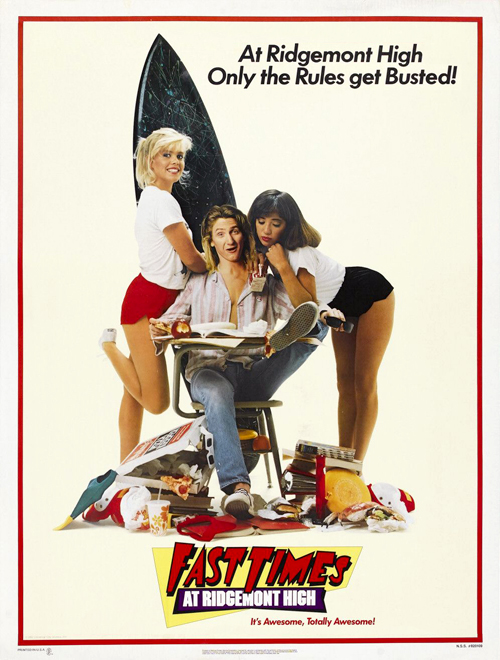
“Fast Times at Ridgemont High” (1982) is actually slow and will leave you feeling low.

“Fast Times at Ridgemont High” (1982) is a pop-culture sacred cow that needs to be skewered.  I’d rate it a 2 out of 10 for being a surprisingly inept and poorly scripted 1980’s “classic.”

I just don’t understand the fervent popular reverence for this movie among people in my age bracket.  It was a minor legend when I was growing up.  I was a fourth grader in 1982, and gradeschool boys could be divided into two groups: 1) those who had seen the “Phoebe Cates pool scene” and 2) those who had not, but wished they had.  When I mentioned on social media a couple of months ago this year that I’d never actually gotten around to seeing this movie, my friends were roundly astonished.

Why do they think this film is indispensable viewing?  Maybe there’s something I’m missing.  I’m tempted to group “Fast Times at Ridgemont High” together with other beloved 80’s films that just don’t resonate with me — like the understandably campy “Tron” (1982) or the unexpectedly sleep-inducing “The Big Chill” (1983).  (I couldn’t even finish the latter.)  But I can’t compare, because I know those movies are objectively good in a lot of ways, even if they weren’t to my taste.

Nor am I squeamish about raunchy sex comedies.  (C’mon.)  I pretty fondly remember “Porky’s” (1981), “Porky’s II: The Next Day” (1983), and “Revenge of the Nerds” (1984).  I mentioned “Porky’s” to the friend with whom I watched “Fast Times” — I told her that it wasn’t highbrow entertainment, but I still remember it being crudely, blasphemously funny.

This movie was just a thinly scripted small collection of vignettes, with no overall plot outside of teenagers having sexual encounters that are … awkward and bluntly sad, for the most part.  (Sean Penn’s character does drugs.)  The dialogue is terrible.  None of the characters are likable — even the story’s nerdy, well-meaning protagonist is grating.

I didn’t really laugh once at anything the director intended — I only laughed at the haircuts and the clothes.  I just can’t believe that the screenwriter here was Cameron Crowe, who also wrote what is possibly my favorite movie of all time — the widely but unfairly maligned “Vanilla Sky” (2001).  (Crowe apparently adapted the screenplay from a novel he wrote.)

There is some enjoyment to be had in watching Penn’s stoner character.  It was fun seeing a well known serious actor in an early comedic role.  Penn is a decent character actor, and it looks like he was having fun.  I do get why kids in the 80’s found him funny.

It’s also fun seeing the handful of other young actors who would go on to great careers (Judge Reinhold is always funny) but, again, this is something that the filmmakers can’t take credit for.

Hey, if you want a slice-of-life dramatic comedy about teenagers in the 1980’s, then go rent “The Breakfast Club” (1985).  It wasn’t perfect, but it was damn good movie that tackled many of the same issues as this movie, but with intelligence and effective humor.  Or, try the oddball “Ferris Bueller’s Day Off” (1986).  Both movies portray teenagers in the 80’s who are smart, likable and emphathetic, in varying degrees.  I myself went to high school in the 1980’s, and I assure you they were around.


fast-times-at-ridgemont-high-poster

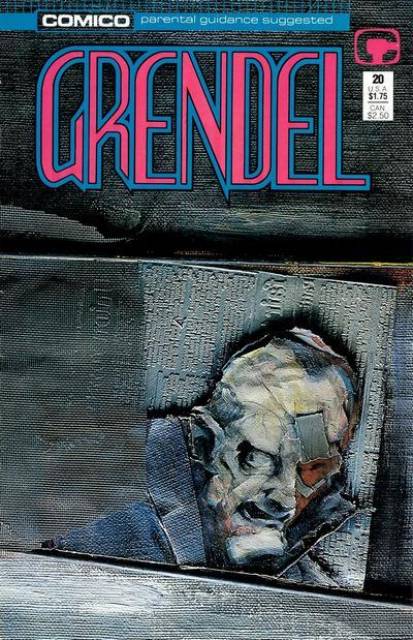
Cover to “Grendel” #20, Ron Turner, 1986

Comico.

26787-3699-29725-1-grendel

A short review of “It” (2017)

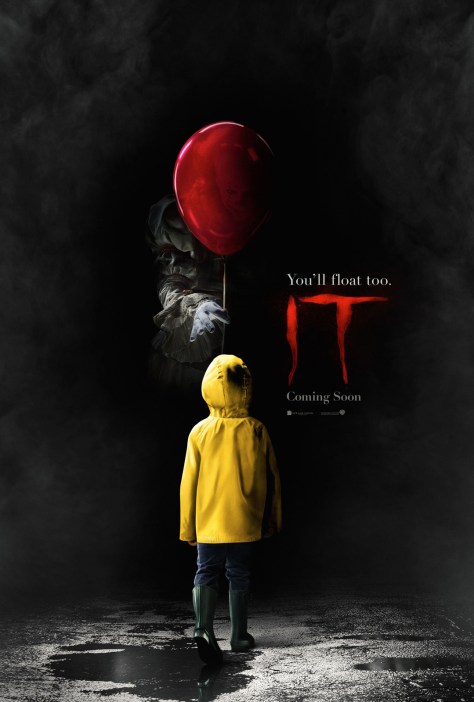
“It” (2017) succeeds on a number of levels; it’s both an excellent horror movie in its own right and a faithful adaptation of Stephen King’s incredible 1986 novel.  It’s rate it a 9 out of 10.

The movie works so well because it captures the book’s key juxtaposition of sweetness with horror.  There is a gentle innocence about the story’s circle of adolescent protagonists, who remain kind and good in King’s story — despite facing an incredibly powerful monster while being alienated by adults who are shifty, feckless, or monstrous themselves.  The screenwriters understand that juxtaposition, and successfully bring it to the screen.  The kids here feel real, three-dimensional, quirky and damned likable.  (My favorite was Eddie, the wisecracking hypochondriac, played by Jack Dylan Grazer.)  It adds great tension to the story.

And the monster itself is truly terrific, thanks to an inspired, menacing portrayal by Bill Skarsgard and startling visual direction that nicely summons summons both coulrophobia and grotesque (yet sometimes subtle) body horror.

The film might suffer just a little from something its makers couldn’t avoid — so many of its basic story elements are overly familiar tropes.  King wrote his novel more than 30 years ago.  “Scary” clowns are now omnipresent in popular culture.  (It’s something I’ll never understand.  Clowns are mysteriously and positively irritating to me.  They’re a lot like David Tennant before “Jessica Jones.”)  We’ve also seen more than a few alienated adolescents, period settings and shape-shifting monsters that impersonate our worst fears, in everything from “The X-Files” to “Stranger Things” to … other Stephen King adaptations.  We don’t want the filmmakers to neglect these key story components.  That would ruin the movie.  But they feel like overly common tropes in 2017.

Still, this was a great fright flick.  I can’t wait for Part 2.


333222

Throwback Thursday: early 1990’s “Aliens” and “Predator” comics.

I was chatting here with a friend last week about the “Aliens,” “Predator” and “Aliens vs. Predator” comics produced by Dark Horse Comics in the 1990’s.  While Marvel, DC and Image Comics all specialized in their superhero universes, Dark Horse tended to corner the market on hot properties in science fiction and horror.  (The company actually did try to compete by launching its own superhero line, but its unsuccessful “Comics’ Greatest World” universe lasted a mere three years.)

Dark Horse acquired the rights to the biggest science fiction movie characters of the first half of the decade, including “Aliens,” “Predator,” “Terminator,” “Robocop,” and “The Thing.”  It also produced great books in other genres too, like Frank Miller’s legendary “Sin City” series, Matt Wagner’s brilliant “Grendel,” and “Indiana Jones” comics.   (I never actually saw “Indiana Jones” on the shelves; the two retailers in my smallish Virginia college town never carried it.)

Perhaps strangely, I don’t remember any regular ongoing series for “Aliens,” “Predator” or “Aliens vs. Predator.”  Instead, the company published limited series on an ongoing basis.

Dark Horse had been a young company back then — it had started only four years earlier, in 1986.  But I’ll be damned if the people running the company didn’t know their stuff.  Not only did they snatch up big-name properties, they did a great job in producing consistently high-quality “Alien” and “Predator” books.  (Maybe “Aliens: Genocide” wasn’t as good as the other series, but it was really more average than flat-out bad.)  I honestly don’t know how they managed to publish such uniformly excellent comics that drew from a variety of creative teams.  The “Big Two,” Marvel and DC, produced their share of mediocre comics — even for tentpole characters or major storylines.  (See the “Batman” chapters of DC’s “Knightfall,” for example, or Marvel’s “Maximum Carnage” storyline for Spider-Man.)

Was Dark Horse’s track record better because their target audience was adults?  Did they just have really good editorial oversight?  Or did they maybe share such oversight with 20th Century Fox, which had a vested interest in its characters being capably handled?  I’m only guessing here.

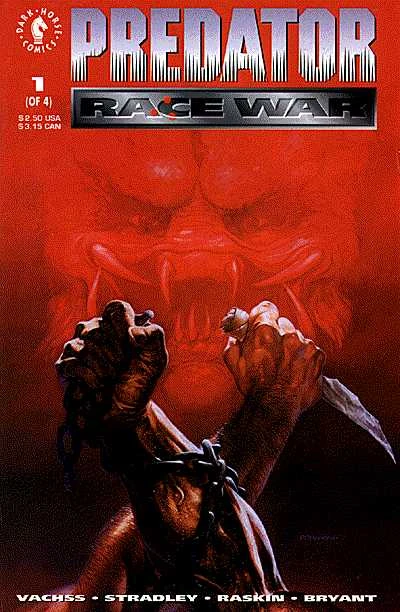
I’ve already blathered on at this blog about how I loved “Aliens: Hive,” so I won’t bend your ear yet again.  An example of another terrific limited series was “Predator: Race War,” which saw the title baddie hunting the inmates of a maximum security prison.  And yet another that I tried to collect was “Aliens vs. Predator: the Deadliest of the Species.”  The series had a slightly annoying title because of it was a lengthy tongue twister, but, God, was it fantastic.  I think I only managed to lay hands on four or five issues, but the art and writing were just incredibly good.

Take a gander at the covers below — all except the first are from “The Deadliest of the Species.”  I think they are some of the most gorgeous comic covers I’ve ever seen, due in no small part to their composition and their contrasting images.  And I’ve seen a lot of comic covers.  I think the very last cover you see here, for Issue 3, is my favorite.

I would have loved to collect all 12 issues … I still don’t know how the story ended.  (It was partly a mystery, too.)  But at age 19, I absolutely did not have the organizational skills to seek out any given limited series over the course of a full year.

In fact, this title may well have taken longer than that to be released … Dark Horse did have an Achilles’ heel as a company, and that was its unreliable production schedule.  Books were frequently delayed.  To make matters worse, these were a little harder to find in the back issues bins.  (I don’t know if retailers purchased them in fewer numbers or if fans were just buying them out more quickly.)

I suppose I could easily hunt down all 12 issues of “The Deadliest of the Species” with this newfangled Internet thingy.  But part of being an adult is not spending a lot of money on comic books.  Maybe I’ll give myself a congratulatory present if I ever manage to get a book of poetry published.  Yeah … I can totally rationalize it like that.


Aliens-Predator_The_Deadliest_of_the_Species_Vol_1_2

Aliens Predator 10

Aliens-Predator_The_Deadliest_of_the_Species_Vol_1_11

avp_deadliest_of_the_species_3


A review of “Logan” (2017)

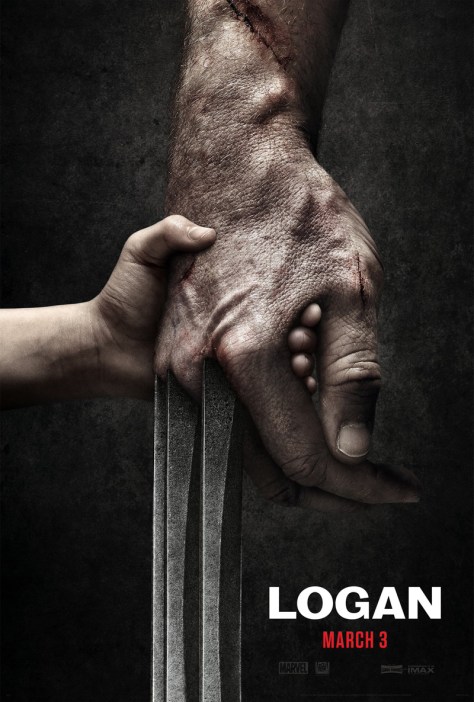
I’m not sure I agree with quite all of the accolades that “Logan” (2017) has been receiving.  (It’s being compared with Christopher Nolan’s “The Dark Knight,” for example, as well as Frank Miller’s medium-altering 1986 graphic novel, “The Dark Knight Returns.”)  It’s still a damn good movie, though, and easily among the best of Fox’s “X-Men” series.  I’d give it a 9 out of 10, and I’d firmly recommend it.

This absolutely doesn’t feel like a “comic book movie.”  It feels more like a brutally violent, sometimes introspective, road-trip drama — though all of the comic book elements are still there.  I’d caution comic book fans that “Logan” was actually much darker than I expected — and, no, it wasn’t just because of the visceral violence that could only be afforded by this movie’s unusual “R” rating.  There was a lot more that went on here that got under my skin … I just can’t say more for fear of spoilers.

There is one thing I can tell you — there is none of the escapism of past “X-Men” films.  (C’mon, for being about a supposedly oppressed group, those movies always made being a mutant look fun as hell, and even glamorous.)  This film follows an aging, ailing Wolverine, and an even worsely afflicted Professor X — subsisting in secret in the Mexico desert.  What’s more, they and their aging friend, Caliban, appear to be among the last of their kind, thanks to an unexplained, decades-long absence of new mutant births.  And what little exposition is given about the other X-Men suggests that they are dead.  If you’ve been a fan of these iconic characters for a long time, then seeing Wolverine and Professor X being so painfully not larger than life is jarring, and even sad.  No matter what is the outcome of its story, this movie’s plot setup alone can make an “X-Men” fan a little despondent.

The action is damned good.  The movie surprised me by how smart it was, too.  Its examination of violence and its consequences is unflinching.  Also, we’ve been instructed through so many “X-Men” movies that humans should not seek to contain the mutants out of fear … yet “Logan” adroitly and subtly questions such one-sided moralizing.  The acting, across the board, is extremely good — predictably from Hugh Jackman and Patrick Stewart, and surprisingly from 11-year-old Dafne Keen.  She’s perfect as the young, imperiled, yet ferocious Laura.

My complaints with “Logan” were minor.  One thing that irked me was my own confusion about whether it was “canon.”  Are we to assume that this takes place in the “X-Men” movies’ “main continuity?”  Or is this a parallel universe or a different timeline?  The feel of this film is so radically different that I found it difficult to imagine it following the previous films (although the post-credits sequence in 2016’s “X-Men: Apocalypse” seems to set up “Logan.”)  I thought that this was based on Marvel Comics’ “Old Man Logan” storyline … wasn’t that an alternate universe story?

Maybe adding more to my confusion, “X-Men” comic books actually exist in the universe of this film.  Laura carries a bunch of them, and they are a minor plot point.  Does this mean that the humans in this universe have finally accepted mutants, enough to create comic books about them being heroes?  How did that come about?

My second criticism of “Logan” is that the character of Laura is thinly rendered.  Saving her is the plot device for the entire film, and Keen is absolutely talented.  Shouldn’t we know more about her, and about her relationship with Logan and Charles?

All in all, this was a superb film, though — with an unexpected tone and a surprisingly sober, risk-taking approach to Jackman’s avowed last appearance as Wolverine.  If you like the “X-Men” movies at all, then you should definitely see it.


logan

Cover to “Grendel” #5, Arnold and Jacob Pander, 1986

Part five of the “Devil’s Legacy” storyline originally printed by Comico.


25012-3699-27811-1-grendel

Throwback Thursday: “The Further Adventures of Indiana Jones” comic books

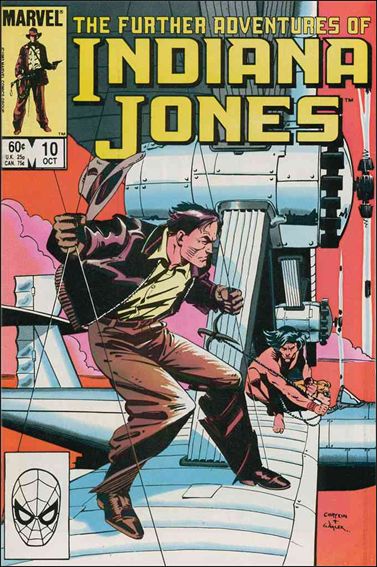
No, I’m not talking about the Marvel Comics adaptation of “Raiders of the Lost Ark” (1981); I’ve written about that separately here at the blog.  This was a regular ongoing comic book title between January 1983 and March 1986.

And every issue of it was a mind-boggling pleasure for a fourth grader whose favorite hero was Indiana Jones.  I remember issues one and two waiting for me after school one day, displayed upright on the kitchen table.  My Dad had picked them up for me.  (He was constantly trying to help me with a problem that had plagued my childhood — I simply never owned enough comic books.)  These were a departure from the “Sgt. Rock” comics that my father usually bought for me, but damn if they weren’t a thousand times better.  I was stunned by the very concept of them.  “Raiders” was a … COMIC BOOK now!?

Of course the plots were derivative of the film.  Ninety percent of the places Indy went, an ancient artifact or temple held a terrifying secret, often unleashing a power that could control or destroy the world.  And only Indy’s superior knowledge of archeology — or just his sheer pluck — would allow him to employ it to vanquish the bad guys.  [Spoiler warning for “Raiders,” by the way.]  The writing was damn good, as far as I can remember.  And we got to see Marion, Sallah, Marcus Brody and even Captain Katanga again.

You see that cover where Indy is on the wing of a plane?  That bad guy just might be one of the Hovitos … I can’t remember well enough to be sure.  At one point this adversary steals Indy’s whip and tries to use it against him.  (It doesn’t turn out well for him.)  In fact …I think it was the scene you see on the cover.  I’m not sure why the artist depicted a grappling hook instead.  I remember the villain’s line being, “It would be fitting for such a man to die by the sting of his own weapon.”  I have no idea why I remember that dialogue after 35 years (and little else about the issue).  The mind is a funny thing.

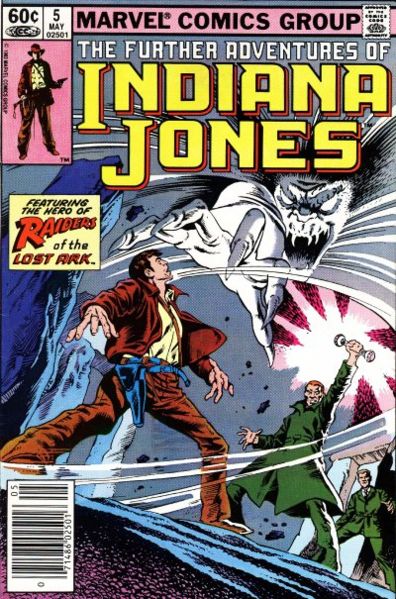
All of the covers were damn cool.  I happen to love that final one  you see at the bottom.  That was Indy’s adventure at Stonehenge.  But the first two covers you see are the ones that I would eventually like to get framed, someday after fame brings me opulence — those were the ones waiting for me on the kitchen table that day in 1981.


Indiania_Further


further-Indiana-Jones-02-00


8-1


22761-3224-25390-1-further-adventures-o

d60be218-6431-4f36-8b49-f0c1343b7a6b

indy_marvel_cover

The_Further_Adventures_of_Indiana_Jones_Vol_1_6

The_Further_Adventures_of_Indiana_Jones_Vol_1_5

“The Revenant” (2015) was astonishingly good.

“The Revenant” (2015) changed the way that I see movies.  This utterly immersive, jaw-droppingly gorgeous period thriller is easily one of the best films I’ve ever seen, and I plan to see it again, soon.  I’d rate it a perfect 10.

It’s a visual masterpiece.  Its cinematography renders its mountains, valleys and plains both dreamlike and lucid, and its action is unflinchingly visceral.  Shot mostly in Alberta, Canada (standing in for 1823 Montana and South Dakota), the film’s visuals are more stunning than anything I’ve ever seen.  You truly do feel that “you are there.”  But “there” is an absolutely brutal 19th century middle American winter wilderness.  It’s fatally dangerous, both with its unforgiving elements and with the human violence that seems to erupt casually and constantly over its land and resources — not to mention bloody retribution among groups and individuals.  This isn’t a movie for the faint of heart.  I won’t spoil the subject of its gut-wrenching action sequences for fear of spoilers — most of these sequences arrive as frightening surprises, thanks to Alejandro G. Inarritu’s expert direction.  It is this juxtaposition of beauty and brutality that define the movie.

Leonardo DiCaprio plays Hugh Glass, an American trapper who begins as one of the seemingly few characters that do not quickly resort to unnecessary violence, prejudice or revenge.  He later does seek vengeance for his son’s death against fellow trapper John Fitzgerald, played by Tom Hardy.  (Glass was a real frontiersman who was the subject of Michael Punke’s 2002 biography, “The Revenant.”  But a cursory Google search suggests to me that this is not actually “a true story;” I think of it as loosely based historical fiction.)  Like DiCaprio and Hardy, Domhnall Gleeson and Will Poulter also excel in their supporting roles.  (Gleeson seems to specialize in playing reluctant innocents; I remember him from his skilled performance as the gentle young computer genius in last year’s outstanding science fiction thriller, “Ex Machina.”)

But the main star of “The Revenant” is the setting itself, beautifully shot by Emmanuel Lebezki and masterfully employed by Inarritu as a kind of character unto itself in the story.  It’s lovely.  I’ve never seen a movie like this.  And while I’m no film connoisseur, or even a genuine critic, I’ve seen a lot of good ones.

The direction most reminds me of Francis Ford Coppola’s work in 1979’s “Apocalypse Now.”  I was also reminded of Stanley Kubrick’s “The Shining” (1980) — that was a film that also depicted threatening snowscapes as dreamlike and eerily beautiful.  There was one shot near the end, following DiCaprio’s vengeful hero on his path through immense firs on either side — it reminded me a lot of Jack Nicholson’s murderous Jack Torrance on his path through the hellish hedge labyrinth.

There is also a central action set piece involving an attack on one group of characters on another — it actually reminded me of Oliver Stone’s work in “Platoon” (1986).  Like Stone’s finale, the battle is staged so that the viewers have no sense of which direction the attack is coming from, paralleling the experience of the confused defenders.  There are countless long tracking shots throughout this film, with fewer cuts — and amazing circular surrounding shots of the action.  I’ve read that Inarritu actually had to transport cranes to his mountaintop shooting locations in order to execute those.

If you had to find a flaw with “The Revenant,” I suppose you could complain that its story and characters are thin.  We know little more about DiCaprio’s Glass beyond that he is competent, patient and slow to fight — then merciless and unrelenting in seeking justice.  Poulter’s Jim Bridger  is loyal, but not as strong as the hero.  Hardy’s Fitzgerald is a greedy, opportunistic bully whose murder of an innocent drives the plot.  That’s … little more than the plot and characters of a lot of throwaway westerns, isn’t it?  (I’ve indeed seen this movie categorized as a western in reviews.  That’s technically correct, I guess, but it feels too unique to pigeonhole that way.)

You could easily read the movie for moral ambiguity.  There are the obvious issues connected with revenge, of course, underscored by a final shot in which one character appears to break the fourth wall.  I found myself wondering about Glass’ compatriots.  Yes, it is Fitzgerald who acts villainously, but all of Glass’ fellow trappers also consign him to death by abandoning him after his injuries.  I do understand that they feel they can’t survive themselves if they try to carry him back to their staging area at Fort Kiowa.  But … is what they do “right?”  What would you or I do?

I think I am coming too close here to revealing too much about the film.  The best way to experience “The Revenant” is to walk into it knowing little about it.  I strongly recommend you do so.


revenant-poster

The-Revenant-03

the-revenant-trailer-screencaps-dicaprio-hardy6

revenant-horse-xlarge

revenant

24115986425_3e247de327_b