Tag Archives: 1988

A short review of “Killer Klowns From Outer Space” (1988)

“Killer Klowns From Outer Space” (1988) is generally a bad movie.  It has the depth and execution of a mediocre high school play; its acting and screenwriting are almost uniformly poor.  (The sole exception here is the wonderful character actor John Vernon, who is always fun to watch.)  I’m not even sure it tries to be a good movie.  But that’s probably okay with both the filmmakers and its target audience — as you can tell from its title alone, this is deliberate schlock.

And … it’s arguably pretty good schlock, despite its failings — depending on your tastes in bad movies.  I don’t think I’d recommend this movie to others, but I suppose I’d rate it a 6 out of 10, based on my own enjoyment.  In addition to its generous helping of 80’s cheese, “Killer Klowns From Outer Space” manages to do several things quite beautifully — namely its low budget creature effects, costuming and set design.

For a film so clumsily unimpressive, you’ve got to admit that a hell of a lot of creativity went into its titular monsters and their spaceship.  (They are not human clowns, the movie informs us, but alien monsters in the shape of clowns — and we don’t get any more exposition than that.)  The garish, creepy art designs are actually really damned good, and it’s easy to see why this film developed a cult following among fans of offbeat horror.  It’s also easy to imagine that coulrophobics (people with a phobia for clowns) might find this movie genuinely unsettling.

Here’s the good news — if you aren’t sure you’d want to spend money on this movie, you can currently watch it for free (and legally) right over at Youtube.  Here’s the link.

Postscript: I thought that Grant Cramer, who played one of the movie’s protagonists, looked incredibly familiar.  Yet I was surprised when I learned I hadn’t seen anything else in his filmography.  Here’s who I may have been seeing — he is the son of none other than legendary starlet Terry Moore.  Classic movie fans might remember her from any number of films from Hollywood’s Golden Age.  But if you’re a monster movie fan like me, then you remember her as the young heroine of 1949’s original “Mighty Joe Young.”


04f02a7edcf1431db0ae3646d0979486

Cover to “Batman: The Cult” #3, Bernie Wrightson and Todd Klein, 1988

DC Comics.

Batman_-_The_Cult_3

A short review of “Child’s Play” (2019)

“Child’s Play” (2019) actually surprised me by being a little more ambitious and well rounded than the typical reboot of an 80’s slasher franchise.  Screenwriter Tyler Burton Smith tries to present audiences with a fresh, updated horror film with funny, engaging, likable characters.  And he mostly succeeds — it helps that the cast is roundly quite good in their roles.  (The voice of Chucky is none other than Mark Hamill.)  There is some discomfiting dark humor here, too, that makes for some great, guilty fun.

But this “Child’s Play” is doomed to suffer in comparison to the 1988 original.  The very first “Child’s Play” was a particularly scary film, even if its sequels were much less so; I remember people screaming in the theater when I saw it with my high school friends.  This new movie doesn’t come close to matching it in that manner.

Smith’s update abandons the admittedly campy premise of the original, in which a serial killer employs voodoo to transfer his soul into an interactive doll.  Smith gives us something that is more plausible — a malfunctioning A.I. that turns homicidal partly because its programming leads it to.  His take is interesting … Chucky is even a little sympathetic at first — he’s a childlike, vaguely cute robot, and his mischievous young owner is at least partly responsible for his early, less frightening transgressions.

This all works on a certain level.  It’s smarter than its 80’s source material.  It might have been gold if it had been fleshed out by a science fiction screenwriting master like Charlie Brooker, of “Black Mirror” fame.  Or, better yet, why not the writers for HBO’s brilliant “Westworld,” which proceeds from essentially the same basic story concept?

Alas, we can’t have our cake and eat it too, at least in this case.  The new Chucky is a more intelligent story concept but a less menacing bogeyman.  He just can’t hold a candle to the voodoo-infused, sociopathic demon-doll voiced by the legendary Brad Dourif so long ago.  The new “Child’s Play” isn’t quite scary enough for our expectations, and that’s a serious criticism for a horror movie.

All things considered, I’d rate this a 7 out of 10.


childs-play-chucky_in_childs_play_rgb-h_2019_0

A review of “The Dead Don’t Die” (2019)

“The Dead Don’t Die” indeed has the greatest zombie cast ever assembled.  Seriously, just look at that poster below.  Unfortunately, it doesn’t have the best zombie screenplay ever written, or the best direction ever seen in a zombie film.  This would-be classic was a surprisingly average viewing experience; I’d rate it a 6 out of 10.

I almost feel guilty for feeling so unenthusiastic, because I like so many of these actors so much.  Bill Murray and Adam Driver actually are quite funny as the movie’s two torpid police officers; Chloe Sevigny makes them even funnier as their panicked straight man.  And the addition of Tilda Swinton’s zany Scottish samurai undertaker makes them the perfect comedic quartet.  (I think this is the first time I’ve seen Sevigny in a movie, as she mostly does arthouse films — including 2003’s ignominiously reviled “The Brown Bunny.”  And I had no idea that Driver was this talented, given his milquetoast turn as a villain in the most recent spate of “Star Wars” films.)  I honestly would love to see the four of these characters battle apocalyptic threats in a series of comedies — aliens, vampires, killer robots from the future … whatever.

Other big names shine here as well.  Tom Waits and Caleb Landry Jones are both surprisingly funny, delivering little bouts of quirky, laconic, character-driven dialogue in a film that seems intended as mashup between “Cannery Row” (1982) and the first two “Return of the Living Dead” films (1985, 1988).  (I first saw Jones as the creepy kid in 2010’s “The Last Exorcism;” I suspect that more of my friends will recognize him as Banshee from 2011’s “X-Men: First Class.”)

The problem is this — although many of the characters are engaging, they populate a subdued, disconnected movie that is frequently quite slow.  Writer-director Jim Jarmusch’s heart is in the right place — assembling this oddball ensemble cast for the mashup I mentioned above is actually a terrific idea.  But “The Dead Don’t Die” ultimately lacks punch, and even a tongue-in-cheek horror-comedy needs a minimum of tension.  The movie is a bit too lethargic to become the truly great film that the trailer led us to hope for.

Complicating matters is the fact that that several groups of characters follow story arcs that go nowhere — sometimes literally.  (Where did the kids from the juvenile detention center run off to?  Why were they included at all?  Not much happens to them and they have nothing to do with the rest of the movie.)  This movie often felt like a number of comedy skits stitched together — some were admittedly quite funny, but they didn’t add up to a cohesive story.

Oh, well.  It’s possible that you will like “The Dead Don’t Die” much more than I did.  I might be the wrong audience for this, as I’ve never cared much for horror-comedies.  (The aforementioned “Return of the Living Dead” films are on the short list of those that I like.)  Your mileage may vary.


deaddont775

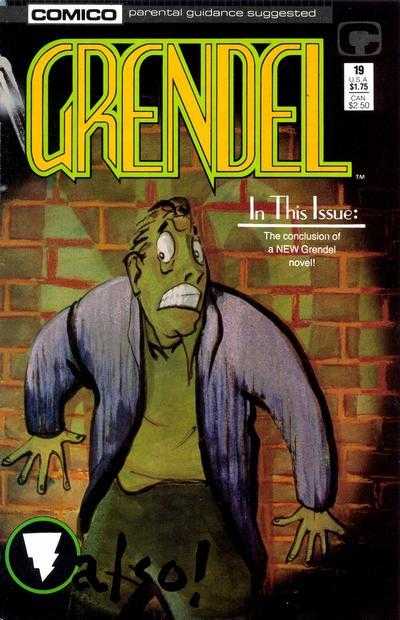
Cover to “Grendel,” #19, Matt Wagner, 1988

Comico.

26684-3699-29615-1-grendel

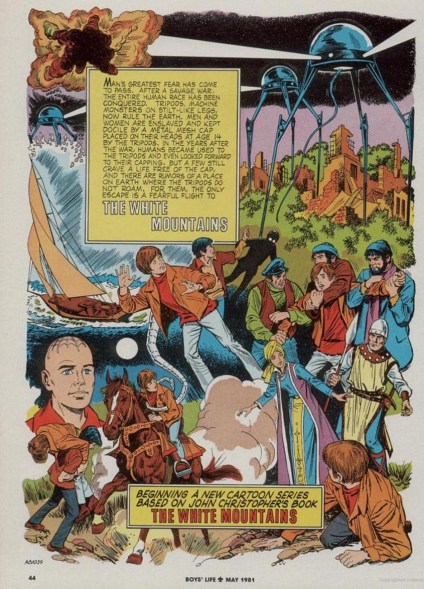
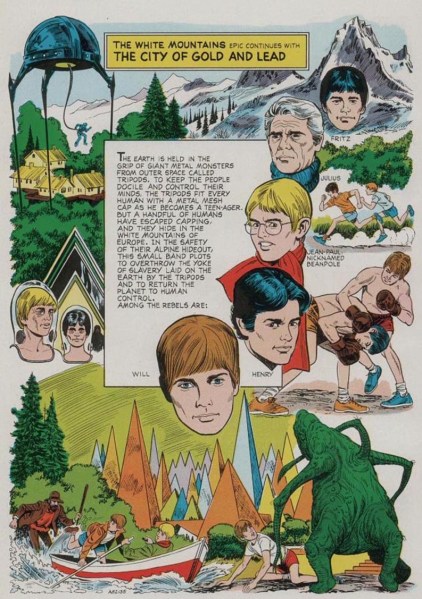
Throwback Thursday: “The Tripods” comic strip in “Boys’ Life” magazine!

I had a subscription to Boys’ Life magazine for a couple of years when I was a Cub Scout in the early 1980’s.  My parents canceled it after a year or two, and I can’t blame them — I just wasn’t reading it.  Boys’ Life was the official magazine of the Boy Scouts of America, and it was pretty wholesome stuff … it just didn’t offer the excitement of my comic books or the occasional copy of Fangoria that I manged to get my hands on.

But there was one feature of Boys’ Life that I followed religiously — the serialized comic strip adaptation of John Christopher’s The Tripods book trilogy.  (Christopher published the first three of his books in the late 1960’s; he added a prequel novel in 1988, but that was long after the Boy Scouts and Boys’ Life was behind me.)

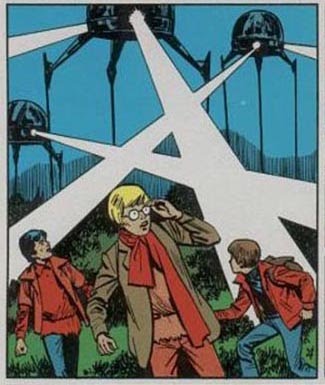
The Tripods was cool, dark dystopian stuff.  The story opened with the first book, The White Mountains, to find humanity settled into an agrarian, pre-industrial age in which their overlords were the titular “tripods” — massive three-legged vehicles piloted by unknown beings.  Humans were ritualistically “capped” with a brain-altering device when they reached age 14 — thereafter becoming docile and conformist and easier for the mysterious machines to subjugate.

The White Mountains followed a trio of 13-year-old boys who escaped the “capping” to seek out a human resistance movement; the second book, The City of Gold and Lead, shows two of these protagonists infiltrate the city of the tripods’ operators.  (Spoiler — they’re grotesque aliens.)  The third book, The Pool of Fire, presumably picks up from there, but my Boys’ Life subscription ran out before the magazine got to that.

I recently, however, used this Interwebs thingamajig to discover what looks like a real gem of a find — a 1984 BBC mini-series adaptation of the books.  I started the first episode and it looks quite good.  If I get around to watching the whole thing, I’ll review it here.


40da7d9da25e489860f6e1bc7bccf65a7112394a

3

4

5

2

I introduced a pal last night to John Carpenter’s “The Thing” (1982).

And she was predictably impressed.  Here are a few observations that came up for me, about the categorically rewatchable sci-fi/horror movie that keeps on giving.  (Yeah, I know I sound overly preoccupied with this movie, and that’s weird, but I’m just really into movies.  And John Carpenter’s “The Thing” is the same kind of classic for monster movie fans as “It’s a Wonderful Life” or “A Christmas Story” is for people who like Christmas movies.)  [THIS BLOG POST CONTAINS MAJOR SPOILERS.]

1) It was fun watching “The Thing” with someone who was seeing it for the first time.  Not only did I have to stifle a chuckle at her cry of “That poor dog!” during the opening credits, but I also watched while she guessed (incorrectly, as most of us did) at which characters had been assimilated by the shape-shifting monster as the story progressed.  (I noticed something ironic last night that I couldn’t mention.  When MacReady delivers his short “I know I’m human. And if you were all these things, then you’d just attack me” speech, all of the men he’s addressing are also still human … Unless I’m mistaken, Norris and Palmer are elsewhere.

Which brings me to what at first occurred to me as a … remotely possible plot hole in this otherwise perfect masterpiece.  If The Thing truly wants to escape Antarctica and prey upon the rest of the world, it doesn’t need to assimilate (or “Thingify,” as I like to think) everyone in the camp.  It only needs to overtake a single human.  (This would be the silhouetted figure that the dog first approaches; my money’s on Norris.)  Think about it … nobody stationed at Outpost 31 remains at the research station indefinitely.  They’d cycle out at the end of a shift of … six months?  Eight months?  Longer?  (And what about vacations and holidays?)  Sooner or later, they’d fly home.  And, having perfectly replicated a human’s anatomy, The Thing need only sustain itself until that departure by eating the same food the other humans were eating.  Then, as soon as it arrived at any other, warmer location on earth, it could attack life in its abundance.

But this morning I realized that my analysis here is faulty.  First, the humans were already getting wise to The Thing and its means of procreation — thanks to a pre-diabeetus Wilford Brimley wisely intoning, “That ain’t dog.”  Maybe The Thing was smart enough to realize the humans could effectively quarantine it.  Second, I am assuming in my criticism that “The Thing” is acting as a single entity.  Yet it shouldn’t act that way at all; this is the entire point of MacReady’s “blood test.”  While one incarnation of The Thing is safely munching on canned goods disguised as a human, a separate incarnation was sitting in storage, exposed — presumably only until the humans finally realized it needed to be destroyed somehow.  That iteration of The Thing needed to attack and duplicate Redding if it wanted to save itself.

2)  The Thing actually shouldn’t need to reach civilization in order to begin attacking all life on earth; it only needs to reach the Antarctic coast. If it enters the water and begins assimilating sea life (and why shouldn’t it be able to?), then it’s game over.  I said last night that “a fish can travel wherever it wants,” which my friend found pretty funny, but it’s true.  A Thingified fish (or its fish-Thing progeny) could arrive at any continental coastline.

3)  If The Thing replicates a human perfectly on a cellular level, then … might it be reluctant to kill anyone else, because it would basically be a human?  (Obviously, the film’s plot-driving antagonist has no such reluctance, but … still, think about it.)  If it perfectly replicates a human brain, right down to its cellular structures and chemistry, then wouldn’t it have a conscience and experience empathy?  My friend pointed out the reductionist nature of my question, though — it assumes that conscience and empathy can have only physical origins.

4)  The movie’s characters (and most viewers) assume that The Thing is “a lifeform” or an organism.  Is it, or is it simply “live” tissue?  Somebody on the Internet Movie Database message board pointed out long ago that it’s “just cells,” and that’s … literally true; the film even shows this via crude 80’s-era computer graphic.  Is it an “organism” if it is simply tissue that replicates?  Or is it no more a “lifeform” than a cancer, or tissue grown in a lab?

5) I honestly opine that the film is perfect, or very nearly so.  It is the paragon of sci-fi/horror movies.  And I’d put it on par with other films that I hold virtually perfect, like “To Have and Have Not” (1944), “Alien” (1979), “Blade Runner” (1982), “Aliens” (1986), “The Accidental Tourist” (1988), “Alien 3” (1992) and “Vanilla Sky” (2001).

6)  My friend reaaaally likes Kurt Russell’s hair in this film.

Okay, enough.  I’m sorry about this.  Hey, at least I’m not obsessing over comics tonight.


421rmr3zl7tab4ovnwtundj3nhk

And here is the latest thing that makes me feel old.

What’s with all the people in music videos looking so damn young these days?  Did they change the child labor laws?

There was a time when I was daily viewer of MTV (the sedate stuff on VH-1 was for old people), and I rocked hard, people.  It seemed to me that whenever I watched a video, I saw people who were my own age.

Now these videos are inhabited only by people who look young enough to be my kids. And that makes sense, because … they kinda are young enough.  (Yes, I realize the video below for The Calling’s “Wherever You Will Go” was made 18 years ago, but that’s beside the point.)  If the performers in a video today were in their very early 20’s, then they’d be about the right age, if I’d fathered kids when I was 26.

Furthermore, some astute commentators pointed out online Monday night that 2019 is the year in which the original “Blade Runner” (1982) was set.  The opening title card names “November, 2019” as the time when all things Fordesque turn angsty and existential and killer-androidy.  Am I … older than Harrison Ford’s character? I am six years older than Ford was when he made the film.

Now I just feel weird.  Why do I write these blog posts, anyway?

[Update: Today I am learning that “Akira” (1988) and “The Running Man” (1987) also set their stories in 2019?! That’s ironic, given that the future we’ve come closest to is that of 2006’s “Idiocracy.”

I wonder how people in our parents’ generation felt when 2001 arrived, if they’d happened to see “2001: A Space Odyssey” in theaters in 1968.]


Cover to “Detective Comics” #587, Norm Breyfogle, 1988

DC Comics.

Detective_Comics_587

Cover to “Detective Comics” #590, Norm Breyfogle, 1988

DC Comics.

Screen-Shot-2018-09-27-at-4.10.53-PM