As I’ve shared here at the blog before, “Mystery Science Theater 3000” was a pretty big part of my college experience. MST3K parties were indescribably fun. I honestly believe that I have literally never laughed so hard in my life.
I’ve previously linked to the priceless episode where Joel and the ‘Bots skewer Joe Don Baker and 1975’s “Mitchell.” Below are three more that were the unofficial required viewing for the second floor of Mary Washington College’s New Hall during the 1993-1994 school year.
What was maddening about MST3K was how difficult it was to explain to the uninitiated. (Bear in mind, this was before the days of Youtube, with which you could just send your friends a clip.) It was an amazing TV show, but my efforts to explain it to friends made it sound preposterously stupid: There are these three comedians that make fun of old movies — really bad ones — as the movies are playing. Two of the comedians are portrayed by robot puppets … There’s an ongoing skit in which they’re stuck in space. The special effects are really terrible — but that’s okay, because it’s kinda part of the joke …
The first episode below is 1966’s “Manos: the Hands of Fate,” which I understand to be the most popular among fans. (Even aside from MST3K’s satirical riffing, I’ve read that this is widely regarded as the worst movie of all time — a distinction I’m not sure it truly deserves.)
The second is the episode devoted to 1944’s befuddling and blithely moralizing “I Accuse My Parents.” (I and the other guys on my floor might have actually liked this one even more than “Manos.”)
The third is my personal favorite — the entry for 1951’s saccharine, preachy “The Painted Hills.” In a strange coincidence, I think it’s actually the first one I ever saw. And it’s also one that I’ve never heard named as a favorite by another MST3K fan. Seeing the Joel and the ‘Bots make fun of a poor defenseless dog (played by the same dog who played Lassie, no less!) was just too irreverently brilliant. SNAUSAGES! (And does anyone else think that this was a morbidly strange film when it was first conceived? It was marketed as a family-oriented “Lassie” movie, but it contains just a bit more murder and bizarre horror than you’d expect from that.)
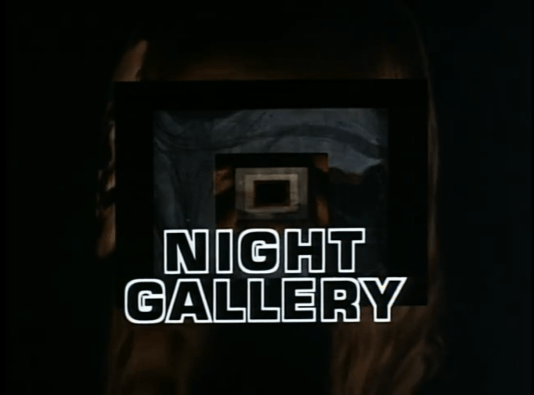
In some ways, I’m a poor excuse for a horror fan. I haven’t seen any episodes of some of the classic anthology series that my friends regard as biblically important. Such was the case with “Night Gallery” — at least until a couple of nights ago. (You can find it online, if you look hard enough.)
I checked out the 1969 feature-length pilot for the series, and I’m glad I did. It was good stuff, despite the now lamentable 1960’s music and camera effects that were occasionally distracting. I’d rate it an 8 out of 10.
There were three half-hour tales comprising the made-for-television movie: “The Cemetery,” “Eyes,” and “The Escape Route.” “Eyes” was by far and away the best written and performed, but they were all quite good. The twists for all three tales were quite satisfactory, and the tone was nice and macabre. And the cast was terrific — Roddy McDowall and Ossie Davis starred in the first segment; Joan Crawford and Tom Bosley appeared in the second. It was weird seeing such youthful versions of actors that were familiar to me in the 1980’s and 1990’s.
The format, along with Rod Serling’s unique narration, was engaging, if a little quaint. It’s easy to see how this went on to become such a popular television show.
Here’s an odd trivium -in the establishing shots for the second segment, which takes place in New York City, the Twin Towers are missing. That’s because construction had only just begun on the first tower in 1969, when this pilot was released. The entire World Trade Center was completed three years later.
I was chatting here with a friend last week about the “Aliens,” “Predator” and “Aliens vs. Predator” comics produced by Dark Horse Comics in the 1990’s. While Marvel, DC and Image Comics all specialized in their superhero universes, Dark Horse tended to corner the market on hot properties in science fiction and horror. (The company actually did try to compete by launching its own superhero line, but its unsuccessful “Comics’ Greatest World” universe lasted a mere three years.)
Dark Horse acquired the rights to the biggest science fiction movie characters of the first half of the decade, including “Aliens,” “Predator,” “Terminator,” “Robocop,” and “The Thing.” It also produced great books in other genres too, like Frank Miller’s legendary “Sin City” series, Matt Wagner’s brilliant “Grendel,” and “Indiana Jones” comics. (I never actually saw “Indiana Jones” on the shelves; the two retailers in my smallish Virginia college town never carried it.)
Perhaps strangely, I don’t remember any regular ongoing series for “Aliens,” “Predator” or “Aliens vs. Predator.” Instead, the company published limited series on an ongoing basis.
Dark Horse had been a young company back then — it had started only four years earlier, in 1986. But I’ll be damned if the people running the company didn’t know their stuff. Not only did they snatch up big-name properties, they did a great job in producing consistently high-quality “Alien” and “Predator” books. (Maybe “Aliens: Genocide” wasn’t as good as the other series, but it was really more average than flat-out bad.) I honestly don’t know how they managed to publish such uniformly excellent comics that drew from a variety of creative teams. The “Big Two,” Marvel and DC, produced their share of mediocre comics — even for tentpole characters or major storylines. (See the “Batman” chapters of DC’s “Knightfall,” for example, or Marvel’s “Maximum Carnage” storyline for Spider-Man.)
Was Dark Horse’s track record better because their target audience was adults? Did they just have really good editorial oversight? Or did they maybe share such oversight with 20th Century Fox, which had a vested interest in its characters being capably handled? I’m only guessing here.
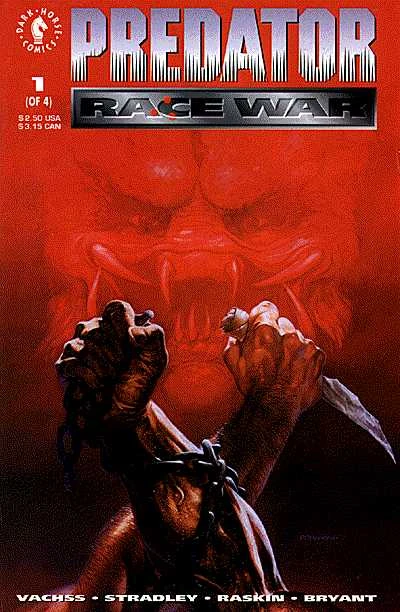
I’ve already blathered on at this blog about how I loved “Aliens: Hive,” so I won’t bend your ear yet again. An example of another terrific limited series was “Predator: Race War,” which saw the title baddie hunting the inmates of a maximum security prison. And yet another that I tried to collect was “Aliens vs. Predator: the Deadliest of the Species.” The series had a slightly annoying title because of it was a lengthy tongue twister, but, God, was it fantastic. I think I only managed to lay hands on four or five issues, but the art and writing were just incredibly good.
Take a gander at the covers below — all except the first are from “The Deadliest of the Species.” I think they are some of the most gorgeous comic covers I’ve ever seen, due in no small part to their composition and their contrasting images. And I’ve seen a lot of comic covers. I think the very last cover you see here, for Issue 3, is my favorite.
I would have loved to collect all 12 issues … I still don’t know how the story ended. (It was partly a mystery, too.) But at age 19, I absolutely did not have the organizational skills to seek out any given limited series over the course of a full year.
In fact, this title may well have taken longer than that to be released … Dark Horse did have an Achilles’ heel as a company, and that was its unreliable production schedule. Books were frequently delayed. To make matters worse, these were a little harder to find in the back issues bins. (I don’t know if retailers purchased them in fewer numbers or if fans were just buying them out more quickly.)
I suppose I could easily hunt down all 12 issues of “The Deadliest of the Species” with this newfangled Internet thingy. But part of being an adult is not spending a lot of money on comic books. Maybe I’ll give myself a congratulatory present if I ever manage to get a book of poetry published. Yeah … I can totally rationalize it like that.
I really missed the boat with last week’s Throwback Thursday — it was the 50th anniversary of the entire “Star Trek” franchise, with the first episode of the original series airing on September 8, 1966. (And even the term “franchise” seems way too narrow to describe “Star Trek” in all of its incarnations — it’s really more like a permanent part of western popular culture.) I’m not old enough to remember the show’s original run, which was a surprisingly scant three years. But I remember it in syndication when I was not much more than a baby in the mid- to late 1970’s.
“Star Trek” was something that my older brother and maybe my father watched. (I was fixated on programming that was more comprehensible for young kids, like “Land of the Lost” and reruns of “The Lone Ranger.” Seriously, the original black-and-white serial western was still in reruns back then.)
But “Star Trek” was definitely something I was attracted to as a tot, doubtlessly resulting, in part, from the contagious ardor for it that I saw in my older brother. (He might not admit it today, but he was a bit of a hard-core science fiction fan long before I was.) The show was on at our tiny house in Woodhaven, Queens, quite a lot. He also had toys and posters connected with it. (And anything my older brother owned was something I endeavored to play with when he wasn’t looking.)
He had that Captain Kirk toy among the figures produced by Mego that you see in the bottom photo. (Again, 1970’s “action figures” were often pretty much indistinguishable from dolls.) In the early 1980’s, he had a totally sweet giant poster depicting diagrammed schematics for The Enterprise in surprising detail. I’ve Google-searched for it, but found only similar pinups. The one hanging in the room we shared was blue.
I remember him annoyedly correcting me because I called it “Star Track.” (I did not yet know the word “trek.” I myself was confused by my own mistake; I knew that there could be no “train tracks” in space, even if I studied the opening credits one time just to make sure.)
I was precisely the sort of pain-in-the-ass kid who fired off an incessant barrage of questions when I saw something on TV that I didn’t understand. My father was patient to a fault when I punctuated his World War II movies with inane questions. (I’m willing to bet I eventually acquired more knowledge of the war’s European theater than the average six-year-old.) My brother was not always so forbearing. I actually remember him changing the channel away from shows he was watching, like “Star Trek” or “MASH,” if I joined him at the little black-and-white television we had in our room. (The poor guy needed me to lose interest and go away, so that he could at least hear the damn show.)
Certain “Star Trek” episodes remain memorable to this day, even if I understood maybe 15 percent of what transpired onscreen. The was The One With The Domino-Face Men, which the Internet now tells me was actually titled “Let That Be Your Last Battlefield.” Then there was The One Where Kids Ruled Themselves on a Deserted World, which made a really big impression on me. (The Internet tells me this one was “Miri.”)
As I grew up, the show faded from prominence in my child’s psyche. It was just never my fandom of choice. Nor was it for many other kids I knew … by the 1980’s, it was already considered “an old TV show.” The kids on my street were always excited about the feature films; even if we were underwhelmed by the “slow” first film in 1979. Blockbuster movies were major events back then, and fewer, and they were enigmatic in a way that is impossible after the Internet’s arrival. (I think that Millennials will never be able to understand that, in the same way that you and I can never appreciate the vintage “serials” that our parents watched before the main feature at a Saturday matinee.)
In the 1980’s, just about every boy I knew was preoccupied with the space-fantasy of “Star Wars.” On television, we had cheesefests like the original “Battlestar Galactica” and “V.” As we got older, we gravitated toward the “Alien” and “Predator” film franchises. At home, I read Orson Scott Card and Harry Harrison, and as I approached college toward the end of the decade, I’d discovered Arthur C. Clarke. If we’d known another kid who was really into “Star Trek,” I’m not sure we would have considered it “nerdy.” It would just have been very weird, because it we viewed it as a campy tv show from maybe two decades prior, like “Bonanza” or something. I don’t think I ever even thought of the franchise as really relevant or popular until I was at Mary Washington College in the 1990’s. “Star Trek: the Next Generation” would regularly draw kids out of their dorm rooms into the lobby at New Hall.
Still, it’s hard not to develop an emotional attachment to something that stimulated your sense of wonder as a tot. I … felt pretty damn sad when Captain Kirk died in 1994’s “Star Trek: Generations.” I saw it in a theater in Manassas, Virginia, I think, with my girlfriend at the time. She actually felt she had to console me after seeing how doleful I was on the drive home.
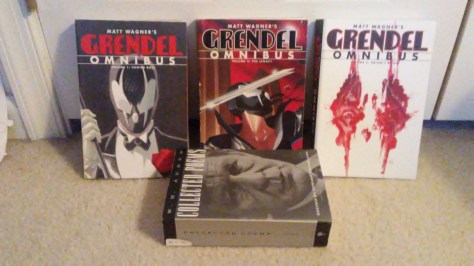
I am now the proud owner of … a goodly portion of all the “Grendel” comics Matt Wagner ever wrote. What you see in the top row are “Grendel Omnibus” Volumes 1, 2 and 3. (I believe I actually shared my review of Volume 1 on this site a while ago.) These would comprise a nearly inclusive history of Hunter Rose, Christine Spar, Brian Li Sung, Orion Assante and Eppy Thatcher. All that remains for me to collect is the fourth Omnibus trade-paperback, chronicling the possibly immortal Grendel Prime and his imperiled charge, Jupiter Assante.
The Omnibus editions do not include crossovers with heroes such as Batman and The Shadow, as those characters are obviously owned by other companies. Nor do they include the diverse dystopian future tales depicted by various artists in the 1990’s “Grendel Tales.” But I am in heaven with what you see below — or maybe hell, considering these books’ central motif.
To top it all off, that hefty tome beneath the comics is W. H. Auden’s “Collected Poems,” edited by Edward Mendelson, with the poet’s work between 1927 and his death in 1973. It’s 927 pages. It weighs 30 pounds, probably. And it is indexed by both the poem’s titles and their first lines. That is what you call a lifetime investment.
The comics will be excellent summer reading; as will Auden. But I’ll focus more on the Briton when fall arrives. Like his countryman, Doyle, he might be best enjoyed outdoors on a gray and increasingly brisk Autumn day.



 Eric Robert Nolan, Author