
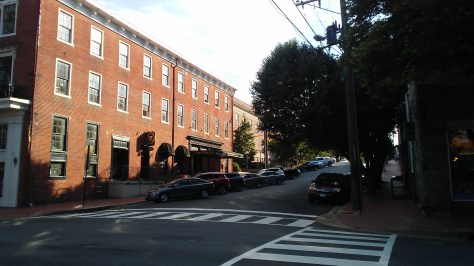
Pitt Street in Fredricksburg is looking terrific — the area seems far more gentrified and better maintained than when I lived there during the summer of 1991, after my freshman year at Mary Washington College.
There were always a few college kids living on Pitt back in the day — either just during the summer or for the entire year, attracted by the dirt-cheap rents just north of downtown. You sort of got what you paid for, though; back then, we thought of it as “Pits Street.”
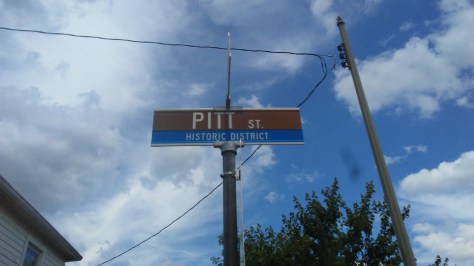
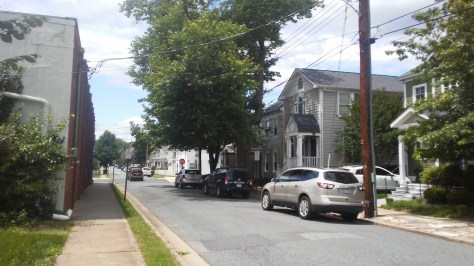
I had my first place (outside of my freshman dorm room) at 304 Pitt Street — that’s the little grey house on the left in the next two photos. I sublet it from another drama student at MWC. (He was an upperclassman who coached me a little on my acting, despite the fact that I wasn’t very good.) Tim was a gigantic guy, and former military. He’d been in some kind of special forces, and the other guys explained to me that he was too tough to care much about the size or quality of the accommodations. “To Tim, a two-by-four is a bed,” one of them explained me.
So the “place” in question wasn’t fancy. It hardly qualified as a room. It was actually just a walk-in closet with a window; I slept on a futon because a mattress wouldn’t fit. But the price was right — rent was just $150 a month, with utilities included. My part-time job was right on Caroline Street. (I played the role of “the tavern-keeper’s son” at The Rising Sun Tavern, a living-history museum.) And right up Princess Anne Street was the comic shop I’ve written about here before — this was the place with the singularly horrid woman who visibly hated every customer who walked in.
I had sooooo little money that summer. Meals occasionally consisted solely of those butter cookies that sold for 99-cents-a-package at the nearby Fas-Mart. (This wasn’t an entirely unhappy circumstance — those things were so good, they were addictive.) I spent a lot of time listening to Depeche Mode on cassette; any song from the “Some Great Reward” album will always take me back to Pitt Street. When I started dating one of the “tavern wenches” at work, our dates always had to cost little or nothing. And I spent a lot of time watching “Star Trek” on VHS tapes from the Fredericksburg Library.
My housemates were Mike and Paul, who were upperclassmen. Mike was a tall, soft-spoken Fairfax native who appeared to endlessly ponder things. Paul was a likable, irreverent metal-head who loved to make fun of me. (Hey, I deserved it, after working hard for a year at Bushnell Hall seeking the Most Obnoxious Resident Award.) My complete dependence on Fas-Mart was an endless source of amusement for him. (I didn’t have a car, and the Giant Supermarket was along Route 1 on the other side of town.) He laughed the hardest when I demonstrated my ignorance of metal. He actually fell over once when I read his Queensryche poster and pronounced their name as “Queensearch.”
Mike and Paul had a friend named Stefan who occasionally stopped by the house. Stefan was unique. He always appeared confused by life, and he always arrived with news of some strange new misfortune that had befallen him. He once showed up at our door, for example, looking like a victim of a nuclear reactor meltdown — his thick black hair had been brutally shorn away into a mottled “crew cut.” (He’d tried to save money by giving himself a haircut, not realizing how difficult that was to do correctly.) Later that summer he stopped by with news of a near-death experience. (This time, he’d electrocuted himself trying to change a broken light-bulb while the lamp was still plugged in.)
There was no shortage of drug activity in that part of Fredericksburg in the early 1990’s. Some girls up the street from where I lived grew a man-sized marijuana “tree” right in their living room. Another guy who was well known in the neighborhood offered the dubious service of delivering acid to anyone’s door.
A Fredericksburg native on the other side of the street was known for howling at the sky from his front porch. This was during the day; the moon had nothing to do with it. I was told he was issuing some sort of recurring, primal challenge to some other local who had threatened him. He was at least not acting out of paranoia … one morning his adversary indeed appeared at the edge of his yard, brandishing a baseball bat. The Howling Man fortified his position on the porch by returning with a lengthy kitchen knife.
Nobody called the police. The guys in my house at least had an excuse — we didn’t have a phone. Cell phones just weren’t a thing in 1991, and we lacked either the money or the organizational skills to set up a landline (probably both).
I remember being concerned about the Howling Man after Mike told me about the extended stalemate. (It had occurred when I was at work, pretending to be a colonist in charge of the tavern wenches.) Our neighbor had always been nice to me. I’d given him some milk after he asked for it one morning, and he’d given me an ostentatious bow, kneeling before me on one knee and bowing his head, like a knight would do before a king. He had plenty of decorum, he just saved it for those who were deserving.

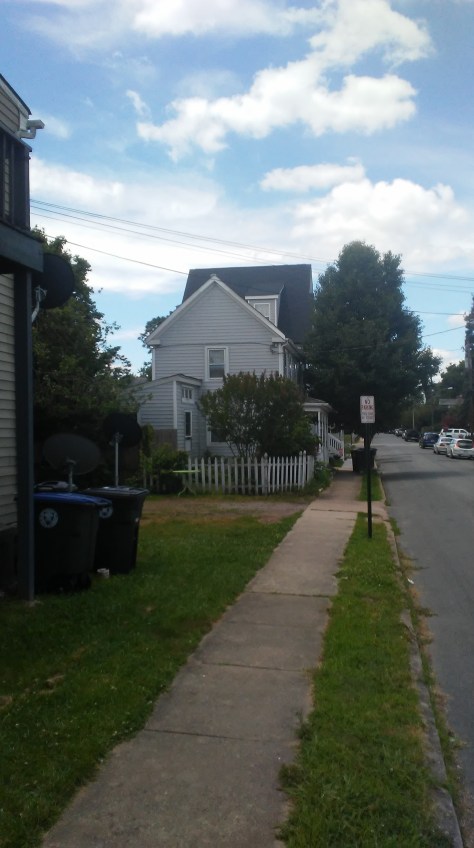
Looking south down Princess Anne Street toward the downtown area. The Irish Brigade used to be all the way down and at left. (I’ve been told that various restaurants close and re-open at the address, and … that the site of Mother’s Pub was also rebranded as the “new” Irish Brigade for a while? But by different owners?) That’s just confusing.
Just a little farther down on Princess Anne is the historic Fredericksburg Baptist Church. My girlfriend during the summer of 1991 sang in the Maranatha choir there.

Looking north on Princess Anne Street, toward Hardee’s, and where Fas-Mart and the comic shop used to be.
Does anyone else remember this grey house on Pitt Street, between Princess Anne and Caroline? (That extension with the latticed porch hadn’t been built yet in the 1990’s.) I think the house number is 209. It became a big party house in 1993 and 1994 … I was at a party with a bunch of New Hall people during my senior year, I think, when the cops arrived. I remember the house emptied out in an instant.
I myself slid down the outside of the house via the gutter from the second floor. (Seriously, people, when I went through my Spider-Man phase, I was really into climbing things.) I did something weird to the joint in my right thumb — it didn’t hurt much, but, to this day, my thumb still makes a clicking noise whenever I bend it.

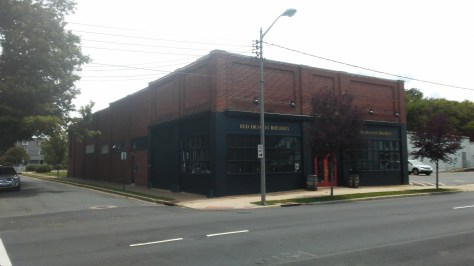
Nothing says “gentrification” like seeing an upscale “Red Dragon Brewery” where a creepy, vacant building used to be. Way to go, Fredericksburg.
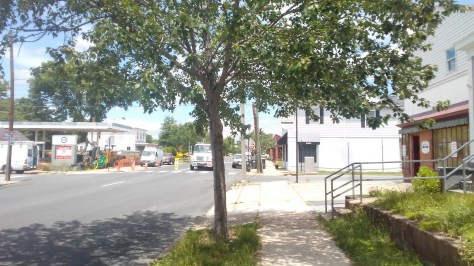
Heading south toward Caroline Street.


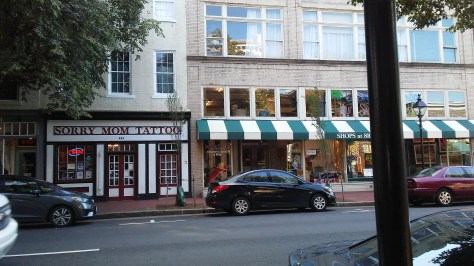
Caroline Street.


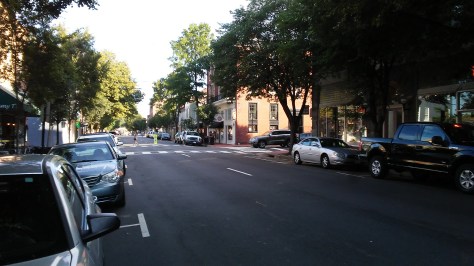
Looking south on Caroline from Pitt.

Looking back up Pitt from Caroline.







 Eric Robert Nolan, Author