Between the towers of the World Trade Center as a cloud passes between them. November 1998.

By Flickr user Beija (https://www.flickr.com/photos/beija/243997357) [CC BY-SA 2.0 (https://creativecommons.org/licenses/by-sa/2.0)%5D, via Wikimedia Commons

Between the towers of the World Trade Center as a cloud passes between them. November 1998.
By Flickr user Beija (https://www.flickr.com/photos/beija/243997357) [CC BY-SA 2.0 (https://creativecommons.org/licenses/by-sa/2.0)%5D, via Wikimedia Commons
NBC’s “Knight Rider” might be the granddaddy of all 1980’s high-tech super-vehicle shows — if I had to guess which one was the most popular or most fondly remembered, this would be it. (I suppose the other leading contender would be “Airwolf,” which we talked about a couple of months ago — but that was aimed at an older audience.)
“Knight Rider” was cheesy. But most 80’s action shows were cheesy, and I still remember it as being decent enough. Lord knows I and Mikey Wagner, the kid on the next block, were fascinated by it.
As anyone who remembers this show can attest, there is a key character that isn’t even hinted at in the intro below. The car was sentient. His name was K.I.T.T. (Knight Industries Two Thousand), and he was an artificial intelligence who actually who had a hell of a lot of personality. K.I.T.T. was a super-intelligent, talking, futuristic, sleek, black sportscar, and he was an incongruous damned hero to us kids.
The other star was Davis Hasselhoff as Michael Knight. We looked up to him too. Hasselhoff, of course, is now better known for his subsequent starring role as a moronic lifeguard on the categorically awful “Baywatch” (1989 – 2001). I remember seeing snippets of “Baywatch” in the 1990’s — it was constantly playing in the newsroom at my first job as a cub reporter. (The guys there loved it.) I remember being disappointed that one of my childhood heroes had somehow morphed into a male bimbo on the most saccharine and brainless TV show I had ever seen. Hey, “Knight Rider” was a show for kids … but it was goddam “Masterpiece Theater” when compared with “Baywatch.”
Weird trivia — the voice actor for K.I.T.T. was none other than William Daniels, who also gave a stellar performance as John Adams in 1972’s film adaptation of Broadway’s “1776.” It’s so weird seeing that movie and hearing the voice of K.I.T.T. come out of Adams’ mouth.
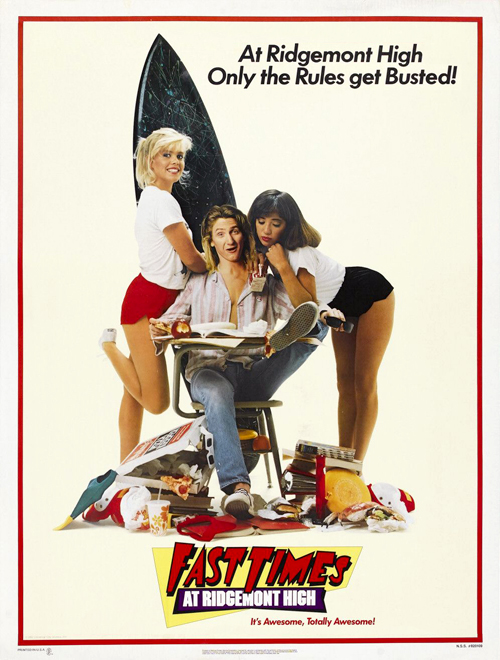
“Fast Times at Ridgemont High” (1982) is a pop-culture sacred cow that needs to be skewered. I’d rate it a 2 out of 10 for being a surprisingly inept and poorly scripted 1980’s “classic.”
I just don’t understand the fervent popular reverence for this movie among people in my age bracket. It was a minor legend when I was growing up. I was a fourth grader in 1982, and gradeschool boys could be divided into two groups: 1) those who had seen the “Phoebe Cates pool scene” and 2) those who had not, but wished they had. When I mentioned on social media a couple of months ago this year that I’d never actually gotten around to seeing this movie, my friends were roundly astonished.
Why do they think this film is indispensable viewing? Maybe there’s something I’m missing. I’m tempted to group “Fast Times at Ridgemont High” together with other beloved 80’s films that just don’t resonate with me — like the understandably campy “Tron” (1982) or the unexpectedly sleep-inducing “The Big Chill” (1983). (I couldn’t even finish the latter.) But I can’t compare, because I know those movies are objectively good in a lot of ways, even if they weren’t to my taste.
Nor am I squeamish about raunchy sex comedies. (C’mon.) I pretty fondly remember “Porky’s” (1981), “Porky’s II: The Next Day” (1983), and “Revenge of the Nerds” (1984). I mentioned “Porky’s” to the friend with whom I watched “Fast Times” — I told her that it wasn’t highbrow entertainment, but I still remember it being crudely, blasphemously funny.
This movie was just a thinly scripted small collection of vignettes, with no overall plot outside of teenagers having sexual encounters that are … awkward and bluntly sad, for the most part. (Sean Penn’s character does drugs.) The dialogue is terrible. None of the characters are likable — even the story’s nerdy, well-meaning protagonist is grating.
I didn’t really laugh once at anything the director intended — I only laughed at the haircuts and the clothes. I just can’t believe that the screenwriter here was Cameron Crowe, who also wrote what is possibly my favorite movie of all time — the widely but unfairly maligned “Vanilla Sky” (2001). (Crowe apparently adapted the screenplay from a novel he wrote.)
There is some enjoyment to be had in watching Penn’s stoner character. It was fun seeing a well known serious actor in an early comedic role. Penn is a decent character actor, and it looks like he was having fun. I do get why kids in the 80’s found him funny.
It’s also fun seeing the handful of other young actors who would go on to great careers (Judge Reinhold is always funny) but, again, this is something that the filmmakers can’t take credit for.
Hey, if you want a slice-of-life dramatic comedy about teenagers in the 1980’s, then go rent “The Breakfast Club” (1985). It wasn’t perfect, but it was damn good movie that tackled many of the same issues as this movie, but with intelligence and effective humor. Or, try the oddball “Ferris Bueller’s Day Off” (1986). Both movies portray teenagers in the 80’s who are smart, likable and emphathetic, in varying degrees. I myself went to high school in the 1980’s, and I assure you they were around.
Jeepers.
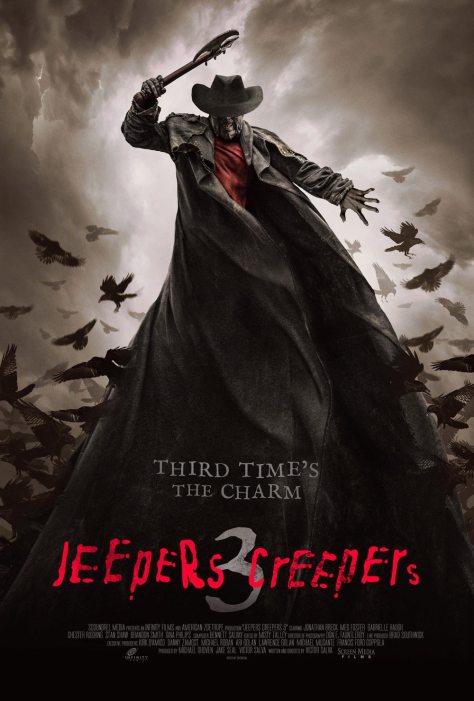
The first two “Jeepers Creepers” movies are vastly underrated classics, in my opinion — they’re well scripted and boast a truly original and frightening bogeyman. The third, regrettably, struggles to retain even a B movie charm. It’s a substandard horror film that I’d only grudgingly rate a 4 out of 10.
“Jeepers Creepers 3” (2017) is cloddishly written and awkwardly filmed. The film also suffers from action sequences that are absolutely cartoonish. A lot of this stems from the titular Creeper’s antique vehicle, which is now inexplicably depicted as being … conscious? Possessed by the Creeper? It drives itself, deflects bullets, launches projectiles, and contains booby traps that defy physics. This leads to some Wile E. Coyote-style fight scenes with the story’s various protagonists, in which the saddest victim is the franchise’s credibility.
About those protagonists — there are far too many to examine with any real success; the two ostensible teenage main characters fall a bit flat. There are so many characters that have backstories connected with the Creeper (and his signature, decades-hopping supernatural murder sprees) that the film simply becomes confusing. And that confusion is made worse by this film’s chronology with the previous movies — it takes place immediately after the first, but before the events of the second. (In all fairness, maybe the problem is me … I am being quite honest when I write here that I just do not follow movies as well as other people.)
With all of this exposition, though, one bit of lore is egregiously omitted – contrary to some of the movie’s advance press, we learn nothing about the creature’s origins. And this is extremely odd, because a bunch of characters do. There is a befuddling central plot point where the good guys methodically gain knowledge of their otherworldly foe by … touching one of its severed body parts. But we, the viewers, learn nothing.
Even the makeup and special effects were inferior to the prior films.
I’m confused by all of the things I’ve written above, as “Jeepers Creepers 3” was written and directed by Victor Salva, who wrote and directed the excellent previous movies in 2001 and 2003.
I hope I’m not being too hard on the movie, because there’s still some fun to be had. Jonathan Breck still chews the scenery quite nicely as the Creeper, and the monster’s character concept still manages to please. In a horror movie market often dominated by seemingly interchangeable serial killers and undead little girls, the Creeper is a truly inventive monster — part human; part gargoyle; part body-stealing, feral Frankenstein’s monster. He’s fun to watch, particularly for horror fans who’ve grown tired of the Patrick Batemans and the various angry ghost children that endlessly haunt the zeitgeist. You could do a lot worse for a plot-driving antagonist.
And, thanks to so brutal a bad guy, there are occasional moments of tension in the movie. It’s a bit scary, for example, when he attacks a group of teenaged motorcyclists.
This isn’t enough to make recommend paying for the movie, however — even if you’re a fan of the franchise, as I am. I’d wait for “Jeepers Creepers 3” to hit Netflix or Hulu, or wait until it’s playing on SyFy again.


Like the two films preceding it, “War for the Planet of the Apes” (2017) is an intelligent, well rounded science fiction thriller. The newest “Apes” series has been leagues ahead of the campy late-1960’s original films, and of course Tim Burton’s bizarre 2001 remake.
There is more going on here than a simple “apes vs. humans” tale. Nor does it engage in simplistic moralizing, in which the innocent animals must escape from their human oppressors. There’s a hell of a lot of moral complexity — something noted by the many positive reviews for the film. One of the things that I liked the most was a compelling new surprise plot element, even though it approaches deus ex machina territory. I won’t spoil it here, but it’s bleak, it’s frightening, and it makes you think. Given the new information one character explains to another … it’s hard to say who is the bad guy, isn’t it? How this plot element plays out is damned effective too.
This movie also superbly renders non-human characters — both in terms of its smart script and its special effects (a combination of both CGI and human actors). I was greatly impressed at the detailed and lifelike facial expressions.
The action sequences were well executed, too, and the film had an epic feel. (Although this would be a decent conclusion to a trilogy, filmmakers Matt Reeves and Martin Bomback have gone on record stating they wouldn’t be averse to future sequels.)
Still, I must confess that my attention sometimes wandered. I think the pacing was a bit off. It also didn’t help much that the conclusion of the final action set piece was spoiled by one of the film’s trailers. (What the hell were they thinking? Who makes these decisions? Was there any backlash from fans who didn’t want advance knowledge of the film’s ending?)
Although this was an exceptionally well developed film, I just can’t give an unusually high rating to a movie that didn’t always hold my interest. I believe, therefore, that I’d rate this an 8 out of 10.

I feel the same way about “The Conjuring” (2013) as I did about its prequel, “Annabelle” (2014) — it has all the earmarks of a bad movie, but it inexplicably succeeds anyway.
Seriously — this film has clunky exposition, cheesy dialogue and over-the-top plot developments (toward the end), not to mention a plot setup that’s in questionable taste. (The movie suggests that the innocents condemned by the infamous 1692 Salem witch trials were indeed witches. This feels a bit awkward to anyone who read Arthur Miller’s “The Crucible” in high school.) “The Conjuring” also plays out like a love letter to Ed and Lorraine Warren, the controversial paranormal investigators who are largely the subject of the film (played by Patrick Wilson and Vera Farmiga). This last offense is forgivable, I suppose — the film was made with the Warrens’ blessing, and Lorraine Warren was even present as a “consultant” during its production.
Strangely, however, these flaws were barely noticeable to me when I watched it. I had a good time. “The Conjuring” just happens to be a decent fright flick that delivers on the scares.
I think James Wan’s skilled directing has a lot to do with that; the film works visually. (I could name specific instances where it works especially well, but I want to avoid spoilers.)
The acting helped a lot too — Wilson and Farmiga are both damned good, as is Lili Taylor as the afflicted family’s mother. (I’ve admired Taylor’s acting since her long ago 1998 guest appearance on “The X-Files,” and she was equally good as a bad guy in 1996’s “Ransom.”) Ron Livingston was also quite good in the role of the father — if you have trouble placing his face, as I did, he also played Captain Nixon in HBO’s “Band of Brothers” (2001). He seems to have a talent for playing the likable everyman — he’s great here as the somewhat feckless father, and functions well as a kind of viewer surrogate. I should also mention the young Joey King as one of the family’s daughters — she played the role of a terrified child to perfection, and really raised the stakes emotionally.
Despite really enjoying most of the movie, some of my enthusiasm for “The Conjuring” flagged a bit toward the end. The denouement here includes an exorcism, and those are almost always boring. There are only so many ways that scenario can play out, and we’ve seen them all — and I shouldn’t even need to name that certain 1973 film that did it best. Furthermore, we see our story’s demon do some pretty extraordinary things, even by demon standards. It can apparently transport itself great distances (using an inanimate object as a kind of fax machine?), and can manipulate both the laws of physics and the area’s wildlife. It was all a little too much for my willing suspension of disbelief.
Again, though — this was a good movie. I’d give it an 8 out of 10, and I’d recommend it to anyone looking for a good scare.

The premise for HBO’s “Westworld” sounds like a bad situation comedy — robot cowboys entertain the rich at a futuristic theme park. There are showdowns and shootouts, and hilarity ensues when the guests fall in love with the coy robot ladies.
But “Westworld” is an arguably brilliant serial science fiction thriller, far transcending its gimmicky central plot contrivance. It is occasionally weighted down by some challenges with pacing, story structure and exposition. But I still loved it enough to get hooked on it immediately, and I’d give it a 9 out of 10.
I think it’s the smartest science fiction show I’ve seen in a long time. Its brilliance doesn’t stem from its kitsch premise. (I haven’t seen the original 1973 film based on Michael Crichton’s screenplay, but I’ve seen it lampooned at least once.) It generally doesn’t extend from the show’s many twists and surprises, however well executed they are. Nor does it stem from the show’s ambitious discussions of the nature of consciousness.
Its brilliance, in my opinion, stems from its nuanced and surprisingly disturbing depiction of human evil. Of course there’s the obvious — the theme park exposes human depravity by allowing people to rob, rape and murder lifelike human surrogates with impunity. But there is far more that the show has to say. To get a sense of it, you have to watch the entire 10-episode season, and see several key character arcs reach completion. One of these arcs was so dark and cruelly contemplative that it’s stayed with me long after I watched the final episode.
The show is well made at every level. It’s gorgeously shot, at locations throughout California, Utah and Arizona. The special effects are great. Anthony Hopkins is characteristically perfect as the park’s patriarch, and Jeffrey Wright is terrific as his well meaning right hand. (That actor is starting to grow on me.) The entire cast is quite good — even those in relatively minor roles, like the two hapless technicians (nicely portrayed by Leonardo Nam and Ptolemy Slocum) who become entangled in the events connected with the park’s malfunctions.
Ed Harris, however, consistently steals the show as “the Man in Black,” a park guest who vacations as a brutal rapist and murderer (and who we learn has another agenda, as well). He’s chilling. I never really saw Harris as an amazing actor before, despite seeing him in many roles, including his memorable turn in “A Beautiful Mind” (2001). But he was incredible here.
I wanted to give this show a perfect 10, but even someone who loves it as much as I do can see the weaknesses of this first season. Overall, “Westworld” is sometimes too drawn out. I feel the plot moves forward rather slowly, and I think Season 1 would be perfect if only it were carefully edited down from ten to maybe seven episodes. I found myself getting a little frustrated by the the fifth episode, when we see two major characters follow arcs that seem redundant. (I’m being intentionally vague here to avoid spoilers.)
The problem is compounded by the deliberately superficial nature of “Westworld’s” setting. This is a theme park with stereotypical stock characters associated with Hollywood westerns. Accordingly, its inhabitants have overly stylized speech and behavior. Furthermore, these androids are programmed to follow the same “loops” repeatedly, as the same preconceived story “narratives” are reused to entertain new patrons of the park.
It gets annoying. Yes, I know it makes perfect sense and is necessary in the context of the story. But it can be grating to someone who tunes in to see a science fiction show, and not a cheesy western. James Marsden is a decent enough actor, and he’s well cast as “Westworld’s” prototypical “good guy” cowboy. But seeing this character’s shtick over and over was irritating. So, too, were the sassy ladies at the brothel and some other minor characters.
Finally, I suggest that, for some viewers, “Westworld” may be hard to follow. I occasionally found it that way. There are twists that are wonderfully well crafted, gradually deciphered mysteries, and a very layered backstory. Finally, the show’s discussions of things like consciousness, morality and artificial intelligence can sometimes border on the didactic. (It helps a hell of a lot, though, when the actor delivering the exposition is the priceless Hopkins.) It’s a lot to take in. People tuning in should be prepared for some challenging, cerebral science fiction instead of easily digested, escapist fantasy.
All in all, this show was superb. If you’re a science fiction fan, you need to at least give it a try.
Unnecessary postscript: actor Jimmi Simpson sure looks a hell of a lot like a young Christian Slater.

DC Comics.

This is Matt Wagner’s cover for the Dark Horse Comics re-release of the series in 2001 — not its first publication by Comico in 1987.
I know this is a silly observation (and almost certainly unintended by Wagner), but this absolutely reminds me of the Green Lantern Corps comics. (Consider the color scheme combined with the placement of the circles, and even Christine Spar’s pose.)

 Eric Robert Nolan, Author