Tag Archives: 2008

A short review of “Bird Box” (2018)

Netflix’ “Bird Box” generally pleases — I’d rate it an 8 out of 10, and I’d recommend it to anyone looking for a creative and effective apocalyptic horror film.  A few reviewers call it a “high-concept” horror movie because of its MacGuffin — an invasion of otherworldly beings causes anyone who looks at them to hallucinate and become suicidally depressed.  (A handful of survivors escape the chaotic mass suicides because they are lucky enough not to lay eyes on the mysterious, mind-bending creatures which can become images of their victims’ worst fears.)

It’s a hell of a setup — it reminds many people of this year’s “A Quiet Place” and 2008’s unfairly maligned “The Happening.”  (Hey, I really liked that movie.)  For some reason, “Bird Box” reminded me of the 1985 “The Twilight Zone” episode, “Need to Know.”  (It’s a great ep.)  And the plot device pays off — “Bird Box” is genuinely unsettling, and the whole story comes across as a blackly inventive end-of-the-world tale.

Sandra Bullock is good here; supporting actors Sarah Paulson and John Malkovich are even better. (Malkovich is mesmerizing whenever he plays an intense or unpleasant character.)

The film suffers somewhat from puzzling pacing problems — sometimes the story appears to be unfolding too quickly, but by the end of the two-hour movie, it feels too long.  “Bird Box” was adapted from a structured 2014 novel by Josh Malerman; I strongly get the sense that it tries to squeeze too much of its source material into a the running time for a movie.  I honestly think I would have enjoyed it much more if its frightening plot device and interesting, well-played characters were explored in a mini-series.

There’s another disappointment too — we learn very little about the story’s antagonists, beyond one character’s hypothesis that they’re archetypal punishing figures from a number of the world’s religions.  I wanted to know more.


Bird_Box_poster

Cover to “Catwoman” #81, Adam Hughes, 2008

DC Comics.

Catwoman_Vol_3_81

Cover to “Hack/Slash New Reader Halloween Treat” #1, Tim Seeley, 2008

Devil’s Due Publishing.

Hack_slash_new_reader_halloween_treat_cover_a


Variant cover to “The Dark Tower: The Long Road Home” #5, Jae Lee, 2008

Marvel Comics.  Sketch variant cover (#5c).

1d859c0a5fb4648765cca9aae8c038aa_xl

Cover to “The Dark Tower: The Long Road Home” #4, Jae Lee, 2008

Marvel Comics.

Dark_Tower_The_Long_Road_Home_Vol_1_4


A short review of “Black Mirror” Season 3

“Black Mirror” (2011) remains the best science fiction show on television; I’d rate the six-episode third season a perfect 10.  The show continues to succeed at every level with its story concepts and their execution.  And I think it’s actually getting better.

It’s getting darker and harder hitting, too.  I’d guess that this season’s blackmailing-hackers episode (“Shut Up and Dance”) would be the one that the majority of viewers find the most disturbing.  For some reason, the man-vs.-monster story of “Men Against Fire” is the one that really got under my skin.

I was surprised to learn that nearly all of “Black Mirror’s” episodes are penned by series creator Charlie Brooker.  I’m still surprised at how many clever ideas and lean, smart scripts could spring from one writer.  I was so impressed that I looked Brooker up on Wikipedia — but was surprised to discover I’m unfamiliar with nearly all of his other work.  The one exception is “Dead Set” (2008) — the truly fantastic British zombie horror miniseries that I’ve been recommending to friends for ages.  That makes sense.

Anyway, I am fully and happily converted to “Black Mirror’s” cult following, and I enthusiastically recommend it to people who ask about it.  (The show’s popularity is still growing — I believe it appeals to the same kind of fans as those who flocked to the various iterations of “The Twilight Zone” and “The Outer Limits” of generations past.)  But I might actually suggest that newcomers begin with the second or third season, rather than the first.  Season 1 is terrific, but it’s three episodes are more subtle and thematic, while the latter seasons follow a more conventional story structure that might better appeal to more mainstream audiences.  (They have more satisfying twists and emotional payoffs, too.)

And a quick caveat — I’ll reiterate that this show is indeed dark.  There is a strictly human element to most of “Black Mirror’s” twists that is intended to surprise the viewer by provoking anxiety or dread.  For a show that relies on technological story devices, it succeeds even more with its old fashioned psychological horror.


1_m1

Cover to “Deadpool” #4, Ed McGuinness, 2008

Marvel Comics.

1128081-616489_2n7fj28_super

A short review of “Death Note” (2017)

True to its manga origins, Netflix’ “Death Note” (2017) seems cartoonish and sometimes intentionally silly.  That doesn’t stop it from being a lot of fun, though — this is the most original, offbeat horror tale I’ve seen in a while, and I’d rate it an 8 out of 10.

It’s definitely a genre-buster — it’s one part comic book, one part horror tale, one part eastern theological fantasy and one part dark teen romance.  It succeeds in part because it has an interesting supernatural story setup that seems reminiscent an episode of “The X-Files.”  (A magical notebook allows it owner to sentence anyone to death, simply by writing the victim’s name down, and describing how they die.)

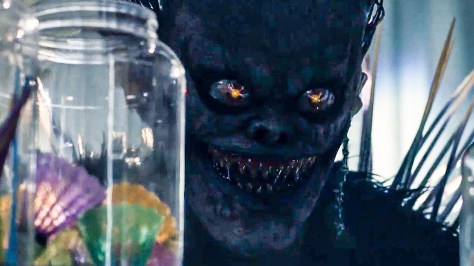
It also succeeds because it has a great bogeyman — a seemingly omnipotent demon named Ryuk.  His visual design is creative and wickedly creepy, and his character is menacingly voiced by none other than Willem Dafoe.

Finally, Shea Whigham is very good as the teen protagonist’s tough but likable dad.  I thought I remembered him only from his relatively minor role in this year’s “Kong Skull Island.”  But, as it turns out, he was actually the sympathetic escaped convict from 2008’s criminally underrated monster movie, “Splinter.”  He’s a great actor.

I really liked this.  I’d recommend it.


Death-Note-Light-Poster

maxresdefault

A very short review of “10 Cloverfield Lane” (2016)

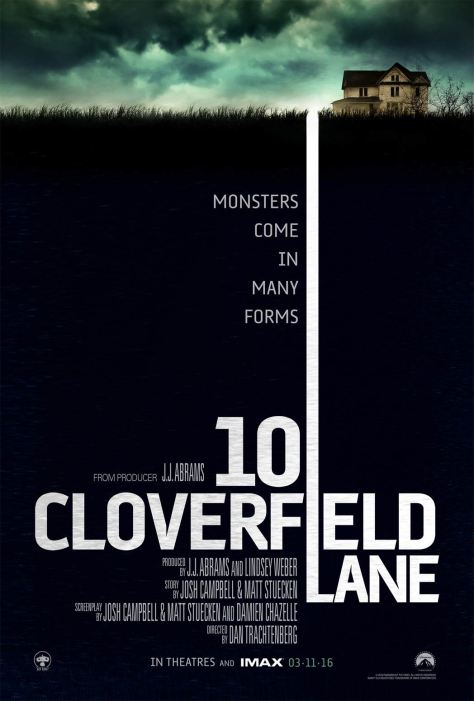
“10 Cloverfield Lane” (2016) is a capably written and well performed thriller; it might not be quite worth the high praise it seems to be receiving elsewhere, but I’d still give it an 8 out of 10.

Mary Elizabeth Winstead actually is terrific actress.  She has far more to do here than her one-note heroine in 2011’s underrated “The  Thing” prequel, and she performs beautifully.  John Goodman is perfect as a mentally ill, dubious savior.  John Gallagher, Jr. does just fine as a good-natured everyman in over his head.

I did think that “10 Cloverfield Lane” ran a little long for its content.  This could have easily been an especially well executed episode of a one-hour show like “The Outer Limits” or “The Twilight Zone.”  It’s feature-length format felt a little padded.  We don’t need the prologue explaining why Winstead’s character is traveling.  Nor do we need the movie’s slowly building character arc for Goodman’s “Howard.”  (We know to suspect his stability from the trailer.)

This appears to have very little to do with “Cloverfield” (2008).


10cl_poster (1)22

“Emilie” (2015) is a superb, gut-wrenching thriller.

I’ll come straight to the point — “Emilie” is an exceptional horror-thriller that belongs on your list of films to see, provided you can stomach some disturbing content.  This movie hooked me in under a minute, even before its title appeared on screen.  Then it kept me glued to it throughout most of its running length.  It could have been an even better film — a classic on par with “Psycho” (1960) or “Fatal Attraction”(1987), were it not for some key creative choices about halfway through.

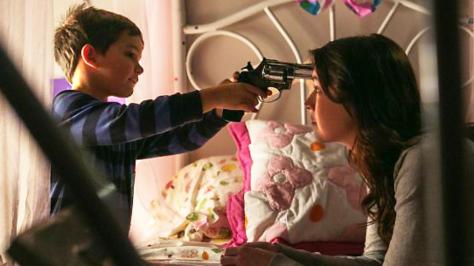
I’d give this movie a 9 out of 10.  It succeeds for two reasons — great acting and a script that perfectly employs dialogue that is at first subtle and nuanced, and then increasingly frightening.  The title character is a babysitter who is not what the parents expected, in more ways than one.  After some deliberately awkward character interaction with the departing parents, she proceeds to subject the children to a series of progressively more demented psychological games.  What follows is a thriller brimming with pathos.  The movie reminded me a lot of the critically acclaimed and controversial “Funny Games” (2007). That film also showed ostensibly innocent adversaries entering a family’s home after gaining their trust, and then doing awful things.

Emilie is played to perfection by Sarah Bolger, who has a beautiful, kind face, which only makes the character’s incongruous psychopathy even more unsettling for the viewer.  It took me a while to place the actress’ face, until I recognized her as the somewhat feckless protagonist of 2011’s “The Moth Diaries.”  I was impressed with her talent then as a hapless good guy, and I think her performance here was phenomenal.  She plays the innocent-looking, yet icy antagonist here with subtle, unnerving malice.  The rest of the cast is also uniformly quite good.  This is true even of the young child actors, but most especially of Joshua Rush.

The movie is briskly paced, but its sparing dialogue still manages to rattle and then shock.  It’s a sometimes obscene story of imperiled children that really gets under your skin.  Most of its directing is clean and clear.  Combined with the unusual score, it gives the story a dreamlike quality.

The movie loses its way just a little at about the 40-minute mark, when its perverse, moody dialogue and strictly psychological horror give way to the familiar elements of a boilerplate thriller.  An unnecessary backstory is given for our antagonist, delivered by an overly convenient, standard flashback sequence that feels out of place and that disrupts the pacing.  (“Her mind was shattered.”)  Then, other plot points also feel just a little by-the-numbers, moving “Emilie” away from true cinematic greatness and toward just being a very good horror flick.

Finally, Bolger’s villain is defanged a little when the script calls for her to lose her calm demeanor after the plucky, oldest child (Rush) defies her, in a well executed but entirely predictable David and Goliath story.  And her character’s reliance on a nameless, voiceless and superfluous confederate here also makes her a little less enigmatic.

How much greater would this movie have been if Emilie’s motivations remained a mystery?  What if, like “Funny Games” or “The Strangers” (2008), all we knew is that she was an highly intelligent sociopath acting for no discernible reason?  What if she were acting entirely alone?

And what if the horror remained strictly psychological, with no actual violence to up the ante until the closing minutes?  The most disturbing scenario I can think of is this — what if she were able to psychologically manipulate the children to violently turn against one another, or against their parents upon their return?  That could be an ambiguous, darker and far more thematic story than the second half of the film we see here.

Still, this was a damned effective scary movie, and that’s good enough.  I recommend it.

One more thing — there actually is a famous, heartwarming French romantic comedy entitled “Amelie” (2001), which I have not seen.  I think it would be blackly funny if some sentimental filmgoers wanted to rent that and accidentally picked up “Emilie.”

 

wjjgzh7t


1280x720-cOf