Tag Archives: Alien

Throwback Thursday: this intro for the 1984 TV premiere of “Alien” (1979)

Here’s another little goody related to ABC’s 1984 broadcast of “Alien” (1979) — the intro to it on “The ABC Sunday Night Movie,” complete with a content warning.

I am linking here, by the way, to the totally cool people at the Retro Channel on Youtube.


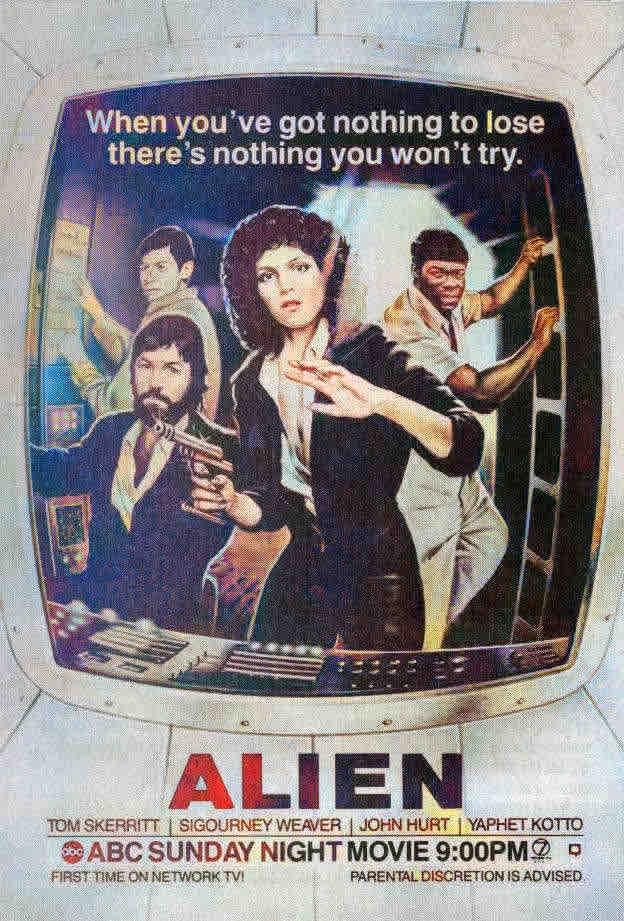
Throwback Thursday: this unfortunate 1984 ad for the network premiere of “Alien” (1979)

If you are even remotely familiar with Ridley Scott’s “Alien,” then you know that ABC’s marketing staff was not.

John Hurt is looking pretty spry.  (At least they had the good sense to leave Ian Holm and Veronica Cartwright out of this mess.)

Anyway … did it really take “Alien” five years to reach network television?  I seem to remember (falsely, I suppose) that it hit TV when I was still a very young child.  Yes, HBO carried it only a year after its theatrical release — maybe that’s what I’m remembering.  (People just called it “Home Box” back in the day.  Being a little kid, I thought they meant the physical “box” –the converter — that sat atop the television.)

Yet I also seem to recall my family having Showtime, but not HBO … and people on my street still just called any premium channel “Home Box?”  Whatever … it was a verrrry long time ago, and I wasn’t the brightest kid out there, anyway.


Source: Screen Gems on Facebook

My Facebook friends wanted me to make a meme out of my Ellen Ripley post.

So here it is.

Okay … in a deleted scene for “Aliens” (1986), Ripley is shown to have had a child, blah, blah, blah. But deleted scenes are not canon, My Dudes.

Postscript —  my fellow nerds know that this message works equally well with Ms. Selina Kyle.


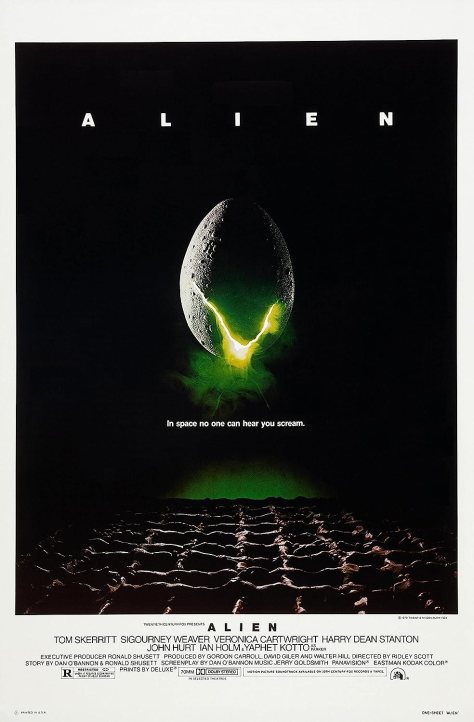
Poster for “Alien” (1979)

20th Century Fox.

Alien poster

A sure thing.

I noticed this last night.  Ridley Scott is a Cinema God, and I should be cast out for nitpicking his genre-defining masterpiece.  (If you need to ask which movie I am talking about, I’m not sure we can be friends.)

But the word nerd in me needs to point out that the computer here probably meant “ensure” instead of “insure.”


ensure

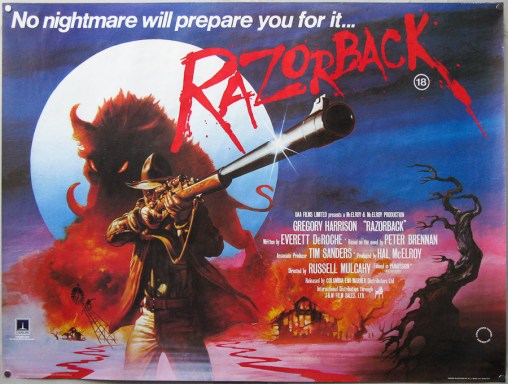
Throwback Thursday: “Razorback” (1984)!!

Legit question for rural Australians  — how do I kill the 30 to 50 feral hogs that run into my yard within 3 to 5 mins while my small kids play?

If you’re anything like me, you’re endlessly regaled by all the viral jokes this past week referencing “30 to 50 feral hogs.”  (And if you’re nothing like me, then you’re an intelligent adult and I congratulate you.  But you can google the new trope, which I have paraphrased above, if you want to.  It is the very height of preposterous predatory animal political humor.)

The jokes made me remember this little disappointment from the 1980’s — the Aussies’ own feral hog horror movie, 1984’s somewhat lethargic “Razorback.”  If memory serves, I rented this sometime around 1986, I suppose.  I  got it on VHS from my nearest shopping center’s sole mom-and-pop video store, before Blockbuster Video’s invasion reached my area.

There are people out there who fondly remember “Razorback.”  You can find some nice compliments about it over at Rotten Tomatoes.  People  enjoy its “atmosphere.”  People like Gregory Harrison a lot.

I didn’t like it.  Sure, it had a pretty neat electronic score that seemed trippy and cool to me as a young high school student.  But that was its only redeeming quality.  It started off with its depressing plot setup, which you can see in the first video below — the titular wild boar absconds with a baby boy.  (The boar also thoughtfully burns the child’s house down as it departs, to underscore that fact that it is an asshole.)

The rest of the movie is boring, because it’s yet another one of those monster movies where you never get to see much of the monster — right up until the movie’s poorly lit climax, which takes place in a slaughterhouse, I think?  Which is supposed to be ironic or something?  Don’t quote me on this stuff; 1986 was a long time ago.  For comparison, think of the legion zombie “thrillers” always available on Netflix where the zombies are always outside, and the movie just follows the indoors arguments among three very-much-alive people inside a windowless warehouse.  I want to invoke the inevitable “wild bore movie” pun, but I’m holding back, because my friends tell me that they have enough of that sort of thing.

I used my own money to rent “Razorback,” probably earned from either my confusing stint at McDonald’s (they just didn’t get me there) or my summer job cleaning boats and lobster traps.  (I lived on an island, people.)  I remember being slightly disgruntled that I’d wasted my hard-earned cash.

Honestly, though, I was a credulous kid when it came to a movie’s marketing.  When I read the back of the VHS boxes, I took things at face value.  I also had my heart set on something called “The Alien’s Deadly Spawn” (1983), which I realize now was just a no-budget early mockbuster ripping off Ridley Scott’s “Alien” (1979).  (It was always out.  I finally caught snatches of it on Youtube this past spring, and it looks pretty unwatchable.)


d9ltqha-b0a27d14-3f5b-4318-b5cc-63dc6ccbbb04

It’s here! It’s here!

My Johnson Smith Company catalog has arrived!!  This is the first time I’ve gotten one in the mail in … 30 years?  35?  (I ordered it on a lark when I wrote that Throwback Thursday post a few weeks ago.)

What a trip!  The mail order company has definitely changed somewhat.  The catalog is far fewer pages now; as you can gather from the picture below, it’s closer in size to those free circulars that you can pick up outside the supermarket.

I was disappointed to see that there are fewer pranks and novelties aimed at kids.  (Whoopee cushions and X-Ray Specs, for example, are nowhere to be found.)  There are far more wares aimed at adults — they include a surprising number of sex toys for both men and women.  (The company adamantly asserts in bold red letters that these items are Non-returnable.)  There is an abundance of pro-Trump merchandise too — check out that “Donald Trump Life and Times Coin & Trading Cards Collection” in the second photo.

Ah, well.  You can still find some cool stuff.  Those “Alien” and “Predator” … “Body Knockers(?)” look pretty neat.  And that Mego “Nosferatu” doll is goddam spectacular.  (I had no idea that the Mego Corporation  was still making toys.)  I don’t know whether its eyes glow in the dark, but I really, really want to believe that they do.


20190531_173548

20190531_181734

20190531_180618c

20190531_180719

I introduced a pal last night to John Carpenter’s “The Thing” (1982).

And she was predictably impressed.  Here are a few observations that came up for me, about the categorically rewatchable sci-fi/horror movie that keeps on giving.  (Yeah, I know I sound overly preoccupied with this movie, and that’s weird, but I’m just really into movies.  And John Carpenter’s “The Thing” is the same kind of classic for monster movie fans as “It’s a Wonderful Life” or “A Christmas Story” is for people who like Christmas movies.)  [THIS BLOG POST CONTAINS MAJOR SPOILERS.]

1) It was fun watching “The Thing” with someone who was seeing it for the first time.  Not only did I have to stifle a chuckle at her cry of “That poor dog!” during the opening credits, but I also watched while she guessed (incorrectly, as most of us did) at which characters had been assimilated by the shape-shifting monster as the story progressed.  (I noticed something ironic last night that I couldn’t mention.  When MacReady delivers his short “I know I’m human. And if you were all these things, then you’d just attack me” speech, all of the men he’s addressing are also still human … Unless I’m mistaken, Norris and Palmer are elsewhere.

Which brings me to what at first occurred to me as a … remotely possible plot hole in this otherwise perfect masterpiece.  If The Thing truly wants to escape Antarctica and prey upon the rest of the world, it doesn’t need to assimilate (or “Thingify,” as I like to think) everyone in the camp.  It only needs to overtake a single human.  (This would be the silhouetted figure that the dog first approaches; my money’s on Norris.)  Think about it … nobody stationed at Outpost 31 remains at the research station indefinitely.  They’d cycle out at the end of a shift of … six months?  Eight months?  Longer?  (And what about vacations and holidays?)  Sooner or later, they’d fly home.  And, having perfectly replicated a human’s anatomy, The Thing need only sustain itself until that departure by eating the same food the other humans were eating.  Then, as soon as it arrived at any other, warmer location on earth, it could attack life in its abundance.

But this morning I realized that my analysis here is faulty.  First, the humans were already getting wise to The Thing and its means of procreation — thanks to a pre-diabeetus Wilford Brimley wisely intoning, “That ain’t dog.”  Maybe The Thing was smart enough to realize the humans could effectively quarantine it.  Second, I am assuming in my criticism that “The Thing” is acting as a single entity.  Yet it shouldn’t act that way at all; this is the entire point of MacReady’s “blood test.”  While one incarnation of The Thing is safely munching on canned goods disguised as a human, a separate incarnation was sitting in storage, exposed — presumably only until the humans finally realized it needed to be destroyed somehow.  That iteration of The Thing needed to attack and duplicate Redding if it wanted to save itself.

2)  The Thing actually shouldn’t need to reach civilization in order to begin attacking all life on earth; it only needs to reach the Antarctic coast. If it enters the water and begins assimilating sea life (and why shouldn’t it be able to?), then it’s game over.  I said last night that “a fish can travel wherever it wants,” which my friend found pretty funny, but it’s true.  A Thingified fish (or its fish-Thing progeny) could arrive at any continental coastline.

3)  If The Thing replicates a human perfectly on a cellular level, then … might it be reluctant to kill anyone else, because it would basically be a human?  (Obviously, the film’s plot-driving antagonist has no such reluctance, but … still, think about it.)  If it perfectly replicates a human brain, right down to its cellular structures and chemistry, then wouldn’t it have a conscience and experience empathy?  My friend pointed out the reductionist nature of my question, though — it assumes that conscience and empathy can have only physical origins.

4)  The movie’s characters (and most viewers) assume that The Thing is “a lifeform” or an organism.  Is it, or is it simply “live” tissue?  Somebody on the Internet Movie Database message board pointed out long ago that it’s “just cells,” and that’s … literally true; the film even shows this via crude 80’s-era computer graphic.  Is it an “organism” if it is simply tissue that replicates?  Or is it no more a “lifeform” than a cancer, or tissue grown in a lab?

5) I honestly opine that the film is perfect, or very nearly so.  It is the paragon of sci-fi/horror movies.  And I’d put it on par with other films that I hold virtually perfect, like “To Have and Have Not” (1944), “Alien” (1979), “Blade Runner” (1982), “Aliens” (1986), “The Accidental Tourist” (1988), “Alien 3” (1992) and “Vanilla Sky” (2001).

6)  My friend reaaaally likes Kurt Russell’s hair in this film.

Okay, enough.  I’m sorry about this.  Hey, at least I’m not obsessing over comics tonight.


421rmr3zl7tab4ovnwtundj3nhk

Throwback Thursday: “Movie Monsters From Outer Space,” 1983

This was another book during my grade-school days that really fed my excitement about monsters — Jerry A. Young’s 1983 children’s book, “Movie Monsters From Outer Space.”  (Why does the author’s name sound so much like a pseudonym to me?)

I’m sure it’s obscure by now.  If memory serves, this was another title I ordered from those classroom bulletins put out by Scholastic Book Clubs.  (I was in the third grade, I think.)  It gave kids a brief, fun run-down of a bunch of space-based baddies — those are the Cylons from the original “Battlestar Galactica” (1978) on the cover.

It featured a bunch of older B-movies too.  I remember really wanting to see “Forbidden Planet” (1956) after seeing a picture of its monster there.

I also seem to remember reading about Ridley Scott’s original “Alien” (1979), although I suppose that I could be recalling another book.  (It would be odd if Scott’s masterpiece were described here, because it was … kinda not for kids.)


51vNHayotEL._SX340_BO1,204,203,200_


d53a39702c7db300584e2bcf0c167bf5


Neill Blomkamp’s free new sci-fi short films are goddam nightmare-inducing.

Writer-director Neill Blomkamp (who brought us 2009’s “District 9” and who wanted to bring us a fifth “Alien” installment) is currently releasing a series of sci-fi short films via his “Oats Studios” channel on Youtube.  There have been four released so far, with a fifth, “ZYGOTE,” scheduled for release today.

The two to which I’ve linked below, “Firebase” and “Rakka,” are fantastic.  They’re both military science fiction, they’ve both got lots of gore and great special effects, and they both show Blomkamp’s trademark predilection for body horror.

They’re both incredibly dark stories, too.  “Firebase” is disturbing; “Rakka” is downright horrifying.  (The Eiffel Tower scene … yeesh.)  It might make you smile, though, to see none other than Sigourney Weaver fighting alien invaders.

If “Firebase” doesn’t make much sense to you, try not to let it hamper your enjoyment of it.  (The short’s reveal shows us that many of these disparate story elements actually aren’t supposed to make much logical sense, considering their cause.)  And you should know ahead of time that both of these short films should serve as prologues for sequels or longer tales.  (Maybe Blomkamp is planning their denouements in subsequent shorts?)

I was so befuddled by “Firebase” at first that I wound up turning it off and then returning to it later.  I still think that its writing could be cleaned up a bit.  It’s definitely out there, and strays from science fiction into fantasy and … maybe even theology.  It was “Firebase,” however, that stayed with me and really got under my skin — much more than the more straightforward invasion horror story, “Rakka.”