Tag Archives: Eric Robert Nolan

Thank you to ALL who serve.

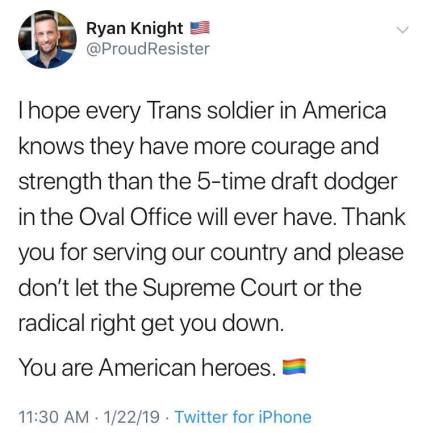
I don’t know much about transgender people or issues.  I don’t think that I’ve ever actually known a transgender person outside of social media (unless I was simply unaware of it).  But after reading the below tweet by Twitter user Ryan Knight, I’d like to echo his sentiment.

Right-thinking Americans are grateful for your service in a job that is so difficult and dangerous that we civilians cannot even fully appreciate what you do.  We know that you are the best of our countrymen.  The actions of a puerile and disastrous president cannot change that.

We support you, and not him.


50623444_535315313640180_8515407645169942528_n


This picture of tonight’s lunar eclipse is kinda terrible.

You probably should have gone outside and viewed it yourself, if you didn’t.

It was also a … Super Blood Wolf Moon, which I am sure is significant somehow.  I could Google it, but it is so damned cold outside that my fingers are partially frozen, and I can hardly type this blog post.

It actually was vaguely creepy to watch; it’s easy to see why medieval folks would have freaked out about this if they didn’t know the cause.

Somebody needs to name their band “Super Blood Wolf Moon.”  (Maybe I could talk those Skybald chaps into renaming themselves.)  Or a child.  A child would be even better.


OLYMPUS DIGITAL CAMERA

I introduced a pal last night to John Carpenter’s “The Thing” (1982).

And she was predictably impressed.  Here are a few observations that came up for me, about the categorically rewatchable sci-fi/horror movie that keeps on giving.  (Yeah, I know I sound overly preoccupied with this movie, and that’s weird, but I’m just really into movies.  And John Carpenter’s “The Thing” is the same kind of classic for monster movie fans as “It’s a Wonderful Life” or “A Christmas Story” is for people who like Christmas movies.)  [THIS BLOG POST CONTAINS MAJOR SPOILERS.]

1) It was fun watching “The Thing” with someone who was seeing it for the first time.  Not only did I have to stifle a chuckle at her cry of “That poor dog!” during the opening credits, but I also watched while she guessed (incorrectly, as most of us did) at which characters had been assimilated by the shape-shifting monster as the story progressed.  (I noticed something ironic last night that I couldn’t mention.  When MacReady delivers his short “I know I’m human. And if you were all these things, then you’d just attack me” speech, all of the men he’s addressing are also still human … Unless I’m mistaken, Norris and Palmer are elsewhere.

Which brings me to what at first occurred to me as a … remotely possible plot hole in this otherwise perfect masterpiece.  If The Thing truly wants to escape Antarctica and prey upon the rest of the world, it doesn’t need to assimilate (or “Thingify,” as I like to think) everyone in the camp.  It only needs to overtake a single human.  (This would be the silhouetted figure that the dog first approaches; my money’s on Norris.)  Think about it … nobody stationed at Outpost 31 remains at the research station indefinitely.  They’d cycle out at the end of a shift of … six months?  Eight months?  Longer?  (And what about vacations and holidays?)  Sooner or later, they’d fly home.  And, having perfectly replicated a human’s anatomy, The Thing need only sustain itself until that departure by eating the same food the other humans were eating.  Then, as soon as it arrived at any other, warmer location on earth, it could attack life in its abundance.

But this morning I realized that my analysis here is faulty.  First, the humans were already getting wise to The Thing and its means of procreation — thanks to a pre-diabeetus Wilford Brimley wisely intoning, “That ain’t dog.”  Maybe The Thing was smart enough to realize the humans could effectively quarantine it.  Second, I am assuming in my criticism that “The Thing” is acting as a single entity.  Yet it shouldn’t act that way at all; this is the entire point of MacReady’s “blood test.”  While one incarnation of The Thing is safely munching on canned goods disguised as a human, a separate incarnation was sitting in storage, exposed — presumably only until the humans finally realized it needed to be destroyed somehow.  That iteration of The Thing needed to attack and duplicate Redding if it wanted to save itself.

2)  The Thing actually shouldn’t need to reach civilization in order to begin attacking all life on earth; it only needs to reach the Antarctic coast. If it enters the water and begins assimilating sea life (and why shouldn’t it be able to?), then it’s game over.  I said last night that “a fish can travel wherever it wants,” which my friend found pretty funny, but it’s true.  A Thingified fish (or its fish-Thing progeny) could arrive at any continental coastline.

3)  If The Thing replicates a human perfectly on a cellular level, then … might it be reluctant to kill anyone else, because it would basically be a human?  (Obviously, the film’s plot-driving antagonist has no such reluctance, but … still, think about it.)  If it perfectly replicates a human brain, right down to its cellular structures and chemistry, then wouldn’t it have a conscience and experience empathy?  My friend pointed out the reductionist nature of my question, though — it assumes that conscience and empathy can have only physical origins.

4)  The movie’s characters (and most viewers) assume that The Thing is “a lifeform” or an organism.  Is it, or is it simply “live” tissue?  Somebody on the Internet Movie Database message board pointed out long ago that it’s “just cells,” and that’s … literally true; the film even shows this via crude 80’s-era computer graphic.  Is it an “organism” if it is simply tissue that replicates?  Or is it no more a “lifeform” than a cancer, or tissue grown in a lab?

5) I honestly opine that the film is perfect, or very nearly so.  It is the paragon of sci-fi/horror movies.  And I’d put it on par with other films that I hold virtually perfect, like “To Have and Have Not” (1944), “Alien” (1979), “Blade Runner” (1982), “Aliens” (1986), “The Accidental Tourist” (1988), “Alien 3” (1992) and “Vanilla Sky” (2001).

6)  My friend reaaaally likes Kurt Russell’s hair in this film.

Okay, enough.  I’m sorry about this.  Hey, at least I’m not obsessing over comics tonight.


421rmr3zl7tab4ovnwtundj3nhk

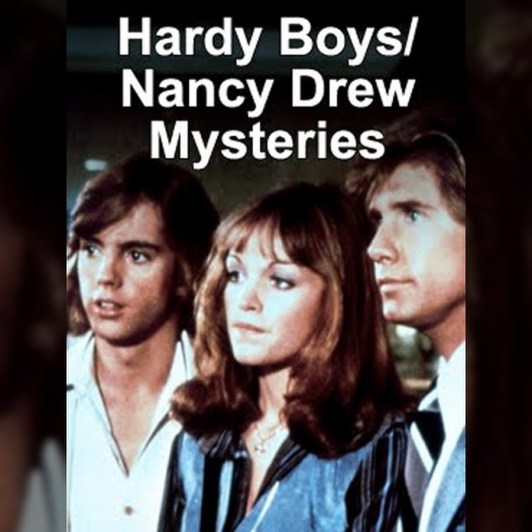
Throwback Thursday: “The Hardy Boys/Nancy Drew Mysteries” (1977-1979)!

“The Hardy Boys/Nancy Drew Mysteries” (1977-1979) is another show that I remember fondly, if very vaguely, from my very early childhood.  It ran on ABC for a scant three seasons (over a two-year period), and that sounds positively odd to me, because my memory has morphed it into something that seems like a much bigger part of the 1970’s.

I also remember it being two different shows, but that maybe makes sense — the first season of the program had a weird format in that you saw a standalone adventure of the Hardy Boys one week, and then a Nancy Drew outing the following week.  (The characters, of course, were based on the young adult books written respectively by Franklin W. Dixon and Carolyn Keene.)  They eventually went on to have adventures together,  Wikipedia tells me, although Nancy Drew had a reduced role, and was eventually dropped altogether in the third and final season.

Wikipedia also tells me that the show’s third season portrayed the Hardy Boys as … adults?  And that they were agents of the Justice Department?  And that the Season 3 premiere saw the younger brother’s fiancee killed by a hit-and-run driver?  I definitely don’t remember that — and it seems a little darker from what I remember of 1970’s primetime television shows.

I loved the show, even if I was too young to follow its relatively simple stories well.  (I would have been in either kindergarten or the first grade.)  But it was a program intended for “big kids” (my older siblings had the books), and that made it wonderfully cool to me.

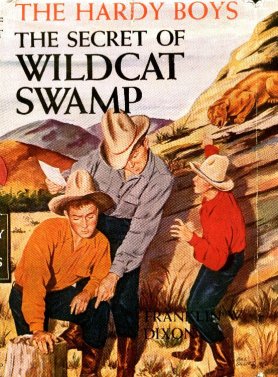
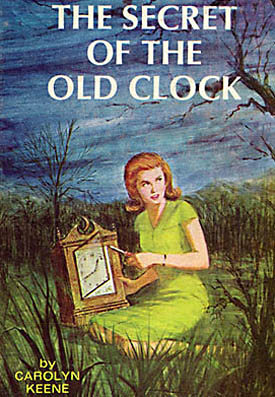
I moved onto the books myself, by the early 1980’s.  I loved those too.  The two that I remember are “The Secret of Wildcat Swamp” (with the Hardy Boys) and “The Secret of the Old Clock” (with Nancy Drew).  It was the Wildcat Swamp adventure that inducted me into the club — you see that snarling mountain lion on the cover?  That was utterly enticing to me when I found the book in the bottom of the closet I shared with my brother, when I was … maybe in the third grade, I guess.  (It looked a lot like the “saber tooth tiger” baddie in that Aurora model kit that I loved so much.)  I kept pondering that scene and wondering what the outcome was.  (Did they even have guns?!  Would the dad or whoever that was protect them?!)  One day, I finally accepted the challenge of reading what seemed like a very long book to me at the time, and I wasn’t disappointed.  That’s the power of a good book cover, I guess.


unnamed


hardy_boys_cover_31 book

Have you heard of the new “Trump Combo” at Burger King?

It’s a hamberder, a cup of covfefe (served smocking hot), and a side of lies.

(You could also substitute orange soda for the drink, if you want.)

[Update: a couple of clever pals of mine on Facebook suggested that we should also include word salad and Cheetos. ]


A review of “Hush” (2016)

I feel like I should have enjoyed “Hush” (2016) more than I did.  It isn’t a bad movie — it’s well made, and it stars Kate Siegel, who this year’s exceptional “The Haunting of Hill House” has led me to really like as an actress.  (Siegel also co-wrote the film with director Mike Flanagan, who is her husband and who was also the writer and director of “Hill House.”)  Siegel is again quite good, and their collaboration here results in a competent, serious horror-drama with no glaring flaws.

Yet my mind wandered.  Even if there was nothing seriously wrong with “Hush,” it didn’t much distinguish itself.  Just about everything you watch here is a standard stalker-vs.-lone-woman scary movie, with little in the way of twists or unexpected plot developments.

Yes, the difference here is that the protagonist is deaf and mute, and is therefore less able to defend herself — but Siegel and Flanagan don’t capitalize on that much in conceiving this story.  By the end of the film, I didn’t get the sense that the character’s disability even affected the course of the story very much.  Events would have unfolded more or less the same way if she hadn’t had this disability.  (Or am I missing something?)  I also get the sense that the protagonist being an author was supposed to affect her choices and strategies in trying to survive, but that didn’t come across consistently or well.  (And it results in “tricking” the viewer at one juncture in a way I didn’t like.)

I can’t actually recommend “Hush” to others because it didn’t thrill me.  But I can’t objectively say that it’s a bad movie.  So I figure I’ll rate it here a 7 out of 10.

A few random observations:

  • Siegel is a talented performer.  I predict she’s going to go on to great things.  Don’t let my lukewarm response to this film dissuade you from catching her elsewhere — especially in “The Haunting of Hill House.”
  • The story’s antagonist is fairly generic; he appears to be simply be a random serial killer in the script, and we get hardly a hint about his motivations.  But John Gallagher Jr. breathes plenty of life into him with a disturbingly authentic, naturalistic performance.  He’s also a very good actor.
  • I saw a plot twist coming that didn’t actually occur, and I wonder if what I saw was a vestige of an earlier version of this movie’s script.  (And it isn’t a spoiler if it didn’t happen.)  During a stalk-and-talk scene in which the bad guy taunts his victim, he inexplicably addresses Siegel’s character as “Squish.”  That sounds like a pet name that parent would give to a very young child.  The twist I predicted was this — Gallagher’s character was not a serial killer who selected his victims at random, but a long lost, homicidal brother who was then parodying the parent by invoking the pet name.  He was motivated by pathological jealousy after growing up with his disabled sister, who he felt monopolized his parents’ attention and sympathies.
  • We learn from dialogue that the protagonist became deaf and mute after contracting meningitis when she was a child.  I knew that meningitis could make a person deaf (or blind).  But … also mute?  Why am I skeptical about that?  Wouldn’t that only happen if someone became deaf when he or she was a baby — so that the disease could delay key early childhood language-acquisition processes?  I have no idea why I am so hung up on this minor bit of exposition.  Maybe watching so many zombie or plague movies has made me a stickler for the way diseases are portrayed in a horror story.


hush-movie-poster

“This Windy Morning” featured by The Piker Press

I’m very pleased to share here that my poem “This Windy Morning” was published today by The Piker Press.  You can find it right here.

The Piker Press is an outstanding online journal of arts, sciences, fiction and non-fiction, and I remain grateful to Editor Sand Pilarski for allowing me to share my voice with its readers.

(And don’t you just love that artwork they selected?!)


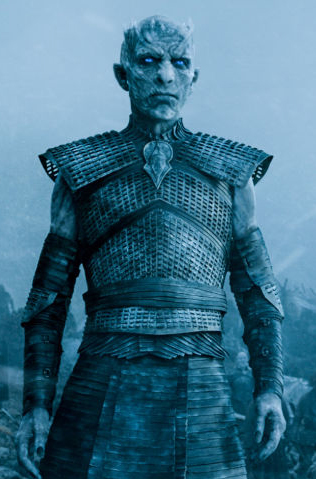
What is the Night King’s favorite movie thriller? “Wight Bird in a Blizzard.”

[THIS POST CONTAINS *MAJOR* SPOILERS FOR “GAME OF THRONES.”]

*

*

*

*

*

That terrifying moment when you realize that the Night King has air superiority, and can probably convert it to naval superiority …

What if he flies over the ocean and “converts” the entire Golden Company as they’re enroute to Westeros from Essos? That way the army of the dead can attack from the south with a navy, in addition to attacking from the north. Things were easier when he couldn’t just fly anywhere and augment his forces wherever he wanted, right?

If the Night King DOESN’T follow this (apparently most logical) strategy, and attack from two fronts, would it be a plot hole?

I at first wondered if maybe the Night King needed to be near his wights in order to animate them. But … the captured wight in Season 7 was alllll the way down in King’s Landing when our heroes showed it to Cersei, while the Night King and the white walkers hadn’t even gotten to the Wall yet.  And that wight up and got jiggy with it just fine.

Bear in mind that Dany’s dragons appear capable of flying virtually anywhere in a very short period of time; fans even decried the “plot hole” when the dragons flew so inexplicably quickly from Dragonstone to north of The Wall to rescue Jon Snow’s wight-hunting party. I suppose we could lampshade this by saying that their speed is indeterminate because they’re magical creatures.

And the undead dragon at the end of Season 7 looked like it was moving even faster than a live dragon, right? This was consistent with what we’ve already seen on the show. The wights, animated by magic, often move a lot faster than living humans.

Yeah, you’re right — it’s a laundry day, which is why I’m procrastinating again by sitting here blogging about “Game of Thrones.”


night_king

“When I said Mexico would pay for the wall … obviously I never meant Mexico would write a check.”

“The past was alterable. The past never had been altered.

“Oceania was at war with Eastasia. Oceania had always been at war with Eastasia.  A large part of the political literature of five years was now completely obsolete. Reports and records of all kinds, newspapers, books, pamphlets, films, sound-tracks, photographs — all had to be rectified at lightning speed. Although no directive was ever issued, it was known that the chiefs of the Department intended that within one week no reference to the war with Eurasia, or the alliance with Eastasia, should remain in existence anywhere. ”

— from George Orwell’s “Nineteen Eighty-Four”


cvbs1taisll01

A petition to save Netflix’ “Daredevil?”

I CAN’T SEE why I wouldn’t sign something like that.

That was terrible.  If this were the Marvel Cinematic Universe, people would actually ask Thanos to ash me.

Anyway, the petition over at Change.org has 48,840 signatures as of this writing, and it’s climbing quickly toward its target goal of 50,000.  It’s even been endorsed by Vincent D’Onofrio, who portrays “Kingpin” on the program.

I swear that it takes all of three seconds to sign.  And what could it hurt?  It worked for Fox’ “Firefly,” right?  (Although it didn’t work for NBC’s “Hannibal.”)

You can find it right here.


https___blueprint-api-production.s3.amazonaws.com_uploads_card_image_849401_e8b0a60b-672f-4480-bf20-079faf336ac1