Tag Archives: Marvel Cinematic Universe

Throwback Thursday: the Marvel superheroes in the 1989 Thanksgiving Day Parade.

Oh, god.  Oh, god.  This … this is evidently what passed for the heroes and villains of the Marvel Universe in 1989.  (This is the company’s float in the Macy’s Thanksgiving Day Parade in New York.)

Can I be blamed for not getting into superhero comics until college?  When portrayals like this represented the genre to the general public?

Dear God, what have they done to Dr. Doom??  And is that misshapen, dirty aluminum golem supposed to be the Silver Surfer?!  And they’re all in a … multi-level mausoleum?  A crumbling clock-tower?  A haunted castle that inexplicably has a manhole right outside its entrance?  Huh?  Wha?

Hey, this was nearly two full decades before the Marvel Cinematic Universe.  Indeed, it was the very same year as Tim Burton’s “Batman” — and that is actually the first bona fide modern superhero movie that I can think of without googling it.  The genre had a long way to go.

Hey … the Spider-man balloon was pretty cool.


A review of “The X-Files” Season 10

I breaks my heart to say this, but 2016’s long-awaited return of “The X-Files” was not a triumphant one.  (Indeed, I am writing this review nearly two years after its conclusion because I only recently got around to watching the last of its six episodes.)  I’d rate the brief season a 4 out of 10 — the lowest rating I’ve ever given to a season of the show.

I hope this year’s Season 11 proves me wrong, but I’m finally starting to wonder of “The X-Files'” time has come and gone.  (This is coming from someone who was a lifetime fan.  I even thoroughly enjoyed seasons 7 through 9, which was when much of the show’s loyal fan-base began truly eroding between 1999 and 2002.)

So many of the show’s core elements seem outdated now.  The character arcs of its two heroes and their relationship were resolved seasons ago.  Its central overriding story arc — an elite cabal’s conspiracy about (and with) aliens — appears to have been milked for most or all all of its entertainment value.  And the show’s format of mixing a handful of “conspiracy episodes” with standalone “monster-of-the-week” episodes feels awkward compared with contemporary programs that better integrate multiple plot lines.  (Consider HBO’s “Game of Thrones,” for example, or even the various Netflix and television series that are part of the Marvel Cinematic Universe.)

The truly fatal blow to “The X Files'” staying power, though, runs a bit deeper — network television just isn’t as positioned as it used to be to tell the scariest stories to a wide audience.  There is too much competition from sources less beholden to censorship or to the milquetoast sensibilities of mainstream appeal.  The first is easily accessible cable channels like HBO and AMC, which can shock viewers with visceral violence.  The second is subscription services like Netflix.

And third is simply the Internet at large, with its endless cornucopia of morbid or bizarre content.  “The X-Files” was created before the Internet was a common household utility.  Part of the show’s appeal was that it offered people the creepiest stories they’d watch anywhere anywhere outside of a movie theater.  And those stories at least seemed well researched by the program’s writers, who did a tremendous job for most of the show’s run.

Today’s Internet-connected entertainment marketplace is different.  No matter how much weirdness “The X Files” can pack into a 43-minute episode, the average consumer can find material online that is darker or more frightening in less time than that.  Compare the average “X-Files” episode, for example, to the array of material devoted to real-life “paranormal” subjects, like “Slender Man,” alleged UFO footage, or tragedies like the mysterious death of Elisa Lam.  (That last one is truly shudder-inducing.  Google it at your own peril.)

The only way a show like “The X-Files” can hope to compete is with excellent attention to tone, tension and character — something I thought that seasons 7 through 9 did pretty well with, despite a gradual fan exodus after David Duchovny’s awkward departure from the series.  Season 10 just didn’t follow suit.  It really was as though a range of previous “X-Files” episodes has been thrown in a blender, so that their component parts could be served yet again.  The conspiracy stuff, in particular, was poorly executed, too hastily paced, and just a bit too campy for my taste.  Mulder and Scully’s return was also too self-conscious — as though Duchovny and Gillian Anderson were reunited for a tongue-in-cheek reunion special.

It wasn’t all bad.  These two leads are always fun to watch.  The fourth episode was superb — “Home Again” served up both a creepy, macabre story and a meaningful character arc for Dana Scully.

Episode 3, “Mulder and Scully Meet the Were-Monster,” was also fun enough.  But while a lot of other fans absolutely loved this humorous entry, I personally didn’t feel its central joke merited a full episode.  Besides, this particular twist has been done before, in a 1989 book by a well known speculative fiction author.  (I won’t name the book or the author here, in order to avoid spoilers.)

The rest of the episodes were … fair, I suppose.  Oh, well.

I’m thrilled that we’re currently being given Season 11 of “The X-Files.”  As someone who was a longtime fan, I never envisioned the show lasting this long, even after a hiatus of many years.  I just hope the show matures and grows in quality after this disappointing rebirth.


XFilesStillOutThere

A very short review of “Guardians of the Galaxy” (2014)

I had fun with “Guardians of the Galaxy” (2014).  I’d rate it an 8 out of 10, if a little grudgingly.  For me, it started quite strong with its introduction of Chris Pratt’s roguish space antihero; I actually had no idea he could be this funny.  (I’ve only seen him once before, weighed down by the failed comedic scripting of 2015’s “Jurassic World.”)

I’m sorry to say that my interest in “Guardians of the Galaxy” waned just a bit as it subsequently unfolded as a cartoonish, relatively tame, family-friendly adventure — complete with a heartwarming value-of-friendship lesson.  That’s fine, I guess — it’s cool and it makes sense that the Marvel Cinematic Universe should offer films more appropriate for younger viewers.  Can you imagine, however, how hilarious this movie would be if it truly deserved its (befuddling) PG-13 rating, and really pressed the envelope?  Between Pratt’s wit and these offbeat character concepts, it would be amazing.

I still had fun with this, though, thanks mainly to the action and the impressive special effects.  I’d recommend it, and I’m planning on seeing the sequel.

Postscript — people are saying that this is the MCU’s answer to “Star Wars,” and I suppose it could be.  But I had a lot more fun thinking that the movie was channeling Harry Harrison’s priceless science fiction book series featuring criminal-antiheroes — the “Stainless Steel Rat” adventures.


MV5BMTAwMjU5OTgxNjZeQTJeQWpwZ15BbWU4MDUxNDYxODEx._V1_SY1000_CR0,0,674,1000_AL_

A review of “The Defenders” (2017)

I hate to say this, guys — I really do.  But aside from some admittedly standout action sequences, Netflix’ “The Defenders” (2017) was generally mediocre stuff.  I’d rate it a 5 out of 10 for mostly being a clunky, messily written, rare misfire for the Marvel Cinematic Universe.

What we’ve got here is an eight-episode story arc depicting nothing less than a cabal of mystical ninjas endeavoring to destroy New York City — and four superheros racing to stop them.  And yet it still manages to feel slow.  I’m surprised at how ploddingly so brief and urgent a story concept like that could be executed.

It’s confusing too.  The cabal in question here is The Hand, and their nature, origins, history and modus operandi are all too muddled to follow — the result of sloppy screenwriting.  Their goal within “The Defenders'” storyline is actually pretty narrow and specific by comic book standards — I’m not sure how razing New York is necessary at all.  (Their actions cause … an earthquake?  How, exactly?  And wouldn’t that jeopardize their process if an earthquake occurs earlier than they expected?  Do these mystical ninjas employ seismologists to forewarn them of that?)

Other questions abound as well.  What is “Black Sky,” exactly?  Does it matter much, considering it’s a story element that doesn’t much change things?  Is the resurrected uber-Elektra really that much different from the regular, mortal Elektra we saw in “Daredevil” (2015)?

To make matters worse, the character elements here are frequently off key.  Elektra herself feels like a mostly flat protagonist, the leads sometimes lack chemistry with one another, and the script pays far too much attention to supporting characters that viewers did not tune in to watch.  (If I hear one more saccharine pep talk between Claire Temple and Colleen Wing, I’m going to scream.)

Look, I’m not saying the show was all bad.  Like “Iron Fist” (2017) before it, “The Defenders” partially redeems a bad script with absolutely excellent fight choreography; Hell’s Kitchen is the corner of the MCU with the best martial arts action.  I cheered a couple of times.

I also think that the cast is roundly excellent.  I’ll always love Charlie Cox in the role of Daredevil and Krysten Ritter as Jessica Jones.  Mike Colter is perfectly cast as Luke Cage, and we even have none other than Sigourney Weaver classing up the MCU (even if she occasionally seemed to phone it in a little).

And I’m including Finn Jones as Iron Fist here — I don’t think he’s the show’s “weak link,” as other viewers do.  The actor is actually quite good; it isn’t his fault that his titular series and this follow-up were poorly written.  In fact, I really like the character concept of Iron Fist as it’s presented here.  It’s mired in a lot of weird and dated kung-fu-type cliches, but this is a comic book property, after all.  The character’s shtick might be the closest the MCU comes to having a “Jedi”-type figure, and that’s fun.  (A good friend of mine who is a lifelong Star Wars fanatic really loves “The Defenders,” as well as Iron Fist’s solo show — I don’t think that’s an accident.)  Plus, Iron Fist is a great foil for the other characters on The Defenders team, who are each cynical and traumatized to some extent– he appears young and idealistic and with a sheltered upbringing, like a recent college graduate with superpowers.

I don’t know that I can actually recommend this, as you can tell from the above.  But I will say that nearly everyone I’ve heard from about this show enjoyed it more than I did.  Your mileage may vary.


The-Defenders_EW

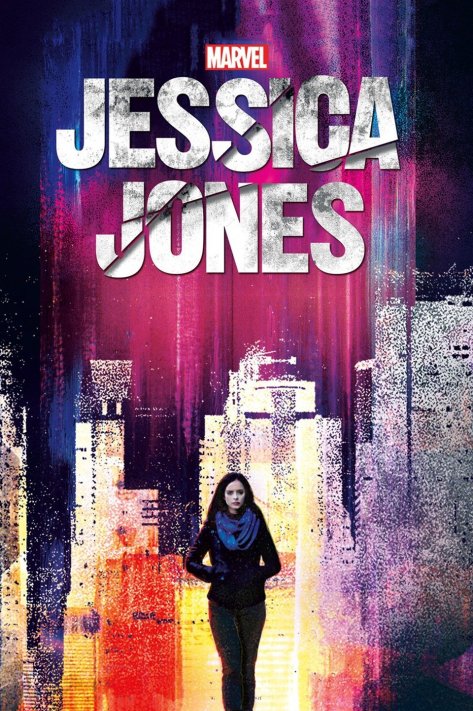
A review of Season 1 of “Jessica Jones” (2015)

Netflix’ “Jessica Jones” (2015) is easily one of the best things in the Marvel Cinematic Universe; I’d rate it a 9 out of 10.  It’s smart, it’s funny and it’s extremely dark — I don’t want to spoil too much by revealing the modus operandi of Season 1’s villain, but his manner of destroying his victims is utterly disturbing.  (I’ve mentioned before how his powers seem like a plot device from a Stephen King novel.)  Although this series excellently retains a “comic book” feel (due in part to its episodic format), its story elements frequently feel like something out of a John Carpenter film.  And, although I know I’m repeating myself yet again, this Hell’s Kitchen niche of the MCU feels like its chosen stage for horror-thrillers.

The cast is excellent.  Krysten Ritter is perfect as the titular, hard-drinking, antihero private detective.  Mike Colter is nearly as good in the role of Luke Cage, another low-level hero in the Marvel universe.  Colter’s talent is evident by the fact that Cage could so easily come across as a one-dimensional character.  (And, Jesus, doesn’t the guy look the part?)

The story’s villain, Kilgrave, is played by fan-favorite David Tennant.  (Yes, the name “Kilgrave” is stupid and is lifted from the comic book source material.  Its silliness is lampshaded in the series several times by other characters making fun of it.)  Tennant is an actor I’ve abhorred in the past.  There was no logical reason for it — there used to be just something about his voice and his face that made me cringe.  It was a running joke for a while among me and my female sci-fi friends.  (Good Lord, how the ladies adore that man.)  My admittedly irrational dislike of the man even detracted from my enjoyment of the otherwise quite enjoyable 2011 “Fright Night” remake.

He’s phenomenal here.  He’s perfect for the part, as Ritter and Colter are for theirs, and he was alternately menacing and quite funny.  (He has perfect timing and line delivery, as Ritter often does.)  I really liked watching him.

“Jessica Jones” might succeed more than any other MCU property in terms of dialogue and character development — although the “Iron Man” and “Daredevil” series also do great work there.  (It’s a tough call.)  The show also seems to flesh out the MCU into a kind of “lived in” universe in a way that other Marvel properties usually haven’t — by creating detailed, three-dimensional protagonists out of characters that have no superpowers whatsoever.  They’re not “sidekicks” (a trope that the script that slyly winks at); they’re realistic characters that affect the plot.  When one or two actually appear to develop superpowers toward the end of the season, the consequences are unexpected and dire.  (There is a truly kickass Easter egg here that will please longtime readers of Marvel Comics.)  Furthermore, Jones, Cage and most of the other characters have power sets that pale in comparison to M.C.U. heavy hitters like Thor, the Hulk or the Vision. The result is that the MCU feels more … integrated and nuanced, with a blurrier line between superheroes and everyday people.  I liked that a hell of a lot.

The show is not entirely without its failings.  Despite what I said above about the show’s attention to ordinary characters, I still think it went a bit overboard here.  The character of Malcom (nicely portrayed by Eka Darville) began as a hugely interesting supporting character.  So, too, did other residents of the heroine’s apartment building.  It was a nice touch that expanded the show’s scope and depth … until the law of diminishing returns kicked in.  By the end of Season 1’s 13-episode arc, I felt that they’d received far too much screen time.  The support group that one character attends started out as an intelligent subplot, but then eventually grew tiresome.  (Again, I’m being necessarily vague here to avoid spoilers.)  Towards the finale, I actually felt that these minor characters were padding the plot and dragging down the narrative.

Which brings me to another criticism — the narrative’s length.  This is yet another show that I felt could be edited down a bit.  As much as I loved Tennant here and found Kilgrave to be an interesting villain, I’m not sure that Jones’s conflict with him warranted 12 52-minute episodes.  This could have been abridged to eight or ten, I think.

Another criticism I had of “Jessica Jones” was its fight choreography.  For a show that succeeds on so many levels, the action sequences were sometimes surprisingly poor.  Why do brawls between superpowered individuals include so much polite (and bloodless) grabbing and throwing?  Especially when a single punch or kick could easily kill or incapacitate an opponent?  The answer, of course, is that those kinds of melees are easy to film, with minimal training for the actors.  It’s especially noticeable here because this show’s sibling, “Daredevil,” has fight choreography that is some of the best I’ve ever seen.  (If you’re curious, then search for “Daredevil stairwell fight” on Youtube sometime.)

The rudimentary effects were usually even poor when depicting the title character’s “jumping” scenes.  (She has super strength, so she can virtually “fly” short distances by literally jumping.)  These shots looked like something out of a primetime 80’s action show.

All in all, though, this was indeed a great show.  Don’t shy away from it, as I initially did, because you’re unfamiliar with the title character.  It’s among the best that Marvel has to offer.


maxresdefault

“You call her Doctor JONES, Doll!”

God damn, Netflix’ “Jessica Jones” (2015) looks like a great show.  I finally got around to watching the complete pilot episode, due to my interest in the upcoming “The Defenders,” which features the character.  And “Jessica Jones” was frikkin’ terrific.  I’d rate the first episode a 9 out of 10.

At first, there were aspects of the pilot that annoyed me.  We’re told virtually nothing about the origin of the title character’s superpowers, and not much about the powers themselves.  They’re also a fairly generic power set, as far as I can tell.  She has enhanced strength and agility and … that’s it?  So she’s a low-grade Superman or Spider-Man, more or less?  We also learn somewhat little about what looks to be the series, antagonist, Kilgrave, played by David Tennant.  We see Kilgrave only briefly, in flashbacks that seem reminiscent of post-traumatic stress disorder.  (These are sometimes weirdly delivered, for a show that is otherwise well directed.)  He has mind-control abilities that resemble the “push” ability seen in Stephen King’s “Firestarter,” as well as my favorite short story of all time, “Everything’s Eventual.”

But … hell, this was just an extremely good show.  For starters, Krysten Ritter is perfect as the wisecracking anti-heroine.  She’s funny; she’s got great, dry line delivery; and she’s a decent actress.  (I know that the Marvel Cinematic Universe’s more powerful heroes rarely visit Hell’s Kitchen, but I’d love to see her trade quips one day with Tony Stark.  She couldn’t beat him, but she’d come closer than anyone else.)

The script is good enough to make her a likable character, and the story itself is scary and compelling.  Considering the plot-driving capability of the show’s villain this … looks like it could become a King-style horror thriller.  Between this show and “Daredevil’s” bloody second season (2016), I’m starting to understand that Hell’s Kitchen might be the MCU’s stage for more horror-type stories.  And I’m fine with that.


p12123988_b_v8_aa

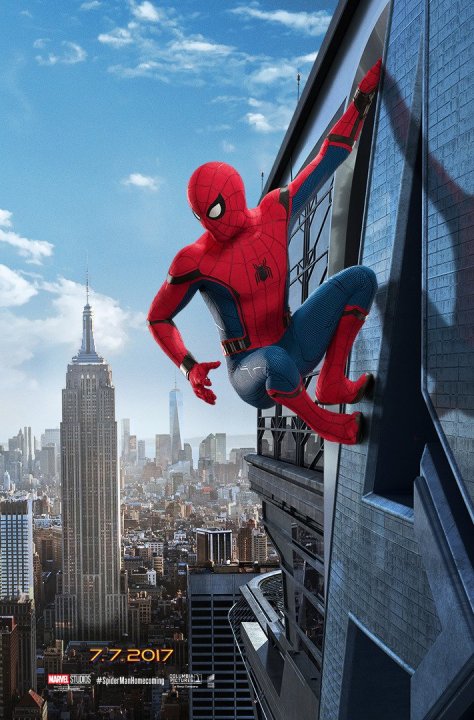
A review of “Spider-Man: Homecoming” (2017)

“Spider-Man: Homecoming” (2017) isn’t a bad movie.  To the contrary, it’s a very good one — I would even rate it a 9 out of 10, if a little reluctantly.

The action, humor, surprises and special effects are all top-notch; it’s got a slew of fun Easter eggs and great continuity within the Marvel Cinematic Universe; and Michael Keaton hits it out of the park as the story’s villain.  (As Ed Harris did recently with HBO’s “Westworld,” the sublimely likable Keaton really surprised me with how he could become so intimidating.)  Furthermore, the screenwriters wisely omit another redundant re-telling of the web-slinger’s origin.  (Even a die-hard fan like me is sick of seeing or reading about it.)

I think your enjoyment of this movie might vary according to what you want Spider-Man to be.  This isn’t a movie in which Peter Parker or his alter ego stand out as his own man (despite its plot resolution’s heavy-handed efforts to tell us that).  I submit that it’s fairly undistinguished as a standalone superhero film —  it feels like an ancillary, companion film to the “Avengers” movies, including last year’s de facto installment, “Captain America: Civil War.”  Indeed, fan-favorite Tony Stark is “Spider-Man: Homecoming’s” most significant supporting character — far more than any of the many friends, family, love interests or villains that have long inhabited the iconic hero’s mythos.  Peter’s primary motivation throughout the movie is his desire to become an Avenger, like a normal kid would aspire to the varsity football team.  Many of his powers stem from a ultra-high-tech costume designed and given to him by Iron Man; it even has an advanced A.I. that is a femme fatale equivalent of J.A.R.V.I.S.  (Fun fact: that alluring voice belongs to none other than the alluring Jennifer Connelly.  The actress is the wife of Paul Bettany, who is the voice of J.A.R.V.I.S. and then the actor portraying The Vision.  And Connelly herself played the love interest of 1991’s mostly forgotten “The Rocketeer,” a World War II-era hero with the a similar character concept to Iron Man.)

I was a big fan of Spider-Man in the 1990’s, and, believe me, the ol’ web-head did just fine with his own powers, intelligence and character — and without any sort of “internship” with Iron Man, either metaphorically or otherwise.  He was also a far more popular character with readers.  I was buying comics regularly between 1991 and 1996 — while Spider-Man books and merchandise were everywhere, I don’t think I ever remember seeing an “Iron Man” comic on the racks at my local comic shop.  I kept thinking inwardly of Spider-Man during this movie as “Iron Man Jr.,” and, for me, that wasn’t a good thing.

I also found myself musing during the film that this felt like “Spider-Man Lite.”  While “Spider-Man: Homecoming” was fun, it doesn’t have the depth, character development or gravitas of the Sam Raimi trilogy.  (Yes, I even liked the third one, despite its bizarre flaws.)  I know that critics are praising the movie’s lighter tone, and I realize the need to avoid a simple rehash of the Raimi films.  (Nobody would want that; we can rightfully expect more from the excellent MCU.)  I actually prefer the Raimi films, though.  While Tom Holland might be the better Peter Parker (Tobey Maguire was a strange casting choice), the Raimi movies were more … heartfelt.  They were an earnest exploration of the Spider-Man of the comics, and they felt … truer.   “Homecoming,” in contrast, is yet another cool installment in the “Avengers” series.  “Spider Man 2” came out 13 years ago, and I can still remember how that movie made me feel — not to mention how its sheer quality vindicated “comic book movies” like no other film before it.  This new movie will not be memorable that way.

Anyway, although my criticisms above are obviously lengthy, please know that this is only because I love the source material so much — and we comic book fans have a tendency to analyze.  I certainly enjoyed the movie, and I’d cheerfully recommend it.  (Note my rating.)  The MCU continues to entertain with quality movies; its consistency, even with its expanding group of ongoing Netflix series, is kind of astonishing.

Go see this.  You’ll have fun.


Spider-Man2

A baffled review of “Lucy” (2014)

Everything you’ve heard about “Lucy” (2014) is correct — it’s exactly as trite and nonsensical as its multitude of unfavorable reviews have described it.  Maybe this was intended as some sort of weird, meta, inside joke by writer and director Luc Besson … after all, it’s a movie about increased “brain capacity” that is, ironically, really dumb.

I can’t imagine why Scarlett Johansson and Morgan Freeman would sully their reputations by starring in this film.  Although, sadly, even the wonderful Johansson is not at her best here.  She seems to try to portray increased intelligence by delivering some of her lines like a robot.  (Seriously, she reads some of her lines like a speedy automaton, and it’s a bad creative decision for her performance.)

I could go on and on about the silly things in this movie.  So could you, if you’ve seen it.  But it’s a lot more fun listening to the surly wise-asses over at Cinema Sins.  Their trademark “Everything Wrong With” video for “Lucy” is particularly harsh.  At one point they call it “an aggressive dickhead of a movie.”  Here’s the link:

https://www.youtube.com/watch?v=i3rZmnJ66Po

There is one overriding problem I need to address myself … and that’s how its premise seems to relate so little to the events of the story.  We begin by understanding that the titular Lucy is affected by a drug that increases her brain capacity.  Before the movie reaches its halfway mark, she appears to gain omniscience.  (She doesn’t need to actually learn anything — she simply knows virtually everything already.  This is evinced by her ability to translate foreign languages instantly, with no books or instruction at all.)  She also appears omnipotent by the film’s end.  Her powers become literally godlike.  And I’m not talking about Thor or Odin from the Marvel Cinematic Universe — we’re talking the all-powerful,  Old Testament God of Abraham.

Why?  Why should increased intelligence, no matter how incredibly vast, give her power of matter, space and even time?  If she were as smart as a thousand Stephen Hawkings, she still shouldn’t be able to do the things she does in the movie.

Believe it or not, I’d rate this movie a 4 out of 10.  (That’s far kinder than the other reviews I’ve read.)  I managed to have fun with this movie by rewriting some of it in my head while I watched.  Instead of Lucy benefiting from a drug that increases her brain capacity (which borrows a bit from 2011’s excellent “Limitless,” anyway), I pretended that I was watching a movie in which Scarlett Johansson became God.  (Think of 2003’s “Bruce Almighty.”)  Honestly.  I swapped out the plot device in my head, and imagined a different movie.  That made it fun — watching Scarlett Johansson as a wrathful God was strangely satisfying, especially when she wreaks havoc on the bad guys.

And speaking of bad guys … that is actually one thing that this otherwise clueless movie manages to get right.  No, I’m not kidding — the Taipei gangsters that serve as the story’s antagonists were performed to perfection by their actors.  The villains were repulsive and terrifying, and they aroused more interest in me than the good guys.  Min-sik Choi was terrific as the homicidal patriarch of the Taiwanese crime syndicate.  Even better, though, was Nicolas Phongbeth as the cherubic-faced, vaguely androgynous, sociopathic lieutenant.  If they were vanquished in this brainless movie, it’d be nice to see them resurrected in a James Bond film or a season of Fox’s “24.”  It’s weird seeing a movie so bad do one important thing so successfully.

There are really only two reasons why anybody should see “Lucy.”  One is morbid curiosity.  Two is if they are a learning to be a screenwriter, and are looking for a feature-length example of what NOT to do.


Lucy_(2014_film)_poster

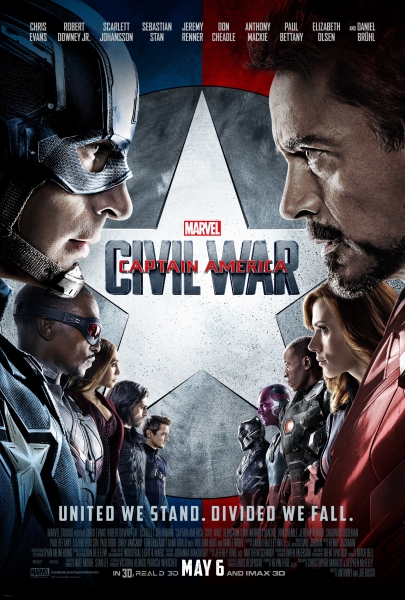
My review of “Captain America: Civil War” (2016)

“Captain America: Civil War” (2016) is nearly everything I hoped it would be; it’s easily on par, if not better, than the first two “Avengers” movies.  (And I can’t help but think of this as the third “Avengers.”  Yes, Cap’s name is in the title, but this is necessarily an ensemble story about the divided superteam.)  I’d give it a 9 out of 10.

I honestly just need to be very vague in this review … this is such an eagerly awaited film, and I want to be extra cautious about spoilers.  No, there are no twists in the movie, but there are surprising character and plot elements.

The movie surprised me in a couple of ways.  One, this film appears to follow the original 2006 comic book crossover only very loosely.  (I have not read it, but I know the story.)  There is no “Superhero Registration Act” that would directly affect countless people in the Marvel Cinematic Universe.  It’s much narrower than that — a demand by the United Nations for direct oversight of The Avengers.

Two, this is definitely the darkest and most adult outing with The Avengers so far.  Don’t get me wrong — the levity and gee-whiz comic book fun that is the MCU’s trademark is still there, and it’s no Christopher Nolan movie.  But the movie’s central story device is set in motion by the question of who should be held accountable for civilian deaths.  And so many individual major characters are motivated by grief or rage.

This is notable throughout the film, for example, in the characterization of Tony Stark, and his portrayal by Robert Downey, Jr.  He’s no longer a wisecracking billionaire playboy who all the guys want to be.  Instead, he’s a troubled, pensive leader who often seems out of his depth.  We watch as his team and the events surrounding him spin out of control, and we no longer want to trade places with him.  He’s more sympathetic.  But he simultaneously fails to engender the viewer loyalty that he so quickly and easily won in every other Marvel movie he’s appeared in.

And yet … he isn’t, as I had suspected, a cardboard adversary for Captain America’s underdog to stand up to.  There are some sad things going on in his life, both during the events of this movie and in “Iron Man 3” (2013), and his failings and poor decisions are perfectly understandable.  (I won’t say more, besides that viewers will definitely get a different spin on “Iron Man 3” after this movie.)  And Downey displays a great range in playing this far sadder Tony.

One character in the movie even makes a quip about “The Empire Strikes Back” (1980), and it feels like a meta reference, as that film is regarded as the darkest in the “Star Wars” original trilogy.  (And their are story structure similarities as well.)

But don’t get me wrong — “Captain America: Civil War” still brings loads of fun.  It’s an effects-laden, geeky, hero-against-hero, superteam gangfight that is straight out of every Marvel fan’s dreams.  (And, needless to say, it’s far better than its analog this year from DC.)  Tom Holland might be the best Spider-Man yet.  The action is damn pleasing, and the one-liners made me laugh out loud.  (“Made ya look.”)

The bromances (including the broken ones) seemed real to me.  I found myself liking and caring about … Winter Soldier, of all people, and I kept hoping things worked out with his friendship with Cap.  (Sebastian Stan impressed me in the role for the first time.)

What didn’t I like?  Well, I had some small criticisms.  I submit that Black Panther was a complete misfire.  The character concept is boring (he’s an African Bruce Wayne), he seems like an ethnic caricature, and he absolutely is shoehorned into the plot.  When his tough female subordinate physically threatens Black Widow, he smugly opines that a fight between them “would be amusing.”  It felt creepy and sexualized, and maybe like something out of a 1970’s blaxploitation film.  He’s also pretty blandly played by Chadwick Boseman.

Spiderman, too, seems shoehorned in as fan service.  I loved seeing him in the movie, but i wish he’d been written in differently.  (Would Stark really recruit a highschooler to combat seasoned soldiers, one of whom is a superpowered psychotic assassin?)

Next is a criticism that is just a matter of personal taste.  I myself would have preferred a movie that was even darker.  Just think for a minute about the basic story.  We have civilian casualties driving the world’s governments to seek control over its superheroes — then the heroes themselves fighting each other with what must at least be considered possibly deadly force.

That’s a story pretty much brimming over with pathos, if you ask me.  But the movie underplays those plot elements considerably.  We hardly see the civilian casualties that are supposed to drive the plot — and when we do, they’re glimpsed briefly in news footage.  And all but three of the heroes (Tony, Black Panther and Winter Soldier) display any of the anger or sense of betrayal that you would expect from a violent “civil war” among former friends.  And it is violent … members of either faction fire missiles at, or try to crush, their opponents.  Does the MCU’s characteristic banter belong anywhere here?

Finally, this could have been an idea-driven movie like the latter two “Dark Knight” films.  But only Cap and Iron Man seem to genuinely fight about ideology.  Others fight according to personal or professional loyalty, personal revenge, or just because they are a “fan” of either Cap or Tony.  And neither does the script articulate their positions especially well.  Wouldn’t it be perfectly in character for Cap to quote Thomas Jefferson or Benjamin Franklin?  “Those who would exchange their liberty for a little temporary safety” and all that?

Oh, well.  I’m probably asking too much from a superhero movie.

This was a hell of a lot of fun.  Go see it.
 

timthumb

A few quick words on Season 2 of “Daredevil”

As though you hadn’t guessed, I absolutely loved Netflix’ second season of “Daredevil.”  It might have had a problem with its concluding Elektra storyline, but I’d still rate it a perfect 10 — I just can’t give a lower rating to a season that made me cheer out loud while watching it.

I really loved it that much.  I’ve started to think of this gritty little corner of the Marvel Cinematic Universe as my own “Star Wars” — these are characters that I grew up with, and to whom I’ve developed an emotional attachment, however strange or childlike that may seem to non-fans.  If adults can cheer during the opening crawl of “The Force Awakens,” then I can cheer “KICK THEIR ASSES, MATT!!” when the ninjas of “The Hand” noiselessly and acrobatically swarm Daredevil.

It’s just a superb show.  On one level, it’s a good character drama and legal thriller that can easily please a modern mainstream television audience.  On another level, one of those characters just happens to be a low-level hero in the Marvel Comics universe.

The show succeeds nicely on the first level and goddam brilliantly at the second.The martial arts and costuming are perfect.  John Bernthal is perfectly cast as The Punisher.  It’s a cliche, and something I’ve written here before, as well, but I’ll say it again anyway — Netflix succeeded in bringing some of my favorite comic book characters from page to screen.

My only minor criticism is that the Elektra storyline was muddled, and understandably confusing for those who haven’t read the source material.  (And if memory serves, it wasn’t all that easily understood in the original comics.)

Now bring on Bullseye!!


12794707_1719825021587067_5890561489880274871_o