This is the 90’s-est song that ever 90’s-ed. Sure, a song by Ace of Base, Oasis or Right Said Fred will take you right back as well, but none of them had the staying power of Bush’s “Machinehead.”
The song is from the band’s “Sixteen Stone” album in December 1994, about seven months after I graduated from Mary Washington College. It it was all over the airwaves. I played the radio a lot, because buying a lot of CD’s was a pricey proposition for somebody just out of school. And, man, did I blast this.
I only saw one third of Roy Ward Baker’s “The Monster Club” (1981), when I was maybe in the third or fourth grade. It was a typical 80’s horror anthology movie, and I walked in when my older brother was watching the third and final segment on television. I’ll be damned if that segment alone didn’t creep me out, though. (And the reviews of the film that I’ve read indeed name “The Ghouls” as the scariest entry in the trio.)
It’s pretty tame by today’s standards, or at least to my adult sensibilities. It was definitely a lower-budget scary story, and probably pretty safe for television even back then. But I watched it again the other night, and it still retains its creepiness after … about 35 years, I guess. The titular monsters are indeed “ghouls” in the classical sense — they are human-looking fiends that are very much alive, but that feed on carrion (which actually makes them the reverse of zombies, I suppose.)
I can’t vouch for the rest of the movie, as I’ve only seen snippets, which seem pretty cheesy. The wraparound segments star none other than Vincent Price and John Carradine, which will of course appeal to fans of classic horror. (Carradine actually portrays a fictionalized version of R. Chetwynd – Hayes, the prominent British author who penned the stories on which the movie is based.)
If you saw this back in the day and “The Ghouls” got under your skin, then let me know. I’d get a kick out of knowing that I wasn’t the only one.
Here’s another very obscure Throwback Thursday post about broadcast television in the New York metropolitan area — this was the intro the ABC 4:30 movie. People commenting here at its Youtube entry remember it from the 1970’s … I thought I remembered it from the very early 1980’s as well. But I could be mistaken.
One commenter said that, as a young child, he thought that the image of the spinning camera-man looked like “a mechanical frog monster.” I thought that as a kid too!
This will probably be a pretty obscure Throwback Thursday post, but the segment below should be recognized by people who grew up in the New York metropolitan area in the late 1970’s and early 1980’s. It’s none other than the intro for WOR-TV Channel 9’s “Million Dollar Movie.” (That music you hear is a particularly brassy rendition of Max Steiner’s “Tara’s Theme” from 1939’s “Gone With the Wind.”)
If you were in the New York area at that time, it ought to bring back memories of the old days of broadcast television. (It’s actually surprising how much nostalgia people online report at seeing this 44-second clip. And it’s amazing what you can find on the Internet.) A few commenters note sardonically that the clip makes Manhattan look like a nighttime paradise — while The Big Apple in the 1970’s was not always an easy place to be. (The city if far cleaner and safer today.)
Some of the comments I read were befuddling. There is one blogger who wrote that he remembers this intro from as far back as the 1950’s. (Had they really used it for more than two decades?) And a populous minority of commenters remember being unsettled by the clip. (They describe it as ominous, and the music as creepy, which mystifies the rest of us who remember “Million Dollar Movie.”)
This intro had an indelible effect on me. While it recalls monster movies like “King Kong” (1939) and “Godzilla” (1954) for a lot of others, it will always remind me of my father watching war films and cowboy movies on his days off — along with the occasional Charles Bronson flick. “The Great Escape” (1963), “A Bridge Too Far” (1977) and “Shane” (1953) all spring to mind.
When I was in the first or second grade, I habitually enhanced my Dad’s enjoyment of the “Million Dollar Movie” by peppering him endlessly with questions about whatever was playing — even if I had only wandered into the room for a few minutes. “Why did they call it ‘a bridge too far?'” “Why did they fight World War II?” “The British and French were good guys in the war, right?” “Why did the cowboy drop his gun on purpose?” “Why did the guy fake his death?” (Bear in mind, folks, this was broadcast television — long before the days of Netflix and DVD’s.)
If any kid did that to me when I was watching my favorite movies, I’d go nuts — even if I had a pause button. My father was a saint.
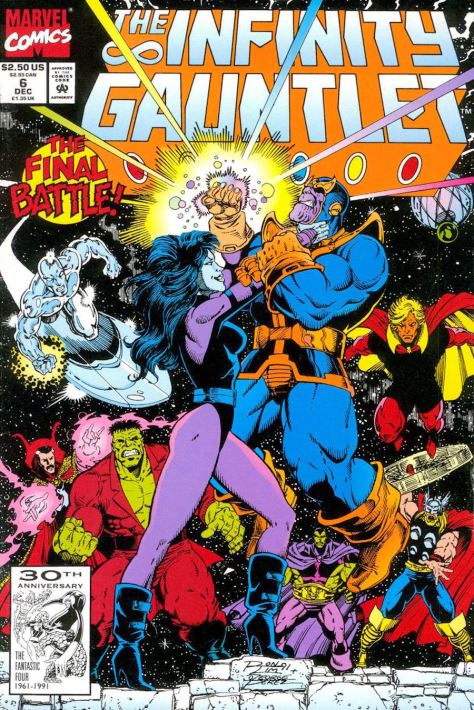
My buddies and I have “Avengers” fever. We can barely wait to see “Avengers: Infinity War,” which opens tonight, and answer some burning questions. I myself want to know how the relatively humble Captain America can deflect a blow from Thanos’ omnipotence-granting Infinity Gauntlet (as depicted in the trailer). Meanwhile, a pal of mine insists it’s possible that some iteration of the Venom alien symbiote will make an appearance — even though that character is owned separately by Sony Pictures. (I’m inclined to think that this is wishful thinking.)
I was actually around for the 1991 debut of “The Infinity Gauntlet” — the six-issue 1991 crossover series upon which this movie is based. (“The Infinity War” was actually a sequel comic crossover that Marvel released a year later.) An upperclassman upstairs in my sophomore dorm lent it to me, and it pretty much blew my mind. I had only recently discovered that the characters owned by the “big two” comic book companies inhabited shared universes. (DC Comics has released its own universe-wide crossover series at about the same time — “Armageddon 2001,” a series I still love, despite other fans’ contempt for it.) I had read a lot of comic books growing up, but they were usually war comics or horror comics; superheroes had always seemed lame to me when I was a kid.
“The Infinity Gauntlet” was thick stuff, as comics went. The sheer number of characters involved (and an abundance of cosmic characters) made it a little hard to follow for a reader new to Marvel. (DC’s major characters were fewer, more familiar and easier to understand.)
But it was still a load of fun. I still think it’s messed up what Thanos did to poor goddam Wolverine, who’d skillfully gotten the drop on him at first.
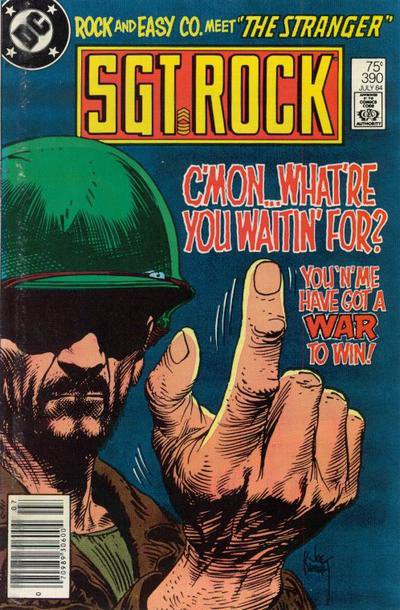
DC Comics’ “Sgt. Rock” was far harder stuff than the “G.I Joe” comics and toys that are more often associated with the 1980’s. They were the darkest and most violent comic books I read when I was a young kid, except maybe for the various “Conan” books. Hasbro relaunched “G.I. Joe” in 1982 concurrently with its toy line, and it was a famously kid-safe (and lucrative) franchise. “Sgt. Rock,” in contrast, consisted of brutal stories that focused on the horrors of war — it was really more of a cultural holdover from the comics of the prior two decades. (The title began as “Our Army at War” in 1959.)
I loved these comics — especially the larger “annuals” with lengthier stories. Nothing was better than “Sgt. Rock” and Reese’s Peanut Butter Cups. What occasionally puzzled me as a second-grader was that none of the other boys I knew seemed to be reading them — although a lot of other kids certainly hopped on the “G. I. Joe” bandwagon.
The last one pictured below, from 1981, was my favorite. If memory serves, it was the first one I ever owned.
No, I wasn’t around in 1965, but I absolutely remember this song from when I was a tot in the late 1970’s. My parents played it quite a bit; they had a few Frank Sinatra albums among their stacks of 8-track tapes in the living room entertainment center. I wasn’t supposed to touch them, but I did. (Hey, they were right at the bottom level, where I could fiddle with them. And, as a kid, would read anything — even album titles.)
Anyway, this Internet thingamajig tells me that the song was written in 1961 by Ervine Drake for the Kingston Trio. Sinatra won a Grammy in 1966 for his rendition of it, as did Gordon Jenkins for his accompanying instrumental work.
Rodney Dangerfield actually was pretty damn funny, even if I was too young to appreciate his humor when I was a kid. Not everything he touched turned to gold … I seem to remember a cheesy movie or two. But this 1983 single was great. It’s catchy, and its humor still holds up today.
There are a couple of 80’s-tastic cameos in the video, too. One is Pat Benatar as the leather-clad prison executioner. (Totally not my thing.) The other Saturday Night Live’s chain smoking priest, “Father Guido Sarducci” (Don Novello).
“Planet of the Apes” (1968) is a half century old; today is the 50th anniversary of the film’s premiere at the Capitol Theater in Manhattan. (Thanks to Blog Correspondent Pete Harrison for pointing out the date for us.) The movie’s original trailer is below. I actually learned something new looking for it — Rod Serling co-wrote the screenplay. (I wasn’t aware of that, but it makes sense.)
I’ve already written at length about how the “Planet of the Apes” franchise was a part of my childhood. (No, I wasn’t alive in 1968, but these films were broadcast periodically on television in the late 70’s and early 80’s.) So I won’t blather on yet again about it.
But I will say that the iconic line of dialogue you see in the above headline made a pretty big impression on me as a kid. (And Charlton Heston’s delivery of it was unforgettable.) When I was in the second or third grade, I once growled that line at a girl at recess who kept poking me and smacking me on the head. She was really taken aback by it.
I had this poster for “Raiders of the Lost Ark” (1981) when I was 11 or so. It was goddam gigantic. It took up nearly an entire wall in my room.
It wasn’t store bought; it came from a theater. My father used to do something that was pretty damned cool for any parent to do — he’d occasionally ask the manager of a movie theater to save their in-house advertising for my favorite movies. (I don’t know how things are done nowadays, but back then they’d just throw them out after using them.) Then my Dad would hand the guy $10 or $20 for one of these, or maybe the manager would just give it to him.
Sometimes that meant a truly industrial-size poster, like this one. Sometimes it meant one of those huge cardboard stand-up advertisments. (I could only have a couple of these at a time … I had a small room.)
I also had a cardboard stand-up for “Colors,” the 1988 film depicting Los Angeles gangs — but my older brother brought me that one. It had nearly life-size cutouts of Sean Penn and Robert Duvall, the movie’s police protagonists. I don’t know why the nerdiest kid in East Coast suburbia was so taken with a movie about inner-city West Coast gangs, but that movie meant a lot to me.
Come to think of it, a lot of people were talking about “Colors” back in the day. It was a big deal. It was considered pretty edgy at the time, the critics loved it, and I’m surprised I never heard about it again after the close of the decade. Its soundtrack had a damned good title track by Ice-T, too.
The poster below was my favorite, though. To this day, “Raiders of the Lost Ark” is probably my favorite film of all time.





 Eric Robert Nolan, Author