My poetry, 1992 through 2015

Care to class up your weekend with some expertly constructed poetry by a genuine artist?

Then you’ve come to the wrong place.

Want to slum it up with a few rhymes by the New York Shanty Irish? Then eat your corned beef and drink your coffee, and check out my page.

 Click here: My poetry, 1992 through 2015


WIN_20150904_20_13_19_Pro

It’s Friday the Not Quite 13th!!

I wanted to run this “Friday the 13th” image on the last Friday the 13th, which was in November.  But that was the occasion of the terror attacks in Paris, and all of our sensibilities were devoted elsewhere.

I like it because it’s a poster for the legendary 1980 movie that I hadn’t seen before.  I actually got it from the Facebook page of actress and painter Adrienne King (pictured in her role as “Alice” below).  She’s incredibly cool and sweet, and she even wished me a happy birthday a while back!  I was also surprised to find out that she’s originally from Oyster Bay, Long Island.

Anyway, if you find her Facebook page, it’s a treasure trove for horror fans.


12032980_1039913376020785_1134315822837670394_n

Throwback Thursday: 90’s music

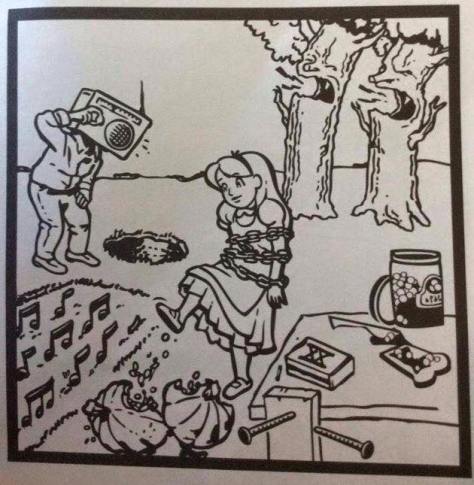
I found this puzzle floating around Facebook; I don’t know it’s author.

How many bands can you name?  I count 8 … maybe 9.


12552881_171439566553288_1088960044730243432_n

Wild ponies at Matley Bog, New Forest, England (Photo)

For my British friends here in the States who sound slightly wistful when they recall the “New Forest” in conversation.


OLYMPUS DIGITAL CAMERA


Photo credit: By Jim Champion (Own work) [GFDL (http://www.gnu.org/copyleft/fdl.html), CC-BY-SA-3.0 (http://creativecommons.org/licenses/by-sa/3.0/) or CC BY-SA 2.5-2.0-1.0 (http://creativecommons.org/licenses/by-sa/2.5-2.0-1.0)%5D, via Wikimedia Commons.

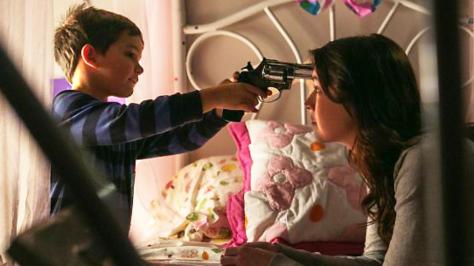
“Emilie” (2015) is a superb, gut-wrenching thriller.

I’ll come straight to the point — “Emilie” is an exceptional horror-thriller that belongs on your list of films to see, provided you can stomach some disturbing content.  This movie hooked me in under a minute, even before its title appeared on screen.  Then it kept me glued to it throughout most of its running length.  It could have been an even better film — a classic on par with “Psycho” (1960) or “Fatal Attraction”(1987), were it not for some key creative choices about halfway through.

I’d give this movie a 9 out of 10.  It succeeds for two reasons — great acting and a script that perfectly employs dialogue that is at first subtle and nuanced, and then increasingly frightening.  The title character is a babysitter who is not what the parents expected, in more ways than one.  After some deliberately awkward character interaction with the departing parents, she proceeds to subject the children to a series of progressively more demented psychological games.  What follows is a thriller brimming with pathos.  The movie reminded me a lot of the critically acclaimed and controversial “Funny Games” (2007). That film also showed ostensibly innocent adversaries entering a family’s home after gaining their trust, and then doing awful things.

Emilie is played to perfection by Sarah Bolger, who has a beautiful, kind face, which only makes the character’s incongruous psychopathy even more unsettling for the viewer.  It took me a while to place the actress’ face, until I recognized her as the somewhat feckless protagonist of 2011’s “The Moth Diaries.”  I was impressed with her talent then as a hapless good guy, and I think her performance here was phenomenal.  She plays the innocent-looking, yet icy antagonist here with subtle, unnerving malice.  The rest of the cast is also uniformly quite good.  This is true even of the young child actors, but most especially of Joshua Rush.

The movie is briskly paced, but its sparing dialogue still manages to rattle and then shock.  It’s a sometimes obscene story of imperiled children that really gets under your skin.  Most of its directing is clean and clear.  Combined with the unusual score, it gives the story a dreamlike quality.

The movie loses its way just a little at about the 40-minute mark, when its perverse, moody dialogue and strictly psychological horror give way to the familiar elements of a boilerplate thriller.  An unnecessary backstory is given for our antagonist, delivered by an overly convenient, standard flashback sequence that feels out of place and that disrupts the pacing.  (“Her mind was shattered.”)  Then, other plot points also feel just a little by-the-numbers, moving “Emilie” away from true cinematic greatness and toward just being a very good horror flick.

Finally, Bolger’s villain is defanged a little when the script calls for her to lose her calm demeanor after the plucky, oldest child (Rush) defies her, in a well executed but entirely predictable David and Goliath story.  And her character’s reliance on a nameless, voiceless and superfluous confederate here also makes her a little less enigmatic.

How much greater would this movie have been if Emilie’s motivations remained a mystery?  What if, like “Funny Games” or “The Strangers” (2008), all we knew is that she was an highly intelligent sociopath acting for no discernible reason?  What if she were acting entirely alone?

And what if the horror remained strictly psychological, with no actual violence to up the ante until the closing minutes?  The most disturbing scenario I can think of is this — what if she were able to psychologically manipulate the children to violently turn against one another, or against their parents upon their return?  That could be an ambiguous, darker and far more thematic story than the second half of the film we see here.

Still, this was a damned effective scary movie, and that’s good enough.  I recommend it.

One more thing — there actually is a famous, heartwarming French romantic comedy entitled “Amelie” (2001), which I have not seen.  I think it would be blackly funny if some sentimental filmgoers wanted to rent that and accidentally picked up “Emilie.”

 

wjjgzh7t


1280x720-cOf


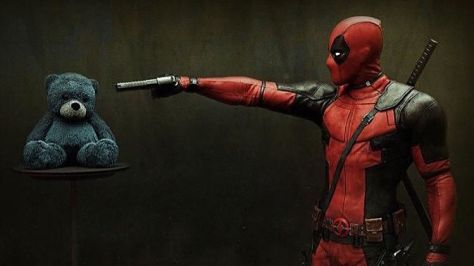
A review of “Deadpool” (2016)

I’ve never read a single “Deadpool” comic book, but that didn’t stop me from enjoying the movie.  It’s  a fun, creative and …  unconventional entry into the “X-Men” film  franchise that actually made me laugh out loud a few times.  I’d give it an 8 out of 10.

It isn’t high art.  It’s got a thin story based on a rickety plot device, nearly no exposition, and it includes some cartoonish action that I thought was just too over the top, even by comic book movie standards.  (Our hero dodges bullets and survives a stab to the brain.)

It helps to bear in mind this movie’s real purpose — fan service for the infamous niche character’s evident legions of followers.  “Deadpool” isn’t meant to be densely plotted, like “X2: X-Men United” (2003), or genuinely cinematic, like the Christopher Nolan “Batman” films.  It’s a long awaited, R-rated feature film to please loyal fans of this profane, adult-oriented antihero, who would be out of place and necessarily bowlderized in a mainstream superhero-teamup flick. (And I kinda get that — I loved the “Wolverine” comics when I was a kid, and, trust me, his film incarnation is tame compared to its source material.)

“Deadpool” is damn funny.  The movie succeeds by making us laugh.  And combining a raunchy comedy with an “X-Men” film gives it a weird, cool, subversive vibe.  It makes you wonder if Stan Lee would approve of this sort of thing … until you see Lee himself in a cameo at the story’s strip bar.  It’s fun to know that dirty jokes indeed do exist within the “X-Men” movie universe.

The lowbrow jokes made me cringe one or twice (“baby hand.”)  But you’ve got to give the movie credit for delivering its bathroom-wall humor if that’s what the original character is about.  (Are the comics like this?)  Ryan Reynolds is genuinely funny, and his deadpan delivery is perfect.  The film might not have even worked at all with out him.

By the way, this movie actually reminded me a hell of a lot of a long-ago flick that I absolutely loved, but which I’m guessing is largely forgotten — Andrew Dice Clay’s “The Adventures of Ford Fairlane” (1990).  That movie also had a foulmouthed, lone, maverick antihero who often broke the fourth wall, and that also made me laugh like hell.  I know it sounds like a strange comparison, but they’re very similar films.

Finally, I’d like to think that the Wade Wilson we see here actually IS a version of the Wade Wilson that we first met in the widely lamented “X-Men Origins: Wolverine” (2009).  (And how can he not be, if that movie is canon?)  If “X-Men: Days of Future Past” (2014) rebooted the timeline, then the Deadpool we’re rooting for here was never recruited, corrupted and experimented upon by William Stryker.  So you can have your cake and eat it, too.


new-deadpool-promo-images-offer-hints-movie-s-unconventional-tone-492440

A review of “Pride and Prejudice and Zombies” (2016)

“Pride and Prejudice and Zombies” (2016) is a fun enough horror-comedy — maybe not quite as good as it could be, considering all of its excellent ingredients, yet still better than most new zombie movies out there.  I’d give it a 7 out of 10.

It’s a great genre mashup, and I don’t just mean combining Jane Austen’s 1813 classic book with horror’s most grisly sub-genre.  (This is a film adaptation of Seth Grahame-Smith’s 2009 eponymous satirical novel.)  It’s also a detailed and thoughtfully constructed horror-fantasy.  (That opening credits’ alternate-history lesson was a nice touch.)  Then it tries, with less success, to be a serviceable romance and a mystery.

The film has a lot going for it: a fun concept, good actors, mostly competent direction, and a creative team that obviously had a hell of a lot of fun with the source material.  Science fiction fans should have fun spotting Matt Smith, Lena Headey and Charles Dance.  The movie has outstanding sets, costumes and filming locations — this was shot on location at historic mansions throughout England.  The fight choreography was decent enough, even if it was occasionally a little hard to follow.  Finally, the zombies that we get to see are indeed creepy — they’re not Romero-type zombies, but the livelier, chattier, brain-eating, sentient baddies similar to those of John Russo’s “Return of the Living Dead” films.  The makeup and digital effects for the monsters are pretty damn good.

Considering its unique idea, its zaniness and its high production values, “Pride and Prejudice and Zombies” could have been an instant cult favorite.  But it still falls short of greatness with two flaws that I couldn’t ignore.

The first is its seeming reliance on a single joke — the juxtaposition of Austen’s proper ladies as badass, feminist heroines in a crazy, Kung-fu, blood-and-guts zombie war.  I believe that’s funny and tickles the viewer for maybe 20 minutes.  But it isn’t enough to sustain the humor for the length of a feature film.  It’s fun, but badass, wise-cracking warrior women have been a common trope in mainstream horror film and television for a long time.  Joss Whedon’s “Buffy the Vampire Slayer” came to TV 19 years ago, for example; the film that inspired it was five years earlier.

Second, for a film with “zombies” in its title, the monsters are a little sparse.  I’m guessing the script closely followed the 2009 book, which I have not read … but this isn’t the actioner that horror fans might be hoping for.  (And why not?  The film falls under so many other categories.)  The movie could have been better if there had been less banter and situational humor, and more zombie fighting.  Its establishing shots and sweeping vistas were downright beautiful … I kept waiting for a major land engagement that would knock my socks off.  But … there isn’t really a final battle, and the story disappoints a little with its anti-climax.  The action sequence that we are presented with is cool, and well executed, but the large-scale period battles you’re probably hoping for occur almost entirely off screen.

Oh — one final quibble … who exactly were the Four Horsemen, outside their allegorical context?  And what happened to them?  They were nice and unsettling — one of the movie’s few scary moments occurs when we wonder whether they’ve spotted a protagonist.  Were scenes cut from this movie that would have explained their role in the story?


zz2

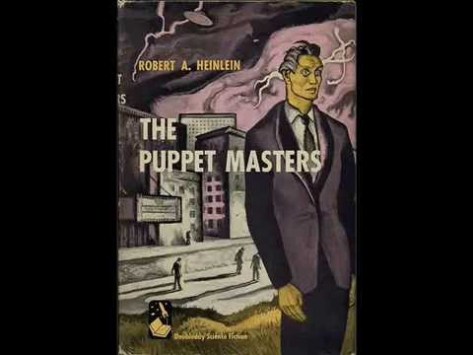
“Boys, we need to fertilize this oak tree. Just jump in that hole at its base and I’ll cover you up.”

“If I had had any sense, I’d have quit and taken a working job. The only trouble with that would be that I wouldn’t have been working for the Old Man any longer. That made the difference.

“Not that he was a soft boss. He was quite capable of saying, ‘Boys, we need to fertilize this oak tree. Just jump in that hole at its base and I’ll cover you up.’ We’d have done it. Any of us would. And the Old Man would bury us alive, too, if he thought that there was as much as a 53 percent probability that it was the Tree of Liberty he was nourishing.”

― Robert A. Heinlein, “The Puppet Masters”


hqdefault (1)

Herbert James Draper’s “Lament for Icarus,” 1898

Draper_Herbert_James_Mourning_for_Icarus

Throwback Thursday: Run-D.M.C. Covers Aerosmith’s “Walk This Way.”

I remember being thrilled when this played on the MTV countdown in 1986.

It was a golden age.  Not only did reality TV shows not appear on MTV, reality TV shows didn’t exist.