Tag Archives: 2017

An interview of a former FBI agent who infiltrated white supremacy groups.

I’m linking here to a brief but excellent AJ+ interview of Mike German, who infiltrated white supremacy groups as an FBI agent in the 1990’s.  To me, German appears to offer a nearly academic analysis of what such organizations actually are and how they appeal to people — but his explanations are easy for any layperson to understand.  He is also critical of both Obama and Trump.

He says some disconcerting things about why these groups are an increased threat in the America of 2017.


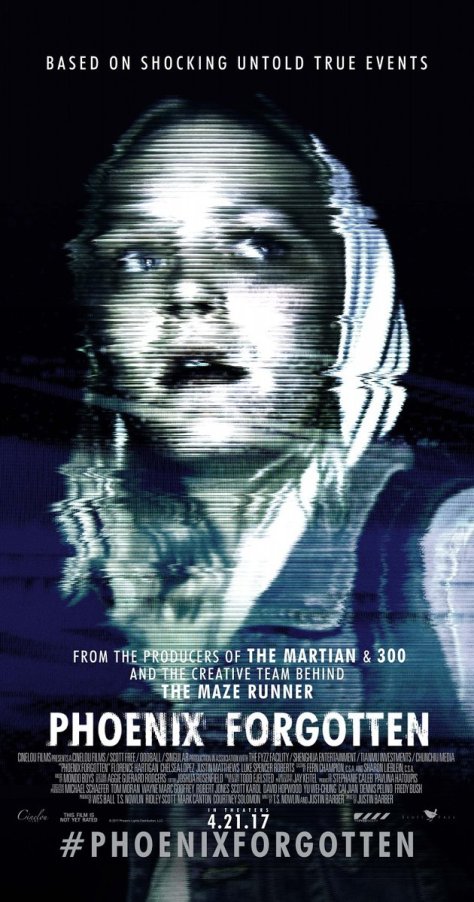
“Phoenix Forgotten” (2017) is a found-footage horror film that didn’t pan out.

“Phoenix Forgotten” (2017) has a couple of things going for it.  The first is its use of real events as the MacGuffin for its found-footage horror story — the 1997 mass UFO sighting in Arizona known as “The Phoenix Lights.”  The second is the young Chelsea Lopez in a lead role.  She appears to be a gifted young actress, and she’s … astonishingly good here.  (The script, too, does succeed in painting her adolescent protagonist as likable and identifiable.)

Those two things, however, do not save “Phoenix Forgotten” from being a mediocre movie.  It’s sometimes slow and occasionally even boring, despite the fact that it picks up quite a bit in its closing minutes.

It also feels far too much like a beat-for-beat remake of 1999’s “The Blair Witch Project.”  Yes, it’s a different sub-genre, with a science fiction plot device instead of a supernatural threat, and a desert setting instead of the Maryland forest.  But its story, its conclusion and even its closing shots parallel that superior film very closely.

I’d rate this a 4 out f 10.


MV5BMTUxODEyNjEzNl5BMl5BanBnXkFtZTgwMDQyMTM2MTI@._V1_UY1200_CR90,0,630,1200_AL_

I wear my sunglasses at night.

I might have gotten ripped off.  These are … “ECLIPSE VIEWING GLASSES,” but it was only after I paid three dollars for them at 7-11 that I realized I have no detailed understanding of why I might need them, or how much (necessary?) protection they might offer.

The packaging instructs me to “WATCH THE SOLAR ECLIPSE.”  But … you could also call them “bird-watching glasses” and it wouldn’t technically be false advertising, right?

If anyone can advise me on how best to photograph the August 21st eclipse, I’d be grateful.  I have a digital camera and a cell phone.  I tried to photograph the last full moon (I wanted a pic to accompany my “Roanoke Summer Midnight” poem), but they absolutely did not turn out.  The only result was that now my neighbors think I’m nuts for taking pictures outside at 1 a.m.

[UPDATE 8/4/17: Okay, as it turns out, eclipse-viewing glasses are serious business.  If you don’t use properly manufactured glasses, you can seriously damage your retinas, or even blind yourself.  What’s more, I’ve read online that there are particularly horrible people who have been selling glasses that are not safe to use?  Let’s hope that’s just an unconfirmed rumor.

A pal of mine sent me this link.  (The glasses I bought below actually do meet the right regulatory standards.)

Reputable Vendors of Solar Filters & Viewers]


20170802_011442


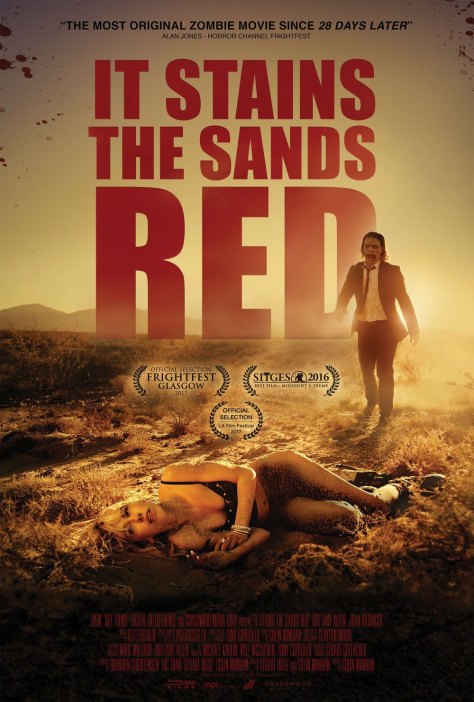
A short review of “It Stains the Sands Red” (2017)

“It Stains the Sands Red” (2017) is a pretty decent zombie film; I’d rate it an 8 out of 10.

The fun starts with a truly impressive aerial shot of Las Vegas in the midst of a full blown zombie apocalypse — it’s great special effects work, and it’s almost enough to compensate entirely for the limited scope of the story that follows it.  (This film focuses largely on one stranded woman being pursued by one zombie antagonist through the Nevada desert.)

Although much of the film might be too slow for some horror fans, it’s actually surprisingly intelligent.  The movie focuses on things often neglected in survival horror scenarios like this one — factors like exhaustion, the elements, firearms proficiency, the availability of basic utilities and even the availability of addictive drugs.  There’s more to admire too — there’s a plot twist late in the game that I thought was skillfully executed.  (I won’t spoil it here.)  Finally, our ostensibly addle-brained anti-heroine does a couple of things that I never would have thought of in order to survive.

It also boasts an incongruously beautiful setting.  (This was shot in Nevada’s “Valley of Fire.”)

“It Stains the Sands Red” isn’t perfect.  There are a couple of stupid parts, particularly near the end of the story.  (Were these otherwise talented screenwriters just running out of steam?)  And there is one surprise plot development that will be sure to have some genre fans rolling their eyes and groaning.

Also, the makeup effects for the monster were good enough, but not stellar.  (Like many longtime fans of zombie horror, I think I’ve been spoiled by the genius of Greg Nicotero and Tom Savini.)

I ‘d still name this as a good movie, however, and I’d recommend it.


ISTSR_poster

A short review of “War for the Planet of the Apes” (2017)

Like the two films preceding it, “War for the Planet of the Apes” (2017) is an intelligent, well rounded science fiction thriller.  The newest “Apes” series has been leagues ahead of the campy late-1960’s original films, and of course Tim Burton’s bizarre 2001 remake.

There is more going on here than a simple “apes vs. humans” tale.  Nor does it engage in simplistic moralizing, in which the innocent animals must escape from their human oppressors.  There’s a hell of a lot of moral complexity — something noted by the many positive reviews for the film.  One of the things that I liked the most was a compelling new surprise plot element, even though it approaches deus ex machina territory.  I won’t spoil it here, but it’s bleak, it’s frightening, and it makes you think.  Given the new information one character explains to another … it’s hard to say who is the bad guy, isn’t it?  How this plot element plays out is damned effective too.

This movie also superbly renders non-human characters — both in terms of its smart script and its special effects (a combination of both CGI and human actors).  I was greatly impressed at the detailed and lifelike facial expressions.

The action sequences were well executed, too, and the film had an epic feel.  (Although this would be a decent conclusion to a trilogy, filmmakers Matt Reeves and Martin Bomback have gone on record stating they wouldn’t be averse to future sequels.)

Still, I must confess that my attention sometimes wandered.  I think the pacing was a bit off.  It also didn’t help much that the conclusion of the final action set piece was spoiled by one of the film’s trailers.  (What the hell were they thinking?  Who makes these decisions?  Was there any backlash from fans who didn’t want advance knowledge of the film’s ending?)

Although this was an exceptionally well developed film, I just can’t give an unusually high rating to a movie that didn’t always hold my interest.  I believe, therefore, that I’d rate this an 8 out of 10.


war-for-the-planet-of-the-apes-poster-380x600

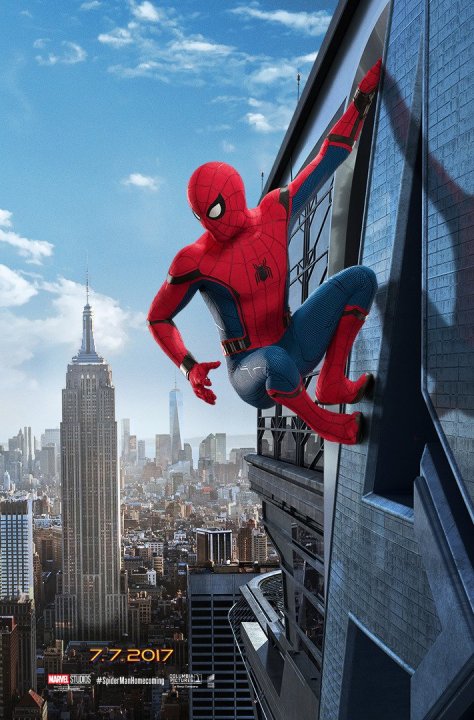
A review of “Spider-Man: Homecoming” (2017)

“Spider-Man: Homecoming” (2017) isn’t a bad movie.  To the contrary, it’s a very good one — I would even rate it a 9 out of 10, if a little reluctantly.

The action, humor, surprises and special effects are all top-notch; it’s got a slew of fun Easter eggs and great continuity within the Marvel Cinematic Universe; and Michael Keaton hits it out of the park as the story’s villain.  (As Ed Harris did recently with HBO’s “Westworld,” the sublimely likable Keaton really surprised me with how he could become so intimidating.)  Furthermore, the screenwriters wisely omit another redundant re-telling of the web-slinger’s origin.  (Even a die-hard fan like me is sick of seeing or reading about it.)

I think your enjoyment of this movie might vary according to what you want Spider-Man to be.  This isn’t a movie in which Peter Parker or his alter ego stand out as his own man (despite its plot resolution’s heavy-handed efforts to tell us that).  I submit that it’s fairly undistinguished as a standalone superhero film —  it feels like an ancillary, companion film to the “Avengers” movies, including last year’s de facto installment, “Captain America: Civil War.”  Indeed, fan-favorite Tony Stark is “Spider-Man: Homecoming’s” most significant supporting character — far more than any of the many friends, family, love interests or villains that have long inhabited the iconic hero’s mythos.  Peter’s primary motivation throughout the movie is his desire to become an Avenger, like a normal kid would aspire to the varsity football team.  Many of his powers stem from a ultra-high-tech costume designed and given to him by Iron Man; it even has an advanced A.I. that is a femme fatale equivalent of J.A.R.V.I.S.  (Fun fact: that alluring voice belongs to none other than the alluring Jennifer Connelly.  The actress is the wife of Paul Bettany, who is the voice of J.A.R.V.I.S. and then the actor portraying The Vision.  And Connelly herself played the love interest of 1991’s mostly forgotten “The Rocketeer,” a World War II-era hero with the a similar character concept to Iron Man.)

I was a big fan of Spider-Man in the 1990’s, and, believe me, the ol’ web-head did just fine with his own powers, intelligence and character — and without any sort of “internship” with Iron Man, either metaphorically or otherwise.  He was also a far more popular character with readers.  I was buying comics regularly between 1991 and 1996 — while Spider-Man books and merchandise were everywhere, I don’t think I ever remember seeing an “Iron Man” comic on the racks at my local comic shop.  I kept thinking inwardly of Spider-Man during this movie as “Iron Man Jr.,” and, for me, that wasn’t a good thing.

I also found myself musing during the film that this felt like “Spider-Man Lite.”  While “Spider-Man: Homecoming” was fun, it doesn’t have the depth, character development or gravitas of the Sam Raimi trilogy.  (Yes, I even liked the third one, despite its bizarre flaws.)  I know that critics are praising the movie’s lighter tone, and I realize the need to avoid a simple rehash of the Raimi films.  (Nobody would want that; we can rightfully expect more from the excellent MCU.)  I actually prefer the Raimi films, though.  While Tom Holland might be the better Peter Parker (Tobey Maguire was a strange casting choice), the Raimi movies were more … heartfelt.  They were an earnest exploration of the Spider-Man of the comics, and they felt … truer.   “Homecoming,” in contrast, is yet another cool installment in the “Avengers” series.  “Spider Man 2” came out 13 years ago, and I can still remember how that movie made me feel — not to mention how its sheer quality vindicated “comic book movies” like no other film before it.  This new movie will not be memorable that way.

Anyway, although my criticisms above are obviously lengthy, please know that this is only because I love the source material so much — and we comic book fans have a tendency to analyze.  I certainly enjoyed the movie, and I’d cheerfully recommend it.  (Note my rating.)  The MCU continues to entertain with quality movies; its consistency, even with its expanding group of ongoing Netflix series, is kind of astonishing.

Go see this.  You’ll have fun.
 

Spider-Man2

A few quick words on “The Rogue Cut” of “X-Men: Days of Future Past”

If you are a die-hard “X-Men” fan, then I do recommend checking out Bryan Singer’s non-canonical “The Rogue Cut” of “X-Men: Days of Future Past.”  You might enjoy it just for its novelty — it actually is a very different version of the original movie.  It has a lot of scenes that are either entirely new or shot and edited quite differently.  (The most notable difference, obviously, is an entire subplot concerning the rescue of Anna Paquin’s Rogue, which was deleted from the 2014 theatrical release.)

I get the sense that this will come across as a better film to “X-Men” purists.  There is greater attention to a multitude of characters, far more character interaction, and greater detail about the apocalyptic future segments.  (I myself was happy to finally figure out why the dystopian mutants were housed in such a strange looking building.  It turns out they were hiding in a Chinese temple as part of an ongoing global evasion strategy.)  “The Rogue Cut” also has greater continuity with more of the prior films — it feels integral to the films’ ongoing mythos, and less like a standalone adventure.

But “The Rogue Cut” might not be better at pleasing general audiences.  It clocks in at just under two and a half hours, and the overall result did feel far slower to me.  There is a reason why movies are edited down — their unabridged versions have problems with pacing that really can affect the average viewer’s enjoyment.

I will also point out that this version of the film fails to rectify what I’ll reiterate is the theatrical version’s biggest story flaw — why would the shape-shifting Mystique be the key to developing the Sentinels power-stealing technology.  Why not the power-stealing Rogue herself?

Anyway … speaking of what is canon and what is not, there is a damned interesting fan theory floating around about the “X-Men” movies following this year’s release of “Logan.”  That movie stood out for many reasons, but two in particular are relevant here.  The first is the radical change in its tone and storytelling, which makes it feel like it takes place in “the real world.”  The second is its odd, apparently meta-fictional inclusion of the “X-Men” comics themselves within the story.  (Copies of the comic books are discussed by the characters, and even serve as an important plot element; Wolverine complains that they are horribly inaccurate.)

Many fans are having fun wondering if there has, in fact, been only one canonical “X-Men” movie — and that is “Logan” itself.  The brutal, subdued reality of “Logan” alone is “the real world” of the X-Men; all of the fantastical prior films (which occasionally contradict one another anyway) are merely the stories inside the last movie’s comic books.  I thought that was pretty damned clever.


newcut2_by_joseelizondo-d901c11

“A Republic, if you can keep it.”

Happy Independence Day, all!  Enjoy any celebrations you might attend, and please be safe.

The quote above is attributed to Benjamin Franklin.  Upon exiting the Constitutional Convention in 1787, he was asked by a bystander what form of government the delegates had created:

“Well, Doctor, what have we got—a Republic or a Monarchy?”

“A Republic, if you can keep it.”

His reply was documented by Dr. James McHenry, the delegate from Maryland.

The imperative implied in Franklin’s words is the same as what Thomas Jefferson expressed when he warned us that “The price of freedom is eternal vigilance.”


120504-M-IX426-237

Photo credit: By U.S. Department of Defense Current Photos (120504-M-IX426-237) [Public domain], via Wikimedia Commons.

A few quick words on “47 Meters Down” (2017)

Yes, “47 Meters Down” is silly in places, and I don’t think it will ever be held up as an example to students of good screenwriting.  But I can’t slam any horror-thriller that scared and entertained me.  And the sharks here (which were surprisingly well rendered by CGI) made me jump a few times.  Furthermore, there are a couple of surprises late in the story, and I thought that one of them was wonderfully well executed.

This movie actually reminds me a little of last year’s “The Shallows.”  Neither movie is 1975’s “Jaws,” but neither pretends to be.  They’re both perfectly serviceable monster movies that present horror movie fans with a great way to kick off the summer.

I’d rate this film an 8 out of 10 for being a fun, if forgettable, shark flick.


poster-large

Botetourt County, Virginia, June 2017

At left is a Bradford Pear tree, at right is a Cleveland Pear.

20170617_113337

Bradford Pear.

20170617_113420

This Bradford Pear tree was felled by a derecho windstorm.

20170617_113548

20170617_113641

Termites?  A mutant steel-billed woodpecker?

20170617_113634

I have no idea what this … organism is, but it looks like the inside of a dog’s ear.

20170617_142410

20170617_142424