Tag Archives: 2018

Cover to “Britannia: Lost Eagles of Rome” #1, Cary Nord, 2018

“Cover A.”  Valiant.

BRIT3_001_COVER-A_NORD

A review of “The Purge” Season 1 (2018)

“The Purge” franchise continues to defy expectations after its move to television.  It still isn’t high art, and it probably can never fully transcend the high-camp trappings of its premise.  (I suppose it’s hard to script a truly grounded horror property about people in Halloween costumes murdering one another with impunity on a designated “holiday.”)  But, like the movies preceding it, the USA Network’s new dystopian horror show is still a bit smarter and more interesting you’d expect from its bizarre central plot conceit.

The 10-episode first season, which aired with seemingly little fanfare last fall, generally succeeds — I’d rate it an 8 out of 10, and I’ve spoken with a couple of other horror fan who were as happy with it as I was.  The people who recommended it to me are also big fans of AMC’s “The Walking Dead” (which has radically improved this season), and that makes sense.  Although “The Purge” has an entirely different feel than “The Walking Dead,” it also has a lot of common elements — both shows are milieu-type horror stories with a large, diverse group of characters negotiating a sprawling setting with innumerable deadly antagonists.

A surprising amount of thought went into this show.  There’s a nice degree of world-building and detail, with various characters embracing, rejecting or remaining ambivalent about the titular “Purge.”  The screenwriter here tries hard to round out the twisted America in which The Purge annually takes place, with a lot of creative and blackly cynical story elements.  (I’m not clear if the writer here is James DeMonaco, who wrote and directed the first three of the four “Purge” movies.)  We see, for example, a cult whose brainwashed members offer themselves up as willing murder victims, as well as anti-Purge revolutionaries who exploit the night to target the fascist oligarchical government which created the brutal holiday.  There are a lot of surprises in terms of plot, character and setting that I will not spoil here.

The gore and violence were surprisingly high for network television.  (Again, this show may be taking its cues from “The Walking Dead,” which always pushes the boundaries.)

Some of the acting is quite good — William Baldwin is absolutely superb, Lee Tergesen is always fun to watch, and the beautiful Hannah Emily Anderson is another talented standout.  I swore I recognized Fiona Dourif’s distinctive looks and mannerisms.  (She portrays the cunning cult leader who entices young people to sacrifice themselves, and I’ll be damned if she doesn’t totally look and sound the part.)  But, upon Googling her, I realized I’d never seen her before — she just reminds me of her father, who also plays a lot of bad guys — the amazing Brad Dourif.

Some of my enthusiasm for “The Purge” waned just a little as the season wound down toward its conclusion.  After Season 1’s unsettling ideas were left fully explored, the show did start to feel more like conventional television — right down to a standard good-guys-vs.-bad-guys shoot-em-up at its climax.  (If the show had fully sustained its tension until the end, I would have rated it a 9 out of 10.)  And the final minutes of Season 1 consist of a coda among three characters that is forced and preposterous … I’m surprised it made it past the editing stage.  But this still wasn’t enough to spoil the fun.

I should also note here that not everyone enjoyed “The Purge” as I and my friends did.  Critical and popular reaction to it is definitely mixed.  (As of this writing, the show has only a 42% rating from critics on Rotten Tomatoes, with just 63% of audiences liking it.)

Postscript — I could almost swear that the auditorium we see towards the end is the very same shooting location used for Thomas Smith’s school in “The Man in the High Castle.”  You can tell by the establishing shots.  It’s even lit the same way.


Purge_TV

A short review of “The First Purge” (2018)

“The First Purge” (2018) isn’t the best horror-thriller I’ve ever seen, but it certainly isn’t the worst, either.  I thought that I would be all purged out by now, but this fourth entry in the film series is a solid prequel — I’d rate it an 8 out of 10.  (There is also a TV show set in “The Purge” universe, which USA has renewed for a second season, and I’m told that it’s pretty good.)  I suppose this is a durable franchise because its premise could be explored through countless different characters.

The movie has some weaknesses.  The pacing is off, and you could argue that the political theme of “The Purge” films, though compelling, is getting redundant by now.  (There are some specific jabs this time out at Donald Trump and his following; they’re heavy-handed, but they’re fun to spot.)

But “The First Purge” is still a suspenseful and disturbing dystopian horror film.  It’s got a terrific bad guy in Rotimi Paul’s “Skeletor” psychopath and some surprisingly damned good action sequences.  There is another difference here, too — this “Purge” is far less campy than the second and third films.  There are fewer plot twists, fewer over-the-top characters, and far fewer trippy visuals — it feels more like a straight horror film instead of a zany one.  Depending on your preferences, you might find it superior.

One more thing — given its obvious love for Staten Island, this film would make a great double-feature with “Bushwick” (2017), another thriller which seems like a love letter to its own setting in Brooklyn.  And they are both urban neighborhood thrillers with a similar storytelling style.


purge3-1068x1691

Variant Cover to “The Walking Dead” #7 –15th Anniversary Edition, Daniel Warren Johnson, 2018

Image Comics.

4787244

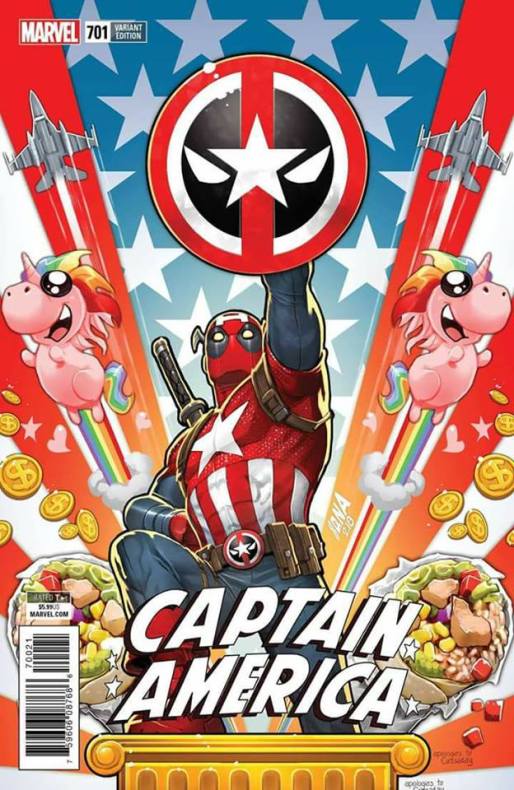
Variant cover to “Captain America” #701, David Nakayama, 2018

(Deadpool variant.)  Marvel Comics.

30261095_628587317473485_5683540539308244992_n

My poetry, 2018

Care to peruse some of the poetry I’ve published in 2018?

You can find it here at the blog at the My poetry, 2018 page.


OLYMPUS DIGITAL CAMERA

Here is the irony of “Bird Box’s” (2018) plot device.

The (entirely invisible) creatures need incredible illusions to provoke their prey to kill themselves, and the creatures never exhibit any physical prowess of their own. (Their victims are never so much as scratched or bitten by the monsters themselves.)

Maybe that’s because they have no teeth, claws, strength, etc. Maybe they’re as fragile as baby fawns, which is why they must rely on such a unique method of attack.

It would be nuts if a future film or book sequel saw a single immune human just kicking them over like a drunk college kid out tipping cows.

Even better would be if someone suffered a traumatic brain injury during the chaos of the invasion — harming their visual cortex, and rendering them unable to process any visual information. They’d have huge vulnerabilities resulting from this new disability, but also a practically messianic power to save everyone.

(I think too much about movies when I need to do laundry, in other words.)


DSC04279.CR2

Throwback Thursday: “Laverne and Shirley” (1976-1983)

Rest in Peace, Penny Marshall.

This is one of only a handful of TV shows that I can remember watching as a tot in the late 1970’s.  “Laverne and Shirley” (1976-1983) was the kind of of thing I’d see in my older sisters’ room.  My Dad and older brother watched war movies, westerns and monster movies, but my two sisters preferred considerably lighter fare.  Two that they watched a lot at the time, if I recall, were this show and “Donnie & Marie” (1976-1979) — about the scariest thing you could find playing on their black-and-white TV was “The Hardy Boys/Nancy Drew Mysteries” (1977-1979). (One of my sisters had a crush on actor Shaun Cassidy; I think there was a poster of him in their room.)

I loved “Laverne and Shirley” when I was that young.  Lenny and Squiggy were my favorite highlight of any episode, even if I was sometimes confused about whether they were meant to be “good guys” or “bad guys.”  I was in kindergarten, and not altogether bright, and I thought that men who wore black leather jackets (Fonzie notwithstanding) were usually “bad guys.”  I also remember thinking that hippies and motorcyclists were the same group of “bad guys” because they disobeyed God or something … my confusion at the time resulted from some vaguely moraled born-again Christian comic books I’d happened across somewhere.

I also remember recognizing “Laverne and Shirley” as being related to another show that a lot of kids back then loved — “Happy Days” (1974-1984), of which it was a spin-off.  This might have been the first time in my life that I was aware of two live-action television properties occupying the same fictional universe; I’d already seen it happen in the movies with the various incarnations of “King Kong” and “Godzilla.”

Here’s what makes me feel old — for both “Laverne and Shirley” and “Happy Days,” I probably watched a lot of the episodes when they were first broadcast, and not just in re-runs (although “Happy Days” was also played in syndication endlessly throughout the 1980’s — it remained a fixture of daytime television).

And I only just realized writing this that Lenny was played by the priceless Michael McKean.  As an adult, I know him primarily from his brilliant turns in “This Is Spinal Tap” (1984) and “The X-Files” (1998-2018).  He’s 71 now.  Wow.


A short review of “Patient Zero” (2018)

I’d be lying to you if I told you that “Patient Zero” (2018) is an especially good movie.  It isn’t.  It plays a lot like the classic “28 Days Later” (2002) would play if it were produced by the SyFy Channel, and by that I mean it generally is a poorly written, low-budget cheese-fest.  (This is one of those movies where even the score was kinda bad.)  Still, there were some hints of greatness hidden within this lackluster zombie movie — enough to save it from being a complete failure — and I would reluctantly rate it a 5 out of 10.  (Most other reviewers are not even that kind.)

First, it has some fine performers. These include two “Game of Thrones” actors who are always fun to watch — the mesmerizing Natalie Dormer and the consistently likable John Bradley.  (The latter seems to specialize in winning audiences over as the “hero’s-affable-friend” role.)  “Doctor Who” fans will of course recognize Matt Smith in the lead role.  But by far and away, they’re overshadowed by a fantastic performance by Stanley Tucci as the zombies’ surprisingly eloquent leader.  (More on that in a moment.)  Tucci is truly a great actor and he makes a perfectly menacing bad guy; his voice, diction and line delivery are goddam perfect.  His talent for voicing a magnetic, highly intelligent antagonist reminds me of Jeffrey Dean Morgan’s portrayal of Negan on “The Walking Dead,” or one of the better “big bads” seen on “24” (2001 – 2014).

Second, there are some really clever ideas hiding under this thin, hasty script.  (I strongly get the sense that “Patient Zero” was a rush job for screenwriter Mike Le and director Vincent Newman.)  The hyper-kinetic zombies here are afflicted with “super-rabies” and are reminiscent of their ilk from “28 Days Later.”  But there is a truly intriguing plot conceit — their roars and screams are perfectly intelligible to Smith’s protagonist.  He speaks their “language” because he’s infected, but also mysteriously asymptomatic.  When he interrogates the zombies for the military, their interaction is filmed as normal dialogue (creating the opportunity for Tucci’s terrific turn here).  Then things get even more interesting when it’s demonstrated that the ostensibly mindless zombies are quite proficient at planning an attack.

I … might be treating this movie a bit charitably simply because I liked some of its ingredients.  Again, I don’t actually recommend it.  But your mileage may vary.


17YBhcjXvv5BFz433OcF1UqcGzd

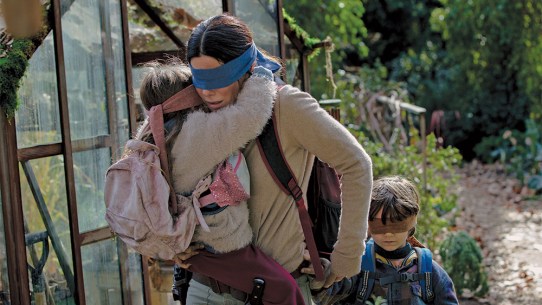
A short review of “Bird Box” (2018)

Netflix’ “Bird Box” generally pleases — I’d rate it an 8 out of 10, and I’d recommend it to anyone looking for a creative and effective apocalyptic horror film.  A few reviewers call it a “high-concept” horror movie because of its MacGuffin — an invasion of otherworldly beings causes anyone who looks at them to hallucinate and become suicidally depressed.  (A handful of survivors escape the chaotic mass suicides because they are lucky enough not to lay eyes on the mysterious, mind-bending creatures which can become images of their victims’ worst fears.)

It’s a hell of a setup — it reminds many people of this year’s “A Quiet Place” and 2008’s unfairly maligned “The Happening.”  (Hey, I really liked that movie.)  For some reason, “Bird Box” reminded me of the 1985 “The Twilight Zone” episode, “Need to Know.”  (It’s a great ep.)  And the plot device pays off — “Bird Box” is genuinely unsettling, and the whole story comes across as a blackly inventive end-of-the-world tale.

Sandra Bullock is good here; supporting actors Sarah Paulson and John Malkovich are even better. (Malkovich is mesmerizing whenever he plays an intense or unpleasant character.)

The film suffers somewhat from puzzling pacing problems — sometimes the story appears to be unfolding too quickly, but by the end of the two-hour movie, it feels too long.  “Bird Box” was adapted from a structured 2014 novel by Josh Malerman; I strongly get the sense that it tries to squeeze too much of its source material into a the running time for a movie.  I honestly think I would have enjoyed it much more if its frightening plot device and interesting, well-played characters were explored in a mini-series.

There’s another disappointment too — we learn very little about the story’s antagonists, beyond one character’s hypothesis that they’re archetypal punishing figures from a number of the world’s religions.  I wanted to know more.


Bird_Box_poster