Tag Archives: Eric Robert Nolan

The Unbearable Lightness of Bee-ing

If you are in the mood for dark, dystopian poetry, then do stop by The Bees Are Dead.  There is some truly outstanding work by Yuan Changming, Robert Alan Rife, Cody Simpson, Jonathan Everitt, Jake Tringali and many more.


800px-Abeille_(5836453261)

Photo credit: By Jean-Raphaël Guillaumin from Lausanne, Suisse – Abeille, CC BY-SA 2.0, https://commons.wikimedia.org/w/index.php?curid=70638405

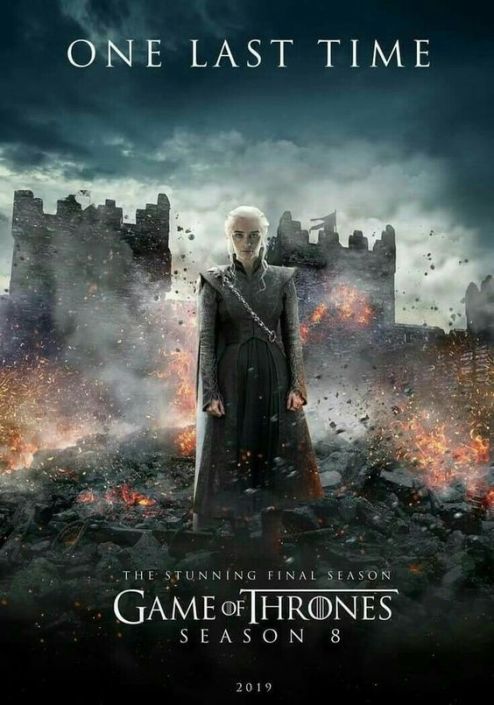
“Game of Thrones” Season 8 (2019) was a Greek tragedy. And I’m fine with that.

I’ve read and heard so many of the popular complaints about Season 8 of “Game of Thrones.”  Most of them are understandable.  A couple I agree with.  But I’m not on board with panning this six-episode final season.  Even with my own reservations about it, I still loved enough to rate it a 10 out of 10.

By far and away, of course, the part of Season 8 that has people up in arms is a major story development in its final two episodes.  (You almost certainly know what it is; because fans are complaining about it everywhere.  I’m not sure why I am trying so hard to keep this review spoiler-free.)  It was a bombshell, and it was damned saddening, and even I’ll admit that it affected my enjoyment of everything that transpired until the credits rolled for the last time.

But I made peace with it quickly.  (Granted, the character who figured the most prominently here was not my favorite, so it was a little easier for me to do so.)

I think it boils down to a matter of taste — specifically what you wanted out of “Game of Thrones.”  I like tragedies.  I love pathos in stories, whether they’re books, movies or television shows.  Stories that end badly aren’t bad stories.  One of the things that excited me about “Game of Thrones” since its second season was how it so often took the traditional elements of fantasy and fairy tales and turned them on their head with a brutal, unexpected (yet reasonable) conclusion to a story arc.  (I wasn’t fanatical about the show during Season 1, which overwhelmed me with exposition and plotting.)

The show has always tried to give us stories that were complex or ambiguous in terms of character, theme, setting and resolution.  One of the things that I tell people who have never watched the show is this — it is almost never as simple as “the good guys vs. the bad guys.”  Instead, it parallels human interaction in the real world — there are disparate groups and individuals fighting and aiding one another out of self-interest or philosophy.  The character turns and story turns that we saw in the last two episodes … somewhat parallel what we’ve seen in and heard on this show before.  As Ramsay Bolton said back in Season 3, “If you think this has a happy ending, you haven’t been paying attention.”

“Game of Thrones” was a Greek tragedy.  This last season’s classical plot resolution was arguably perfect for the show’s sweeping fantasy epic masterpiece.  The ending didn’t make me happy.  But it impressed me and affected me and made me think.  This was a fantasy show for adults.  It was an edgier, less predictable, more provocative alternative to “The Lord of the Rings” in all of that epic’s incarnations.  I far prefer the ending I saw to a pandering, cookie-cutter “happily ever after.”

And the show has indeed hinted at the outcomes we see in the final two episodes.  It’s been doing so for years, not just with major events but also with obvious dialogue.  I kept asking one other fan in particular, “Are you seeing what I’m seeing?”  But he didn’t.  Maybe a lot of fans didn’t.

If you tell me that a certain character decision was made too abruptly, with insufficient buildup, I hear you.  But, in the real world, I’m inclined to think that the internal processes we witness in the penultimate episode are often completely invisible.

If I had any complaints about Season 8, they lay elsewhere.  I simply cannot understand why this was six episodes instead of 10.  The two major battles we see each occupy one episode.  Why?  Even with a longer running time for each episode, this season felt rushed and truncated.  It still bothers me, even as I write this.

I had the same quibble as everyone else about the Battle of Winterfell being difficult to follow, but I’m willing to accept that this was a deliberate stylistic choice.  (And although I loved both major battles this season, I think the show’s three prior major land engagements were superior.  The Massacre at Hardhome, the Battle of the Bastards and the Attack on the Rose Road were all so well choreographed and scored that they were just too difficult to surpass.)  I even had my own disappointments for the outcomes we see for various characters.

I consequently almost rated the eighth season a 9 out of 10, instead of a perfect 10.  But I couldn’t.  I loved Season 8 too much.  It wasn’t perfect, but it was … still so damned riveting and enjoyable.  It was still “Game of Thrones,” with all of the attention to story and detail and performances that I’d come to love.  It was still the best thing on television.
 

7266820ea23a32cfa984e7be5e1450f0

A review of “Phantasm” (1979)

I don’t enjoy panning films that others revere.  There’s no percentage in it.  I’m not the guy who tries to be edgy or cool by telling you he dislikes something that everyone else loves.

But I do need to tell you that I think that “Phantasm” (1979) is a bad movie.  I’d rate it a 3 out of 10, based on some interesting ingredients, but I suspect that even that is a bit generous.  I finally managed to make it through its entire running time tonight, and it feels amateurish on every level.

It’s poorly scripted, directed and edited, with performances that are nearly all quite bad.  The first exception here is A. Michael Baldwin, who was a decent child actor when this movie was made, and who was quite likable as the story’s adolescent protagonist.  The second exception, I suppose, is “The Tall Man” himself, Angus Scrimm, the deep-voiced and admittedly unsettling big-bad.

There’s really only one other positive thing I can say about the movie — it has a damned good set design for its mausoleum.  (Somewhat confusingly, the film suggests this is located … inside the funeral home itself?  Is that a thing in some places?  I honestly don’t know.)  The set is simultaneously beautiful and frightening, with symmetrical hallways of contrasting white and red — the kind of thing you’d expect to see in a Stanley Kubrick film.  I can’t escape the suspicion that it was somehow pilfered from a far better film.

And I do understand the unconscious appeal of “Phantasm’s” story.  We see an adolescent boy who has lost his parents team up with his likable older brother to fight mysterious monsters at their local funeral home.  They enlist the aid of the brother’s guitar-playing, everyman best friend, they use everyday weapons like guns and knives, and they bond over the shared experience.  It’s a tailor-made, understandable power fantasy for any adolescent boy first grasping adult concepts of death and mortality.

But … those things aren’t enough to redeem the film.  In my opinion, it’s bad enough to be a candidate for the “Mystery Science Theater 3000” treatment.

Hey — what do I know?  Your mileage may vary.  “Phantasm” has a cult following in the horror community, and spawned no fewer than four sequels.  (The latest, “Phantasm: Ravager,” was released just three years ago.)  You might enjoy it, or you might need to watch it out of curiosity, as I did.


518kDX8g+zL

“Sullen Robin Haiku” appears at Haikuniverse

The good folks over at Haikuniverse have kindly published the haiku I wrote about that pissy robin in my backyard!  🙂

You can find it right here:

“Sullen Robin Haiku,” by Eric Robert Nolan


Throwback Thursday: Olympic Prizes or Cash!

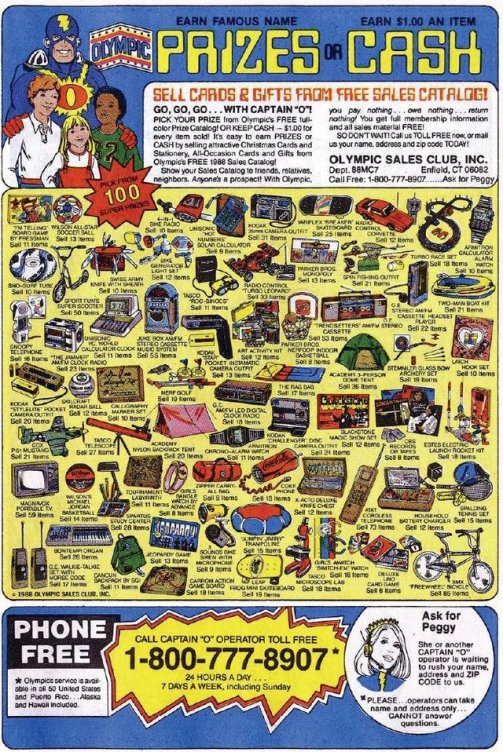
Here’s another ad that was a permanent fixture of comic books in the 1980’s.  I myself was never interested in joining the advertised “Olympic Sales Club;” nor did I want to “GO, GO, GO WITH CAPTAIN “O”!” [sic].

I found this ad pretty patronizing, with its generic champion hugging his demographically diverse charges in the upper left-hand corner.  What kind of superhero was “Captain O” supposed to be, anyway?  Was he the protector of the company?  The guardian of the kids who went door to door selling its wares? The hero of … salespeople generally?  To me, this was really just an example of adults pandering to kids as though they were idiots.

But ads like this fueled a lot of conversation among grade-school boys.  It really made it seem like you could earn some cool prizes for selling only a moderate amount of greeting cards or stationary.  (The radio-controlled cars and planes were what all the boys eyed most eagerly.)

And 80’s kids often prided ourselves on our sales skills.  Most of us had sold things door-to-door for school-related fundraisers — it was just a very common practice at the time, even if it seems needlessly dangerous to me as an adult.  When I was in second and third grade at Catholic school, we annually sold candy bars door-to-door.  If memory serves, we weren’t even required to do that for any particular fundraising purpose, like a school trip or a sports team.  I think it we were just turning a profit for the school, in addition to what our parents were paying them in tuition.

I also remember seeing ads in my older comics that recruited kids to sell “Grit,” which was some sort of periodical that was oddly billed as a “family newspaper.”  But I think that was primarily a 1970’s thing, and was just before my time.


4BHeRXx12ibMWVWbVFQS0O_6mzEpxbe5uUl5Y-nfUkI

“My Mother’s Apartment” appears at The Piker Press.

I’m honored to share here that a short poem of mine, “My Mother’s Apartment,” was published today over at The Piker Press.  You can find it at the link below.

As always, I am grateful to Editor Sand Pilarski for allowing me to share my voice with the readers of The Piker Press.

“My Mother’s Apartment”


I FED THE RABBITS IN ROANOKE AND ALL I GOT WAS THIS LOUSY HAIKU.

I’m just a poor boy — no bunny loves me.

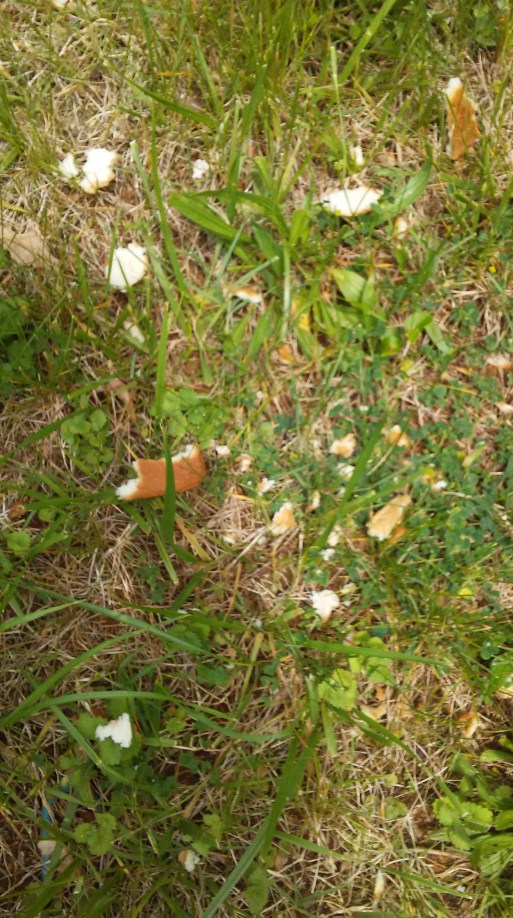
As I told you guys yesterday, I’ve been trying to feed the legions of little brown bunnies that perennially invade my neighborhood.  They’re totally not going for it.  I’ve been out there two days in a row this weekend, and it looks like they haven’t touched my offering below.

Yeah, yeah, I know — I should be feeding them lettuce or something; rabbits probably don’t eat bread.  But I don’t really maintain a healthy fridge; the only green thing in there is a package of Mint-Chocolate Chip Klondike Bars.  (I have a problem.)

Cheese?  Will bunnies eat cheese?

I suspect I’m still thinking too much in terms of New York’s animal supplicants.  The cats there will eat anything, and then demand more.  You feed a stray cat in New York, he shows up the next day with five more cats and a lobbyist.

Even the birds won’t eat my bread, for some reason.  That makes no sense to me.  There was a single, dejected-looking robin outside this morning that only looked at me like I was some sort of imbecile:

Presented with bread,
one plumping, sullen robin,
indicates disdain.

[Update: that Robin has not left the yard.  Pretty sure she lives here now.]


20190504_131146

Today’s agenda — feed the bunnies.

Seriously. The annual influx of little brown bunnies has arrived. There’s a warren somewhere under my backyard.

I gotta get some video for you guys.  I tried last year, but those little fur-twerps are quick and shy.  I felt like a paparazzi last spring zig-zagging around my yard with my cellphone camera. Neighbors thought I was nuts.

[Update: a “warren” is a rabbit burrow, right? I can never remember my “Watership Down” accurately.  I don’t mean that a guy named “Warren” is buried somewhere under my backyard. This is Roanoke, not New Jersey.]


“The lone wolf dies, but the pack survives.”

[MINOR “GAME OF THRONES” SPOILERS BELOW. ]

This is what makes me worry over Arya’s fate before the show ends. I think a lot of people would think of Jon as the “lone wolf” of the family, being a putative “bastard” and being relegated to the Night’s Watch, etc.  I, for one, always imagined the prognostication applied to him. (I think it was a verse Ned recited to Sansa in Season 1?) But … being marginalized, vilified or betrayed doesn’t mean Jon has been alone.

Jon’s has always had friends near him.  He became a King, for god’s sake.  But more than any of the other Stark children, Arya has usually walked alone.  Her primary motivation is personal revenge, whereas Sansa, Jon and Bran are respectively motivated by their duties to House Stark, Westeros, and all of humanity.  (I myself am slightly befuddled about Bran’s importance, including during the Battle of Winterfell.  He’s … “the world’s memory?”  I thought we had books and maesters for that.  But whatever.)

Arya doesn’t exactly leave the Faceless Men under the best of terms.  Even when she encounters Nymeria in the woods on her way back to Winterfell, her own former pet turns down her invitation to join her.

Then, even when she’s back among her siblings at Winterfell, she keeps to herself.  Upon her arrival, she slips by the two guards who were supposed to escort her.  When Jon asks where she is, Sansa says something to the effect of “She’s lurking around here somewhere.”

Besides … [MAJOR SPOILERS FOR SEASON 8 AFTER THE JUMP BELOW]

Arya-Stark-seems-distorted-in-trailer-alone-with-her-horse-closer-to-north


Continue reading “The lone wolf dies, but the pack survives.”

10 classic movies that I will never fully understand the appeal of:

Because I can’t sleep, and you’ve been dying to know.  Here they are, in no particular order:

1) “Memento” (2000)
2) “Fight Club” (1999)
3) “American Psycho” (2000)
4) “Rosemary’s Baby” (1968)
5) “The Rocky Horror Picture Show” (1975)
6) “Monty Python and the Holy Grail” (1975)
7) “Natural Born Killers” (1994)
8) Lucio Fulci’s “Zombi” (alternately titled “Zombi 2,” 1979)
9) “Fast Times at Ridgemont High” (1982)
10) “The Big Chill” (1983)

And … worst of all … I’m kinda on the fence about the first two “The Evil Dead” films (1981, 1987), Stanley Kubrick’s “A Clockwork Orange” (1971) and John Carpenter’s original “Halloween” (1978).   I am hanging my head in shame here over those last two.  I know Kubrick’s film is considered a masterpiece.  I saw it twice when I was a college student (once in a psychology class!), soooo … maybe I just wasn’t mature enough to grasp it?  Mea culpa, people.

I left “Citizen Kane” (1941) and “Ben Hur” (1959) off the list, because I haven’t seen them in their entirety.  I was nonplussed enough to turn those off after 40 minutes or so, but I’m weird about never saying I dislike a movie unless I watch the whole thing.  You can add 1979’s “Phantasm” to this category too.

I know, I know … there’s nothing wrong with any of these films (except “Fast Times at Ridgemont High,” of course, which is terrible).  There are just basic ingredients in them that I somehow fail to appreciate.

Now one of you needs to e-mail me a cure for insomnia.


51jojzqpkPL (1)