Tag Archives: Eric Robert Nolan

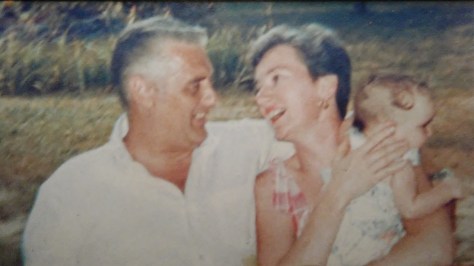
Robert and Kathleen Nolan, circa mid-1970’s

20180617_215015 (2)

“Who knows what evil lurks in the hearts of men? THE SHADOW KNOWS!”

The weed of crime bears bitter fruit.  Crime does not pay.

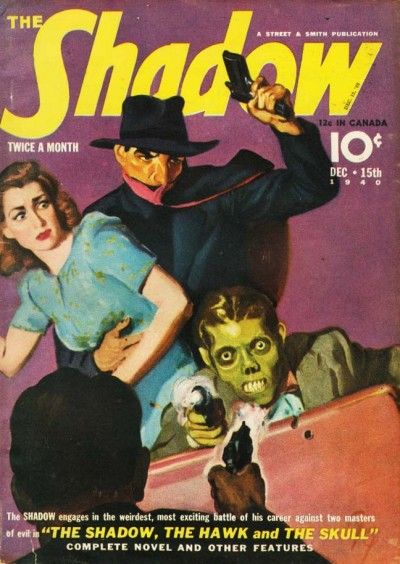
Dabbling in old time radio inevitably brought me to “The Shadow” — a character I’d heard about periodically when I was growing up.  My Dad had been a fan of the radio program and film serials when he was a kid, and he was fond of rattling off that tagline you see in this blog post’s headline.  (The radio shows were broadcast in to the mid-1950’s, long after they started in 1937.)  I also remember the character from the truly unfortunate 1994 feature film with Alec Baldwin, which I actually saw in the theater with my college girlfriend.  (The less said, the better.  About the movie, I mean.)  The Shadow is also cited periodically as an influence in the creation of my own favorite iconic dark detective, Batman.

The Shadow has a loooooooong, varied and occasionally confusing history – spanning radio, pulp magazines, comic books, television and film.  He’s still being portrayed in comics.  DC Comics released a crossover with Batman last year that looks interesting, and the incomparable Matt Wagner produced a couple of books in 2015 and 2016 that I’d love to get my hands on.  (He fights Grendel!!!)

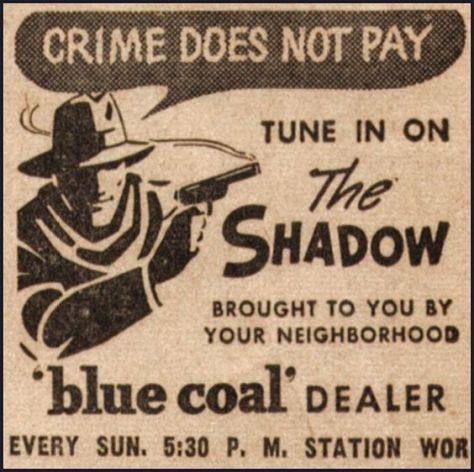
The radio shows are a lot if fun, just like the antique horror and mystery programs that I’ve linked to here at the blog.  And, just like those, they’re easily found on Internet.  (How my Dad might have marveled at that!)  They’re definitely more campy.  And I suppose that makes sense, as they seem aimed at children, whereas the horror shows seem intended for general audiences or just adults.  The period commercials for Blue Coal are a weird glimpse into the past, too.  If I had to name one thing that I found annoying about all of the old time radio shows I’ve found, it’s the omnipresence of that damned organ music.  (Was it just a cultural staple of the time?)

If “The Shadow’s” stories are a bit hokey, the show’s voice acting and production are just terrific.  I particularly like the actor performing The Shadow for the episode in the first link below — “Death is a Colored Dream” (1948).  I believe it is Bret Morrison.  (And I was surprised to learn that the famous Orson Welles only voiced the character for a year or so a decade earlier.)

But what’s most interesting is the character’s inception.  He didn’t start out as a character in a story at all … “The Shadow” was simply the name of the generic host for a series of unrelated mystery stories comprising “The Detective Story Hour” in 1930.  After a surprising fanbase developed around the creepy-sounding host (voiced at the time by Frank Readick, Jr.), people started asking for stories featuring “The Shadow” at the news stand.  Street & Smith commissioned writer Walter B. Gibson to write up some tales featuring a supernatural detective; the first came out in 1931.  The iconic character was just sort of made-to-order for confused customers who might have thought he already existed.  That “Shadow” later arrived at the airwaves in 1937, with Welles voicing him.

Seriously, though, I totally need to get my hands on “Grendel vs. The Shadow.”


65abeb7e5ce5ea7298ae9cf177524b71

CareysSaltRingAd-47-03-28

56ef5b24ef0bfc25d46cca42c5574a28

(It’s all about less evolved primates, I guess.)

That awkward, recurring moment when people write “follow the money” in online political discussions, but I keep reading “follow the monkey” because I’m old and easily confused and I need new reading glasses.

I WANT it to be “follow the monkey.” That suggests a less depressing outcome than most political discussions.


Guerrilla poetry at Tenleytown, Washington, D.C.

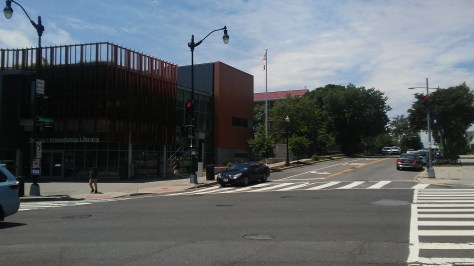
This is Tenleytown, in Washington, D.C.’s Northwest, just a couple of blocks from a campus of American University — where I almost went to school, instead of Mary Washington College in Virginia.  I even (somewhat hilariously) received “honors admission” there.  (I was never actually a true “honor student,” even in high school, because my grades in math and science were fair at best — and anyone who knew me at age 18 could tell you that I was not exactly the brightest bulb in the socket.)

I remember being pretty excited as a high school senior at that admission letter.  American U. was my first choice; I was only seduced away to small-town Virginia by a generous financial aid package from the good people at Mary Washington.  (Yes, young people, Fredericksburg was indeed a small town in 1990, even if it now looks like downtown frikkin’ Fairfax.)

It was freaky sipping coffee in Tenleytown and pondering some other parallel-universe me who lived and studied and partied there as a kid.  (Where would I have bought my comic books?)  Most people don’t think about string theory when they travel, but I am both a science fiction fan and a really weird guy with a lot of time on his hands.  (Where is that other Eric right now?  Is he married?  Is he writing?  Is he equally irritated by Star Wars obsessives, the religious right, Orwellian language, people who push “healthy snacks,” the dumbing down of America, “fun-sized” candy, and the gradual decline of “The Walking Dead?”)

Anyway, Tenleytown a pleasant neighborhood with a brisk, college-town vibe to it.  DC consistently surprises me by how friendly its people can be.

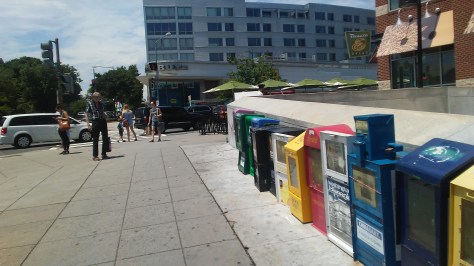
I left some poetry mini-books beside some news-stands on Albemarle Street, a cross-street with Wisconsin Avenue.  The stands alternately inform readers in Greek, Spanish, Chinese and English about how DC’s most deplorable resident has most recently embarrassed our country.  (I admire the Spanish-language papers’ predictable special antipathy for the president.)  No matter how sad the news is, this town will not let you hide behind a language barrier.

Am I nuts, or does that Best Buy look like it was designed with the Watergate in mind?  I keep wondering if that is someone’s idea of an obscure joke.


20180605_124817

20180605_124821

20180605_124824

20180605_124750

20180605_124734

20180605_124946

20180605_125023

Guerrilla poetry at Farragut Square, Washington, D.C.

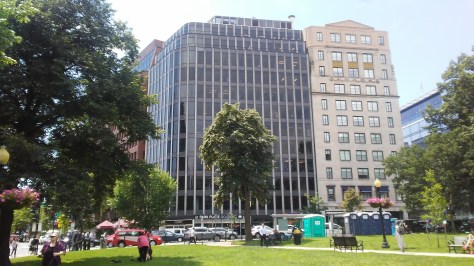
June 2018.  This is the only part of Washington, D.C. that can truly remind me of New York City.  (The diverse array of “food trucks” help quite a bit.)  The people there, however, seem far more likely to make eye contact and begin a conversation.  (I briefly chatted with a nice photographer who took a couple of poetry mini-books home with her.)

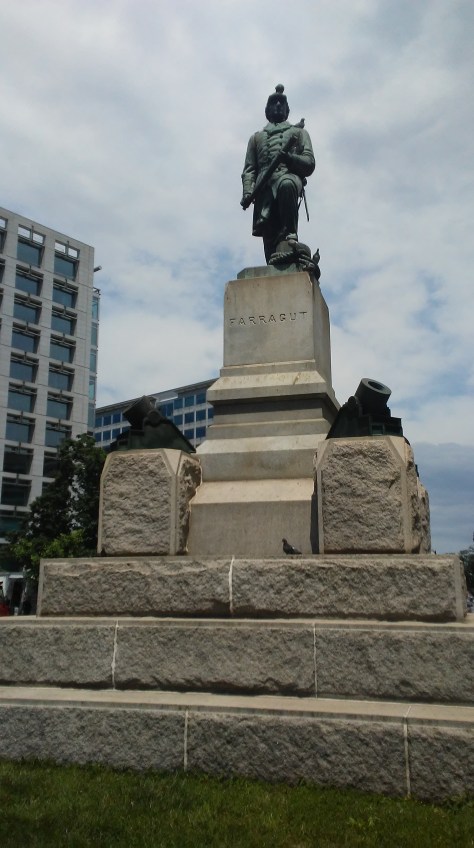
I’m proud of that last shot you see of pigeons alighting the park’s namesake — even if it is a little fuzzy and even if I only snapped it by chance.  David G. Farragut was a Southerner who nevertheless served heroically as an admiral in the Union navy during the Civil War.  He coined the famous phrase, “Damn the torpedoes, full speed ahead!”  Maybe I’m only demonstrating my ignorance here, but I didn’t even realize that torpedoes were really a thing during the Civil War, even after seeing the C.S.S. Hunley at Charleston, South Carolina as a kid.


20180605_115920

20180605_115742

20180605_114926

20180605_115757

20180605_115805

20180605_115855

20180605_120120

20180605_115904

20180605_113429

20180605_114222

20180605_115559

20180605_115531

20180605_115732

20180605_115653

20180605_115700 (2)


Poetry-bombing Locust Grove, Virginia.

I left these beside a symphony of singing insects’ sibilances.

20180604_184726

We should have a National Donald J. Trump Day.

We should have a National Donald J. Trump Day, in which we all lie, contradict ourselves, falsely accuse others, insult one another and ramble incoherently. We could do all of the above on Twitter, complete with the expected errors in spelling and grammar.

If anyone calls us on our bullshit, tradition wold require us to blame an educated black guy.

AND MEXICO WOULD PAY FOR IT.


celebration-1514592420fWp

Into the Woods.

Roanoke, Virginia, May 2018.

20180514_161736

20180514_161724

20180514_161916

20180514_161938

20180514_162500

20180514_162408

20180514_162546

8167524746664631777

“school shooter,” by Eric Robert Nolan

Grendel’s mother wanted murder; but we all knew that,
you knew that just by looking at her:
the green and odorous skin like dark olive parchment over her cheeks’ low bones,
the blackening teeth where the stale blood caked
and dried in her receding gumlines
like burgundy ink on her molars and incisors,
and a blackening-scarlet
stain on her canines.

Remember when we first saw her —
her flaccid breasts like flour-sacks,
her womanhood a stagnant moss,
the cadaverous, driving
lime of her hips,
her labia in livid lines
of bitter water lilies?

Remember the rising, putrid moon of her —
her green, sour form arching over ours in her ascent,
burning up from the green lake, a gangrene flame from the brackish water,
her profane grin adorning her,
and algae tracing her lips?

Remember the wet weeds
trailing the viridian strait of her throat
like silt-laden necklaces,
and all the mud and water rolling off her knuckles?
The spoiled laurel of her sinewed shoulders,
her outspread arms and their
parody of embrace?
Remember her mocking our own mothers?
Her derisive voice was like
the crack of splitting emeralds, asking,
“Am I so strange to young eyes?”

Remember the boiling fat on her tongue and
her victims’ burning skin there?
The scalps she held in her upturned palms
were like watery garments.
Her talons were as black
as snapping-turtle shells.
We all knew at once that we were quarry.

Remember her
sorrel-colored cataracts?
Her eyes were as green seas
boiling under Ragnarok.
Remember their ruptured capillaries
like collapsing red galaxies?
Remember her very irises bleeding?

But what if evil appeared
not as the face of Grendel’s mother,
but, rather, the ordinary boy in her maw —
as unexotic and as common
as we are?
If we were boys and girls again
and bored in English class —
maybe at Beowulf’s strangeness,
or maybe the strangeness of Jung —
and he were next to us,
with neither green skin
nor blood along his molars,
if he wanted murder, could we tell?
His face was as a clock’s face — prosaic and round.
Neither silt nor sinew lined his frame.
His gaze did not depict a grisly cosmos;
no galaxies had hemorrhaged in his eyes.
Would the difference be perceptible there
between wanting to kill time
and wanting to kill ten?
Would we know that we were quarry?

Tonight we’d like to believe
that the young are strange to old eyes
for any resemblance would kill us,
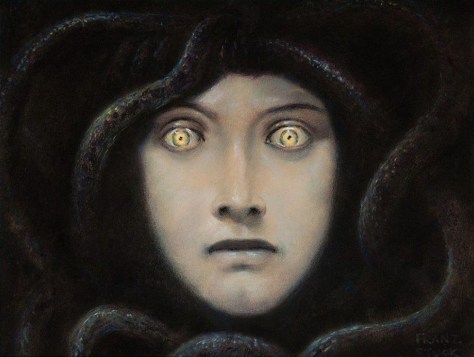
as Medusa’s own face was fatal
to her upon the shield.
As adults, we understand
that Beowulf is only fable —
but that Jung’s reservoir
is a fatal green lake.
Better an Idis than likeness —
if a monster looks like us, it stands to reason
that maybe he could BE us,
we’d nag in our primordial minds.
It might make us envision
a kind of reverse baptism:
our own plain faces
cresting the flat, green waters
to glide across the lake,
but bearing the eyes of strangers,
emerald and seething,
irises bleeding,
crushed green reeds in our jaws, like captive verses …

And we could not suffer the thought.
Better to be quarry, or be drowned.
We’d know that, and so
we would run mad, we would run weeping, we would run forward and ravening to the green, forgiving lake,

where we could sink like Beowulf,
and our silenced lungs would fill with water.

                                                            (May 19th, 2018)

(c) 2018 Eric Robert Nolan
 

franz-von-stuck-head-of-medusa-1892

These are M&M’s … containing espresso.

Nothing can possibly go wrong.

Who came up with this invention?  It’s probably equivalent to splitting the atom — complete with the potentially disastrous consequences.

How much do you want to bet that these will cause drama for me and those around me?


20180513_201620