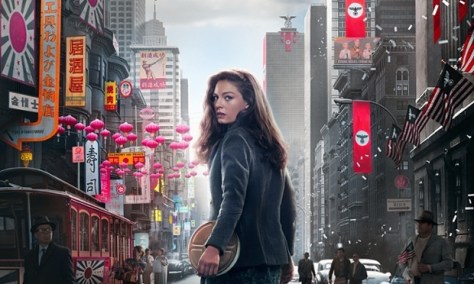
They had 20 years to develop a sequel for “Independence Day: Resurgence” (2016) — 20 years after the original “Independence Day” exploded into theaters, defining the 1990’s summer blockbuster. You figure that’d be enough time to come up with a really cool script.
Maybe there was one — maybe they had a really great screenplay that was thrown out for some reason at the very last minute. (Political correctness? Copyright issues? Internal studio politics?) Then this by-the-numbers, live-action “G.I. Joe” cartoon was hastily thrust in front of the cameras. What we’ve got here is really just a lot of common tropes strung together by a thin story, performed by cliche stock characters. The charm, surprises, humor and impact of the (admittedly silly) original film are entirely absent here.
Don’t get me wrong. “Independence Day: Resurgence” isn’t quite as bad as some other reviewers might make it seem. There’s some fun to be had, especially if the kid in you still gets a kick out of gooey aliens. (The ending sequence was enjoyable.)
It’s just disappointing because it’s quite average. I’d give it a 6 out of 10, and I’d caution you to wait until you pay a dollar for it at Redbox.
Postscript: given what the movie reveals as their goal, why don’t the aliens just nuke us from orbit? Ellen Ripley is smarter than an entire alien race.
Everything you’ve heard about “Train to Busan” (2016) is indeed correct; it’s a first-rate South Korean zombie film that fans of the genre won’t want to miss. I’d give it a 9 out of 10.
It’s maybe a little campier than I expected, with some over-the-top zombies that feel more reminiscent of the “Evil Dead” films than George A. Romero’s movies or Robert Kirkman’s work. It’s also a bit long at nearly two hours — if I were editing it, I would have swapped out some of the time devoted to car-to-car melees with additional scenes showing what’s transpired beyond the train. Imagine how a skilled screenwriter could further expand on the (really cool) train station plot points we already see … what if the train was forced to stop at every station? What if it couldn’t stop? What if its passengers were turned away at safe areas? What if desperate stragglers tried to board the train?
I really missed the boat with last week’s Throwback Thursday — it was the 50th anniversary of the entire “Star Trek” franchise, with the first episode of the original series airing on September 8, 1966. (And even the term “franchise” seems way too narrow to describe “Star Trek” in all of its incarnations — it’s really more like a permanent part of western popular culture.) I’m not old enough to remember the show’s original run, which was a surprisingly scant three years. But I remember it in syndication when I was not much more than a baby in the mid- to late 1970’s.
“Star Trek” was something that my older brother and maybe my father watched. (I was fixated on programming that was more comprehensible for young kids, like “Land of the Lost” and reruns of “The Lone Ranger.” Seriously, the original black-and-white serial western was still in reruns back then.)
But “Star Trek” was definitely something I was attracted to as a tot, doubtlessly resulting, in part, from the contagious ardor for it that I saw in my older brother. (He might not admit it today, but he was a bit of a hard-core science fiction fan long before I was.) The show was on at our tiny house in Woodhaven, Queens, quite a lot. He also had toys and posters connected with it. (And anything my older brother owned was something I endeavored to play with when he wasn’t looking.)
He had that Captain Kirk toy among the figures produced by Mego that you see in the bottom photo. (Again, 1970’s “action figures” were often pretty much indistinguishable from dolls.) In the early 1980’s, he had a totally sweet giant poster depicting diagrammed schematics for The Enterprise in surprising detail. I’ve Google-searched for it, but found only similar pinups. The one hanging in the room we shared was blue.
I remember him annoyedly correcting me because I called it “Star Track.” (I did not yet know the word “trek.” I myself was confused by my own mistake; I knew that there could be no “train tracks” in space, even if I studied the opening credits one time just to make sure.)
I was precisely the sort of pain-in-the-ass kid who fired off an incessant barrage of questions when I saw something on TV that I didn’t understand. My father was patient to a fault when I punctuated his World War II movies with inane questions. (I’m willing to bet I eventually acquired more knowledge of the war’s European theater than the average six-year-old.) My brother was not always so forbearing. I actually remember him changing the channel away from shows he was watching, like “Star Trek” or “MASH,” if I joined him at the little black-and-white television we had in our room. (The poor guy needed me to lose interest and go away, so that he could at least hear the damn show.)
Certain “Star Trek” episodes remain memorable to this day, even if I understood maybe 15 percent of what transpired onscreen. The was The One With The Domino-Face Men, which the Internet now tells me was actually titled “Let That Be Your Last Battlefield.” Then there was The One Where Kids Ruled Themselves on a Deserted World, which made a really big impression on me. (The Internet tells me this one was “Miri.”)
As I grew up, the show faded from prominence in my child’s psyche. It was just never my fandom of choice. Nor was it for many other kids I knew … by the 1980’s, it was already considered “an old TV show.” The kids on my street were always excited about the feature films; even if we were underwhelmed by the “slow” first film in 1979. Blockbuster movies were major events back then, and fewer, and they were enigmatic in a way that is impossible after the Internet’s arrival. (I think that Millennials will never be able to understand that, in the same way that you and I can never appreciate the vintage “serials” that our parents watched before the main feature at a Saturday matinee.)
In the 1980’s, just about every boy I knew was preoccupied with the space-fantasy of “Star Wars.” On television, we had cheesefests like the original “Battlestar Galactica” and “V.” As we got older, we gravitated toward the “Alien” and “Predator” film franchises. At home, I read Orson Scott Card and Harry Harrison, and as I approached college toward the end of the decade, I’d discovered Arthur C. Clarke. If we’d known another kid who was really into “Star Trek,” I’m not sure we would have considered it “nerdy.” It would just have been very weird, because it we viewed it as a campy tv show from maybe two decades prior, like “Bonanza” or something. I don’t think I ever even thought of the franchise as really relevant or popular until I was at Mary Washington College in the 1990’s. “Star Trek: the Next Generation” would regularly draw kids out of their dorm rooms into the lobby at New Hall.
Still, it’s hard not to develop an emotional attachment to something that stimulated your sense of wonder as a tot. I … felt pretty damn sad when Captain Kirk died in 1994’s “Star Trek: Generations.” I saw it in a theater in Manassas, Virginia, I think, with my girlfriend at the time. She actually felt she had to console me after seeing how doleful I was on the drive home.
My dear friend Lade Saint gave a terrific interview over at Book Goodies about “Window To The Soul: Light, Darkness and Paranormal Gifts.” You can find the interview right here:
This was placed on my Facebook wall, courtesy of a Mary Washington College Alumnus. Why did he select ME for this?
I am occasionally surprised at the weird or dark material that people send me with messages like, “Only you would get this,” “Seems like your thing,” or, the grandest caveat of all, “I can’t put this on my wall — maybe you can put it on yours.”
I’m just not sure what that says about how I am perceived by others.
This is the major professional and commercial area of Ballston, an affluent section of Arlington, Virginia. These were taken near the Virginia Square Metro Station; just north of George Mason University. (Do college students eat frequently at these upscale cages and gourmet delis? When I was going to school in Fredericksburg, we splurged when we went to Olive Garden after a formal.)
Also just a few blocks away is the Defense Advanced Research Projects Agency (DARPA).
If you’re in the mood for some excellent apocalyptic or dystopian reading, then do remember to stop over at The Bees Are Dead. We recently have been fortunate for the opportunity to share dark visions from poets throughout the world, including Edilson A. Ferreira, Jason Ramsey, Jonathan May, Jonel Abellanosa, Andres Rodriguez, Marianne Szlyk, Stela Xega and Scott Thomas Outlar.
I myself am especially partial to May’s outstanding poem, “The Wolves;” its imagery is both nightmarishly vivid and expertly rendered. You can find it right here:
All The Pretty Horses! (That’s a James Patterson reference, by the way.)
This pretty girl took a shine to me instantly. (I was surprised, as I thought horses were generally shy around strangers.) I wanted so badly to pet her, but I elected not to cross onto this person’s property in order to do so. I am told Southern people take certain things very seriously — and two of them are property lines and Second Amendment rights.
This eastern rat snake (or northern black racer?) elected to join our party, or he at least ventured near it, where he was expertly plucked up by one of our group. (You’ve got to lift them from just behind the head, so that they cannot bite you.)
Forget that narrow-fellow-in-the-grass bull@#$% you heard; this mamajama was KAIJU.
Watching “Captain America: Winter Soldier” on the big screen on the side of a barn! And then “Civil War!”