I’m so happy today to see my latest letter to the editor (about mandatory prayer in the public school classroom) appear in the pages of The Free Lance-Star. You can read it online right here.
In addition to being the newspaper for my college town of Fredericksburg, Virginia, The Free Lance-Star is a leading regional news source with more than 65,000 weekday readers. I’m quite grateful to its editorial staff for allowing me to share my perspective there.
What a great day, guys. I’m honored to share that three of my poems appeared today in EgoPHobia — an independent Romanian e-journal dedicated to literature and philosophy.
I am quite grateful to Editor Stefan Bolea and the staff at EgoPHobia for allowing me to showcase my work in this important cultural resource for Eastern Europe.
I’m very happy today to see the Bristol Herald Courier publish my letter to the editor about mandatory prayer in the public school classroom. You can read it right here.
As always, I am grateful to Managing Editor Roger Watson and his staff for allowing me to share my perspective in this leading regional newspaper for Southwest Virginia.
It seems that no school shooting is complete without renewed calls for mandatory prayer in the public school classroom. But how exactly would that help?
What sort of Creator do the proponents of mandatory prayer envision? Only a barbarous God would demand prayers from schoolchildren before protecting them from being shot to death. Is He really so voracious for praise? Is He really so ruthless in extorting it from us? Should we trust such a deity to help us, if He egomaniacally threatens us so — with violence so horrifying that we are loathe to even imagine it?
And if prayer is sufficient to secure this god’s protection, then why do we see shootings at houses of worship? Were the victims there not praying hard enough? Were they just not sincere enough in their invocations?
Finally, why should arriving police wear body armor, instead of only the “armor of God” that their prayers could afford them? Shouldn’t that be enough, according to those calling for mandatory prayer?
Separation of church and state is enshrined in our Constitution. By keeping the government and public institutions neutral in religious matters, it protects the rights of both religious and non-religious people. (Students are already perfectly free to pray voluntarily, alone or in groups, without being prompted by school staff — because the First Amendment protects their rights, as well.)
Church and state are like peanut butter and tuna fish. Either one of those things might be just fine on their own — but not when they are combined together.
One of my totally awesome MWC alums insisted on picking me up from the oral surgeon Thursday — even after I told him I could get an Uber.
And he didn’t even laugh too hard when I was so doped up afterward that I didn’t recognize him! (“Who is this strange, albeit polite, man greeting me in the waiting room?”)
Good friends are hard to come by, but I’ve got a few.
Or … maybe it WAS a stranger who drove me home. Seriously. This really is a hospitable Southern city and I was high AF.
It was a mad and spinning world in which you met her, but she was a mad and spinning girl — so brightly and resolutely burning that she herself was celestial. There was starshine bottled up in her heart, solar winds charged the particles of her thoughts, ions in the atmosphere ignited her impulses. Her willful joy was her own burning sun.
When she was sly, her eyes were hasty comets. Her passion amassed from Saturnal storms. Her smile was silver Jupiter– you wanted to repose over its white sands, beside the stained and rose-metal lakes of smoldering, darkening copper.
Between the spaces of her words, chasms of cosmos would occasionally open. You could stare into those depths for indifferent and measureless distances of light years — the sublime nightmare-nothingness that Providence had made, the Forever-of-Empty-Dark. But before you could be afraid, her own gravity drew you in.
And you were glad. That such loveliness could exist in a single soul was reassurance. (The Forever-of-Empty-Dark wasn’t entirely empty, after all.) And you were grateful — grateful for her rejoinders, for the taste of her mouth on your own, for her girlish laugh, for the way that she regularly lighted a murky Earth with the moonbeams of her quiet kindnesses.
She was unstoppable. Ultraviolet rode the coronal shades of her irises, and flared in her contemplation. She blazed. Magnetic radiation murmured in her poetry. You loved her for her uniqueness in a universe of cold space, for the way that she burned and turned and burned and turned without ever slowing or expiring. When her light fell across you, you could almost believe that you, too, were spinning and illuminated. You loved her enough for the illusion alone.
You loved her more for her gravity that drew you in and held you, and for her arms that did the same.
(c) Eric Robert Nolan 2022
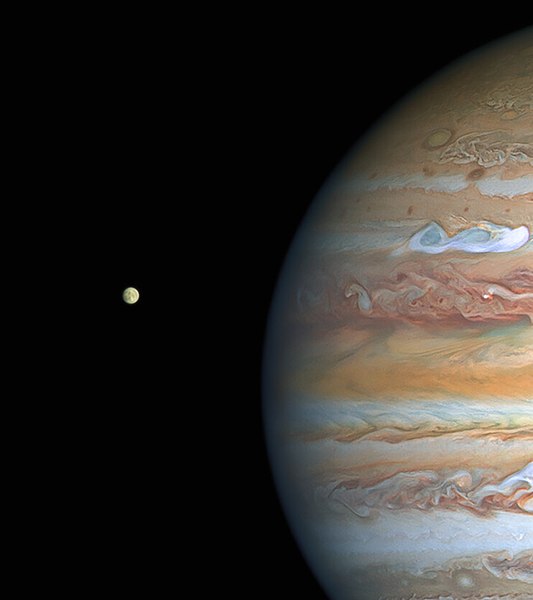
This image of Jupiter and Europa, taken by the NASA/ESA Hubble Space Telescope on 25 August 2020, was captured when the planet was 653 million kilometres from Earth. The full view of this Hubble image can be viewed here.
As always, I am grateful to the editorial staff of this superb regional newspaper. The Roanoke Times is the primary newspaper for Southwest Virginia, and its Sunday readership throughout 19 counties is estimated at 230,000 people.
I’m also pleasantly surprised that this particular letter seems to have struck a chord with people the way that it did. After it was carried by a number of newspapers in Virginia and by Newsday in New York, it was shared with a combined 733,000 readers. That would make it the most broadly circulated single item of all of my writing.
I got some more amazing news today, guys — Newsday printed my most recent letter to the editor, about the word “overeducated” being thrown around by our national politicians. You can find it right here in yesterday’s paper.
My letter was edited down considerably for length, but I am still quite honored to see something I authored appear in this major regional newspaper. Newsday is the America’s 10th largest paper, and the third largest in New York State. It has a weekday circulation of 437,000 in the New York metropolitan area, and reaches nearly half of the households on Long Island.
I really am grateful to Newsday’s editorial staff for deciding that my letter merited the attention of its readers.
I’m honored to share here that the Bosphorus Review of Books in the Republic of Turkey today published my poem “Delaware Sheets.” You can find it right here.
The Bosphorus Review of Books is a bi-monthly English-language literary journal based in Istanbul. It is a truly outstanding publication, with the goal of connecting Istanbul with the global literary community. I am grateful indeed to Poetry Editor Maged Hussein for allowing me the opportunity to see my work appear in such a superb periodical.

 Eric Robert Nolan, Author