Tag Archives: review

A few quick words on the Season 3 premiere of “Fear the Walking Dead” (2017)

I’m going to go ahead and commit horror-nerd heresy here … at this point, I think I enjoy AMC’s “Fear the Walking Dead” more than “The Walking Dead.”  The characters feel more “real,” and the stories move far, far faster.

Last night’s first episode was a hell of a lot of creepy, disturbing, pathological fun — enough for me to give it a 9 out of 10.  And to make it a little cooler, we’ve got a couple of terrific “that guy” actors in supporting roles.  The first is “Band of Brothers” and “24” alumnus Ross McCall, the second is “The Following’s” Sam Underwood.

Good stuff!


A very short review of “The Dead” (2010)

Take a look at the movie poster below for the Ford Brothers’ “The Dead” (2010).  It’s problematic for two reasons.

One, of course, is that it contains what is arguably the most unimaginative title in zombie movie history.

Two is its immediate recollection of the marketing art for Zack Snyder’s terrific 2004 “Dawn of the Dead” remake.  It is so similar in composition and color scheme that it makes the Ford Brothers’ film look like a “mockbuster,” whose cover is designed to fool hasty movie renters.

And that’s a shame, because “The Dead” is a fairly decent zombie movie in its own right — I’d rate it a 7 out of 10.  It’s a lower-budget feature, and some of the acting is a bit flat, but this is a movie that does a lot with a little.  The film wisely makes the most of its African setting, and has an intelligent, if slowly paced, story.  It focuses on its two military protagonists’ needs for food, sleep, shelter, fuel and vigilance, during the course of a lengthy overland trek.  That’s refreshing in an era of “Strippers vs. Zombies” (2012), and various fairly lackluster clones of “Shaun of the Dead” (2004).

Best of all, however, is the film’s skilled manner of evoking “slow burn” or “creeping” horror.  The zombies in “The Dead” usually move quite slowly.  They might be the slowest zombies I’ve ever seen.  This might be the anti-“28 Days Later” (2002).  But that makes the vibe here unique among the spate of modern zombie films — and maybe a little reminiscent of George A Romero’s pioneering early films.  If your reaction is like mine, you’ll find it a little unnerving to see them gather en masse at a snail’s pace.

I recommend this.

the-dead-1464333825197

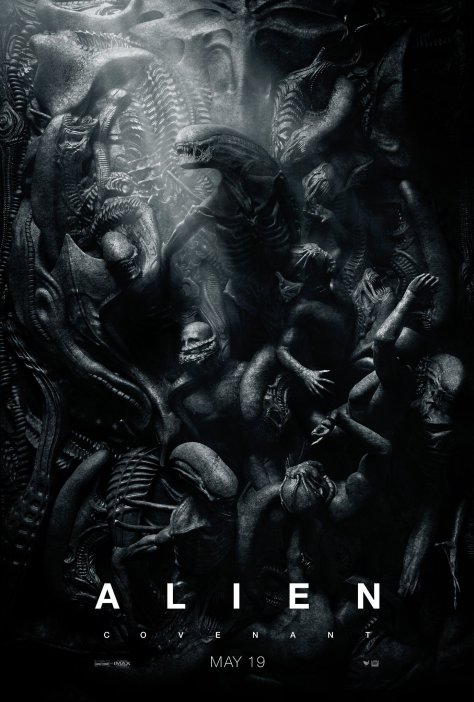
“Alien: Covenant” (2017) is a first-rate sci-fi horror show with lots of monstery goodness.

I am part of a happy minority where “Alien Covenant” (2017) is concerned — I keep hearing about “meh” or negative reactions from my friends, but I quite enjoyed it.  I’d rate it a 9 out of 10.

No, this second installment in the “Alien” prequel trilogy doesn’t bring much new to the table.  It often seems like a collection of common tropes, and borrows a bit from previous films in the franchise — especially the first movie in 1979.  Some aspects of it — like a predictable and slightly gimmicky development late in the story — even feel like horror movie cliches.  (I am doing everything I can to avoid spoilers, so forgive how vague I’m being here.)  “Alien: Covenant” isn’t groundbreaking, and it isn’t destined to be called a “classic.”

Here’s the thing, though — all of the movie’s common tropes are exactly what make fans happy.  Think about it … if you had to name two “Alien” movies as unique or the most divergent, they might be the heady, ambitious “Prometheus” (2012) and the baroquely experimental “Alien: Resurrection” (1997).  Whatever their failings, both of those movies deserve points for creativity.  And they are among the three films that fans hated the most.  (The third here is the smartest and most underappreciated installment, 1993’s brilliant “Alien 3.”)

With “Alien: Covenant,” Ridley Scott gives fans exactly what they were clamoring for — a frightening, gory, space-based horror film with creatively designed monsters and some nasty surprises.  It very much returns to the tone of the first film.  It is even jarringly darker than “Prometheus,” which was defined partly by its moments of cautious optimism.  And, more than any other sequel, it seems directly inspired by the grotesquerie of H. R. Giger’s original, nightmarish monster designs.  I feel certain this movie would have received the late artist’s blessing.  (I could name a certain scene and an excellent surprise story development, but I won’t.)

Michael Fassbender shined in his two roles here.  (He not only reprises his role as the android, “David,” but also portrays a newer model, “Walter.”)  The rest of the acting was roundly good too.

I also found the movie nice and scary.  I, for one, don’t think Scott’s direction of action scenes here is perfect.  (They are harder to follow here, for example, than his beautiful arena melees in 2000’s “Gladiator.”) But they were still effective.

So this return to form made me pretty happy.  I didn’t want another muddled attempt at profundity like “Prometheus.”  Nor did I want a winding, bizarre, arthouse-horror tale like “Resurrection” — that movie was like a poorly written, drug-fueled comic book.  I wanted a first-rate sci-fi horror show with lots of monstery goodness, and that’s what I got.

If I had to pick a criticism of “Alien: Covenant,” I’m surprised to have to point to some less-than-stellar CGI.  This was something I noticed from early trailers for the film, and I’m surprised I haven’t heard another reviewer mention in it yet.  One scene rendered a title baddie about as well as a modern video game, albeit a good one.  Another’s depiction of an upright “neomorph” seemed … fairly bad.  (Fans of decent creature features shouldn’t despair, however — there are still some outstanding monster moments, and no small amount of accompanying gore and goo.)  Have I just become spoiled by the amazing dinosaur effects of 2015’s “Jurassic World?”  I don’t think so … I suggest that the otherwise lamentable “Alien: Resurrection,” with its combination of CGI and practical effects, had far better creature effects than this newest outing.

Of course I recommend this movie.  Maybe I should only do so with the caveat that I am (obviously) a huge fan of the series.  It has been said that I’m easy to please, too — I actually gave a glowing review to “Prometheus” shortly after its release, before wiser minds pointed out to me its sometimes egregious flaws.  (A friend of mine shared with me one of those “Everything Wrong With” videos that CinemaSins produces … it’s a hilarious webseries, but it sure will dull the shine of some of your favorite movies, lemme tell ya.)  Your mileage may vary, especially depending on how much you enjoy horror movies, as opposed to more general science fiction.

Oh!  There is a mostly non-sequitur postscript that I can’t help but add here … yet another one of my movie prognostications was flat out wrong.  It isn’t a spoiler if it’s a far-out prediction that didn’t happen, so I’ll go ahead and share it here … during one of the ads for “Alien: Covenant,” I could swear I heard a character call out the name “ASH!!!!”  (I’ve evidently started hallucinating at the start of mid-life.)  I predicted that the new and robotic Walter would turn evil, and actually become the android named Ash in the 1979 original.  (And why not?  Androids do not age, and a web-based prologue for “Alien Covenant” suggests their faces can be easily swapped out.)  I further predicted that the more human David would be pitted against him in order to save humanity somehow from alienkind.  (These things do not happen.)

I still think that’s a pretty clever idea, though, even if I only accidentally arrived at it.  It would be great if that happened somehow in the planned “Alien: Awakening.”
 

IMG_20170323_0950491

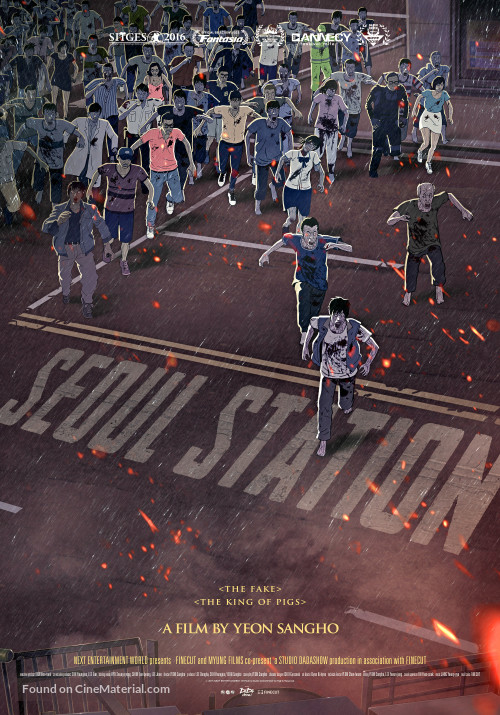
A few quick words on “Seoul Station” (2016)

If you enjoyed last year’s excellent “Train to Busan,” then check out its animated prequel, “Seoul Station.”  They’re both directed by Yeon Sang-Ho, and I was surprised at how much I enjoyed this movie.  (I don’t usually prefer animated features — even the truly impressive anime classics.)

But this was worth a watch — and it even had some moments of real tension toward the end.


ps0sh5sx


A tiny review of “Dead Rush” (2016)

“Dead Rush” (2016) isn’t quite as bad as other reviewers have made it out to be; it’s a passably entertaining zombie feature that I’d rate a 6 out of 10.  It occasionally rises above its central gimmick to create a few moments of suspense and emotion.  (The gimmick here is that the entire film is shot from the point-of-view of one man in the middle of a zombie apocalypse.)

That point-of-view device does wear a little thin by the end of this feature-length film … and I’m a found-footage horror movie fan who usually doesn’t mind that sort of thing.  This movie might have been better overall if the viewer weren’t required to follow those “shaky-cam”-type visuals for quite so long; my understanding is that it was adapted from a well received short film.

If there was one thing that bothered me the most, though, it wasn’t the POV.  There is a recurring shot in “Dead Rush” that I liked a hell of a lot, involving the main character’s memory of a loved one.  It’s made even better when it is rather creatively used as a framing device at the film’s end.  A little reflection, though, made me remember that this shot seems to crib a little too much from a similar effective recurring shot in 2011’s “The Grey.”

What the hell … if you need a zombie horror fix, you could do worse than “Dead Rush.”


dead-rush-poster-768x1084

A short review of “The Belko Experiment” (2016)

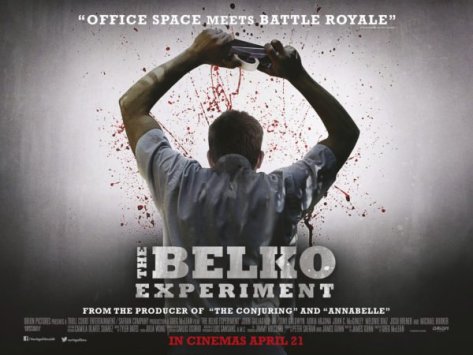
“The Belko Experiment” (2016) is a fairly gut-wrenching and potent horror film.  I was going to describe it as “Battle Royale” (2000) meets “The Office” (2005 – 2013).  But, from the looks of the poster, somebody more or less beat me to it.

As you can imagine, there is a sequence of blood-curdling events after the workers of an entire office building are forced to fight one another to the death.  It’s made all the more horrifying (and a bit sad) by a surprisingly effective early montage that shows these people are indeed likable and relatable.

I’m not sure how I feel about the ending.  There’s a twist that is nicely satisfying, I’ll grant the movie that.  But there was far too little exposition, and a closing shot that was a little too ambiguous and open-ended … maybe even abstract.  I’d be happier if the person doing the talking told us a lot more.  If you think about it, they mostly just reiterated what various characters had hypothesized earlier.

This film has a couple of “I swear I know that guy” actors.  These include Tony Goldwyn, who I last remember from 1990’s “Ghost.”  Turns out he’s a damn fine actor (in addition to being one of those people who weirdly appear to age little or not at all).  They also include John C. McGinley, Owain Yeoman and Michael Rooker.  And if you think you can recall the gentle giant played by Abraham Benrubi, the actor is none other than “Big Mike” from the classic “The X-Files” episode, “Arcadia.”

I was going to rate “The Belko Experiment” a 9 out of 10; it was exceptionally good.  But I was just too nonplussed by that rushed ending, and I think I’ll settle on an 8.


the-belko-experiment-600x450


A review of R. J. Davey’s “Panthalassa”

R. J. Davey’s “Panthalassa” is an excellent read for both new and veteran readers of poetry, as the author’s direct and authentic poetic voice makes it easily enjoyable for either. Davey’s writing has an unaffected quality that makes his first published collection here stand out among books by freshman authors. And it makes “Panthalassa” easy for me to recommend.

There are 15 poems comprising this short volume, and some of the poems are themselves brief.  They feel … unencumbered.  There isn’t a trace of pretense or pedanticism about Davey’s work.  There are occasional classical or biblical references, but none that weigh the poems down, and none that are self-indulgent.  There is almost no archaic language, either.  (I will say that I had to Google the book’s title – “Panthalassa” is the name for the primordial sea encircling the prehistoric “super-continent” of Pangea.)

Nor does Davey imitate other poets, either consciously or unconsciously.  This isn’t a prospective new author trying to impress an editor.  This is Davey talking.  And he employs a simple, direct voice to share his thoughts.  He uses unassuming language, however ambitious the targets his muse has set for him may be.

That makes these poems accessible to anyone.  It was refreshing for me to sit down with a short book of new poetry that I could easily understand, and that I could share with just about anyone I knew.   A dear friend of mine, for example, recently commented to me on a drive through the Virginia mountains that she felt that the poetry she read was often frustratingly oblique: “If they want to say something, I’d rather they just say it.”  I think that this would be a great collection to lend to her.

Davey’s poems have an unusual conversational tone – it gives them the uncommon resemblance of a thoughtful discussion with a friend.  An ironic example, I suppose, would be the poem, “Cigarettes,” which depicts exactly such an exchange between friends:

“we drank and conversed,
“musing upon the eternal:
“attempting to bring some meaning
“to this life …”

The result is an unexpected kind of trust.  The poems feel “true.”  Their directness gives them a sense of honesty.

Maybe my reaction here is because I am positioned to identify personally with the author; I suspect we are at similar stages in life, and I believe we have similar outlooks.  (Davey is a friend, and has long been a quite valued colleague of mine.)  Or maybe it is because Davey’s easy, ingenuous style better invites eisegesis.  Either way, I’m impressed indeed by any poem that seems to perfectly describe something that I myself have felt.

But don’t misunderstand – despite his poetry’s informal qualities, Davey can employ poetic devices to great effect.  The two examples that spring to mind are my two favorites in the collection: “In Her Eyes” and “A Love Like Cocaine.”  Each piece explores a single simile throughout.  The poetic comparison drawn by “In Her Eyes,” a particularly painful piece, is inventive and downright haunting.  (I think I love these two poems because I identify with the speaker for each.)

I suggest that “Panthalassa’s” poems should be read aloud by the author himself – the way their conversational quality would be best appreciated.  I hope Davey will consider an online platform like SoundCloud or YouTube, so that I we hear these in his own voice.  I would like to listen specifically for the “beat poetry” quality that I think they have.  And I think I would enjoy hearing them at a small reading at a bar – they just have that sense about them.

Again, I recommend this collection.  (And, as of this writing, its Kindle edition is only 99 cents at Amazon.com, and it’s free to subscribers to Kindle Unlimited.)

I have an electronic copy of “Panthalassa,” but intend to print it out.  I’d like to have it handy along with a few other poetry books by colleagues of mine, so that I can browse through a physical copy, the old-fashioned way.  These are the kind of poems that I enjoy talking over with friends, much in the manner I remember from the long-ago, pre-internet days when I was an undergraduate, and reading poetry in the dorms and downtown bars.

I hope you enjoy these as much as I did.


Panth


Do not see “Tank 432” (2015)

[WARNING: THIS POST CONTAINS A MINOR SPOILER FOR THE FILM.]  “Tank 432” (2015) is alternately boring and confusing.  To be fair, its surreal story aspects are necessary to the plot, but I don’t think that redeems the movie much.

Don’t let the poster’s image of the tank and the soldier fool you — there’s a little bit of action as the film opens, but most of the movie takes place inside the titular abandoned tank, which remains stationary throughout most of the story.  (The protagonists are trapped inside it by a jammed door. )  Thereafter, the unease and claustrophobia they feel are soon felt by the audience.  Maybe that suggests skilled film-making on a certain level, but it certainly doesn’t make for an entertaining viewing experience.

The film is quite slow.  Furthermore, writer-director Nick Gillespie appears to assemble the components of several mysteries as subplots, and then leaves those smaller mysteries with little in the way of an explanation.

I’d rate this movie a 1 out of 10, and that’s only because Rupert Evans is a very good actor.


tank-432

A review of “The Conjuring” (2013)

I feel the same way about “The Conjuring” (2013) as I did about its prequel, “Annabelle” (2014) — it has all the earmarks of a bad movie, but it inexplicably succeeds anyway.

Seriously — this film has clunky exposition, cheesy dialogue and over-the-top plot developments (toward the end), not to mention a plot setup that’s in questionable taste.  (The movie suggests that the innocents condemned by the infamous 1692 Salem witch trials were indeed witches.  This feels a bit awkward to anyone who read Arthur Miller’s “The Crucible” in high school.)  “The Conjuring” also plays out like a love letter to Ed and Lorraine Warren, the controversial paranormal investigators who are largely the subject of the film (played by Patrick Wilson and Vera Farmiga).  This last offense is forgivable, I suppose — the film was made with the Warrens’ blessing, and Lorraine Warren was even present as a “consultant” during its production.

Strangely, however, these flaws were barely noticeable to me when I watched it.  I had a good time.  “The Conjuring” just happens to be a decent fright flick that delivers on the scares.

I think James Wan’s skilled directing has a lot to do with that; the film works visually.  (I could name specific instances where it works especially well, but I want to avoid spoilers.)

The acting helped a lot too — Wilson and Farmiga are both damned good, as is Lili Taylor as the afflicted family’s mother.  (I’ve admired Taylor’s acting since her long ago 1998 guest appearance on “The X-Files,” and she was equally good as a bad guy in 1996’s “Ransom.”)  Ron Livingston was also quite good in the role of the father — if you have trouble placing his face, as I did, he also played Captain Nixon in HBO’s “Band of Brothers” (2001).  He seems to have a talent for playing the likable everyman — he’s great here as the somewhat feckless father, and functions well as a kind of viewer surrogate.  I should also mention the young Joey King as one of the family’s daughters — she played the role of a terrified child to perfection, and really raised the stakes emotionally.

Despite really enjoying most of the movie, some of my enthusiasm for “The Conjuring” flagged a bit toward the end.  The denouement here includes an exorcism, and those are almost always boring.  There are only so many ways that scenario can play out, and we’ve seen them all — and I shouldn’t even need to name that certain 1973 film that did it best.  Furthermore, we see our story’s demon do some pretty extraordinary things, even by demon standards.  It can apparently transport itself great distances (using an inanimate object as a kind of fax machine?), and can manipulate both the laws of physics and the area’s wildlife.  It was all a little too much for my willing suspension of disbelief.

Again, though — this was a good movie.  I’d give it an 8 out of 10, and I’d recommend it to anyone looking for a good scare.


A few quick words on “24: Legacy” (2017)

I hate to say it, but “24: Legacy” (2017) was mostly average stuff; I’d give the 12-episode arc a 7 out of 10 for being a mildly engaging thriller, but nothing more than that.

I was one of the few people back in the day who opined that “24” could continue even without Kiefer Sutherland.  As priceless as he was in his role as anti-hero Jack Bauer, he wasn’t the only star of the show — the show’s gritty universe and its unique format could carry on without him.  I even thought, during the early years, that Fox was grooming Tony Almeida (Carlos Bernard) to be a viable lead if Sutherland departed.

I still think the show could manage without Sutherland.  The real culprit behind “Legacy’s” failure to stand out was its somewhat average writing.  It wasn’t bad, exactly … it was just average.  (Alright — for a little while, it was bad.  We see a key subplot/cliffhanger repeated three times, consecutively, in the same season. I’m surprised that major redundancy made it past the editing process.)  But mostly, it was average — we see thin staples of characters, and a plot that seemed largely reminiscent of … well, every other season of “24.”  (Admittedly, it must be tough after nine years to think up an original story for a serialized contemporary terror thriller in real-time format.)

The sad part is this — during the show’s final two or three episodes, it started showing more promise, with truly original plotting and unexpected conflicts.

The show got disappointing ratings.  We won’t know until at least May, but I think most viewers are guessing it won’t be renewed for another season.