Tag Archives: review

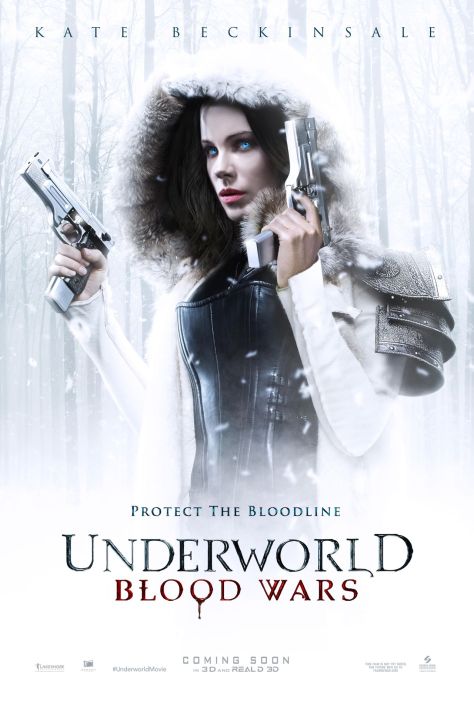
A short review of “Underworld: Blood Wars” (2016)

I’m not sure what to say about “Underworld: Blood Wars” (2016).  It really differs little from the previous “Underworld” movies.  If you’ve seen those, you’ve kinda seen this one.

The vampires look like underwear models, or maybe a goths-only high school drama club.  The werewolves look … not homeless, exactly, but like burly, long-haired, unemployed grunge rockers.  Both groups speak portentously and repeatedly about things like “LINEAGE” and “BLOOD LINES” and “THE WAR” and “AMELIA.”  (Who was Amelia again?)  There are the requisite betrayals and forbidden inter-species romances.  The entire thing felt like a feature-length music video.

Maybe I’m being too harsh.  I would actually give this film a 5 out of 10 for at least bringing some good things to the table.  Kate Beckinsale is a good actress, and she brings the same magnetism that she always does to Selene, the franchise’s protagonist.  Charles Dance is always superb, and is always fun to watch.  (There are at least two “Game of Thrones” alumni here — one is Dance as a vampire elder, and the other is Tobias Menzies as the leader of the “Lycans.”)  The nicest surprise, though, was seeing Lara Pulver as an ambitious vampire alpha female — fans of “Sherlock” (2010 – 2017) will recognize her as that series’ incarnation of Irene Adler.  She’s a great actress, and she seems to relish this kind of role.

All in all, though, I can’t say I actually recommend this.


underworldbwposter

A short review of “The Good Neighbor” (2016)

“The Good Neighbor” (2016) generally didn’t work for me.

My first problem was its premise.  Two teenage aspiring filmmakers play an elaborate high-tech prank on an elderly neighbor by installing hidden cameras in his home and then manipulating his environment: causing his lights and TV to malfunction, causing his windows to break, and even adjusting his thermostat to plunge the temperature so he’s forced to cope with the bitter cold.  They plan to mimic a haunting, and they rationalize it because he actually is a horrible person, well portrayed by James Caan in an understated performance.

Here’s what doesn’t make sense — what the teens are doing is against the law, and they know it.  (One explicitly states it at least once mid-way through the film.)  I count trespassing, criminal mischief and unlawful surveillance to start with, and I’m willing to bet they’d face charges for harassment too.  Yet they fully intend to makes themselves “famous” via the Internet with this cruel prank/documentary.  They shoot lengthy footage of themselves narrating the construction and implementation of their project; this is intended as part of the documentary.

But why would they upload detailed, inclusive evidence of their crimes to the Internet?  If they truly become “famous” with thousands of “hits” for their video, wouldn’t that mean countless people could bring them to the attention of the police?  (And, truthfully, even if they tried to remain anonymous, I’m sure any competent investigator viewing their video would at least count them as suspects.  One lives right across the street from Caan’s character.)

For much of its running length, “The Good Neighbor” actually succeeds at being a serviceable horror-thriller — if you can get past that hole in the premise.

But then we come to the second problem with this movie.  Towards its end, it takes an unexpected dramatic turn.  It stops being a thriller, and simply becomes a particularly sad drama.  I don’t want to say to much for fear of spoilers, suffice to say it’s a real downer.  But it isn’t frightening at all — or even terribly entertaining.

The only part near the end that pleased me was the movie’s final shot.  It was ambiguous, but it suggested a nice new level of character depth.  I thought it was neat.

Oh well.  Maybe others will enjoy this film more than I did.  I myself can’t recommend it, and I’d give it a 5 out of 10.

Postscript: you can have some fun here trying to figure out where you’ve seen these teenage actors before.  They’re both veterans of horror.  The mild-mannered one is Keir Gilchrist, who horror fans will recognize from “It Follows” (2014).  The meaner, more manipulative of the pair is Logan Miller, who played the goodhearted Benjamin in this past season of “The Walking Dead.”  It’s so weird seeing him play such different characters.


good_neighbor

A short review of “Here Alone” (2016)

I think “Here Alone” (2016) would disappoint a lot of casual zombie movie fans.  It is admittedly quite slow, there is very little action, and the zombies mostly inhabit the story’s background.

I really liked it.  It is a thoughtful, sensitive post-apocalyptic drama that is beautifully filmed in the mountains of upstate New York.  The idyllic rural setting is a terrific contrast to the film’s brutal plot devices.  And its naturalistic dialogue feels authentic — it’s either a very well written movie or its three principal actors are unusually good at improv.  (The conversations flow so organically that the latter seems plausible.)

The movie focuses on three survivors of a horrifying epidemic.  (The “zombies” here are of the “28 Days Later” variety, and turn murderous upon infection.)  Although they remain off screen for much of the movie, we are reminded of their threat by some intermittent, hellish screams.  (The sounds were perfect; it’s a nice touch that lent tension and atmosphere.)

All three leads — Lucy Walters, Adam David Thompson and Gina Piersanti — were outstanding.  Walters’ performance was especially superb.  Her portrayal of a bereaved young wife and new mother was understated and subdued, but powerful.  She absolutely drew me in to the story.  We visit via flashback the fates of her husband and infant, and some of what we see is truly heart-rending.

The movie’s surprising final shot stayed with me for a while.   It’s ambiguous — maybe even confusing, at first.  But it makes sense if you reflect a little about the dialogue concerning the characters’ coping mechanisms.  It’s bittersweet, and seems to say something sad about survival and human attachments.

I’d give this an 8 out of 10, and I recommend it.

Website-Thumbnail1

A short review of “Split” (2016)

For much of its running length, I was considering writing a review for “Split” (2016) that rated it a perfect 10.  (I am an unabashed fan of M. Night Shyamalan, no matter how reviled he is by other Internet commentators.)  I love the way he frames his shots, I love his dialogue, I love his stories, and I love the strange way he can make a slowly paced film nevertheless absorbing.)

And “Split” looked nearly perfect.  James McAvoy handed in a tour-de-force performance as Kevin, a man with dissociative identity disorder (DID).  (Yes, I am aware of the clinical controversies connected with whether the disorder even exists — I was a psychology student many, many years ago.  I think we should suspend whatever disbelief we have for the purposes of enjoying the movie.)  McAvoy plays his role to perfection.  His “Dennis” persona is particularly frightening, and “Barry,” one of the “good personalities” he portrays, is surprisingly endearing and sympathetic.

Playing off McAvoy wonderfully are Betty Buckley as his gentle psychiatrist and Anya Taylor-Joy as one of three teenaged girls kidnapped by his nastier personalities.  The talented Taylor-Joy was also perfect in her role.  (I last saw her 2015’s “The Witch” and she was also in last year’s “Morgan;” I’m gaining the impression that this promising young specializes in cerebral horror-thrillers.)

I would rate “Split” an 8 out of 10.  It suffers a bit, I think, from two missteps toward the end.  One, this taut psychological thriller takes an ill-advised turn into dark fantasy.  I thought it was amazingly good as a thriller grounded only in the real world — it was far less so with the later jarring story elements.  (I do realize why Shyamalan made this creative decision, and you will too, after watching it and then reading up on it.)  But I still think that this would have been a perfect film if the majority of it focused on McAvoy’s personalities either aiding or misleading his psychiatrist, with Taylor-Joy’s fate hanging in the balance.

Two, this film seemed to suffer from the too-many-endings syndrome that people often associate with Peter Jackson’s “The Lord of the Rings” movies.  We seem to have one denouement that works quite well, then a second that should have been re-shot and re-scripted.  And then there’s another plot strand finally addressed … but it is played so subtly that I’m not even sure I got it.  And this isn’t even counting the significance of the movie’s final line, which works as a fantastic framing device.

About that line … if you’re a Shyamalan fan, then you simply must watch the film until it’s very end, as the camera pans through the coffee shop.  You’ll love it.


A baffled review of “Lucy” (2014)

Everything you’ve heard about “Lucy” (2014) is correct — it’s exactly as trite and nonsensical as its multitude of unfavorable reviews have described it.  Maybe this was intended as some sort of weird, meta, inside joke by writer and director Luc Besson … after all, it’s a movie about increased “brain capacity” that is, ironically, really dumb.

I can’t imagine why Scarlett Johansson and Morgan Freeman would sully their reputations by starring in this film.  Although, sadly, even the wonderful Johansson is not at her best here.  She seems to try to portray increased intelligence by delivering some of her lines like a robot.  (Seriously, she reads some of her lines like a speedy automaton, and it’s a bad creative decision for her performance.)

I could go on and on about the silly things in this movie.  So could you, if you’ve seen it.  But it’s a lot more fun listening to the surly wise-asses over at Cinema Sins.  Their trademark “Everything Wrong With” video for “Lucy” is particularly harsh.  At one point they call it “an aggressive dickhead of a movie.”  Here’s the link:

https://www.youtube.com/watch?v=i3rZmnJ66Po

There is one overriding problem I need to address myself … and that’s how its premise seems to relate so little to the events of the story.  We begin by understanding that the titular Lucy is affected by a drug that increases her brain capacity.  Before the movie reaches its halfway mark, she appears to gain omniscience.  (She doesn’t need to actually learn anything — she simply knows virtually everything already.  This is evinced by her ability to translate foreign languages instantly, with no books or instruction at all.)  She also appears omnipotent by the film’s end.  Her powers become literally godlike.  And I’m not talking about Thor or Odin from the Marvel Cinematic Universe — we’re talking the all-powerful,  Old Testament God of Abraham.

Why?  Why should increased intelligence, no matter how incredibly vast, give her power of matter, space and even time?  If she were as smart as a thousand Stephen Hawkings, she still shouldn’t be able to do the things she does in the movie.

Believe it or not, I’d rate this movie a 4 out of 10.  (That’s far kinder than the other reviews I’ve read.)  I managed to have fun with this movie by rewriting some of it in my head while I watched.  Instead of Lucy benefiting from a drug that increases her brain capacity (which borrows a bit from 2011’s excellent “Limitless,” anyway), I pretended that I was watching a movie in which Scarlett Johansson became God.  (Think of 2003’s “Bruce Almighty.”)  Honestly.  I swapped out the plot device in my head, and imagined a different movie.  That made it fun — watching Scarlett Johansson as a wrathful God was strangely satisfying, especially when she wreaks havoc on the bad guys.

And speaking of bad guys … that is actually one thing that this otherwise clueless movie manages to get right.  No, I’m not kidding — the Taipei gangsters that serve as the story’s antagonists were performed to perfection by their actors.  The villains were repulsive and terrifying, and they aroused more interest in me than the good guys.  Min-sik Choi was terrific as the homicidal patriarch of the Taiwanese crime syndicate.  Even better, though, was Nicolas Phongbeth as the cherubic-faced, vaguely androgynous, sociopathic lieutenant.  If they were vanquished in this brainless movie, it’d be nice to see them resurrected in a James Bond film or a season of Fox’s “24.”  It’s weird seeing a movie so bad do one important thing so successfully.

There are really only two reasons why anybody should see “Lucy.”  One is morbid curiosity.  Two is if they are a learning to be a screenwriter, and are looking for a feature-length example of what NOT to do.


Lucy_(2014_film)_poster

A review of “The Walking Dead” Season 7.

[THIS REVIEW CONTAINS GENERAL, MINOR SPOILERS FOR SEASON 7 OF “THE WALKING DEAD.”]  I loved Sunday’s season finale of “The Walking Dead” — it was well executed, well performed (especially by Andrew Lincoln), and well written.  It was even beautifully scored.  (The closing narration and montage, combined with the music, were surprisingly moving.)  It had some great twists, unexpectedly good CGI, and some nice callbacks to the original comics.  (One surprise we see actually occurs with respect to another major character in the books.)  Towards the end of the episode, I was riveted.

The finale, however, can’t really redeem Season 7 as a whole.  I would honestly rate the season a 7 out of 10.  This was definitely one of the lesser seasons; I believe it would be the one I liked the least, if not for the inexplicably poor Season 2.

Maybe I was a little grumpy about “The Walking Dead” even before the season started.  Like a lot of viewers, I felt that the “cliffhanger” where Season 6 left off was absolutely manipulative on the part of the writers.  It pissed me off, and I went into Season 7 with reservations.

Then I was reminded about some of the smaller complaints I had about the show in the past.  I strongly differ with my friends about this show’s character development — I think it’s inconsistent at best.  And “The Walking Dead” seems to have so many characters that it can’t seem to decide who is a major character and who is not.

There’s a bit too much cheesy melodrama, like the schoolyard dynamics among the good kids, Maggie and Jesus, and the meanie, Gregory.  (This subplot was drawn from the comics, too — but it played out there in a far more adult fashion.)

Then I had a new quibble or two — one was a lack of proper minimal exposition.  We know extremely little about Jadis and the survivors in the garbage dump, despite the major role they play in the story.  They seem … sort of like a cult, and sort of like a performance art group, but that’s all I could tell you about them.  (The Internet tells me that some fans refer to them as either “the Heapsters” or “the Garbage Pail Kids.”  I find both appellations pretty funny.)

My biggest complaints about Season 7, however, were that it was too much of a downer, and that it was too slow.

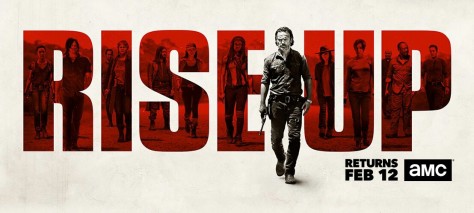
We start the season with a front seat to Negan’s gory, merciless punishment of Rick’s de facto family.  And then the victimization of our favorite characters simply … continues for the length of the season, until the last episode’s climax.  You see that cool image at the bottom of this blog post?  The advertisement depicting bad-ass Rick and his allies getting ready to “RISE UP?”  (It actually looks a lot like the posters for the “Walking Tall” films.)  Well … we don’t see much of that until the final episode. I told one friend that “The Walking Dead” was disappointing me because it had grown tiresome “seeing Negan beat everyone all the time.”

And some episodes felt like filler.  Yes, there were some nice “milieu” -type stories — it was actually a lot of fun expanding the show’s world, to see other settlements, like The Kingdom, The Sanctuary and Oceanside.  But I think the plot needed to move forward more quickly.  (For a far better discussion of these issues, check out Ryan Roschke’s excellent review over at Popsugar.)

Hey … I’m still a fan.  I’m just not as satisfied a fan as I used to be.  I certainly looked forward to “The Walking Dead” every week, and never missed an episode.

And this season did have its high points.  Dwight emerged as quite an interesting, compelling character, thanks in no small measure to Austine Amelio’s portrayal of him.  The character interaction among him, Daryl, Negan and Rick is great stuff — I find myself wishing that the lion’s share of the season was devoted to those four.  I am finally starting to understand that Norman Reedus is indeed a really good actor — his performances were strong throughout the entire season, but must notably upon his return to Alexandria and his embrace with Rick.

And there were moments of nice action and horror as well — the sand-buried walkers pursuing Tara and Health spring to mind, not to mention the neat trick Rick and his group use to dispatch an entire herd of zombies on the interstate.

Let’s hope that Season 8 will pick up a bit, now that “war” is underway.


tumblr_oi2yv4Y4U91vai2dso1_1280

Season 1 of “Westworld” was fantastic.

The premise for HBO’s “Westworld” sounds like a bad situation comedy — robot cowboys entertain the rich at a futuristic theme park.  There are showdowns and shootouts, and hilarity ensues when the guests fall in love with the coy robot ladies.

But “Westworld” is an arguably brilliant serial science fiction thriller, far transcending its gimmicky central plot contrivance.  It is occasionally weighted down by some challenges with pacing, story structure and exposition.  But I still loved it enough to get hooked on it immediately, and I’d give it a 9 out of 10.

I think it’s the smartest science fiction show I’ve seen in a long time.  Its brilliance doesn’t stem from its kitsch premise.  (I haven’t seen the original 1973 film based on Michael Crichton’s screenplay, but I’ve seen it lampooned at least once.)  It generally doesn’t extend from the show’s many twists and surprises, however well executed they are.  Nor does it stem from the show’s ambitious discussions of the nature of consciousness.

Its brilliance, in my opinion, stems from its nuanced and surprisingly disturbing depiction of human evil.  Of course there’s the obvious — the theme park exposes human depravity by allowing people to rob, rape and murder lifelike human surrogates with impunity.  But there is far more that the show has to say.  To get a sense of it, you have to watch the entire 10-episode season, and see several key character arcs reach completion.  One of these arcs was so dark and cruelly contemplative that it’s stayed with me long after I watched the final episode.

The show is well made at every level.  It’s gorgeously shot, at locations throughout California, Utah and Arizona.  The special effects are great.  Anthony Hopkins is characteristically perfect as the park’s patriarch, and Jeffrey Wright is terrific as his well meaning right hand.  (That actor is starting to grow on me.)  The entire cast is quite good — even those in relatively minor roles, like the two hapless technicians (nicely portrayed by Leonardo Nam and Ptolemy Slocum) who become entangled in the events connected with the park’s malfunctions.

Ed Harris, however, consistently steals the show as “the Man in Black,” a park guest who vacations as a brutal rapist and murderer (and who we learn has another agenda, as well).  He’s chilling.  I never really saw Harris as an amazing actor before, despite seeing him in many roles, including his memorable turn in “A Beautiful Mind” (2001).  But he was incredible here.

I wanted to give this show a perfect 10, but even someone who loves it as much as I do can see the weaknesses of this first season.  Overall, “Westworld” is sometimes too drawn out.  I feel the plot moves forward rather slowly, and I think Season 1 would be perfect if only it were carefully edited down from ten to maybe seven episodes.  I found myself getting a little frustrated by the the fifth episode, when we see two major characters follow arcs that seem redundant.  (I’m being intentionally vague here to avoid spoilers.)

The problem is compounded by the deliberately superficial nature of “Westworld’s” setting.  This is a theme park with stereotypical stock characters associated with Hollywood westerns.  Accordingly, its inhabitants have overly stylized speech and behavior.  Furthermore, these androids are programmed to follow the same “loops” repeatedly, as the same preconceived story “narratives” are reused to entertain new patrons of the park.

It gets annoying.  Yes, I know it makes perfect sense and is necessary in the context of the story.  But it can be grating to someone who tunes in to see a science fiction show, and not a cheesy western.  James Marsden is a decent enough actor, and he’s well cast as “Westworld’s” prototypical “good guy” cowboy.  But seeing this character’s shtick over and over was irritating.  So, too, were the sassy ladies at the brothel and some other minor characters.

Finally, I suggest that, for some viewers, “Westworld” may be hard to follow.  I occasionally found it that way.  There are twists that are wonderfully well crafted, gradually deciphered mysteries, and a very layered backstory.  Finally, the show’s discussions of things like consciousness, morality and artificial intelligence can sometimes border on the didactic.  (It helps a hell of a lot, though, when the actor delivering the exposition is the priceless Hopkins.)  It’s a lot to take in.  People tuning in should be prepared for some challenging, cerebral science fiction instead of easily digested, escapist fantasy.

All in all, this show was superb.  If you’re a science fiction fan, you need to at least give it a try.

Unnecessary postscript: actor Jimmi Simpson sure looks a hell of a lot like a young Christian Slater.

 

evan-rachel-wood-as-dolores-abernathy-ed-harris-as-the-man-in-black-c1


“Life’s” a bitch.

Or at least it is to the astronauts who make an abortive attempt to escort it back to Earth.  (They realize that bringing a Martian organism home is a bad idea in this year’s surprisingly satisfying science fiction-thriller.)

I actually had more fun with this than I expected; the movie is much faster paced and scarier than the trailer made it look.  There are some real surprises and moments of genuine horror here, following a requisite plot setup that is relatively brief.  It’s a really nice monster movie that should please fans of the genre.

I actually didn’t prefer its ending, which is something for which other reviewers are praising it a lot.   I’m disinclined to say more, for fear of spoilers.  The movie’s marketing already spoiled enough.  (The ads infuriatingly show the fate of a main character.)

I will say what the movie is not, however.

One, it’s not a stealth prequel for Sony’s planned 2018 “Spider-Man” spinoff, “Venom” (though that’s such a clever idea, I wish I’d thought of it).

Two, it’s not a ripoff of Ridley Scott’s “Alien” (1979).  Yes, it’s got the same MacGuffin, and some story parallels that I noticed early on.  But I like to think of this as a more grounded contemporary thriller, where “Alien” was a futuristic fantasy creature feature.  Besides, if we criticize every “haunted-house-in-space” movie as an “Alien” imitator, we won’t get more of them.

I’d give this an 8 out of 10, and I’d recommend it.


life_ver2

A few quick words on “Kong: Skull Island” (2017)

“Kong: Skull Island” doesn’t have the charm and sense of fun of Peter Jackson’s version, but it’s still a first-rate monster movie that I highly recommend.  It’s got a good script, likable characters and terrific special effects.

Parts of it were actually scary.  The first action set-piece is unexpectedly brutal, and there’s a sequence with a giant spider that was a little unnerving, too.  I was surprised at how the filmmakers here so heavily emphasized the story’s action-horror elements.

I had a blast with this, and I’d give it a 9 out of 10.

I have a question — did anyone else notice a reference to “Jurassic Park” (1993)?  At one point, Samuel Jackson’s character tells his companions to “Hang on to your butts.”  Isn’t that his character’s line in “Jurassic Park” when he restores power to the facility, shortly before he gets killed?


A review of the “Westworld” pilot (2016)

Blog Correspondent Pete Harrison suggested I give the Westworld” series (2016) a try, and I’m damn glad he did.  The first episode was superb, and it’s safe to say it’s reeled me in.  I’d give the pilot a 9 out of 10; this seems like it could be the best science fiction television show I’ve seen in a long time.

I still think the premise is just slightly cheesy — grown men and women spending a fortune to visit a western-themed amusement park with interactive android cowboys.  (I think maybe westerns were a more mainstream genre in 1973, when Michael Crichton’s original film was in theaters.)  And there are times when the show’s central western-themed motifs are a little annoying to me … even though I know the park is supposed to appear superficial and cliche.

But “Westworld” is a highly intelligent thriller — it looks like a hell of a lot of thought went into the script.  Just about every aspect of the show seems like it was well developed — everything from the actors’ performances to the set design.  And don’t let the gorgeous, idyllic, sunny landscapes fool you — there is no shortage of pathos here.  It’s brutally dark in its storytelling.  (By the way, if you happen to be a fan of this show, I must recommend 2014’s “Ex Machina” film — it is similarly cerebral and dark in its outlook.)

Anthony Hopkins is fantastic, as usual; Jeffrey Wright, James Marsden, Evan Rachel Wood and Thandie Newton are all very good.  They’re all overshadowed here, though, by two stellar performances.

The first is Ed Harris as a black-clad psychopathic visitor to the park — I had no idea he could be so frightening.  Dear God.  Has he played bad guys before?  I’ve always associated him with nice-guy roles — even his antagonist in 1996’s “The Rock” was misguided and sympathetic.  I’d love to see him get a role in an upcoming “The Dark Tower” film, maybe as one of the Big Coffin Hunters, if they are ever featured.

The second is Louis Herthum, the ostensible “father” of Wood’s heroine.  (They are both androids within the park — I don’t think that’s much of a spoiler, as it’s all over the show’s advertising.)  Herthum may be a lesser known actor, but he stole the show in a tour-de-force performance, in my opinion.  And that’s no small feat in a cast including Hopkins and this surprisingly vicious Harris.  I haven’t seen a performance that good on television since NBC’s “Hannibal” went off the air.

Anyway, I noticed something funny here.  Steven Ogg plays a bandit who invades people’s homes and murders them … this is basically the same role he plays as Negan’s chief henchman on “The Walking Dead.”  It must be weird to be typecast like that.

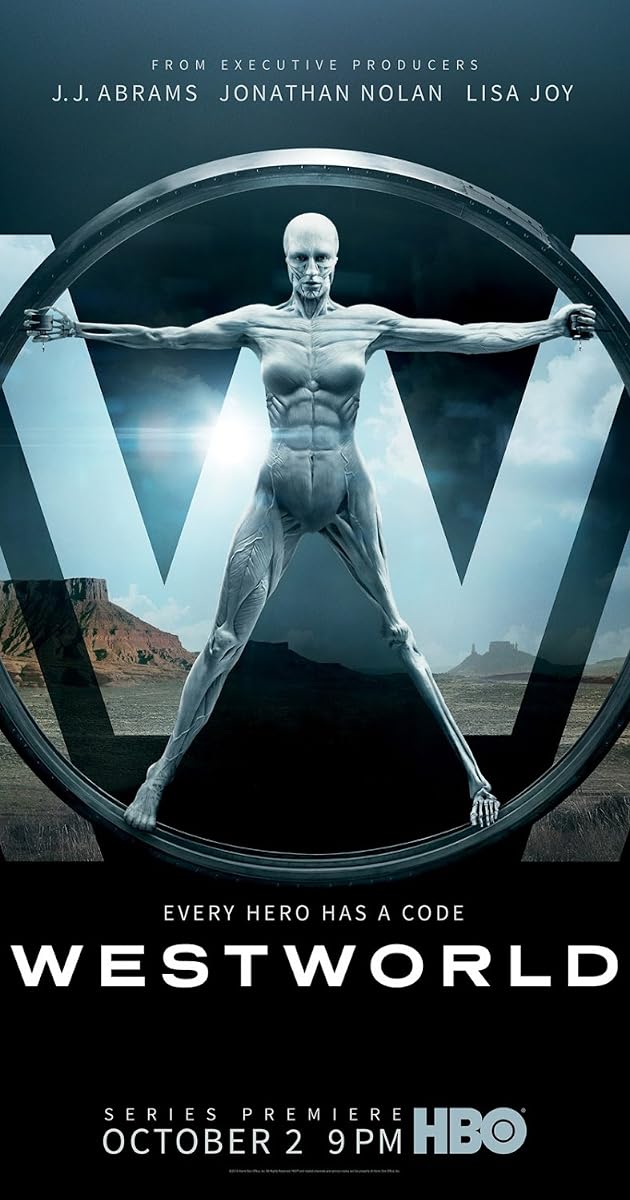
Hey … it is only just now that I realized the logo below is a riff on Da Vinci’s “Vitruvian Man.”