Tag Archives: review

A quick review of “The Green Inferno” (2015)

There is one special effects sequence in Eli Roth’s “The Green Inferno” (2015) that is technically very well done.  I won’t describe it, for fear of spoilers here, but if you know that Greg Nicotero was in charge of effects for this movie, and you know the TV show with which he’s associated, then you have a pretty good idea of what this sequence entails.  (Hint: it’s “The Walking Dead.”)

This movie also makes excellent use of its Peruvian location, and the real tribe employed as extras.

Beyond those two things … this really is a rather mediocre horror-thriller, folks.  It’s nothing to write home about.  In fact, it seems amateurishly made on a few levels, especially considering the creative talent Roth exhibited with films like “Hostel” (2005), “Hostel 2” (2007) and “Cabin Fever” (2002).

This movie held my attention, and it does serve up a disturbing horror film that’s weird and different — which is what I think Roth is known for.  But, regrettably, it just wasn’t especially well scripted, performed or directed.  I’d give it a 4 out of 10.

the_green_inferno-2

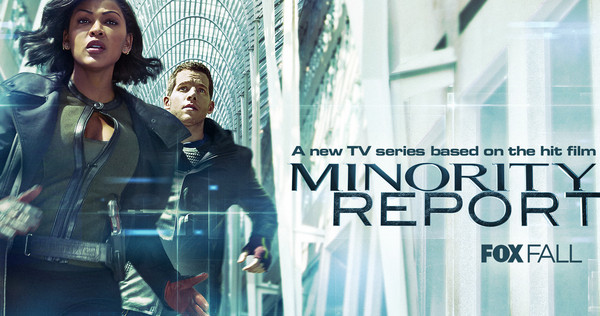
A quick pan of “Minority Report’s” pilot episode (2015)

The first episode of television’s “Minority Report” (2015) has all the bells and whistles of its 2002 cinematic source material, but little of its skilled storytelling.  I’d rate it a 6 out of 10, and that probably reflects my positive bias connected with my love for the classic film.

The show looks great — the special effects are well thought out, well rendered, and in abundance.  Visually and in terms of its fictional technology, this is terrific way to revisit the future that was painstakingly envisioned for the fantastic movie.  The show is an earnest follow-up, too; you can tell that the writers respect the film and were reaching for its unique vibe and its fast-paced suspense.

Regrettably, the pilot here just doesn’t suggest that this will be an unusually good show.  The writing and directing are average, at best, and some of the acting is downright poor.  A hastily conceived plot features one of the movie’s plot-driving psychic “precogs” rushing to intervene in future murders, which he can still predict, like some kind of lone, nonviolent, pre-emptive vigilante.  A cheesy covert partnership develops between him and a tough-and-sassy-but-sexy, single, female cop.  And blah, blah, blah, blah, blah.  Cue the bad dialogue.  I honestly think my friends and I could have come up with something better than that.

Oh well.  It can’t all be “A” material.  At least, that’s what I’ve been telling people who bitch about my jokes on Facebook.  And this was just the pilot — maybe the show will get better.

MinorityReportFOX-ad

A quick review of the Season 6 premiere of “The Walking Dead.” And is a major death hinted at?

I tend to obsess a little about spoilers, so I’m reluctant even to describe the plot of the Season 6 opener for “The Walking Dead.”  The story I thought we’d see absolutely wasn’t the story we saw, and the very first scene should be a terrific surprise for the viewer.  Suffice to say, this episode was fantastic — I’d give it a 9 out of 10.

After five seasons, even a diehard fan of the program can ask about its screenwriters, “How long can they keep this up?”  This is a horror subgenre that’s hard to keep fresh.  But the show still succeeds.

The writers are trying, and it shows.  I suggest that this actually is sometimes a pretty smart show.  A nice amount of thought has gone into the major action set-pieces since the start of Season 5 — everything from strategy, tactics, terrain, diversion, leadership, and even differing levels of training for new or seasoned combatants.  When one protagonist refers to our heroes’ adversaries as “an army,” I began looking at this episode as … “military horror?”  Is that even a thing?  Anyway, it’s a refreshing change for fans of zombie horror who are tired of the spate of second-rate movies on Netflix — those typically show attractive twenty-somethings in vague battles, cheerfully rattling off dry one-liners while swinging impact weapons, despite their lack of any training or experience.  This episode offered horror fans both exploding zombie heads and an intelligently staged battle to follow.  Nice stuff!

Also present were the other things that people love about the show — great character moments, surprise character development, and terrific dialogue.  The exchange between Morgan and Carol was goddam beautiful, and it makes me rethink my longstanding (and unpopular) criticism that this show sometimes struggles with characterization.

The suspense and tension tonight were absolutely perfect.  I was on the edge of my seat until the end of story.  And the final surprise development and cliffhanger there really drove me nuts, even if I have a pretty good idea why it occurred.

There is one question here that I am embarrassed to ask.  I’m afraid I’m going senile.  Am I the only fan who absolutely does NOT remember the character of Ron?!  I … I thought that Alexandria’s Hester Prynne here had only ONE son, young Sam!

Hey, one more thing — if I’m onto something here, I’m going to be damn proud … and I don’t think this counts as a spoiler, as it is only an unconfirmed suspicion on my part.  We see an erratic Abraham manically and cavalierly battle some zombies here.  When asked why he was behaving strangely, he replies that he’s “taking the bull by the balls.”

He sounded a hell of a lot to me like the erratic Roger manically and cavalierly battling zombies during a fateful scene in George A. Romero’s “Dawn of the Dead” (1978).  He keeps blurting, “We got this by the balls, we got this by the balls!”  And both scenes involve people getting in and out of vehicles.  The 1978 sequence ends poorly for Roger because of his carelessness.  Does this mean that Abraham is likewise doomed?

cf43d0c11dcbb85457b9fe4f7282c11c

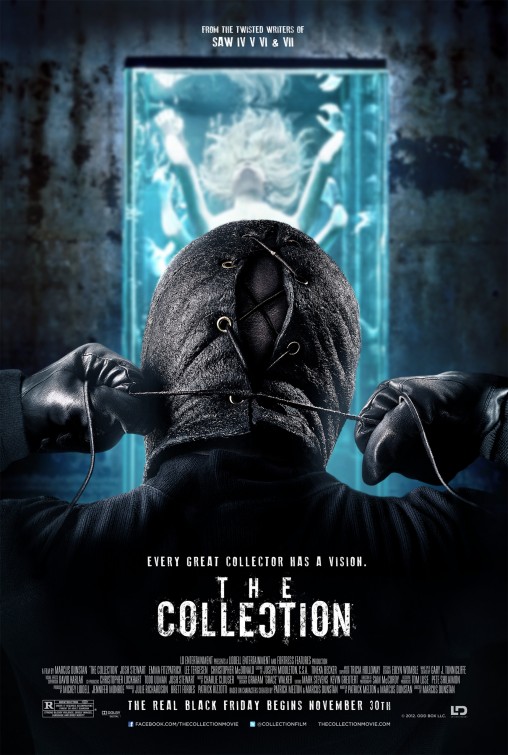
A short review of “The Collection” (2012)

I have to give “The Collection” an 8 out of 10.

No, it’s not a classic horror movie — it’s derivative of the “Saw” movies, and it seems to result from too little thought by the screenwriters.  The antagonist is a serial killer (and here a mass murderer) who employs extraordinary Rube Goldberg-esque machines to brutally trap his victims.

We know nothing about how he arrived at his expertise.  (He appears to be a demon-possessed Thomas Edison.)  His choice of victims is random.  His modus operandi is puzzling.  (Why bring a prior victim to a new crime scene?)  And we’re not even shown how these machines work — only CG’ed tracking shots of cables and pulleys.  Neither do we know why he has unarmed combat training that seems to approach the level of Batman’s.  And the question I was left with by the previous film (“The Collector,” 2009) is still the most egregious omission — how on earth does our bad guy have time to invade a house or building and set all these things up?!  There is SOME nice exposition about the killer’s motivations in some closing dialogue, and it’s wickedly interesting, but it’s cut short.

But, hey — this still got under my skin enough to be an effective horror movie.  The opening action set-piece (YEESH!) was not only frightening, it was also something completely surprising.  I knew bad things were afoot when we spot our horrible machinist lurking above, but … I didn’t expect THAT.

Even with almost no speaking lines, Randall Archer deserves credit for terrific physical acting throughout — not to mention some the best (worst?) crazy-evil eyes in horror film history.  (Just LOOK at this mamajama in the second picture below.)  Archer is a professional stuntman, and his movement and posture sell the role perfectly.

Even better is the presence of Josh Stewart, who returns as the first movie’s nuanced antihero.  I’ll say it again — I love this guy.  He’s a damned talented actor, and he deserves more leading roles in major films.  He was even frikkin’ awesome in his small role as Bane’s craven little henchman in “The Dark Knight Rises” (2012).

And Lee Tergeson, who I remember best as Beecher in HBO’s “Oz” (1997-2003), is also great to watch.

There are other nice touches too.  Like its predecessor, this movie could be smart and creative when it tried.  The use of a gun here is pretty clever, even if it seems obvious in retrospect.  (I wouldn’t have thought of that.)  And the fate of some of our bad guy’s past victims is both fresh and very disturbing.  If those ideas had been expanded on much further, this film would have risen above its status as a “Saw” imitator.

Finally, I love endings like the one we see here.  I won’t say more for fear of spoilers.

collection_ver2

The-Collection-e1364275552414

A short review of “The Gift” (2015)

I guess the formula for “The Gift” (2015) is pretty simple — hand a superb script to three superb actors.  Here, they are Jason Bateman, Rebecca Hall and Joel Edgerton, and the dark drama they bring to life is driven by dialogue and unexpected character development, instead of jump scares and dark hallways and other conventional thriller conventions.  (Edgerton, who I last saw as a boilerplate good guy in 2011’s “The Thing” prequel, is also the director here.)  The three actors are magic together.  I became uncomfortable (as was the filmmaker’s intention) even during the first apparently innocuous conversation when the three interact for the first time at a chance meeting in a department store.

In fact, I’m not sure that “The  Gift”  is even a thriller instead of a particularly disturbing drama.  Like other viewers, I’d suggest that what filmgoers see is not what the movie’s trailer suggests.  This is yet another film that reviewers can’t describe in detail for fear of spoilers.

I’d give this a 9 out of 10.  My only criticisms are very mild.  I think Bateman underplayed the distress his character ought to have felt in the last 10 minutes or so.  Also, I found myself wanting more closure and less ambiguity in the ending, as well more of a standard climax.   But that probably just reflects my expectations as a traditional horror-thriller fan, and not any real failings of the movie.

The-Gift-Movie-Poster-Simon

A review of Season 2 of “The Strain”

When I favorably reviewed the first season of “The Strain” (2104) last year, I predicted that the show couldn’t sustain its momentum much longer, as the creepy effectiveness of its vampires was already beginning to fade.  I was pleasantly proven wrong.  Season 2 was a creepy, devilishly surprising ride, despite its silliness, and I’d rate it an 8 out of 10.

Let’s get a little killjoy pedanticism out of the way first.  “The Strain” has absolutely not lived up to its promise as an epic horror-movie-meets-technothriller, as suggested by the opening episodes of Season 1.  Those episodes looked like a collaboration between Bram Stoker and Tom Clancy.  Imagine how amazing this show could have been!

What we’ve got instead is more EC Comics horror than intelligent horror.  You’ll enjoy the program more the less that you think it through.  I can’t resist being a know-it-all here and deflating one of my favorite shows with some pretty big things it overlooks.

First, the vampire legions we see laying siege to New York City here are nothing less than invading force.  New York is the financial capitol of the United States, and arguably the world.  Its fall would cripple not only America, but also the world’s economy, and that’s not even considering the more obvious threat of the vampires extending their forces outward from there.

I think that Congress would repeal The Posse Comitatus Act, which prohibits America’s armed forces from occupying U.S. lands.  (Or the president could easily circumvent it.)  We would see large standing armies surrounding and then moving in to New York, with support from the Navy and Air Force.  It absolutely would not just be outnumbered national guardsmen, heroic everyday policemen, and plucky, average New Yorkers rallying together, even if those things are fun to think about.  I think our armies would have plenty of international support as well.

Second, if our vampire forces (and their human collaborators) had any sense at all, they’d try hard to spread their contagion anywhere in the United States, even if they don’t intend to invade beyond New York.  Creating wildfire epidemics anywhere else on the continent would confuse and slow America’s response.

But I’m overthinking things.  “The Strain” is silliness, but it’s sublimely fun silliness.  This show didn’t fail to surprise and entertain me, and from time to time it creeped me out too.  I jumped a few times.  It indeed remains scary, with story devices that were spooky and damned creative.  One such device is the new breed of … what I call the “spider-vampires.”  They’re a different and even more unsettling threat than the baddies we’re used to.  And I can’t say much without spoilers, but the manner of their creation is pure genius horror writing.  Yeesh.  There are other little plot-related or character-related goodies that I’m thinking of, but I can’t specify without spoiling them.

Richard Sammel and Jonathon Hyde still lead the cast in talent; this is definitely a tv show in which the bad guys are the better thespians.  (For a show where Holocaust flashbacks have become stale, Sammel shines especially in fangless flashback that unexpectedly humanizes him.)  Their performances were often good enough to make me overlook the humdrum character of our often boring good guys.

Again, “The Strain” isn’t high art.  But it can be a damn fun time for a horror fan.  Check it out.

season-2-poster-2

A review of “Fear the Walking Dead,” Season 1 (2015)

I know that love for “Fear the Walking Dead” (2015) is not universal, but I needed to pipe in at least once to say that I thought that “Season 1” was terrific.  (I feel funny calling six episodes a “season,” but I’ve heard that de facto miniseries like this are a new trend in television.)  I’d give this apocalypse story a 9 out of 10.

For me, “Fear the Walking Dead” satisfied a longstanding itch.  If you grow up a fan of post-apocalyptic horror, you are constantly exposed to the aftermath of the end of the world.  In the vast majority of films and fiction, horror fans are treated to flashbacks, at best, of how it all went down.  Here we (partly, at least) get to see it all go down.

I’ll bet that stories so expansive in scope are a little harder to conceive and write convincingly.  Very few writers of prose or screenplays have expertise in disaster management, disease control, mass psychology or homeland security.  How much easier is it to have protagonists roam a landscape of burned out buildings, with only graffiti, snippets of conversation, and occasionally a blown newspaper offering hints of exactly how the end came about?

“Fear” deserves a hell of a lot of credit just for trying (as does “The Strain” over at FX).  It’s also why the globally plotted “Contagion” (2011) was such a frighteningly interesting thriller, and why Max Brooks’ stage-by-stage zombie pandemic easily made “World War Z” the greatest zombie novel ever written.  Through the eyes of an average family, “Fear” at least tries to show us meaningful glimpses into how police, emergency and military authorities would react.  The result is some interesting stories.  A nerdy high school student is the first to prepare, for example, due to his attention to the Internet’s alternative media.  And a doomed compact between a civilian neighborhood and their putative military protectors concludes in a particularly horrifying way.

Soooooo many viewers complained that there were “no zombies.”  Well, there were always a couple, at least — we got a great one in the first episode’s earliest minutes.  But that wasn’t the point.  The creators of “Fear” told us that this would be a different type of show, with a “slow burn” -type horror.  For me, that worked.  Look at it this way — we routinely see “zombie swarms” over at that other show (what was its name again?).  We’ve been seeing them for five whole seasons — the first repelled Rick Grimes’ ill advised solitary horseback exploration of Atlanta.  That’s fun for a zombie horror fan, but it’s nothing new.

“Fear” offers us something much different — a kind of “creeping horror.”  This seemed like the “Psycho” (1960) of onscreen zombie tales.  No, we don’t see zombies everywhere, but watching even one episode of “The Walking Dead” (2010) lets us know that these lackadaisical everyday people are in for a hell of a ride.  We, the viewers, know what they do not.  That’s what our high school English teachers taught us was “dramatic irony,” and it makes this a nice little companion show to “The Walking Dead.”  In fact, ALL the characters we see are probably doomed to die, given what we know of the statistics established by “The Walking Dead.”  That’s pretty dark stuff.

Other viewers complained about the characters being boring or unlikable.  I do get that.  Nobody here, I think, will ever gain the same viewer loyalty as Rick, Michonne or Daryl Dixon.  (If it were put to a vote among the women of the world, I’m pretty sure they’d rename “The Walking Dead” as “The Norman Reedus Show.”)  But “Fear’s” average (and, yes, sometimes boring) people seemed far more “real” to me — I think they functioned better as viewer surrogates, and better allowed me to imagine how I might react in a world like this.  I almost started viewing this as an end-of-the-world docudrama in the same manner as the BBC’s little known “End Day” (2005).

Besides, two characters in particular do show great promise.  I just can’t say who or why without spoiling that they survived.  Yet another character who appears suicidal in the final episode is one that I thought was pretty interesting, and we do not actually see this person’s death.

Sure, I had my own quibbles.  Los Angeles is remarkably empty for a city of nearly 4 million people.  I’m inclined to think that, even after an unlikely evacuation attempt, it would still be swamped either with people who still needed help, or with zombies.

Also … the sparse information we’re given about the zombie phenomenon here seems disappointingly contradictory.  We’ve established that a universal, invisible illness means people will return into undeath, regardless of how they died.  But we also see a flu-like illness affect some people (who are doomed to die shortly thereafter), but not all people.  Are these two different manifestations of the same disease?  Is it even technically a contagion, or is it an environmental illness?  (I know my questions here are absurdly silly, but this is precisely the sort of thing that horror nerds argue about over at the Internet Movie Database.)

Oh, well.  My recommendation here is to give this a chance, with the caveat that it definitely isn’t “The Walking Dead.”  It’s damn good.

Oh!  One more thing!  Keep an eye out for occasional homages to “28 Days Later” (2002).  And watch closely — one such plot arc is devilishly turned on its head in a subtle thematic twist.

tumblr_ntb25ok2ex1t7b5qro1_1280

A short review of “These Final Hours” (2013)

“These Final Hours” (2013) is an unflinching Australian end-of-the-world movie that views humanity’s last 12 hours through the eyes a flawed, desperate everyman.  It’s outstanding; I’d give it a 9 out of 10.

This movie pulls off a pretty neat trick — it effectively portrays a global catastrophe with zero special effects until its closing set-piece.  (And these visual effects work quite nicely for a low-budget film.)  A meteor has struck the northern Atlantic, and a resultant wave of destruction is enveloping the earth.  Its progress is documented in real time by a sad ham radio operator, wonderfully performed by David Field.

What we see is gut-wrenching.  Some people turn suicidal, a few turn homicidal.  People drink, use drugs and have sex, either privately or not.  Some are depressed, some are too drug-affected to care, and others are in shock.  The rare, vain efforts to survive include the laughable (a tin foil-covered house) to the sadly insufficient (a stocked bunker that nevertheless isn’t deep enough).  One reaction is befuddling; we see a street barricaded with metal shopping carts with a sign cursing at passersby.  This is a fatalistic story premise in which every character on screen is doomed to die within hours.

We follow the surprisingly touching character arc for our troubled everyman.  He’s played by perfectly by Nathan Phillips.  The young Angourie Rice is just as good as an incongruously self-controlled little girl who winds up his charge after being separated from her father.  The cast is uniformly excellent.  Hearing Kathryn Beck wail that she doesn’t want to die is heartbreaking.

For me, there were only a few flaws here.  The pacing seemed … off somehow.  This movie slowed toward the end, the nearer disaster approached.  Phillips’ protagonist seemed thinly scripted for much of the first hour.  He seems like a generic guy, who plans to get drunk before the end of the world, which makes him much like nearly everyone else we see in this movie.  Yes, he intervenes heroically when he first encounters the little girl, but we expect every movie protagonist to do that.

With that said, however, every character did seem “real” to me, thanks to terrific naturalistic dialogue, written by Zak Hilditch.  (He’s also the director.)  It made the drama hit home.

Thanks to blog correspondent Len Ornstein for recommending this movie!  I recommend it too.

these-final-hours-movie-poster

A review of “Parallels” (2015)

First, a clarification — “Parallels” (2015) is absolutely not a feature film; it’s an undisguised attempt at a pilot for an ongoing web-based series.  I think it’s pretty cruddy of Netflix to market it as a standalone film, as viewers expecting a conclusive story will doubtless be disappointed.  Its parallel universe-hopping premise also seems so similar to “Sliders” (1995-1999) that it just might approach the boundary between inspiration and ripoff.

With that said, however … dear LORD!!!  “Parallels” was frikkin’ FANTASTIC.  What we’ve got here is a far edgier, grownup version of “Sliders,” with a first episode introducing the same type of show-spanning mysteries as “Lost.”  But where “Sliders” was milquetoast primetime family fare, this looks like an excellent serialized thriller with plenty of pathos.

What a shame this thoughtful series never reached fruition.  I was hooked.  It’s smartly written by Christopher Leone; he’s visibly well acquainted with string theory, and has a hell of a lot of clever fun with it.  “Parallels” is a face-paced 80 minutes that follows a tragic, dysfunctional modern family embroiled in the mystery of the plot-driving “Building.”  The Building appears to be the nexus of countless parallel universes, a bit like the “The Dark Tower” links them in Stephen King’s multiverse.  The cast is uniformly good; the standouts were Eric Jungmann as the comic relief and Michael Monks as an understated but terrific bad guy.

I had only a few tiny quibbles.  Some of the family melodrama and the mysteries were a little forced and heavy-handed.  The ending (?) here, while really intriguing, also borrows a page or two from “Cube” (1997) and one particularly good episode of Ron Moore’s “Battlestar Galactica” (2004-2009).

I’m not sure how to rate this.  It fails as a standalone film, I think, because it simply doesn’t have an ending.  I suppose I’d give it … a 4 out of 10?  If you can forgive that fatal flaw, however, and want to enjoy some top-shelf science fiction, then I’d easily give it a 9 out of 10.

Dammit.  Why wasn’t this show made?

B0tPX3b

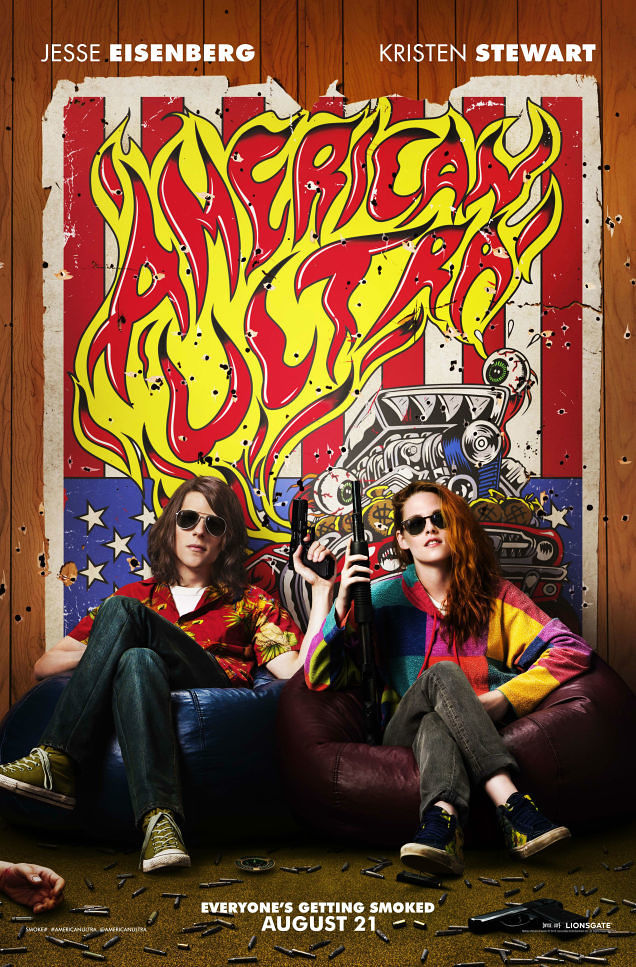
A short review of “American Ultra” (2015)

The Manchurian candidate is a common trope.  A Manchurian candidate hidden within a neurotic, drug addled, underachieving comic book creator is actually pretty creative.

That’s just one of the reasons that “American Ultra” (2015) had the makings of a great movie.  This film has more going for it too.  The soft spoken Jesse Eisenberg is extremely talented, being both quite funny and bizarrely likeable in the role.   Kristen Stewart is also just great.  (I haven’t seen her in the “Twilight” films that made her famous/infamous, but she really impressed me as a child actress in 2002’s terrific “Panic Room.”) And, like Eisenberg, Connie Britton has perfect comic timing and delivery.  (I’m still smiling at her offhand “Hey!” to the guy in the barn.)

Regrettably, maybe just past the halfway mark, this film loses its way just a bit.  The humor stops being character- and dialogue-driven, and the fish-out-of-water comedy sort of segues into a generic (and not terribly well executed) action –thriller.  There are some half-hearted action set pieces that aren’t especially well staged, or even well conceptualized.  And precisely nobody acts as though they have any sort of government or military training — either conventional or subliminally hidden.  Does EVERYONE in hollywood movies ALWAYS cluster together in a clear field of fire without seeking cover?

There is another miscalculation, too, that makes “American Ultra” less than great.  Our bad guys are cartoonish.  Eisenberg’s pursuers turn out to be (sigh) former mental patients who have received the same mental conditioning.  One is code-named “Laugher” because he cackles hysterically.  (That’s something out of a mediocre comic book.) And, like everyone’s least favorite Spiderman movie from the 2000’s, Topher Grace is cast against type as a raging psychotic.  (Am I the only one who thinks he was far funnier as the mild-mannered, relatable everyteen in “That 70’s Show?”)

How much funnier would this movie have been overall if Eisenberg’s quirky antihero (and maybe his weird friends) were the only comedic characters?  What if all their antagonists were “straight men” characters who ironically struggled in vain to defeat them?  This film could have been a classic.

Oh, well.  I still liked this well enough.  I’d give it a 7 out of 10.

kristen-stewart-gets-mega-stoned-for-american-ultra-496323