Tag Archives: The Thing

Throwback Thursday: “Willard” (1971) and “Ben” (1972)!

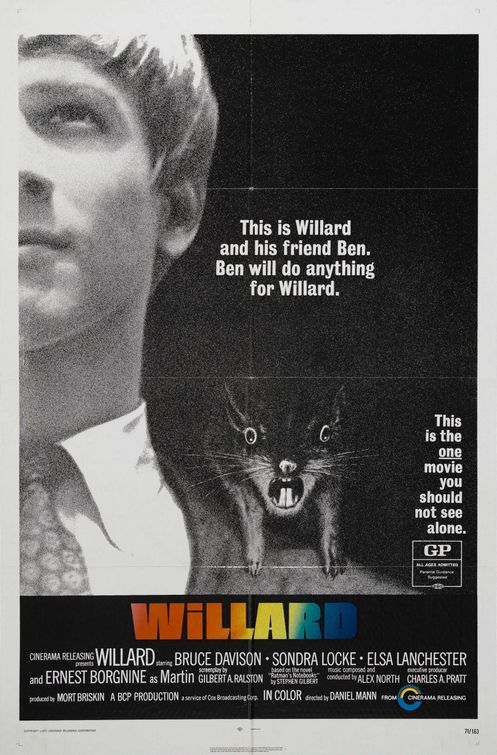
“Willard” (1971) and its sequel, “Ben” (1972), were another pair of 1970’s movies that got plenty of airtime on 1980’s television.  I read both books when I was a kid too.

First I picked up Stephen Gilbert’s Ratman’s Notebooks at a yard sale, because that’s how you found cool horror books during summer vacations when you were too young to drive.  (Sometimes adults had few compunctions about what they sold to minors too.  I bought a vampire book in gradeschool that was full of nude photos, for some reason, and that led to what I’m sure was an interesting conversation between my parents and the neighbor-proprietor down the street.)

Anyway, I absolutely loved Ratman’s Notebooks (despite its lamentable absence of nude photos) and I finished it in a day or two.  The novelization of the “Ben” film by Gilbert A. Ralston was somewhat less impressive, but I still enjoyed it.

If you’re a comics fan, like I am, then it might occur you that “Willard” and his army of trained rats seem to inspire a villain in Batman’s rogue’s gallery — Ratcatcher.  Ratcatcher has been a minor league villain since he debuted in DC Comics in 1988, but he’s a pretty neat bad guy when placed in the hands of the right writer.

I feel certain that anyone will recognize Ernest Borgnine in the first trailer below– his  face and voice are impossible to confuse with those of another man.  If the disaffected, spooky, eponymous Willard looks familiar to you, that’s none other than a young Bruce Davison.  He’s a good actor who’s been in a lot of films, but I think a plurality of my friends will know him as Senator Kelly from the first two “X-Men” movies (2000, 2003).

You’ll note the presence of flamethrowers in the trailer for “Ben.”  Flamethrowers were a staple of 70’s and 80’s horror films; it was just part of  the zeitgeist.  They were handy for heroes fighting any nigh-unstoppable nonhuman baddie — think of “The Swarm” (1978), “The Thing” (1982), “C.H.U.D.” (1984), “Aliens” (1986), and “The Blob” (1988), for example.  Hell, 1980’s “The Exterminator” featured a vigilante using a flamethrower to kill criminals.   It was a weird time.


willard

ben_ver2

A short review of the “Cabin Fever” remake (2016)

I don’t understand why the 2016 remake of Eli Roth’s “Cabin Fever” (2002) is so hated by critics and audiences.  It has a 0% rating over at Rotten Tomatoes, and reviews of the movie are withering.  I personally thought it was a very well made horror film; I’d rate it at least an 8 out of 10.

Sure, I understand the criticisms.  This is definitely an unneeded remake.  And the new cast here feels bland compared to the doomed vacationers in Roth’s campier, weirder outing 14 years prior.  (Although this isn’t a shot-for-shot remake, it still proceeds mostly from his original script.)

But the new “Cabin Fever” is well filmed, and it’s damned horrifying.  Director Travis Z significantly ups the gore, violence and frightening imagery — it’s not for the squeamish.  It passes the litmus test for decent horror movies, because it scared me.

Maybe I’m just partial to Roth’s basic story concept — a terrifying new illness that jumps from person to person in an isolated location from which it’s difficult to escape, turning them against one another.  It’s precisely the same plot driver as the one for John Carpenter’s “The Thing” (1982), which is among the greatest sci-fi/horror films of all time.  And I suppose Roth’s story could be taken as modern retelling of Edgar Allan Poe’s “The Masque of the Red Death,” with some of the director’s sadism and unique black humor injected into it via his screwball, eccentric characters.  Remake or not, this is still a creative change of pace from a genre consistently overcrowded with slashers and shrieking ghosts.


cabin-fever-2016-poster

I introduced a pal last night to John Carpenter’s “The Thing” (1982).

And she was predictably impressed.  Here are a few observations that came up for me, about the categorically rewatchable sci-fi/horror movie that keeps on giving.  (Yeah, I know I sound overly preoccupied with this movie, and that’s weird, but I’m just really into movies.  And John Carpenter’s “The Thing” is the same kind of classic for monster movie fans as “It’s a Wonderful Life” or “A Christmas Story” is for people who like Christmas movies.)  [THIS BLOG POST CONTAINS MAJOR SPOILERS.]

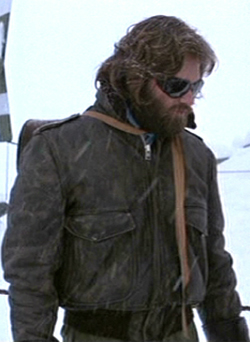
1) It was fun watching “The Thing” with someone who was seeing it for the first time.  Not only did I have to stifle a chuckle at her cry of “That poor dog!” during the opening credits, but I also watched while she guessed (incorrectly, as most of us did) at which characters had been assimilated by the shape-shifting monster as the story progressed.  (I noticed something ironic last night that I couldn’t mention.  When MacReady delivers his short “I know I’m human. And if you were all these things, then you’d just attack me” speech, all of the men he’s addressing are also still human … Unless I’m mistaken, Norris and Palmer are elsewhere.

Which brings me to what at first occurred to me as a … remotely possible plot hole in this otherwise perfect masterpiece.  If The Thing truly wants to escape Antarctica and prey upon the rest of the world, it doesn’t need to assimilate (or “Thingify,” as I like to think) everyone in the camp.  It only needs to overtake a single human.  (This would be the silhouetted figure that the dog first approaches; my money’s on Norris.)  Think about it … nobody stationed at Outpost 31 remains at the research station indefinitely.  They’d cycle out at the end of a shift of … six months?  Eight months?  Longer?  (And what about vacations and holidays?)  Sooner or later, they’d fly home.  And, having perfectly replicated a human’s anatomy, The Thing need only sustain itself until that departure by eating the same food the other humans were eating.  Then, as soon as it arrived at any other, warmer location on earth, it could attack life in its abundance.

But this morning I realized that my analysis here is faulty.  First, the humans were already getting wise to The Thing and its means of procreation — thanks to a pre-diabeetus Wilford Brimley wisely intoning, “That ain’t dog.”  Maybe The Thing was smart enough to realize the humans could effectively quarantine it.  Second, I am assuming in my criticism that “The Thing” is acting as a single entity.  Yet it shouldn’t act that way at all; this is the entire point of MacReady’s “blood test.”  While one incarnation of The Thing is safely munching on canned goods disguised as a human, a separate incarnation was sitting in storage, exposed — presumably only until the humans finally realized it needed to be destroyed somehow.  That iteration of The Thing needed to attack and duplicate Redding if it wanted to save itself.

2)  The Thing actually shouldn’t need to reach civilization in order to begin attacking all life on earth; it only needs to reach the Antarctic coast. If it enters the water and begins assimilating sea life (and why shouldn’t it be able to?), then it’s game over.  I said last night that “a fish can travel wherever it wants,” which my friend found pretty funny, but it’s true.  A Thingified fish (or its fish-Thing progeny) could arrive at any continental coastline.

3)  If The Thing replicates a human perfectly on a cellular level, then … might it be reluctant to kill anyone else, because it would basically be a human?  (Obviously, the film’s plot-driving antagonist has no such reluctance, but … still, think about it.)  If it perfectly replicates a human brain, right down to its cellular structures and chemistry, then wouldn’t it have a conscience and experience empathy?  My friend pointed out the reductionist nature of my question, though — it assumes that conscience and empathy can have only physical origins.

4)  The movie’s characters (and most viewers) assume that The Thing is “a lifeform” or an organism.  Is it, or is it simply “live” tissue?  Somebody on the Internet Movie Database message board pointed out long ago that it’s “just cells,” and that’s … literally true; the film even shows this via crude 80’s-era computer graphic.  Is it an “organism” if it is simply tissue that replicates?  Or is it no more a “lifeform” than a cancer, or tissue grown in a lab?

5) I honestly opine that the film is perfect, or very nearly so.  It is the paragon of sci-fi/horror movies.  And I’d put it on par with other films that I hold virtually perfect, like “To Have and Have Not” (1944), “Alien” (1979), “Blade Runner” (1982), “Aliens” (1986), “The Accidental Tourist” (1988), “Alien 3” (1992) and “Vanilla Sky” (2001).

6)  My friend reaaaally likes Kurt Russell’s hair in this film.

Okay, enough.  I’m sorry about this.  Hey, at least I’m not obsessing over comics tonight.


421rmr3zl7tab4ovnwtundj3nhk

Ugliest Christmas ornament ever?

I am inclined to think so.

This was a gag gift for a pal of mine — I got it for three bucks at my local five-and-dime.  Unless Picasso designed this ornament (and I don’t think he did), that misshapen, asymmetrical dog’s head is unintentional.  (Is anyone else reminded of Blair in the autopsy scene of John Carpenter’s “The Thing” saying, “That’s not dog?”  In fact … this could arguably be the coolest Christmas ornament ever …)  Anyway, I can’t tell if that stringy brown fur is supposed to symbolize the dog’s bed or just … dog hair?

Somewhere this holiday season, there is a craftsman who should keep his day job.

Do people in the South say “five-and-dime?”  It occurs to me now that I don’t think I’ve heard the expression since I left New York.


20181221_114844

“Nobody trusts anybody now, and we’re all very tired.”

I’m going to hide this tape when I’m finished. If none of us make it, at least there will be some kind of record. The storm’s been hitting us hard now for 48 hours. We still have nothing to go on.

One other thing: I think it rips through your clothes when it takes you over. Windows found some shredded and bloody long-johns in the trash but the name tag was missing. They could be anybody’s.

Nobody trusts anybody now, and we’re all very tired. There’s nothing more I can do, just wait.

This is R.J. MacReady, helicopter pilot, US outpost #31.

— From John Carpenter’s “The Thing” (1982)


Feature_the_thing-med

Lee Hardcastle’s “Thingu” (a parody of John Carpenter’s “The Thing”)

I’ve been meaning to run this on the blog since forever — artist Lee Hardcastle’s brief, brilliant 2012 send-up of John Carpenter’s 1982 masterpiece, “The Thing.”  (It is also a claymation parody of the European children’s program, “Pingu.”  Please note, however, that the video below is NOT for children.)

Even if the animation method is crude, this is damned creative stuff — in addition to being blackly funny, according to your tastes in humor.  This went viral when it was released, and I believe it fully deserves its online fame.

Is it weird if I’d never heard of “Pingu” before this video?  I have friends who certainly recall it.  Maybe it was just a European thing.  Or maybe it’s an example of “The Mandela Effect.”  I am very much an 80’s kid, and I swear I cannot remember that “Oregon Trail” computer game either.


If you’re cold, they’re cold. Bring them inside.

That’s some Thing you always need to remember on a cold night, right?

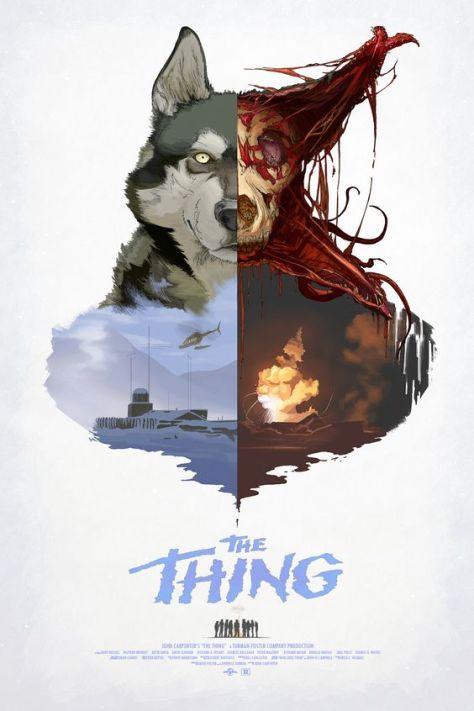
Anyway, this fan-made movie poster for John Carpenter’s “The Thing” (1982) is absolutely incredible.  I am unaware of its creator, but it’s all over the Pinterest boards for similar fan-made posters.


c4904596122a8a0ea6e84ccdfb6224bb

#cakefail

A buddy of mine made the cake on the right for a Christmas party.  (At left was his Pinterest inspiration; it was supposed to be a tie-dyed yule log cake.)  He is actually a truly superb cook and baker, but here he finally created something that I can embarrass him with.

I opined that it looked like a rainbow submarine melted by nuclear radiation; others drew more … lewd comparisons.  Today I think it most resembles John Carpenter’s “The Thing” after devouring and assimilating the Smurf Village.  (And how’s that for a double 80’s reference?)

Look … I’m the first one to admit that I myself can’t find my way around a kitchen.  Just now, as I am writing this, I almost put “Sweet Onion (Sea Salt Blend)” on my sausage and eggs, because at first I thought it was regular salt.


More gooey monstery goodness from Oats Studios (The “ZYGOTE” short film)

Oats Studios dropped its newest science fiction – horror short film yesterday, and it’s pretty damned good.  “ZYGOTE” follows (an all grown up!) Dakota Fanning and Jose Pablo Cantillo as they try to escape an inspired and truly horrifying monster.  (Cantillo was none other than Martinez a few seasons ago on “The Walking Dead.” )

My enjoyment here was hampered just a little with some problems I had with the short film’s audio … I tried watching this both with my laptop’s speakers and with my headphones, and I found the early dialogue a little difficult to hear either way.  (I’m guessing the problem is only mine.)

Nevertheless, this was a pretty decent short film, taking writer-director Neill Blomkamp’s zeal for body horror to a new level.  (I get the sense that Blomkamp watched a lot of David Cronenberg growing up.)

Fans of John Carpenter’s “The Thing” should be pleased.  Check it out below.


Throwback Thursday: early 1990’s “Aliens” and “Predator” comics.

I was chatting here with a friend last week about the “Aliens,” “Predator” and “Aliens vs. Predator” comics produced by Dark Horse Comics in the 1990’s.  While Marvel, DC and Image Comics all specialized in their superhero universes, Dark Horse tended to corner the market on hot properties in science fiction and horror.  (The company actually did try to compete by launching its own superhero line, but its unsuccessful “Comics’ Greatest World” universe lasted a mere three years.)

Dark Horse acquired the rights to the biggest science fiction movie characters of the first half of the decade, including “Aliens,” “Predator,” “Terminator,” “Robocop,” and “The Thing.”  It also produced great books in other genres too, like Frank Miller’s legendary “Sin City” series, Matt Wagner’s brilliant “Grendel,” and “Indiana Jones” comics.   (I never actually saw “Indiana Jones” on the shelves; the two retailers in my smallish Virginia college town never carried it.)

Perhaps strangely, I don’t remember any regular ongoing series for “Aliens,” “Predator” or “Aliens vs. Predator.”  Instead, the company published limited series on an ongoing basis.

Dark Horse had been a young company back then — it had started only four years earlier, in 1986.  But I’ll be damned if the people running the company didn’t know their stuff.  Not only did they snatch up big-name properties, they did a great job in producing consistently high-quality “Alien” and “Predator” books.  (Maybe “Aliens: Genocide” wasn’t as good as the other series, but it was really more average than flat-out bad.)  I honestly don’t know how they managed to publish such uniformly excellent comics that drew from a variety of creative teams.  The “Big Two,” Marvel and DC, produced their share of mediocre comics — even for tentpole characters or major storylines.  (See the “Batman” chapters of DC’s “Knightfall,” for example, or Marvel’s “Maximum Carnage” storyline for Spider-Man.)

Was Dark Horse’s track record better because their target audience was adults?  Did they just have really good editorial oversight?  Or did they maybe share such oversight with 20th Century Fox, which had a vested interest in its characters being capably handled?  I’m only guessing here.

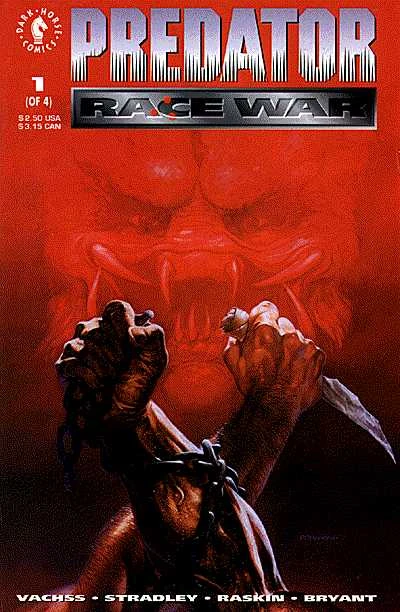
I’ve already blathered on at this blog about how I loved “Aliens: Hive,” so I won’t bend your ear yet again.  An example of another terrific limited series was “Predator: Race War,” which saw the title baddie hunting the inmates of a maximum security prison.  And yet another that I tried to collect was “Aliens vs. Predator: the Deadliest of the Species.”  The series had a slightly annoying title because of it was a lengthy tongue twister, but, God, was it fantastic.  I think I only managed to lay hands on four or five issues, but the art and writing were just incredibly good.

Take a gander at the covers below — all except the first are from “The Deadliest of the Species.”  I think they are some of the most gorgeous comic covers I’ve ever seen, due in no small part to their composition and their contrasting images.  And I’ve seen a lot of comic covers.  I think the very last cover you see here, for Issue 3, is my favorite.

I would have loved to collect all 12 issues … I still don’t know how the story ended.  (It was partly a mystery, too.)  But at age 19, I absolutely did not have the organizational skills to seek out any given limited series over the course of a full year.

In fact, this title may well have taken longer than that to be released … Dark Horse did have an Achilles’ heel as a company, and that was its unreliable production schedule.  Books were frequently delayed.  To make matters worse, these were a little harder to find in the back issues bins.  (I don’t know if retailers purchased them in fewer numbers or if fans were just buying them out more quickly.)

I suppose I could easily hunt down all 12 issues of “The Deadliest of the Species” with this newfangled Internet thingy.  But part of being an adult is not spending a lot of money on comic books.  Maybe I’ll give myself a congratulatory present if I ever manage to get a book of poetry published.  Yeah … I can totally rationalize it like that.


Aliens-Predator_The_Deadliest_of_the_Species_Vol_1_2

Aliens Predator 10

Aliens-Predator_The_Deadliest_of_the_Species_Vol_1_11

avp_deadliest_of_the_species_3