Tag Archives: Writer

The Galway Review publishes my new love poem, “The Beach House, Early Spring.”

I’ve been published in Ireland for the second time!  I am absolutely honored that The Galway Review today published my new love poem, “The Beach House, Early Spring.”

You can find the poem right here.

The editors also elected to list my poem as one of the journal’s Best of the Month for October 2023.

The Galway Review is the city’s leading literary magazine, boasting more than a half million online readers worldwide.

I am quite grateful to Managing Editor Ndrek Gjini and The Galway Review Board of Editors for allowing me to see my work appear in such a distinguished periodical.


“The Beach House, Early Spring,” by Eric Robert Nolan

“The Beach House, Early Spring,” by Eric Robert Nolan

1.

For a moment,
we are outside of Time.
The long shore road before us,
graying in a wraith of fog,
is immemorial slate,
the fog the same fathomless iron
as the primeval cloak which once
crowned and veiled a world of only oceans.

We arrive “off season.”
The houses around the one that we’ve selected
hold only unlit windows.
Oblivious in their square and bare-roomed silences,
they are hewn at angles from a sandy landscape —
monoliths of dark apertures.

We invade our own.
You glow along the curve of the walk
like a slowly circling star.
A key rattles and we
explore the rooms in succession.
We are interlopers,
newly inhabiting each,
announced in electric light.
Your laughter enchants them
back to their habit of residence.

“Look at the size of it!” you yell,
tossing your pocket’s contents
upon the kitchen counter.
There your coins arrange —
planets in an accidental cosmos.

The gulf of the parlor yawns.
The sofas are motionless hills.
The hall is a valley lined with the caverns of rooms.
The kitchen is vast.
The kitchen is a vast canyon where dust has settled.

Only an old clock is in motion –
the slowly rolling, backlit iron
of its hour hand, its minute hand
in its indifferent face;
giddy with our sense of space,
we do not slow to notice it.

The fracture in the sliding glass door at the rear
is the fissure of an opaque glacier.
Together we draw the door
to greet to roar of our purpose, for
we wanted to see the sea.

2.

It bellows over all the dark dunes —
booming in pendulum rhythm
under immeasurable night.
But I only pull you to me.
For me, there is more allure
where ambrosial strands will greet your skin in graceful eddies —
the waves of your hair down your neck.
Even at this vastness of sea and sky,
the implacable, sheer and unending
Glower of Creation, I favor
your warming skin so longingly that
the Infinite would rear and roar in envy.

We rush out,
to salt and sweeping winds,
heedless under heedless stars,
to the dun high dunes like heaps of cretaceous remains,
then, through the shadow-burnished breach
in their slumbering dim ellipses,
to the paradox of every beach —
the sand’s coarse silicon still
softens all our darkened steps to silence.

Here Existence shouts
the very Bark of Providence.
The sea is a flat dimension
of slowly rolling, moonlit, coldly undulating irons,
lashing shore in endless duel,
and throbbing, epochal pulse.

Between stars of an unrivaled
hardness and brightness,
we discern within the black
one color poured to another,
blue which fills with voids of driving violet,
and the moon’s own rounded border,
burning gold on silver-opal circle.

I pull you to me.
We spill across the sand as eagerly as surf.
You are the very lighted moon upon my skin.
The heat in you is undiluted stars.
All of space recedes in salience beside
the fragrance of the space behind your ear.
And your breath’s accelerando
is greater than the cadence of tide.

We are alone.
We are as rhythmic as the unseeing
and boundless and indifferent sea.

3.

We escape the notice of stars as easily
as we laze to delineate them –
lying on our backs, the backcloth
of galaxies flush in front of us.

We are white and linking figures on the shore:
you are a lucent pearl, and I
a dim, wan shard of jagged, broken shell.
The pearl of you is shorn to sheen
by the pressures of your depths.
And I remember my life before you
as a conch will remember the ocean floor–
caliginous illusive dream.

My body finds your own again.
My thumb draws in to trace
your concave, shining oyster shell
of starlit open palm.
The contour of your wrist, in light,
is lustered spiral cerith under moon —
in shadow, is tawn of junonia.

I tell you the ocean is paradox –
fixed and ever moving …
or remorseless memory
by confabulation changed.
Caressing the warmth of your palm, I tell you,
the ocean is a clock.
The collisions of its tides
are our common metronome.

Kissing my inner wrist, you opine
the ocean is a poet —
ever keeping meter. And
you giggle that it never stops.

We pause.
Then we sit, in colloquy,
cross-legged, unobserved
under glittering galaxies in
incomprehensible distances.
And I ask you whether we matter.

Time is endless,
exceeding even circumference of
its slow and sliding clock of circling stars:
the North Star is its center;
the arms of constellations are
its hour hands, its minute hands;
the arcs of stars advance it, stars
number our moments together,
so slowly that we won’t notice,
unless we dwell to examine
their ponderous momentum.

I say more.
This time it’s physics.
I worry over a kind of
special relativity —
when time speeds up when we’re together, our
sated, stationary closeness, is it
our ardor dilating time?
In our glad adjacency,
lovers’ lives will therefore contract;
all of our moments are shrinking.

If so, then, Love, I give you
all of my dwindling moments.
I give you
all of my rapiding hours,
my blithe pilgrimage for your white form,
my quickening existence in this
salt and starlit air, with these
smooth stones and sounds of ebbing water —
the receding endless melee of sea —
this stillness and sensation,
this coast where sky reels faster now.

4.

I sleep. In dream, the tide
is embryonic rhythm.

I wake, and the moon is in a different place –
higher over us, its shimmering eye in chaperone,
or intent upon its mirror – the shine in the sand —
the eased and willowy silver of you,
your luminous integer.

You tell me, “You went away,
for a little while.”
I ask you how long but you only
point to the movement of moon.

Sleepily, I ask you if
the universe is so large that no god could ever
pity the infinitesimal.
The math of it leaves us abandoned.
We are each diminishing concepts
when the light years reach ever farther
in our abstract contemplations –
those cold and compassless lengths in space.
And no god could ever love us any more
than you and I could pause in our keenness to love
two random grains of sand upon this beach.

I measure the stars.
I confide in you that at times
I imagine them all empty.
In my mind I will search them all
finding neither mother, nor father,
nor friends and other poets fallen silent.
Like a child, I am learning only now
how to love a universe
that even in my reverie is soulless.

You pull me to you.
You draw your alabaster palm
to the roughening coral of my cheek.
Your arms are whitened driftwood.
Your legs are lettered olive shells.
And your eyes are as full and smooth and dark
as umber, nearly weightless sea glass.

You draw my face to yours,
and press your hand to mine.
You kiss me, and whisper solipsism:
that the universe is only us —
our perceptions.
We need only to close our eyes
to extinguish it all, on our own, in an instant, and then
reverse the extinction by blinking
them open again.

And if we shut our eyes together, our hands pressed, you tell me,
then we are all there is in Time and Space.
No distances exist between our palms —
only the actions of atoms,
and their electrons in hastening orbit,
excited at greater temperature,
moving faster in their warmed adjacency, as we are.
“Ask yourself if that is all there is, and it will be.”

My eyes are closed, but I can feel you smiling.
The tide reduces to silence,
as a slowing iron clock now winding down,
and the warmth of your open palm is enough
to soften all the universe.

I want to hold you, hold this moment,
outside of time, forever, outside
of the vastness pressing down us,
as we warm one another, adjacent,
lest eons align to suffuse our skin
or endlessness slide through our irises,
lest the Vacuum arrange in our veins,
or distances invade our bones.

My heart is neither calm nor song,
nor tender look, nor mildness,
nor summer, nor stillness
nor ode’s serene device.

For you – the hushed and stormless all of you –
my heart is a hungry universe.
My heart is the same vast,
unknowing insatiety
that with measureless abandon
reels when you distract from it.

And I will love you, Dear,
not only here,
not only until the end of my days;
I will love you past all that which is.
I will love you
outside of Time.

© Eric Robert Nolan 2023

Dike_in_Frontignan_BW

Photo credit: Christian Ferrer, CC BY 4.0 <https://creativecommons.org/licenses/by/4.0&gt;, via Wikimedia Commons

“Where Would We Go?” by Eric Robert Nolan

Where would we go, you and I?
The sea which breathes, in aquamarine,
its rhythmic, salty epic at our ankles
and inundates a foam refrain,
over and over, in rolling green glass:
the tide — the oldest poem — an immutable meter preceding
words, or man, or even ears to hear?

The unvarying sea
takes no notice of poets —
you and I, ourselves inconsonant poems,
varying as all our kind are wont to do …
faithless at the foot of the green, returning tide,
both our lives arrhythmic and
bitter with metaphor.

Where would we go, asalam?
The staid and angled mountains, vaulting up?
Mountains are always odes. The miles of stone
which rise to cut their rival heavens
lance the air, and spin the winds to narrative.
Those winds were singing long before us,
will sing when we are gone.

The mountains will not know our names
even as we whisper one another’s,
or the rise of your breathing where we lay there —
the blithe and meadowed slope that will not blush beneath us,
where we are ribald lyrics, songs out of our lawless senses,
lascivious and nearly wordless.

Where would we go, my muse?
The river that rushes like a fugitive ghost
absconding with its own requiem?
Rivers’ roars are always dirges, for rivers run past
lives beside their banks. Lifetimes
are as seasons to them, always ending.

This timeless river
is unconcerned for poets
and will not slow to note us.
Only our own faces on its hastening, dim and opaque surface.
answer back our gaze. We are elegies, reflected
in heedless, racing waters moving on.

Stay with me, here, for now.
We have two temporary
yet temperate pages all our own
over which is the script of our ardor:
my gray-grizzled Irish cheek and your Iranian skin,
to read and study, see and know, slowly and tenderly, in this ordinary room,
in this little city, in this waning light, in this fleeting moment,
in these fleeting lives.

I am inelegant free verse, but you …
you are my perfect poem.
We will draw the sheets over us,
over our moving euphony,
and frame to evoke one another —
the rounded warmth of your white shoulder,
the cadence of my pulse.
We will hear one another, and speak
in sedulous repetition
the particular rhythm of each of our names,
measured in the meter of tremulous breath.

(c) Eric Robert Nolan 2022


Santorin (GR), Exomytis, Vlychada BeachDietmar Rabich / Wikimedia Commons / “Santorin (GR), Exomytis, Vlychada Beach — 2017 — 2999 (bw)” / CC BY-SA 4.0
Poetry, 2019

Hey, guys — if you happen to be amused by any of these poemy-type things that I repeatedly fumble at, you can find all of my 2019 publications right here:

Poetry, 2019


20180914_122602 (1) f

Tis’ the season.

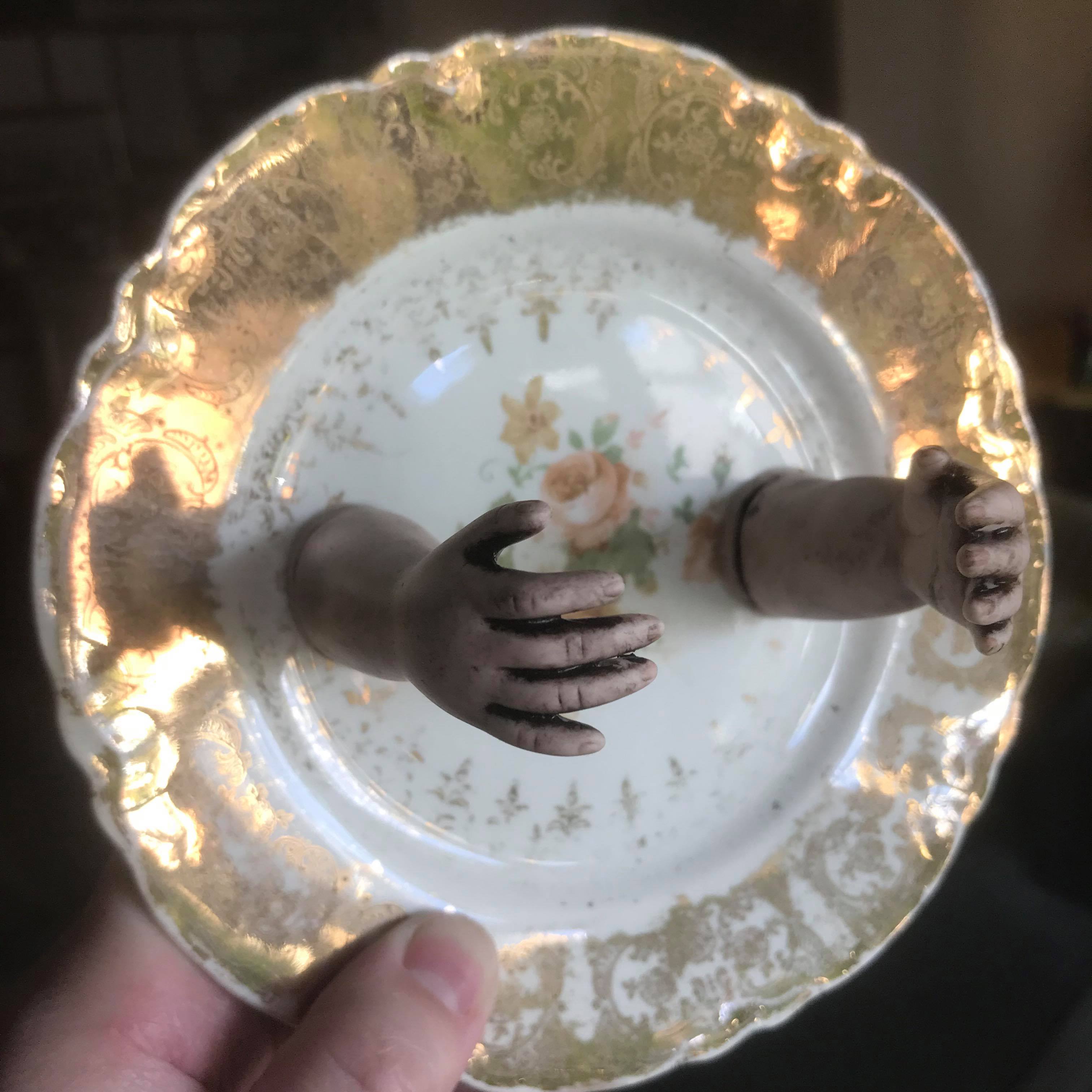
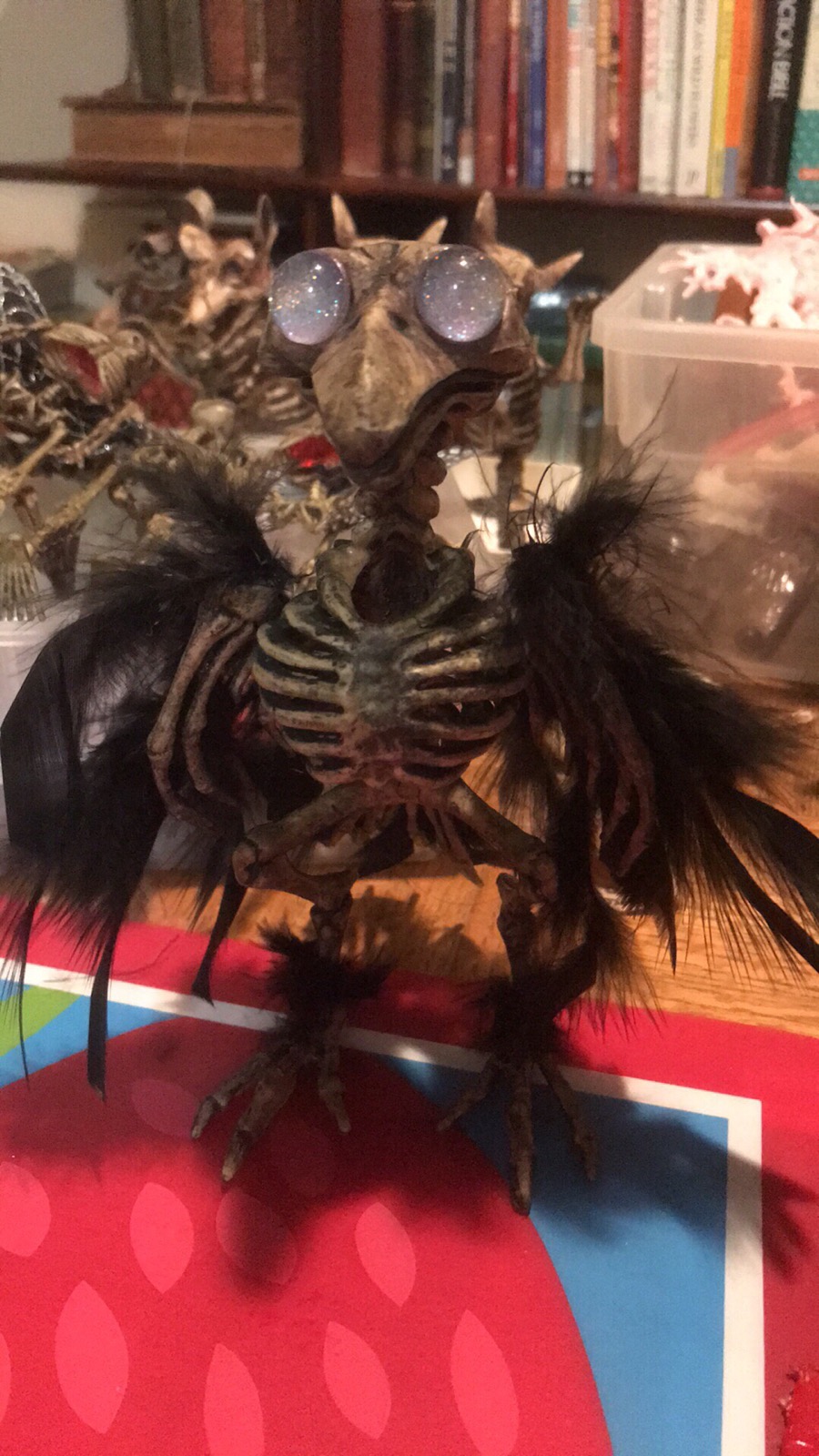
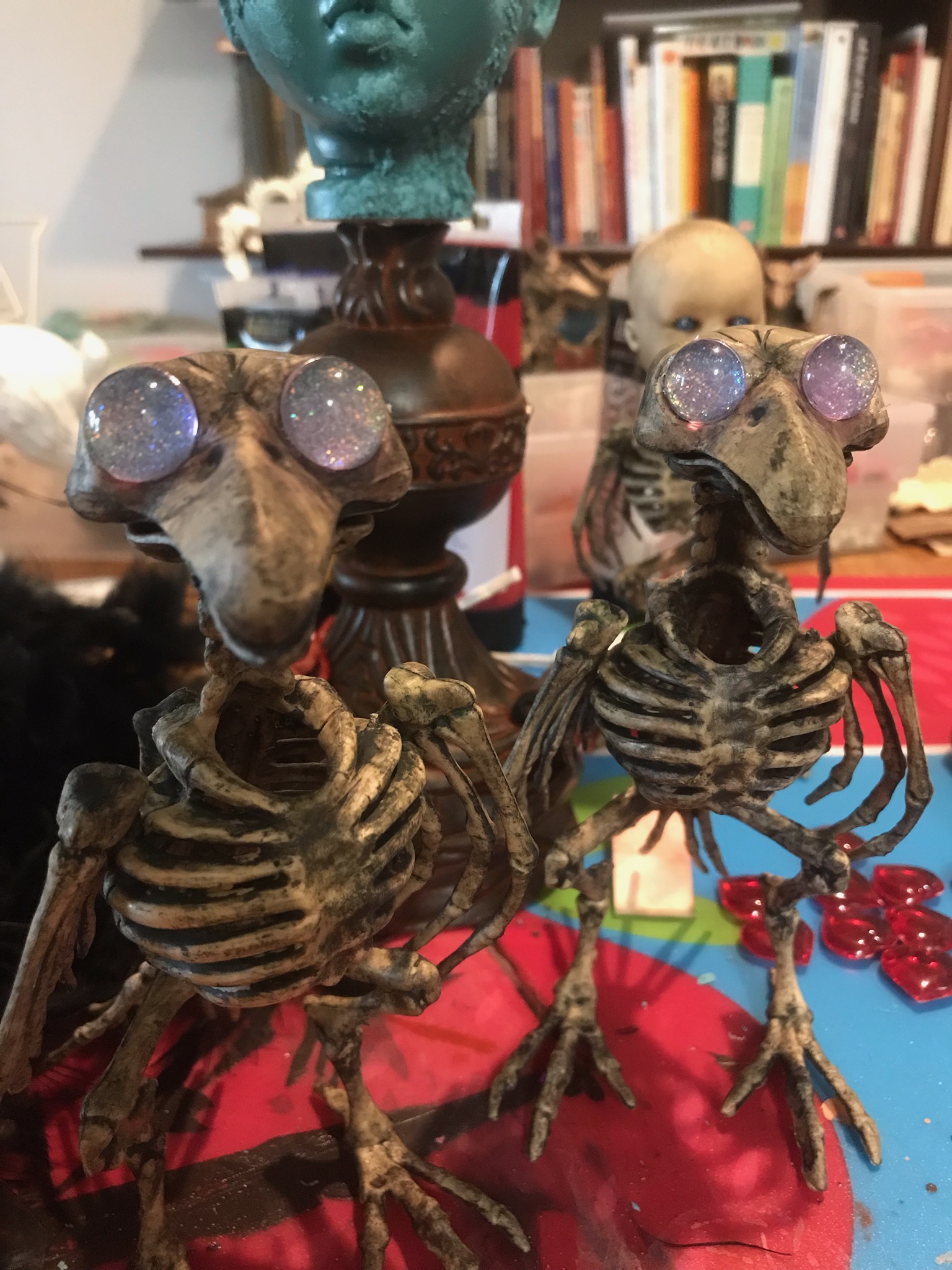
You know which one I mean.  Halloween 2018 is advancing on us like a creeping black cat.  I hope you guys are getting into the spirit.  I know a lot of you are already way ahead of me.

I know Emily E. James is.  She spends most of her time being a first-class editor (you can find her website right here), but she also finds time for her own unique brand of truly macabre handmade Halloween decorations.  As you can see, she is a sublimely talented woman (albeit one who is quite mad).

Emily has an Etsy store for her creations in the works.  I’ll post it here when it becomes available — lest the little infernal monsters find and haunt me.


43569417_911402375730751_778430459821424640_n

IMG_37841

IMG_37831

“Gonzalo,” by W. H. Auden (recited by Eric Robert Nolan)

“Gonzalo”

— from W. H. Auden’s “The Sea and the Mirror”

Evening, grave, immense, and clear,
Overlooks our ship whose wake
Lingers undistorted on
Sea and silence; I look back
For the last time as the sun
Sets behind that island where
All our loves were altered: yes,
My prediction came to pass,
Yet I am not justified,
And I weep but not with pride.
Not in me the credit for
Words I uttered long ago
Whose glad meaning I betrayed;
Truths to-day admitted, owe
Nothing to the councilor
In whose booming eloquence
Honesty became untrue.
Am I not Gonzalo who
By his self-reflection made
Consolation an offence?

There was nothing to explain:
Had I trusted the Absurd
And straightforward note by note
Sung exactly what I heard,
Such immediate delight
Would have taken there and then
Our common welkin by surprise,
All would have begun to dance
Jigs of self-deliverance.
It was I prevented this,
Jealous of my native ear,
Mine the art which made the song
Sound ridiculous and wrong,
I whose interference broke
The gallop into jog-trot prose
And by speculation froze
Vision into an idea,
Irony into a joke,
Till I stood convicted of
Doubt and insufficient love.

Farewell, dear island of our wreck:
All have been restored to health,
All have seen the Commonwealth,
There is nothing to forgive.
Since a storm’s decision gave
His subjective passion back
To a meditative man,
Even reminiscence can
Comfort ambient troubles like
Some ruined tower by the sea
Whence boyhoods growing and afraid
Learn a formula they need
In solving their mortality,
Even rusting flesh can be
A simple locus now, a bell
The Already There can lay
Hands on if at any time
It should feel inclined to say
To the lonely – “Here I am,”
To the anxious – “All is well.”


“school shooter,” by Eric Robert Nolan

Grendel’s mother wanted murder; but we all knew that,
you knew that just by looking at her:
the green and odorous skin like dark olive parchment over her cheeks’ low bones,
the blackening teeth where the stale blood caked
and dried in her receding gumlines
like burgundy ink on her molars and incisors,
and a blackening-scarlet
stain on her canines.

Remember when we first saw her —
her flaccid breasts like flour-sacks,
her womanhood a stagnant moss,
the cadaverous, driving
lime of her hips,
her labia in livid lines
of bitter water lilies?

Remember the rising, putrid moon of her —
her green, sour form arching over ours in her ascent,
burning up from the green lake, a gangrene flame from the brackish water,
her profane grin adorning her,
and algae tracing her lips?

Remember the wet weeds
trailing the viridian strait of her throat
like silt-laden necklaces,
and all the mud and water rolling off her knuckles?
The spoiled laurel of her sinewed shoulders,
her outspread arms and their
parody of embrace?
Remember her mocking our own mothers?
Her derisive voice was like
the crack of splitting emeralds, asking,
“Am I so strange to young eyes?”

Remember the boiling fat on her tongue and
her victims’ burning skin there?
The scalps she held in her upturned palms
were like watery garments.
Her talons were as black
as snapping-turtle shells.
We all knew at once that we were quarry.

Remember her
sorrel-colored cataracts?
Her eyes were as green seas
boiling under Ragnarok.
Remember their ruptured capillaries
like collapsing red galaxies?
Remember her very irises bleeding?

But what if evil appeared
not as the face of Grendel’s mother,
but, rather, the ordinary boy in her maw —
as unexotic and as common
as we are?
If we were boys and girls again
and bored in English class —
maybe at Beowulf’s strangeness,
or maybe the strangeness of Jung —
and he were next to us,
with neither green skin
nor blood along his molars,
if he wanted murder, could we tell?
His face was as a clock’s face — prosaic and round.
Neither silt nor sinew lined his frame.
His gaze did not depict a grisly cosmos;
no galaxies had hemorrhaged in his eyes.
Would the difference be perceptible there
between wanting to kill time
and wanting to kill ten?
Would we know that we were quarry?

Tonight we’d like to believe
that the young are strange to old eyes
for any resemblance would kill us,
as Medusa’s own face was fatal
to her upon the shield.
As adults, we understand
that Beowulf is only fable —
but that Jung’s reservoir
is a fatal green lake.
Better an Idis than likeness —
if a monster looks like us, it stands to reason
that maybe he could BE us,
we’d nag in our primordial minds.
It might make us envision
a kind of reverse baptism:
our own plain faces
cresting the flat, green waters
to glide across the lake,
but bearing the eyes of strangers,
emerald and seething,
irises bleeding,
crushed green reeds in our jaws, like captive verses …

And we could not suffer the thought.
Better to be quarry, or be drowned.
We’d know that, and so
we would run mad, we would run weeping, we would run forward and ravening to the green, forgiving lake,

where we could sink like Beowulf,
and our silenced lungs would fill with water.

                                                            (May 19th, 2018)

(c) 2018 Eric Robert Nolan


franz-von-stuck-head-of-medusa-1892

More stories from Eric Robert Nolan

If you happened to enjoy “Shine Now, Fiercely, Forever” last week, then stop by the “My stories” section right here at this website.  It has links to all of my published stories, and some of them can be read for free:

https://ericrobertnolan.wordpress.com/stories/

Publication notice: “Shine Now, Fiercely, Forever” featured at The Bees Are Dead!

I am truly honored today to see my colleagues over at The Bees Are Dead feature a new short story of mine.  Its title is “Shine Now, Fiercely, Forever,” and it might be the darkest thing I’ve ever written.  It portrays a married couple constructing the world’s first functioning time machine — and then discovering what are possibly the worst possible consequences of such a device malfunctioning.

Thanks so much to Philippe Atherton-Blenkiron for allowing me to share via The Bees Are Dead, his online magazine for dystopian prose and poetry!  I am grateful indeed for the opportunity he’s afforded me.

“Shine Now, Fiercely, Forever” can be found right here:

http://www.thebeesaredead.com/prose/shine-now-fiercely-forever-eric-robert-nolan/

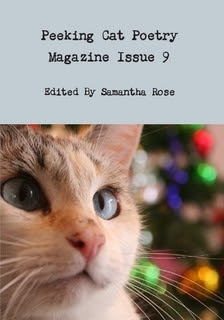
Peeking Cat Poetry Magazine features “Amanda” and “Amanda II, A Haiku”

Peeking Cat Poetry Magazine released Issue 9 tonight; if you’re so inclined, you can peruse my poems, “Amanda” and “Amanda II, A Haiku.”  (You can find them on pages 16 and 20, respectively.)

You can actually download the magazine for free right here:

http://www.lulu.com/shop/samantha-rose/peeking-cat-poetry-magazine-issue-9/ebook/product-22468453.html

Or, if you’d like to have a hard copy of Peeking Cat delivered to you, you can purchase it here:

http://www.lulu.com/shop/samantha-rose/peeking-cat-poetry-magazine-issue-9/paperback/product-22468430.html

Once again, thanks to Peeking Cat Poetry Magazine for allowing me to have my work included among that of so many talented authors.


unnamed