Tag Archives: 2017

A short review of “War for the Planet of the Apes” (2017)

Like the two films preceding it, “War for the Planet of the Apes” (2017) is an intelligent, well rounded science fiction thriller.  The newest “Apes” series has been leagues ahead of the campy late-1960’s original films, and of course Tim Burton’s bizarre 2001 remake.

There is more going on here than a simple “apes vs. humans” tale.  Nor does it engage in simplistic moralizing, in which the innocent animals must escape from their human oppressors.  There’s a hell of a lot of moral complexity — something noted by the many positive reviews for the film.  One of the things that I liked the most was a compelling new surprise plot element, even though it approaches deus ex machina territory.  I won’t spoil it here, but it’s bleak, it’s frightening, and it makes you think.  Given the new information one character explains to another … it’s hard to say who is the bad guy, isn’t it?  How this plot element plays out is damned effective too.

This movie also superbly renders non-human characters — both in terms of its smart script and its special effects (a combination of both CGI and human actors).  I was greatly impressed at the detailed and lifelike facial expressions.

The action sequences were well executed, too, and the film had an epic feel.  (Although this would be a decent conclusion to a trilogy, filmmakers Matt Reeves and Martin Bomback have gone on record stating they wouldn’t be averse to future sequels.)

Still, I must confess that my attention sometimes wandered.  I think the pacing was a bit off.  It also didn’t help much that the conclusion of the final action set piece was spoiled by one of the film’s trailers.  (What the hell were they thinking?  Who makes these decisions?  Was there any backlash from fans who didn’t want advance knowledge of the film’s ending?)

Although this was an exceptionally well developed film, I just can’t give an unusually high rating to a movie that didn’t always hold my interest.  I believe, therefore, that I’d rate this an 8 out of 10.


war-for-the-planet-of-the-apes-poster-380x600

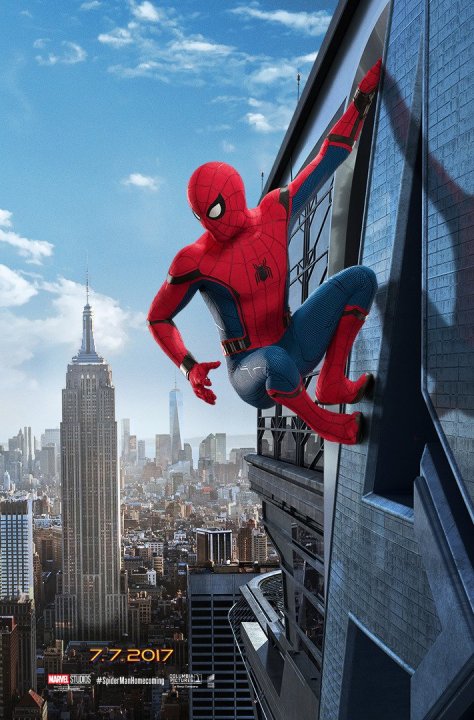
A review of “Spider-Man: Homecoming” (2017)

“Spider-Man: Homecoming” (2017) isn’t a bad movie.  To the contrary, it’s a very good one — I would even rate it a 9 out of 10, if a little reluctantly.

The action, humor, surprises and special effects are all top-notch; it’s got a slew of fun Easter eggs and great continuity within the Marvel Cinematic Universe; and Michael Keaton hits it out of the park as the story’s villain.  (As Ed Harris did recently with HBO’s “Westworld,” the sublimely likable Keaton really surprised me with how he could become so intimidating.)  Furthermore, the screenwriters wisely omit another redundant re-telling of the web-slinger’s origin.  (Even a die-hard fan like me is sick of seeing or reading about it.)

I think your enjoyment of this movie might vary according to what you want Spider-Man to be.  This isn’t a movie in which Peter Parker or his alter ego stand out as his own man (despite its plot resolution’s heavy-handed efforts to tell us that).  I submit that it’s fairly undistinguished as a standalone superhero film —  it feels like an ancillary, companion film to the “Avengers” movies, including last year’s de facto installment, “Captain America: Civil War.”  Indeed, fan-favorite Tony Stark is “Spider-Man: Homecoming’s” most significant supporting character — far more than any of the many friends, family, love interests or villains that have long inhabited the iconic hero’s mythos.  Peter’s primary motivation throughout the movie is his desire to become an Avenger, like a normal kid would aspire to the varsity football team.  Many of his powers stem from a ultra-high-tech costume designed and given to him by Iron Man; it even has an advanced A.I. that is a femme fatale equivalent of J.A.R.V.I.S.  (Fun fact: that alluring voice belongs to none other than the alluring Jennifer Connelly.  The actress is the wife of Paul Bettany, who is the voice of J.A.R.V.I.S. and then the actor portraying The Vision.  And Connelly herself played the love interest of 1991’s mostly forgotten “The Rocketeer,” a World War II-era hero with the a similar character concept to Iron Man.)

I was a big fan of Spider-Man in the 1990’s, and, believe me, the ol’ web-head did just fine with his own powers, intelligence and character — and without any sort of “internship” with Iron Man, either metaphorically or otherwise.  He was also a far more popular character with readers.  I was buying comics regularly between 1991 and 1996 — while Spider-Man books and merchandise were everywhere, I don’t think I ever remember seeing an “Iron Man” comic on the racks at my local comic shop.  I kept thinking inwardly of Spider-Man during this movie as “Iron Man Jr.,” and, for me, that wasn’t a good thing.

I also found myself musing during the film that this felt like “Spider-Man Lite.”  While “Spider-Man: Homecoming” was fun, it doesn’t have the depth, character development or gravitas of the Sam Raimi trilogy.  (Yes, I even liked the third one, despite its bizarre flaws.)  I know that critics are praising the movie’s lighter tone, and I realize the need to avoid a simple rehash of the Raimi films.  (Nobody would want that; we can rightfully expect more from the excellent MCU.)  I actually prefer the Raimi films, though.  While Tom Holland might be the better Peter Parker (Tobey Maguire was a strange casting choice), the Raimi movies were more … heartfelt.  They were an earnest exploration of the Spider-Man of the comics, and they felt … truer.   “Homecoming,” in contrast, is yet another cool installment in the “Avengers” series.  “Spider Man 2” came out 13 years ago, and I can still remember how that movie made me feel — not to mention how its sheer quality vindicated “comic book movies” like no other film before it.  This new movie will not be memorable that way.

Anyway, although my criticisms above are obviously lengthy, please know that this is only because I love the source material so much — and we comic book fans have a tendency to analyze.  I certainly enjoyed the movie, and I’d cheerfully recommend it.  (Note my rating.)  The MCU continues to entertain with quality movies; its consistency, even with its expanding group of ongoing Netflix series, is kind of astonishing.

Go see this.  You’ll have fun.
 

Spider-Man2

A few quick words on “The Rogue Cut” of “X-Men: Days of Future Past”

If you are a die-hard “X-Men” fan, then I do recommend checking out Bryan Singer’s non-canonical “The Rogue Cut” of “X-Men: Days of Future Past.”  You might enjoy it just for its novelty — it actually is a very different version of the original movie.  It has a lot of scenes that are either entirely new or shot and edited quite differently.  (The most notable difference, obviously, is an entire subplot concerning the rescue of Anna Paquin’s Rogue, which was deleted from the 2014 theatrical release.)

I get the sense that this will come across as a better film to “X-Men” purists.  There is greater attention to a multitude of characters, far more character interaction, and greater detail about the apocalyptic future segments.  (I myself was happy to finally figure out why the dystopian mutants were housed in such a strange looking building.  It turns out they were hiding in a Chinese temple as part of an ongoing global evasion strategy.)  “The Rogue Cut” also has greater continuity with more of the prior films — it feels integral to the films’ ongoing mythos, and less like a standalone adventure.

But “The Rogue Cut” might not be better at pleasing general audiences.  It clocks in at just under two and a half hours, and the overall result did feel far slower to me.  There is a reason why movies are edited down — their unabridged versions have problems with pacing that really can affect the average viewer’s enjoyment.

I will also point out that this version of the film fails to rectify what I’ll reiterate is the theatrical version’s biggest story flaw — why would the shape-shifting Mystique be the key to developing the Sentinels power-stealing technology.  Why not the power-stealing Rogue herself?

Anyway … speaking of what is canon and what is not, there is a damned interesting fan theory floating around about the “X-Men” movies following this year’s release of “Logan.”  That movie stood out for many reasons, but two in particular are relevant here.  The first is the radical change in its tone and storytelling, which makes it feel like it takes place in “the real world.”  The second is its odd, apparently meta-fictional inclusion of the “X-Men” comics themselves within the story.  (Copies of the comic books are discussed by the characters, and even serve as an important plot element; Wolverine complains that they are horribly inaccurate.)

Many fans are having fun wondering if there has, in fact, been only one canonical “X-Men” movie — and that is “Logan” itself.  The brutal, subdued reality of “Logan” alone is “the real world” of the X-Men; all of the fantastical prior films (which occasionally contradict one another anyway) are merely the stories inside the last movie’s comic books.  I thought that was pretty damned clever.


newcut2_by_joseelizondo-d901c11

“A Republic, if you can keep it.”

Happy Independence Day, all!  Enjoy any celebrations you might attend, and please be safe.

The quote above is attributed to Benjamin Franklin.  Upon exiting the Constitutional Convention in 1787, he was asked by a bystander what form of government the delegates had created:

“Well, Doctor, what have we got—a Republic or a Monarchy?”

“A Republic, if you can keep it.”

His reply was documented by Dr. James McHenry, the delegate from Maryland.

The imperative implied in Franklin’s words is the same as what Thomas Jefferson expressed when he warned us that “The price of freedom is eternal vigilance.”


120504-M-IX426-237

Photo credit: By U.S. Department of Defense Current Photos (120504-M-IX426-237) [Public domain], via Wikimedia Commons.

A few quick words on “47 Meters Down” (2017)

Yes, “47 Meters Down” is silly in places, and I don’t think it will ever be held up as an example to students of good screenwriting.  But I can’t slam any horror-thriller that scared and entertained me.  And the sharks here (which were surprisingly well rendered by CGI) made me jump a few times.  Furthermore, there are a couple of surprises late in the story, and I thought that one of them was wonderfully well executed.

This movie actually reminds me a little of last year’s “The Shallows.”  Neither movie is 1975’s “Jaws,” but neither pretends to be.  They’re both perfectly serviceable monster movies that present horror movie fans with a great way to kick off the summer.

I’d rate this film an 8 out of 10 for being a fun, if forgettable, shark flick.


poster-large

Botetourt County, Virginia, June 2017

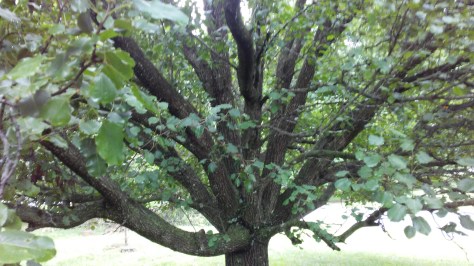
At left is a Bradford Pear tree, at right is a Cleveland Pear.

20170617_113337

Bradford Pear.

20170617_113420

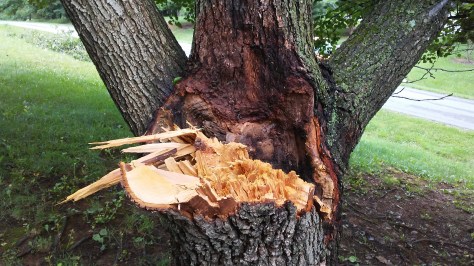
This Bradford Pear tree was felled by a derecho windstorm.

20170617_113548

20170617_113641

Termites?  A mutant steel-billed woodpecker?

20170617_113634

I have no idea what this … organism is, but it looks like the inside of a dog’s ear.

20170617_142410

20170617_142424


A short review of the premiere of “The Mist” (2017)

I couldn’t help but feel just slightly disappointed by the premiere of “The Mist” (2017).  It wasn’t bad … it just wasn’t as amazing as its trailer made it look.  I’d rate it a 7 out of 10.

The first episode’s horror elements felt rote, rushed and cheesy.  The pre-credits teaser was nearly campy.  Director Adam Bernstein just isn’t Frank Darabont.  (Curiously, each episode seems to be helmed by a different director.)  And what seems like “The Mist’s” milquetoast main protagonist is played somewhat anemically by Morgan Spector.

Still, the show displays some promise.  Instead of rushing straight into its otherworldly-monster MacGuffin, it goes to great lengths to set up some interesting human drama, and it mostly succeeds.  Besides Spector’s ostensibly likable Dad, the characters felt fresh and interesting.  (And regarding that human drama?  I strongly suspect the individual accused of the crime here is not the actual perpetrator.  That’s what the clues are telling me, anyway.  It would be devilishly clever, I think, if his accuser turned out to be the one guilty.)  “The Mist’s” attention to characters here is something of which I think Stephen King would approve.

The show also seems pretty ambitious.  It places its diversity of characters in a number of locations throughout its small-town setting, and a couple are embroiled in some kind of interesting conflict even before the titular mist arrives.  For just a single episode, it feels tightly plotted.

Anyway, if you’re curious about what the mist really is … there is an explanation in King’s source material — and I’m not talking about only the vague allusions in the novella of the same name.  Die-hard King fans know it was further described in his “The Dark Tower” series.  It’s been named as “todash space” by the denizens of one of King’s many worlds — it’s a monster-filled limbo that falls between myriad parallel universes: http://stephenking.wikia.com/wiki/Todash_space.


17917318_1630442733637084_5273923078462957098_o


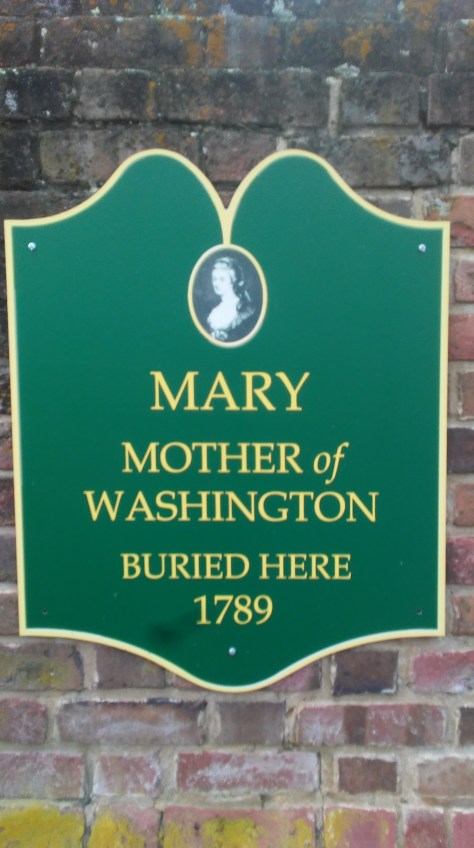
Mary Washington’s grave and the Gordon Family Cemetery, Fredericksburg, VA, June 2017

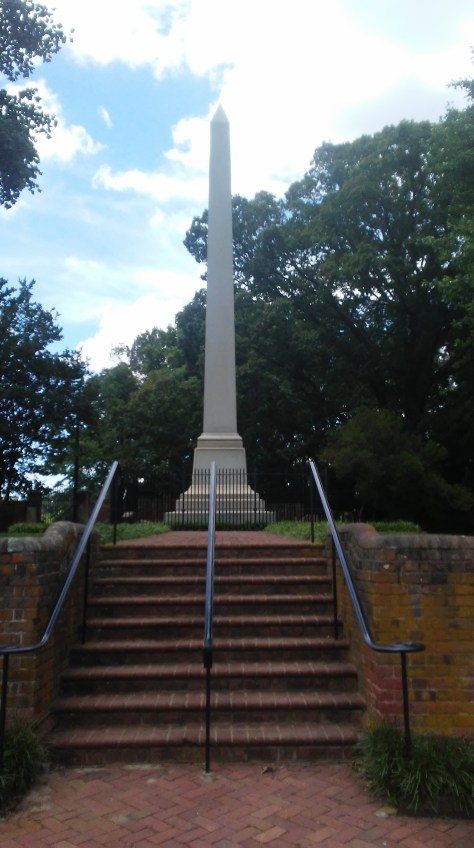
The entrance to Kenmore Park/Memorial Park on Washington Avenue.  The obelisk itself is the grave of Mary Washington, George Washington’s mother; right behind it is the Gordon Family Cemetery.  Although George’s father died when he was just 11 years old, his mother saw him ascend the presidency.  She died in 1789.

20170608_124317

20170608_124414

20170608_124436

20170608_124500


Looking east from the park’s entrance, you can see First Christian Church, on the intersection of Washington Avenue and Pitt Street.

20170608_124443


Washington Avenue looking south.

20170608_124519


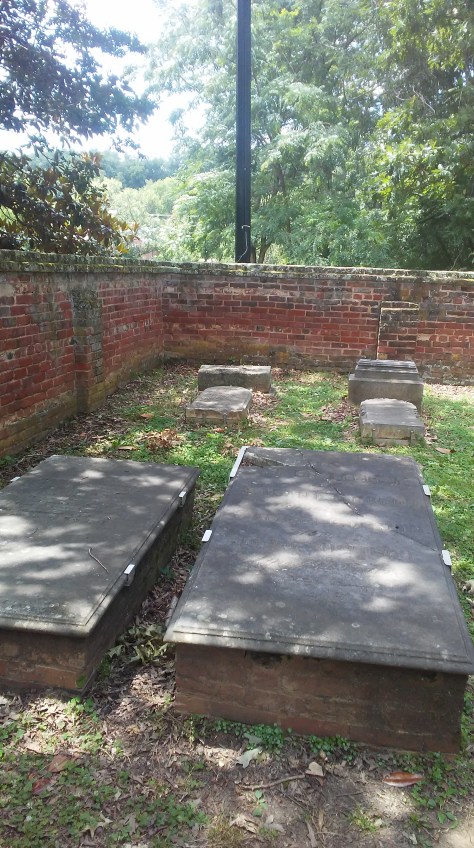
Gordon Family Cemetery.  The Gordons lived at Kenmore; the gravestones date from 1826 to 1872.

If you were a Mary Washington College student returning from a party downtown in the 1990’s, you could pass the cemetery on your way back to campus at night.  I saw a group of high school kids inside the cemetery one night; they scattered in a panic when they realized I’d noticed them.  (To my knowledge, no Mary Wash kids were involved in shenanigans like that here.)  I believe it is illegal to enter a cemetery like this at night … and I have it on good authority that Southern cops take such an offense very, very seriously.

20170608_124556

20170608_124605

20170608_124610

20170608_124628

20170608_124631


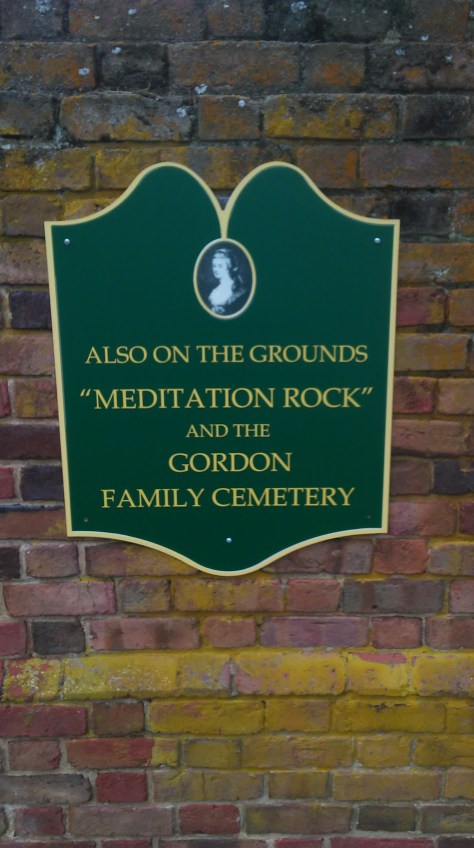
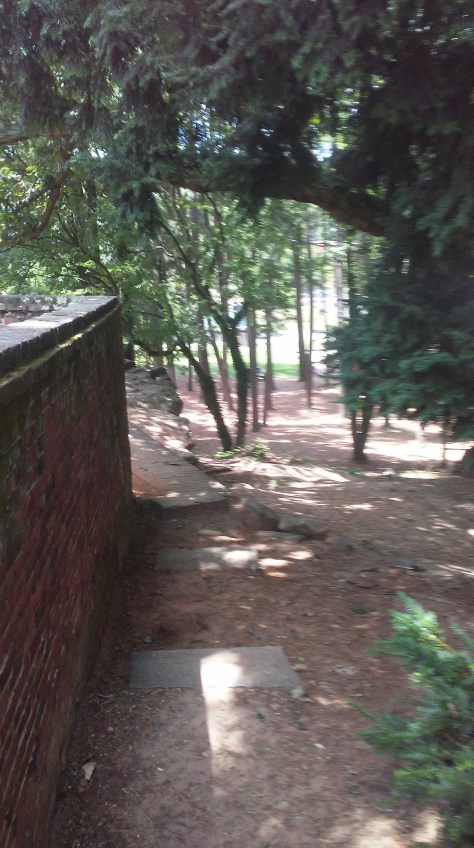
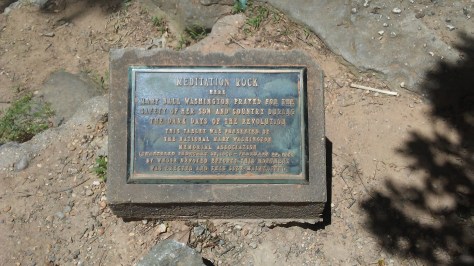
Behind the cemetery is Meditation Rock.  This was an occasional destination for college students out for a walk.  Shortly after I arrived at Mary Washington in 1990 from New York, a patient group of upperclassmen “adopted” me and kindly resolved to keep me out of trouble.  (One of them is still my “big brother” today.)  This is one of the first places they showed me when they gave me a tour of the town.

20170608_124701

20170608_124714


Am I a weird guy if I suggest that images of Meditation Rock can have Freudian undercurrents?  Is that wrong?  There is a whole “Picnic at Hanging Rock” vibe here.  (The sad thing is, I was actually studying Freud at about the time I first saw it, and it never occurred to me then.)  The juxtaposition with the nearby images associated with death and godliness is aesthetically striking.

20170608_124717

20170608_124723

20170608_124739

20170608_124750

20170608_124829


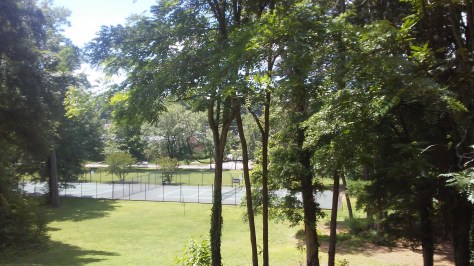
The Kenmore Apartments are still across Kenmore Avenue on the other side of the park.

20170608_124842


Mary Washington College, Fredericksburg, VA, June 2017 (6)

Pictured are Willard Hall, The Fountain, Woodard Campus Center and New Hall.

*****

My cell phone’s battery died as my Alumbud and I reached the northern end of Mary Washington College’s campus earlier this month.  Hence, there are no pictures of the truly massive Simpson Library/Hurley Convergence Center.  (I swear to you, that entire complex is about the size of the goddam S.H.I.E.L.D. Helicarrier.)


Willard Hall and The Fountain.

20170606_193326

20170606_193337


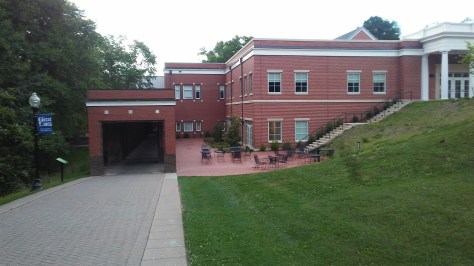
Woodard Campus Center.  I don’t remember calling it that when I went to school here in the early 1990’s.  Wasn’t it just “The Student Center?”

20170606_193432

20170606_193454

The student mailboxes.

20170606_193517

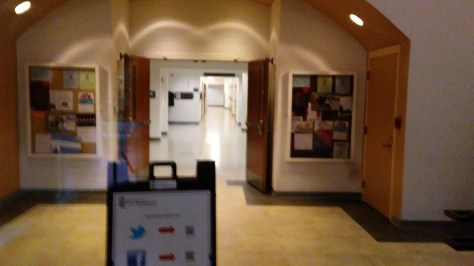
Inside Woodard.  The Eagle’s Nest would be down and to the left.  Upstairs was where the fall and spring formals were held.  Those were significant social events back in the day.

20170606_193553

I thought this was nice — I’m guessing it’s probably a product of the campus-wide remodeling project.  And it has the college’s correct name!  Beyond it is Seacobeck Dining Hall.

20170606_193535

The renovated outdoor deck, another apparent feature of the remodeling project.  I much prefer the unenclosed split-level deck that I remember.

20170606_193631


New Hall, old man.  My battery failed also before I could get pictures of the nearby light pole and the Fredericksburg municipal water tower, both of which I climbed on a dare, back in 1994 when I went through my “Spider-Man” phase while residing here. (That’s my senior year dorm room window behind me.)

20170606_193954

“The Bridge!”

20170606_194104


Mary Washington College, Fredericksburg, VA, June 2017 (4)

Pictured is Bushnell Hall at Mary Washington College in Fredericksburg, Virginia.  I lived here during the 1990-91 school year.  It was a freshman dorm then; I don’t know if that’s still the case.

I arrived here just before my 18th birthday; this was the first place I ever lived away from home.  I have never admitted it until this moment, but I was terrified watching my mother’s car pull away after I unloaded the last of my things.  That terror lasted … two hours?  Three?  After my first dinner with the other Bushnell kids at Seacobeck Dining Hall, Mary Washington College felt goddam perfect.  I never wanted to leave.

20170606_192711


My dorm room was on the bottom floor, second from the right in the picture below.  It was a suite — there were two rooms connected by a small bathroom.  And there were six 18-year-old boys living there — yes, that means three to a room.  Good lord, those were close quarters.  We were awakened twice a week by the BEEP-BEEP-BEEP of the garbage truck reversing to empty a dumpster outside our window.  And this was in a room without air conditioning, in Virginia, where teenagers were experiencing college-level academic stresses for the first time.  I helpfully eased tensions in the suite by playing Depeche Mode’s “Policy of Truth” 3,043 times.  The other five guys LOVED that.

There were even good-natured jabs connected with the North and the South.  I habitually and dryly referred to one of my suitemates as “South Virginia;” he addressed me just as dryly as “Long Island Piece of Shit,” (or just “L.I.P.S.,” for short).  He also took to calling me “Urban Spillover,” an appellation he derived from one of Dr. Bowen’s “Geography of North America” classes that mentioned Long Island.  For some reason, the latter nickname absolutely felt more pejorative.

Seeing those double white doors beside my room below, and that steep hill in the following photos, will always remind me of my 18th birthday.  A group of first-floor guys and fourth-floor girls had gathered inside that door just after moving in during the August of 1990, before classes started.  A polite debate stirred there about whether opening those doors would set off the fire alarm.  (They were clearly marked “Fire Doors” by an electric sign but … the LIGHT wasn’t on in the sign.  And surely the administration wouldn’t require the guys on my floor to walk up an entire flight to the lobby just to exit the building, right?)

Without a word of warning, one of the first-floor guys spontaneously decided to test this theory by just blasting right through it.  (No, it WASN’T me.)

The fire alarm went off.  Everyone panicked.  The guys and girls all shot down the hill outside Bushnell after the guy who’d triggered the alarm, and we all ran … right off campus.  We didn’t stop running until we’d reached somewhere along William Street, I think.

But not all of us escaped without injury.  One of my roommates was a tall, burly guy from right there in Fredericksburg, and he slipped in the sand and loose gravel that characterized that hill during that long ago August.  I still remember that dull, loud, discordant thump-and-rattle as his body hit the slope, while my own lungs were pounding.  When we reached the spot along William Street where our panic finally subsided, we all turned and gaped at his wound.  One of his legs had become a sepia Monet of sand-encrusted blood.  There were still pebbles clinging there, I’m sure of it.

He took it like a trooper.  I guess … he just walked it off.  And we walked around the ENTIRE town.  We were scared to return to campus, what with images of arrest and expulsion dancing in our teenage minds.  (We all might have overreacted a little.)  So we went on a truly lengthy hot summer trek that circled all of the historic downtown area.  (I think we wound up at Carl’s Ice Cream on Princess Anne Street at some point.)

That was really when I saw the City of Fredericksburg for the first time.  I remember thinking that the South seemed like some other world — or maybe the same world, but 100 years ago.  And I don’t mean that in any negative sense.  It genuinely confused me that this town was called a “city,” but it just seemed idyllic and old fashioned and beautiful.  I’m not sure if the average Fredericksburg resident realizes this, but their city indeed makes an impression on newcomers.

Somewhere along the way, I finally let it slip that the day was my birthday; I think heat exhaustion influenced my usual reticence on the subject.  A couple of the girls stole away to a card store on Caroline Street, I think, and bought a card for me.  My new friends all signed it for me upon our eventual return to Bushnell Hall that day (which was thankfully not occasioned by even a mention of the fire doors).  I went to bed that night thinking that my new friends were a pretty decent group.

Anyway — more on my roommate’s injury … he was a bit of an eccentric guy, and one of his eccentricities was that he did not like to go to the Campus Health Center.  He cleaned his long leg scrape himself, and then … bandaged it with duct tape.  That’s right — duct tape.  He’d apparently brought some along with him as an incoming freshman, just in case of an emergency.  You can’t say it was a needless precaution — here he was, using it in lieu of bandages.

He walked around campus like that for a while.  He looked a lot he was wearing part of an extremely low-budget “Robocop” Halloween costume.  I honestly don’t know what transpired when it came time to remove the duct tape, and I’m not sure I want to.

You can’t make this stuff up.

20170606_192055

20170606_192505

20170606_192424


This the dorm’s south side.  If you face Bushnell looking north, the southern cap of the rectangular campus will be at your back.  Today, it is is one the last places of the main campus’ 234 acres that remains undeveloped.

I’m not sure if there is any connection here, but there is a large mound of dirt among the trees and ivy that was rumored to be the remains of a Civil War fortification.  It makes sense — that hill commands a view of the city; that’s why I used to go there to have my once-a-day Newport menthol cigarettes around dusk.  And in the Nineteenth Century, before William Street’s more modern buildings were erected, I’ll bet you could see Marye’s Heights and the key sections of Sunken Road where the Battle of Fredericksburg raged.

I chatted with a girl on the steps of Bushnell once who told me she’d spoken with the ghost of a Civil War soldier.  She actually carried on a brief conversation with him.  She re-enacted the exchange after a some urging from me, but I wound up giving her story little credence.  I didn’t exactly believe in ghosts, and she sounded like an actress confused about a role.  (I wasn’t sure why her Confederate soldier would speak with a British accent.)

20170606_192538