You are not “an enemy of the American people.” Nobody sane actually believes that. (And no sane president would say it.)
The people who make this claim that are the very same poorly educated whites and insecure, blustering religious zealots who put the dangerous imbecile in office (with a little help from America’s actual enemies, in Russia).
They don’t want their leader held accountable. They would vastly prefer that the free press be censored so that he is portrayed only in a positive light. They would rather see the president have the same rigid controls over the media as the vicious dictators abroad who he fawns over. (The man consistently uses the adjectives “strong” and “beautiful” in connection with Vladimir Putin and Kim Jong Un — you don’t need to be a Freudian to see his adolescent infatuation with homicidal strongmen.)
I honestly believe that even Trump’s supporters, on some level, are embarrassed at the words that come out of his mouth. The man is a train wreck. As of this writing, the president just today boasted about “a beautiful letter” he received from Kim Jong Un — and he seemed to comment that he would prohibit the CIA from spying on Kim. In a separate news item, Trump said that he would accept foreign help in the 2020 presidential election. (That second item broke less than an hour ago.)
It is easier for Donald Trump supporters to believe that the news media is a sprawling conspiracy than it is to admit the truth — that their anointed leader is a moron. It’s a very old joke, but I’ll resurrect it here anyway — denial isn’t just a river in Egypt.
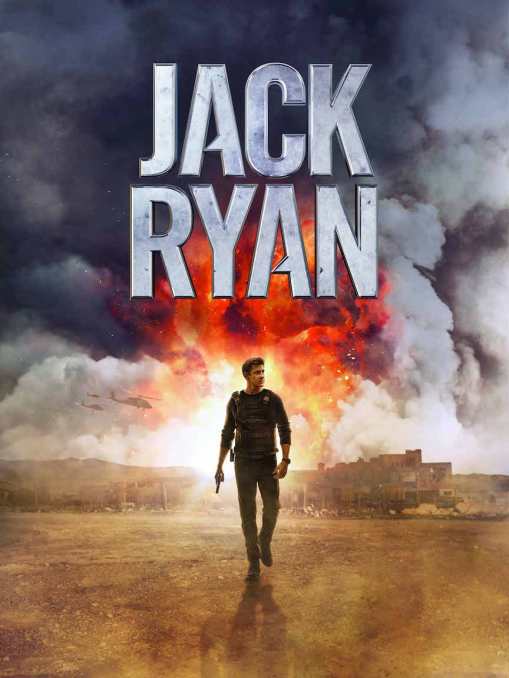
I didn’t quite love the first season of the “Jack Ryan” television series, but I still really, really liked it. It’s a decent adaptation of Tom Clancy’s source material, albeit a very loose one. (And that’s just fine — we already have a number of excellent films that closely adapt the events of the books; we don’t need another methodical retread of the author’s novels.) I’d rate this an 8 out of 10.
There are some narrative weaknesses, particularly in the show’s failure to sustain tension between its episodes. And there are some surprise plot developments that the show telegraphed a bit obviously. (I usually don’t pick up on these things, but even I saw the clues.) There is also a subplot involving a drone operator that is largely unnecessary … some viewers will find it interesting while others will not.
“Jack Ryan” also suffers just a little in comparison with the Audience network’s superior “Condor” (2018). That excellent show covered much of the same subject matter, with its own ordinary CIA-analyst thrust into deadly game with terrorists. Season 1 of “Condor” was better written, boasted an amazing cast, and was far more frightening.
John Krasinski does a good job as the title character. I’ve always thought that this character would be tough for an actor to play, simply because he is so consistently nondescript. (The whole character concept is that he usually appears to be an especially bright but otherwise ordinary civil servant … his background as a United States Marine and his patriotism and courage aren’t things that he advertises.) Krasiniski’s Ryan is closer to that of the books than the version we see in the Harrison Ford films. I love Ford as much as the next person, but his interpretation of the character was too a bit too meek and diffident for me. That wasn’t quite the Jack Ryan that Clancy created.
What’s strange about the show is that it truly shines when deviates widely from the source materiel — especially in the character of Jim Greer. He is played to perfection here by Wendell Pierce, and he is no longer the gentle, wizened father figure that we saw in his counterpart from the books and movies. Nor is he a minor character — Pierce’s Greer is a gruff, pissy operations man fresh off of an ominous and unfair demotion, who shoots and runs right alongside Ryan when the bad guys attack. It sounds preposterously stupid. But … it works — largely, I think, because of Pierce’s talent. He’s a good enough actor to sell the idea and he invests Greer with a kind of perpetually disgruntled, antisocial charm. I honestly would continue watching this show if it focused on him as the main character.
HBO’s “Chernobyl” (2019) is … flawless, as far as I can tell. I can’t name a single criticism I have of its writing, directing or performances. It is among the best miniseries I’ve ever seen, and I don’t hesitate to rate it a 10 out of 10.
I can’t comment with any credibility about its historical accuracy, of course. I know that the character of Ulana Khomyuk (wonderfully played by Emily Watson) was a composite meant to represent a number of scientists responding to the world-changing 1986 nuclear disaster; HBO notes this in its closing notes of the last episode. But, to an average viewer like myself, the show certainly felt accurate — not once did I pause to remember that I was watching a TV show, and not getting a real-life glimpse into the closing days of the Soviet Union. There is an immersive authenticity to “Chernobyl” that underscores every second of the horrors it depicts.
The entire five-episode program is an exercise in balance. Screenwriter Craig Mazin deftly portrays terrifying events (including the effects of radiation exposure on average people nearby) without sensationalizing them.
The show does a masterful job of explaining the necessary technical information without overwhelming the viewer. I typically have some trouble following material like this, and I understood most of it. (The relationship between Jared Harris’ character and Stellan Skarsgard’s character helps quite a bit. The former is a leading nuclear scientist who explains things in layman’s terms for the latter, who is a high-ranking Soviet official supervising the disaster response.)
And the script is ultimately quite moving, without once approaching the threshold of melodrama. The character interaction and dialogue is a lot more restrained than you might expect for this subject matter. But I was surprised at the sense of sympathy for the Russian people that this engendered for me, and at the dismay I felt for the visceral technological horrors they faced. (The show admirably highlights how average Russians were very much like Americans in 1986, albeit under an oppressive government. It was ironic how some characters ominously referred to “The West,” with the same apprehension as people here in the 1980’s referred to “the Russians.”)
It’s a nuanced script too. By the times the miniseries concludes, the viewer comes to understand that the putative “bad guys” are scapegoats who are not fully and solely responsible for the disaster. (And the character arc for Skarsgard’s bureaucrat is a compelling redemption.) More troubling, though, is that some of the “good guys” we are rooting for are also not completely inculpable.
For me, though, Chernobyl succeeded mostly because of Harris and Skarsgard. They were both phenomenally good — perfect, in fact. They are accomplished actors who have the subtlety and restraint to play men from a stoical culture who must nonetheless have human reactions to tragedy.
I mentioned last week when I wrote about “Mazes and Monsters” (1982) that the pre-Internet age still had its share of urban legends. They were definitely a part of 1980’s kid culture in my little stretch of New York suburbia. (Would they be suburban legends, then? Borderline-rural legends?) They were bandied about most often during the summertime — maybe because there were long, idle days when grade-school boys had little to do beyond swap the scary stories they’d heard.
A lot of it was predictable horror-movie fare — we’d all compared tales about prowlers who killed babysitters, or babysitters who killed their charges, or about a friend’s cousin’s neighbor’s classmate who’d discovered a razor blade in the their Halloween candy.
Some of the legends stemmed from our geographic area. There were the giant turtles, for example, that emerged from the Long Island’s waterways to stalk our neighborhoods — that one I actually believed (and still do). A fellow Cub Scout and his Scoutmaster father had both seen one, and if there’s one person you trust when you’re a Cub Scout, it’s another Scout and his Scoutmaster dad who backs up his story. And every kid had heard about the Amityville Horror house.
Another local myth was the “gangs” who tore through our imaginations as nefariously as we thought they tore through the region’s woods and marshes. (In addition to farmlands, Long Island has plenty of protected woodlands and wetlands.) There were definitely adults who went into the woods to break the law — I think it was primarily drug users and underage drinkers, and people who dumped cars illegally and then stripped them for parts. There were a few deep-woods graveyards, for example, of rusting white Volkswagen “Bugs.”
But in our fecund imaginations, the petty criminals who’d left them there were gangs of bikers and hippies and devil-worshippers and ruthless car thieves, who just might kill a few young kids if they found them playing army or going on a hike. (All of us occasionally ventured miles into the woods for such avocations, while we told our mothers that we were only going to the next block. If you were a boy in my neighborhood who didn’t lie to his mother to leave the area, you were considered a wimp.)
When you’re in the second or third grade, bikers and hippies and devil worshipers and car thieves all blended together in your mind into one single nebulous group. (As an adult today, if I ever met someone who was a biker, a hippy, a devil worshipper, and a car thief, I would be thrilled to interview them for this blog.) We’d found evidence. There were frequently peace signs spray-painted on or around the junked cars we liked to play on; it was just a motif of the prior decade that was still a popular graffito. One of our number gravely explained to the rest of us that it was actually a coded symbol for Satan — if you turned it upside down, the lines in the circle represented the head of a goat.
“Fear the Walking Dead” has devolved. It’s fallen a long way from its early years as an earnest, deadly serious prequel to “The Walking Dead.” (I, for one, really liked the first season’s creative mix of slow-burn horror and family drama, and I loved the ambitious, milieu-exploring apocalypse-in-progress stories of subsequent seasons.) Today, we’ve reached the point where the show has become so slapdash and campy that you have to wonder whether its creators take it seriously at all.
I’m sorry to say this, but the Season 5 premiere felt like pretty amateurish stuff. Its writing, directing and acting (in some places) were really, really spotty. Its early action set-piece involving a plane crash, for example, was choppy, confusing and awkwardly staged. The plotting and dialogue were … poor.
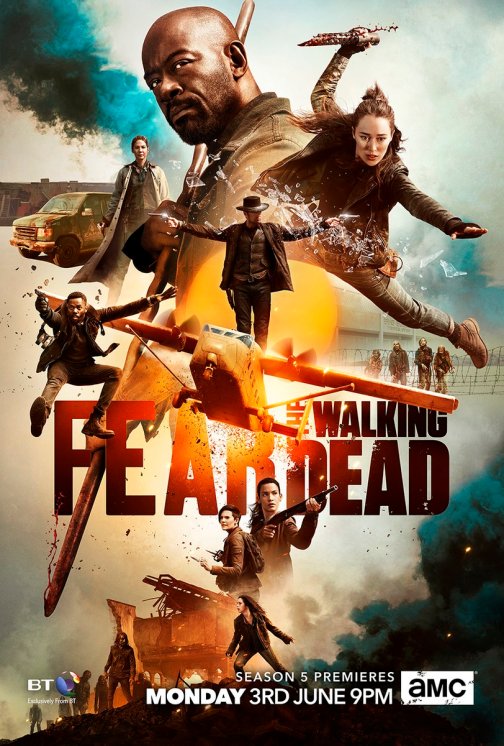
Even the premiere’s marketing was goofy. Its television ads seemed like an intentional self-parody — like maybe a Saturday Night Live skit lampooning zombie shows. (See below.) The poster is a mess too — even if the center image’s suggestion that John Dorie is a gunslinging Christ figure is pretty damned nifty.
With all of this said, it may surprise you that I still liked the episode well enough, and I’ll still watch the show. I’d rate the premiere a 7 out of 10, because “Fear the Walking Dead” still has its merits. I can think of three reasons in particular why I still had fun with the premiere, and why I’ll still tune in next Sunday.
First, some of the characters are terrific. I’ll always love Victor Strand (Colman Domingo). I really like Dorie (Garret Dillahunt) and his mild-mannered girlfriend, June (Jenna Elfman), and Charlie (Alexa Nisenson) is the kind of child character that typically grows on me. (Let’s hope Dorie’s posture in the poster isn’t a hint about his death.) I still like Morgan, because Lennie James is always a pleasure to watch, even if I don’t share the immense zeal of his legions of fans. (The writers need to do more with him beyond his weird, vaguely “Kung Fu,” born-again altruism. I know he’s supposed to be the Eastern philosophy guy, but his dialogue sometimes makes him come off like a stereotypical, nattering Evangelical.)
The second reason I’ll stay with this show is that its stories move along quickly. There are no static, Negan-centered endless epics here, like there are on this show’s plodding progenitor.
The third reason is this — “Fear the Walking Dead” has always hatched the most creative story ideas. Whatever problems the show might have developed over time with character, dialogue or plot details, the basic story concepts have always been really damned inventive. (They consistently offer much more than “The Walking Dead’s” two boiler-plate plot arcs — group-vs.-group or refuge-with-a-hidden-danger.) This season looks like it will be no exception. There are two major reveals in this episode’s closing minutes. One connects Season 5 with past seasons of “Fear the Walking Dead,” while another is a tantalizing hint about greater forces in the “Walking Dead” universe.
Oh! One more thing! There is an important new character here played by the terrific Matt Frewer. If you’re a true zombie horror fan, then you’ll recognize him as none other than Frank, from Zack Snyder’s superb, unfairly reviled 2004 “Dawn of the Dead” remake. And if you’re an 80’s kid like I am, then you might remember him as the original Max Headroom — from both the Coca-Cola ads and excellent but short-lived 1987 sci-fi series. That’s some pretty fun casting — and the guy is a really good actor.
Purchase pre-seasoned southern fried catfish at the grocery store.
Fry.
Serve.
Throw out that tartar sauce in your fridge. There is no need sniff-test it. You have never sniff-tested tartar sauce in your fridge and ever, ever found it viable. Ketchup will work just fine, possibly.
Smother your urgent existential dread into a brief and tenuous silence with a Klondike Bar for dessert. Preferably Brownie Fudge Swirl.




 Eric Robert Nolan, Author