I have a counter-protest idea for conservatives who are angry with Colin Kaepernick.
Just bring your American flag to a Neil Young concert and wave it all night long.
In other words, flag before the Neil.

I have a counter-protest idea for conservatives who are angry with Colin Kaepernick.
Just bring your American flag to a Neil Young concert and wave it all night long.
In other words, flag before the Neil.
It’s my first meme! What do you think?
If you are unaware of the implied joke here, this is indeed referencing the new and controversial Nike ads featuring Colin Kaepernick.

There’s a pretty cool article over at Signature about commonly misused words.
I refuse to believe that I (and countless others) have been misusing the expression “the prodigal son” for my entire life. Yeah, I get that its Biblical significance is that this was a dude who went out and lived a decadent life, but was received lavishly and thankfully by his father when he returned. When the good son sort of objects, their father explains along the lines that “someone who was lost has been returned to us.”
But I thought that the term’s popular modern usage was different — and that it denoted someone who was extremely successful (even if that contradicts its Biblical meaning).
It’s also a key metaphor and a key line at the climax of the greatest science fiction film of all time — “Blade Runner.”
TYRELL: The light that burns twice as bright burns half as long, and you have burned so very very brightly, Roy. Look at you. You’re the prodigal son. You’re quite a prize!
ROY: I’ve done questionable things.
TYRELL: Also extraordinary things. Revel in your time!
The photo below ought to give pause to anyone who went to Mary Washington College when I did in the early 1990’s. That is indeed Campus Walk back when it was Campus Drive, a legitimate roadway for the Town of Fredericksburg.
I have no idea when it was closed to automobile traffic and the walkway was created. The photo dates from 1981. (I am using it here with permission from UMW Special Collections; it comes from the Simpson Library’s Centennial photo database.)
It’s weird though. Campus Walk was a focal point of college life, especially its social aspects. It was where you said hello to a lot of your friends and exchanged news and plans, in the days before the internet and cell phones. And it gave the small campus an isolated feel that was kind of cool.
I’d heard about it being a road when I was a student, though. I worked at The Rising Sun Tavern museum downtown, and a couple of the other tour guides were women who had graduated from Mary Wash in the 1980’s. They had some vivid memories of young men from town (and Marines from Quantico) hollering at them as they drove through. I can see how that might have occasionally gotten awkward.

I’m quite happy to share here today that a poem of mine will be featured in the Peeking Cat Anthology 2018. Its title is “school shooter,” and it appeared here at the blog back in May. This will be the fifth time my creative work has been published in an anthology.
Thank you, Peeking Cat Poetry Magazine Editor Sam Rose, for selecting the piece for inclusion. The Peeking Cat Anthologies are always beautifully put together, and I’m honored to see my work appear alongside so many talented contributors from around the world.
The anthology is scheduled for release in October. I’ll post ordering information when it becomes available.
I hope you all are enjoying a wonderful holiday weekend!
Emily E. James is one of the most intelligent people I’ve ever encountered. I could easily swap her out for one of my professors at Mary Washington College, and I had some damned good profs.
Her insights into language, communication and culture have taught me tremendously, even as I’ve interacted with her only informally. (Emily is a good friend of mine.) I can only imagine that contracting with her for editing services is a sound investment.
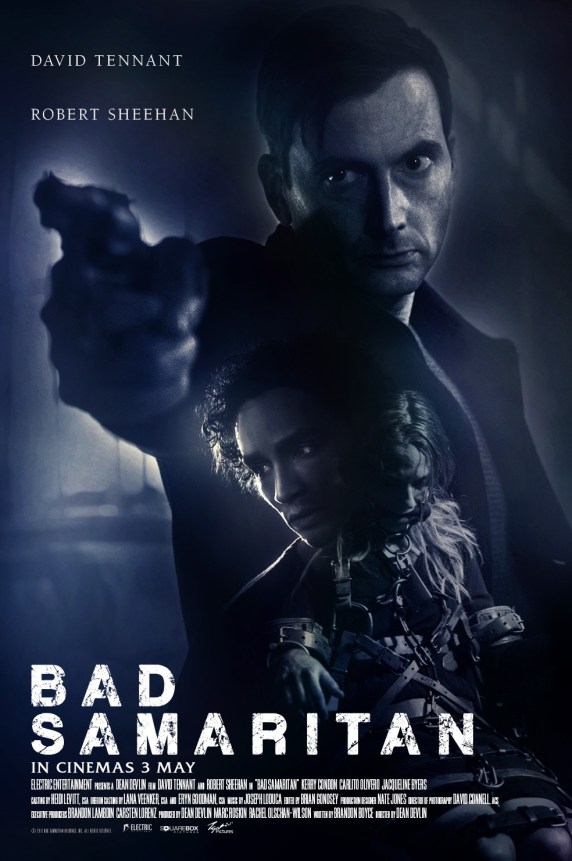
As I believe I may have mentioned, I have a love-hate relationship with David Tennant’s onscreen performances. I find him inexplicably, positively grating whenever he plays a protagonist. (See 2011’s “Fright Might” remake, or his cringe-inducing stint as “Doctor Who.”) But it seems to me that the man is absolutely fantastic when he plays a bad guy. (See his frightening and hilarious role as Kilgrave the first season of “Jessica Jones” in 2015.)
“Bad Samaritan” (2018) thankfully presents us with the latter Tennant. He musters an intensity with his eyes and his voice that are incongruous counterpoints to his innocent-looking face, and this makes him a damned good antagonist in a thriller. (He is a highly organized, sociopathic kidnapper in this film. I don’t think that’s much of a spoiler, as all of the film’s marketing make it clear.) He’s a hell of a lot of fun to watch — and listen to.
With that said, “Bad Samaritan” is an average movie — not altogether bad, but not awesomely good, either. (I suppose I’d rate it a 7 out of 10.) It benefits a lot from another very good actor in Robert Sheehan as its anti-heroic young protagonist. (The plot setup here is interesting — a mild-mannered burglar discovers a psychopath’s captive while in his house, then struggles with how he can help the terrified victim of a far worse criminal than he is.) The movie’s biggest sin seems to be that it borrows heavily from comparable genre-defining works from the likes of Thomas Harris and James Patterson. But it’s still an enjoyable enough movie in its own right.
There’s someone else here that’s great fun to watch too — Kerry Condon as the kidnapee. Her voice is amazing, and she’s a superb actress; I think she’s strong enough to carry another movie like this. I just knew she looked familiar … it turns out she played Clara, the really weird woman that Rick found in the woods during Season 3 of “The Walking Dead.” (He asks her the show’s signature “three questions.”)
She is also to voice of F.R.I.D.A.Y., Tony Stark’s on-board A.I. in several of Marvel’s “Avengers” movies. Didn’t see that one coming. Weird world.
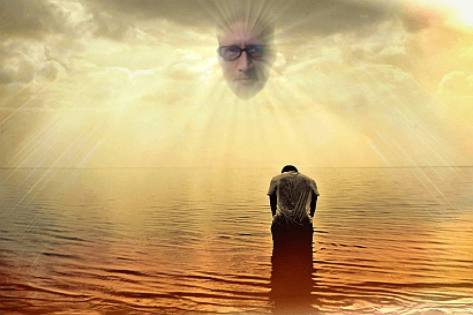
Today’s artwork is definitely the weirdest birthday greeting I received this week … it comes to me from my good friend Jorgen over in Denmark. I’ve never before received a birthday message depicting me as a deity.
It’s weirdly hilarious, but it is also vaguely unnerving. I don’t know why, but I never thought I’d be so terrifying rendered as a celestial Eric.
Thanks again, Jorgen!
By the way, I can easily think of several people in New York who would attest that this is indeed the view I hold of myself.
… for all of the kind messages, gags and goodies sent my way for my 41st birthday. You guys are the best. You made me laugh like hell, and you made the day far more enjoyable.
Edit: 46th. It was my 46th birthday.

If you prefer darker poetry, art and photography, then please stay current with The Bees Are Dead, the transatlantic indie lit magazine devoted to dystopian visions.
The most recent publication there is an absolutely stunning poem by Paul Brookes.
There is also some wonderful work by poets Matthew Borczon and David Spicer, the list of B.A.D.’s nominations of Sundress Publications’ “Best of the Net” 2018, and some truly awe-inducing photography of “dereliction and decay” by urban explorer Carl Bennett.
Do stop in.

Photo credit: By Falcon® Photography from France (Old Bathroom) [CC BY-SA 2.0 (https://creativecommons.org/licenses/by-sa/2.0)%5D, via Wikimedia Commons.

