Tag Archives: review

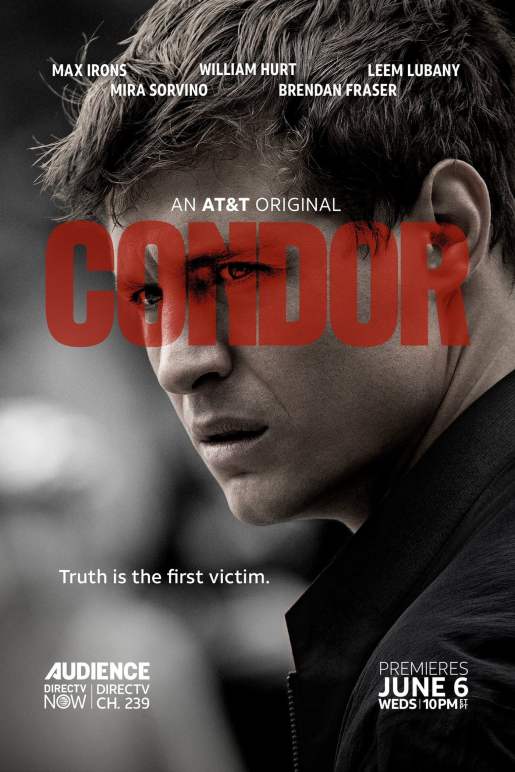
A review of Season 1 of “Condor” (2018)

When Season 1 of “Condor” was good — and it almost always was — it was a cinema-quality spy thriller.  This was a smart, suspenseful, well made TV show that was very nearly perfect — I’d rate it a 9 out of 10.

“Condor” was adapted loosely from James Grady’s 1974 book, “Six Days of the Condor,” and its famous film adaptation the following year, “Three Days of the Condor.”  I’ve neither read the former or seen the latter, but I can tell you that this new iteration of the story is intelligently written, nicely directed and edited, and well performed by its actors.  It seems to channel the modus operandi of Tom Clancy’s books and films — showing multiple thoughtful characters plotting and acting either against or alongside one another — while the show keeps the tension high with sequences of surprise violence.  (And there is indeed some disturbing violence here, particularly when the story calls for it to be perpetrated against non-combatants.  “Condor” aired on the Audience channel on DirecTV; I suspect its content might be too much for a regular network.)

William Hurt has always been a goddam national treasure, as far as I’m concerned.  (I may be biased in my appraisal of his work, as I grew up watching him in films like  1983’s “Gorky Park” and 1988’s “The Accidental Tourist.”  I think he’s one of the best actors out there.)  Seeing his talent colliding with Bob Balaban’s on screen should make this show required viewing for anyone who enjoys spy thrillers.  (There is an extended, loaded exchange between them in a coffee shop here that is absolutely priceless.)

The whole cast is great.  I’ve never been a fan of Brendan Fraser, simply because his movies are usually too goofy for me — but he shines in “Condor,” playing against type as an awkward villain.

Leem Lubany is terrific as the story’s merciless assassin.  (See my comments above about the violence.)  The role doesn’t call for her to have much range, as her character is a somewhat stoical sociopath.  But she looks and sounds the part — combining sex appeal with an incongruous, calm, homicidal intensity.  She reminded me a lot of Mandy, Mia Kirshner’s priceless, plot-driving assassin in Fox’s “24” (2001-2014).

If “Condor” has a failing, then it lies with its saccharine protagonists.  The screenwriters seem to have gone to great lengths to paint an edgy, unpredictable, violent world full of compromised good guys and moral ambiguity.  Why, then, are its handful of young heroes so implausibly perfect?  The putative hero is “Joe,” nicely played Max Irons, who is just fine in the role.  But the writers make him so idealistic, so gentle, so smart and so kind that it just requires too much suspension of disbelief.  At one point I even wanted to see a bad guy at least punch him in the face, simply for being a goody-goody.  It makes the story feel weird, too.  (Who wants to see Jesus in a violent spy thriller?)  The few other protagonists that we see here are also too good — they feel like thinly drawn, cookie-cutter heroes and not real people.

There are some plot implausibilities, too, that I’ve seen pointed out by other reviewers.  (I have arrived at the resignation that others are simply far more perceptive about these things than I am.)  But there was nothing that affected my enjoyment of Season 1.

“Condor” is great stuff.  I recommend it.
 

3IKwV4MleAlDIzBDXhbx0pQfZMb

A short review of “Brightburn” (2019)

For all of its promise, “Brightburn” (2019) is the kind of movie that you can wait to rent from Redbox, rather than paying for a theater ticket.  It isn’t a bad movie, exactly — I’d rate it a 7 out of 10, due to its admittedly great premise and some nice visuals.  But you can wait for the DVD for two reasons:

  1.  The film does little with its wicked-cool premise (what if a super-powered child like Clark Kent became a homicidal bad guy?).  After walking the viewer through a horror-movie version of Superman’s origin story, the movie does almost nothing to expand on the idea.
  2. If you’ve already seen the trailer for “Brightburn,” then you’ve already seen most of the important parts.  Seriously — this is another instance where a movie’s trailer reveals too much, and shows you virtually the entire story.  I can’t see spending the ticket price to see what you might feel is mostly filler.

One of the more interesting things about “Brightburn” is its story concept, which is borrowed wholesale, of course, from DC Comics — apparently without any agreement with the company.  I’m no expert on intellectual property rights, but … isn’t that kind of a big deal?  Why is nobody commenting about it?  This is essentially an unauthorized “Elseworlds” tale.  (For those who don’t read comics, “Elseworlds” was an official DC imprint series where its characters were re-imagined in “what-if” scenarios, unconnected with the “real” DC universe’s continuity.  What if Superman landed in the jungle as a baby and was raised by animals?  What if he landed in Soviet Russia?  What if he were found by Thomas and Martha Wayne, whose subsequent murder motivated his emergence as Batman?)  

To make matters even more interesting, I’m willing to bet that some people will like “Brightburn” better than a few of the official Superman movies, especially 2016’s head-scratching “Superman vs. Batman: Dawn of Justice.”

The filmmakers appear to making no effort to lampshade the intentional similarities, even in the movie’s marketing.  (Even the boy villain’s “logo” in the story is like a twisted cubist remix of Superman’s logo.)  I suppose if they claimed that “Brightburn” was a deliberate parody of the Superman mythos (and you could kinda view it that way), then it seems acceptable as satire.


brightburn-movie-l9-1280x2120

“Game of Thrones” Season 8 (2019) was a Greek tragedy. And I’m fine with that.

I’ve read and heard so many of the popular complaints about Season 8 of “Game of Thrones.”  Most of them are understandable.  A couple I agree with.  But I’m not on board with panning this six-episode final season.  Even with my own reservations about it, I still loved enough to rate it a 10 out of 10.

By far and away, of course, the part of Season 8 that has people up in arms is a major story development in its final two episodes.  (You almost certainly know what it is; because fans are complaining about it everywhere.  I’m not sure why I am trying so hard to keep this review spoiler-free.)  It was a bombshell, and it was damned saddening, and even I’ll admit that it affected my enjoyment of everything that transpired until the credits rolled for the last time.

But I made peace with it quickly.  (Granted, the character who figured the most prominently here was not my favorite, so it was a little easier for me to do so.)

I think it boils down to a matter of taste — specifically what you wanted out of “Game of Thrones.”  I like tragedies.  I love pathos in stories, whether they’re books, movies or television shows.  Stories that end badly aren’t bad stories.  One of the things that excited me about “Game of Thrones” since its second season was how it so often took the traditional elements of fantasy and fairy tales and turned them on their head with a brutal, unexpected (yet reasonable) conclusion to a story arc.  (I wasn’t fanatical about the show during Season 1, which overwhelmed me with exposition and plotting.)

The show has always tried to give us stories that were complex or ambiguous in terms of character, theme, setting and resolution.  One of the things that I tell people who have never watched the show is this — it is almost never as simple as “the good guys vs. the bad guys.”  Instead, it parallels human interaction in the real world — there are disparate groups and individuals fighting and aiding one another out of self-interest or philosophy.  The character turns and story turns that we saw in the last two episodes … somewhat parallel what we’ve seen in and heard on this show before.  As Ramsay Bolton said back in Season 3, “If you think this has a happy ending, you haven’t been paying attention.”

“Game of Thrones” was a Greek tragedy.  This last season’s classical plot resolution was arguably perfect for the show’s sweeping fantasy epic masterpiece.  The ending didn’t make me happy.  But it impressed me and affected me and made me think.  This was a fantasy show for adults.  It was an edgier, less predictable, more provocative alternative to “The Lord of the Rings” in all of that epic’s incarnations.  I far prefer the ending I saw to a pandering, cookie-cutter “happily ever after.”

And the show has indeed hinted at the outcomes we see in the final two episodes.  It’s been doing so for years, not just with major events but also with obvious dialogue.  I kept asking one other fan in particular, “Are you seeing what I’m seeing?”  But he didn’t.  Maybe a lot of fans didn’t.

If you tell me that a certain character decision was made too abruptly, with insufficient buildup, I hear you.  But, in the real world, I’m inclined to think that the internal processes we witness in the penultimate episode are often completely invisible.

If I had any complaints about Season 8, they lay elsewhere.  I simply cannot understand why this was six episodes instead of 10.  The two major battles we see each occupy one episode.  Why?  Even with a longer running time for each episode, this season felt rushed and truncated.  It still bothers me, even as I write this.

I had the same quibble as everyone else about the Battle of Winterfell being difficult to follow, but I’m willing to accept that this was a deliberate stylistic choice.  (And although I loved both major battles this season, I think the show’s three prior major land engagements were superior.  The Massacre at Hardhome, the Battle of the Bastards and the Attack on the Rose Road were all so well choreographed and scored that they were just too difficult to surpass.)  I even had my own disappointments for the outcomes we see for various characters.

I consequently almost rated the eighth season a 9 out of 10, instead of a perfect 10.  But I couldn’t.  I loved Season 8 too much.  It wasn’t perfect, but it was … still so damned riveting and enjoyable.  It was still “Game of Thrones,” with all of the attention to story and detail and performances that I’d come to love.  It was still the best thing on television.


7266820ea23a32cfa984e7be5e1450f0

A review of “Phantasm” (1979)

I don’t enjoy panning films that others revere.  There’s no percentage in it.  I’m not the guy who tries to be edgy or cool by telling you he dislikes something that everyone else loves.

But I do need to tell you that I think that “Phantasm” (1979) is a bad movie.  I’d rate it a 3 out of 10, based on some interesting ingredients, but I suspect that even that is a bit generous.  I finally managed to make it through its entire running time tonight, and it feels amateurish on every level.

It’s poorly scripted, directed and edited, with performances that are nearly all quite bad.  The first exception here is A. Michael Baldwin, who was a decent child actor when this movie was made, and who was quite likable as the story’s adolescent protagonist.  The second exception, I suppose, is “The Tall Man” himself, Angus Scrimm, the deep-voiced and admittedly unsettling big-bad.

There’s really only one other positive thing I can say about the movie — it has a damned good set design for its mausoleum.  (Somewhat confusingly, the film suggests this is located … inside the funeral home itself?  Is that a thing in some places?  I honestly don’t know.)  The set is simultaneously beautiful and frightening, with symmetrical hallways of contrasting white and red — the kind of thing you’d expect to see in a Stanley Kubrick film.  I can’t escape the suspicion that it was somehow pilfered from a far better film.

And I do understand the unconscious appeal of “Phantasm’s” story.  We see an adolescent boy who has lost his parents team up with his likable older brother to fight mysterious monsters at their local funeral home.  They enlist the aid of the brother’s guitar-playing, everyman best friend, they use everyday weapons like guns and knives, and they bond over the shared experience.  It’s a tailor-made, understandable power fantasy for any adolescent boy first grasping adult concepts of death and mortality.

But … those things aren’t enough to redeem the film.  In my opinion, it’s bad enough to be a candidate for the “Mystery Science Theater 3000” treatment.

Hey — what do I know?  Your mileage may vary.  “Phantasm” has a cult following in the horror community, and spawned no fewer than four sequels.  (The latest, “Phantasm: Ravager,” was released just three years ago.)  You might enjoy it, or you might need to watch it out of curiosity, as I did.


518kDX8g+zL

A short and spoiler-free review of “Avengers: Endgame” (2019)

Mind. Blown.

If I could tell my 19-year-old self discovering superhero comics in college exactly how good their big screen adaptations would become, I wouldn’t believe me.

I saw “Avengers: Endgame” (2019) tonight with expectations that were very high. It was still better than I thought it would be. It was easily better than last year’s “Avengers: Infinity War” (although I think of them as two halves of the same epic movie).  I don’t pretend to be a film expert, so take this as speculation — I personally think the pair of “Infinity” films have made comic-book movie history in the same manner as the original “Superman” (1978), Tim Burton’s “Batman” (1989) and Christopher Nolan’s “Dark Knight” trilogy (2005-2012).

I don’t really want to make any more observations, because I’m too afraid of inadvertently posting spoilers.  But I will say that there is a massive tonal change between “Infinity War” and “Endgame.”  The banter and humor of the former is largely left aside, and this concluding story is darker and far more emotionally sophisticated.  It’s moving.  It feels strange to write here, but I kept thinking during the movie that this was a more “grown up” Marvel film.

And it is EPIC.  I honestly can’t imagine how Marvel can top it with future films.  There is an action set piece that made my jaw drop.  I can’t say more.

This is an obvious 10 out of 10 from me.


71x0IhSHtqL._SL1303_

A short review of “Truth or Dare” (2018)

Blumhouse’s “Truth or Dare” (2018) isn’t high art, but it isn’t quite as bad as everyone makes it out to be.  I’d rate it a 6 out of 10 for being a passably good fright flick.

It’s a gimmick horror film, but the gimmick kinda works –a powerful demon possesses an oral game of “truth or dare” — then follows its players home from vacation with lethal consequences. It’s actually not quite as stupid as it sounds; I had fun with the premise, which sounds like the basis for a decent “The X-Files” (1993-2018) episode.  An exposition-prone minor character explains to our protagonists late in the game that demons need not infect only people and objects, but also “ideas” like games or competitions.  The notion of an idea or a philosophy being demonically possessed has a hint of creative brilliance, and I’d love to see it fully developed in an intelligent, well written horror film.

Alas, this isn’t it.  And instead of lovable heroes like Mulder and Scully, we get a predictable, throwaway group of unlikable teens on spring break.  The movie’s most interesting character is the one it sets up as the stereotypical jerk, Ronnie, adroitly played by Sam Lerner.  The film would have been much better if it had fleshed him out as a three-dimensional character, and had the story revolve around him as a surprise anti-hero.

“Truth of Dare” also borrows maybe a bit too much from “It Follows” (2014) and “The Ring” films (2002-2017). Finally, it confuses the viewer with some head-scratching plot turns near its end.

Oh, well.  The movie still doesn’t deserve the hate it gets.  I figure it’s at least a fun time waster before bed on a weeknight.


Truth+or+Dare+2018

A few quick words on the premiere of “The Twilight Zone” (2019)

If the premiere is any indication, then Jordan Peele’s relaunch of “The Twilight Zone” (2019) looks to be quite decent.  It’s got Peele’s fingerprints all over it (he even serves as the narrator here), and that’s a very good thing.  I’d rate it an 8 out of 10.

This first episode, written by Alex Rubens and directed by Owen Harris, channels the same muse as Peele did with his outstanding “Get Out” (2017) — it’s got clever characters, snappy dialogue and gravely dark humor.  I suppose it’s impossible to gauge the quality of an anthology show by its initial episode, but I’m on board.

And one of the upcoming episodes is penned by Glen Morgan, of “The X-Files” fame.  I’d say that’s an auspicious sign too.


rs_1024x759-190221103529-1024x759.the-twilight-zone-jordan-peele-lp.22119_fit_inside_900_auto_output-quality_90

A short review of “The Silence” (2019)

“The Silence” may be dreck, but it’s good dreck.

If you’ve read anything about this new Netflix movie, than you know it’s regarded as a lower-budget ripoff of the immensely well received “A Quiet Place” (2018).  (Both follow a family surviving an apocalyptic invasion by monsters who hunt by sound.)  And I suppose it is, with a bit of saccharine teen drama and a neglected cult subplot shoehorned into it.

But I’d be lying if I told you I didn’t enjoy it at all.  I’d rate it a 7 out of 10 for being a fairly entertaining creature feature.

Stanley Tucci and Miranda Otto are always great to watch, and the young Kiernan Shipka is a cute kid with a lot of charisma.  (Am I the only guy in the world who thinks that Tucci is extremely talented?  To appreciate his range, compare his milquetoast suburban dad here with his growling, menacing super-zombie in last year’s “Patient Zero.”)

The monsters were suitably revolting and well rendered, and the action sequences were mostly engaging.  (The scene involving a well was well executed — no pun intended.)  Maybe I’m just a kid at heart and want more creepy crawlies in my horror films, as opposed to endless demons and shrieking wraiths.

Here’s the key to enjoying it — think of it as a throwback to cheesy 70’s monster movies like “Kingdom of the Spiders” or “Damnation Alley” (1977).  We had fun with those when we were kids, didn’t we?


MV5BMmZlOGZkMjMtZDc4Ny00ZTQ1LWFmYTQtOThlY2JjYjg1NGQyXkEyXkFqcGdeQXVyNDg4NjY5OTQ@._V1_SY1000_CR0,0,675,1000_AL_

A short review of Season 1 of “Black Summer” (2019)

I don’t understand how “Black Summer” can be as good as it is.  It’s produced by The Asylum, the makers of low budget, direct-to-video ripoff films like “Atlantic Rim” (2013) and “Triassic World” (2018).  It’s a prequel to the horror-comedy “Z Nation” (2014-2018) — a show that was so bad I couldn’t make it through its first episode.  Yet “Black Summer” is inexplicably a great, albeit imperfect, TV show.  I’d rate it a 9 out 10.

I might be in the minority here; a lot of people are severely panning this show online.  And I do recognize its weaknesses — there is very little detail in its plot or character development … there is often even very little dialogue at all.  And even I recognized some plot holes.  (I’m typically a little slow on the uptake where these are concerned.)

But this bare-bones zombie story still manages to screen some likable characters, and then put them through a thrilling succession of hyper-kinetic chases and melees.  I was on the edge of my seat, and I consequently didn’t miss the methodical, detailed plotting of shows like “The Walking Dead.”  The season’s finale is crowned by an extended, eye-level, real-time action set-piece that ought to be considered a classic in the  zombie-horror subgenre.  It was mind-blowing. I just can’t dislike a horror property that genuinely scared me.

I could simply be out of step with everyone else; I often have different tastes in zombie fare.  I love Zack Snyder’s 2008 remake of “Dawn of the Dead,” which this series reminds me of.  And I also love similar overseas productions like Spain’s “[REC]” films (2007 – 2014) and Britain’s “Dead Set” miniseries (2008), while those amazing entries are hardly known among my friends.  I also cannot understand why many people who love George A. Romero’s and Robert Kirkman’s productions must always compare other films and TV shows unfavorably to them.  We can love both.  Why not?

Hey, if you don’t want to make my word for it, here is what Stephen King tweeted: “No long, fraught discussions. No endless flashbacks, because there’s no back story. No grouchy teens. Dialogue is spare. Much shot with a single handheld camera, very fluid.”

I obviously recommend this.


black-summer-season-1-poster-1166630-1280x0

A few quick words on the Season 8 premiere of “Game of Thrones”

I’ll keep this brief, because it’s unlikely by now that I can write an unbiased review of a “Game of Thrones” episode anyway.  The show is so close to my heart that simply seeing the characters again for Season 8 is like being reunited with old friends.  I’d rate the first episode a 10 out of 10 if only for the characters and dialogue.

And that’s mostly what we get in the premiere.  If you’ve been waiting for this universe’s apocalyptic war to escalate, then you’ll be disappointed.  The episode focused almost entirely character reunions, relationships and conflicts, laying out the stakes for what will be a bloody final season.  Nearly all of it was great stuff.  (Like a lot of viewers, I loved the closing seconds of the show.)  There was only one key exchange of dialogue that didn’t play the way the writers intended — an interaction among Sam, Danerys and Jorah that was blackly and unintentionally hilarious.

I read comments from a couple of fans online who were nonplussed by the episode’s lack of action.  I think we needed this character-focused groundwork to lend emotional weight to the war when it arrives at Winterfell.  (I think we can assume it will fall; I can’t imagine the good guys defeating the Night King in their first major battle.)

I loved it.


960x0