Tag Archives: 1983

A short review of “Godzilla: King of the Monsters” (2019)

It’s true what they say about “Godzilla: King of the Monsters” (2019) — its script is almost completely brainless.  It’s got about as much depth as the old “G.I. Joe” cartoon (1983-1986) that played after school when we were kids.

But I’d be lying to you if I said I didn’t enjoy this.  And I’m sure you know why — the big-budget, big-MONSTER special effects.  They were spectacular — and sometimes they approached being unexpectedly beautiful.  (It’s hard to explain here, but our eyes are treated to more than skyscraper-tall brawls between “titans.”  We get a light show too — thanks to some confusing, thinly scripted, but nonetheless dazzling energy-based monster powers.  It was really damned good.)

Add to this a generally excellent cast, and you might be able to forgive the screenplay for insulting your intelligence.  I know that most people would name Ken Watanabe as the actor who truly classes up the joint.  And there’s plenty of truth to that, but I myself would name Charles Dance as the movie’s biggest standout.  The man’s craft is goddam Shakespearean, and I think he’s equal of the likes of Patrick Stewart or Ian McKellen.  And I’d like to think that his throwaway line, “Long live the King,” was at least partly a fan-service reference to what I’m guessing is his best known role — Tywin Lannister on HBO’s “Game of Thrones” (2011-2019).

Based on my own enjoyment, I’d rate this movie an 8 out of 10 — with the caveat that I’m a kid at heart when it comes to giant monsters.  If you’re the same way, then “Godzilla: King of the Monsters” might just become a guilty pleasure that you return to more than once.


GodzillaKingOfTheMonstersPoster

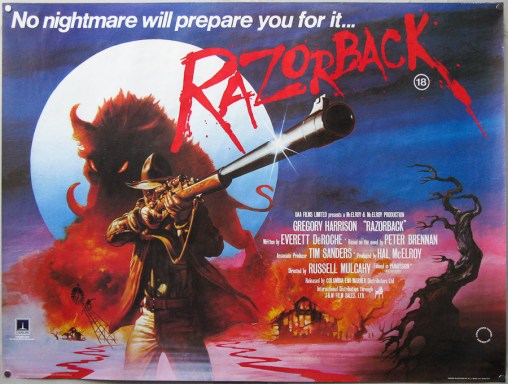
Throwback Thursday: “Razorback” (1984)!!

Legit question for rural Australians  — how do I kill the 30 to 50 feral hogs that run into my yard within 3 to 5 mins while my small kids play?

If you’re anything like me, you’re endlessly regaled by all the viral jokes this past week referencing “30 to 50 feral hogs.”  (And if you’re nothing like me, then you’re an intelligent adult and I congratulate you.  But you can google the new trope, which I have paraphrased above, if you want to.  It is the very height of preposterous predatory animal political humor.)

The jokes made me remember this little disappointment from the 1980’s — the Aussies’ own feral hog horror movie, 1984’s somewhat lethargic “Razorback.”  If memory serves, I rented this sometime around 1986, I suppose.  I  got it on VHS from my nearest shopping center’s sole mom-and-pop video store, before Blockbuster Video’s invasion reached my area.

There are people out there who fondly remember “Razorback.”  You can find some nice compliments about it over at Rotten Tomatoes.  People  enjoy its “atmosphere.”  People like Gregory Harrison a lot.

I didn’t like it.  Sure, it had a pretty neat electronic score that seemed trippy and cool to me as a young high school student.  But that was its only redeeming quality.  It started off with its depressing plot setup, which you can see in the first video below — the titular wild boar absconds with a baby boy.  (The boar also thoughtfully burns the child’s house down as it departs, to underscore that fact that it is an asshole.)

The rest of the movie is boring, because it’s yet another one of those monster movies where you never get to see much of the monster — right up until the movie’s poorly lit climax, which takes place in a slaughterhouse, I think?  Which is supposed to be ironic or something?  Don’t quote me on this stuff; 1986 was a long time ago.  For comparison, think of the legion zombie “thrillers” always available on Netflix where the zombies are always outside, and the movie just follows the indoors arguments among three very-much-alive people inside a windowless warehouse.  I want to invoke the inevitable “wild bore movie” pun, but I’m holding back, because my friends tell me that they have enough of that sort of thing.

I used my own money to rent “Razorback,” probably earned from either my confusing stint at McDonald’s (they just didn’t get me there) or my summer job cleaning boats and lobster traps.  (I lived on an island, people.)  I remember being slightly disgruntled that I’d wasted my hard-earned cash.

Honestly, though, I was a credulous kid when it came to a movie’s marketing.  When I read the back of the VHS boxes, I took things at face value.  I also had my heart set on something called “The Alien’s Deadly Spawn” (1983), which I realize now was just a no-budget early mockbuster ripping off Ridley Scott’s “Alien” (1979).  (It was always out.  I finally caught snatches of it on Youtube this past spring, and it looks pretty unwatchable.)


d9ltqha-b0a27d14-3f5b-4318-b5cc-63dc6ccbbb04

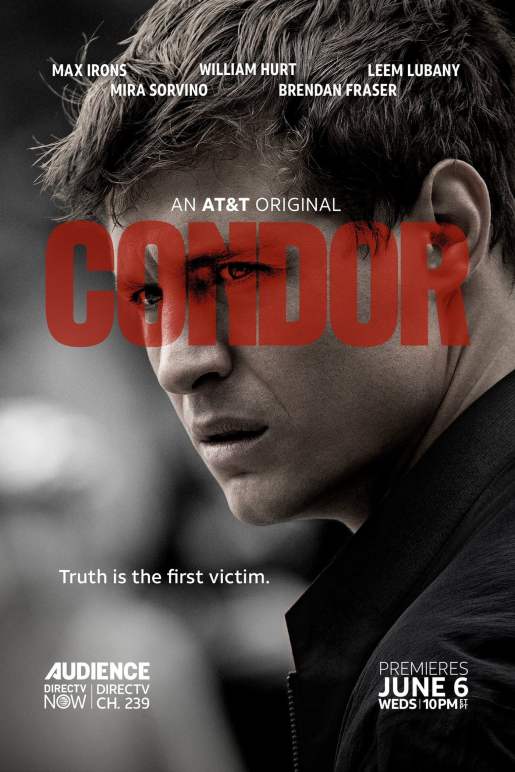
A review of Season 1 of “Condor” (2018)

When Season 1 of “Condor” was good — and it almost always was — it was a cinema-quality spy thriller.  This was a smart, suspenseful, well made TV show that was very nearly perfect — I’d rate it a 9 out of 10.

“Condor” was adapted loosely from James Grady’s 1974 book, “Six Days of the Condor,” and its famous film adaptation the following year, “Three Days of the Condor.”  I’ve neither read the former or seen the latter, but I can tell you that this new iteration of the story is intelligently written, nicely directed and edited, and well performed by its actors.  It seems to channel the modus operandi of Tom Clancy’s books and films — showing multiple thoughtful characters plotting and acting either against or alongside one another — while the show keeps the tension high with sequences of surprise violence.  (And there is indeed some disturbing violence here, particularly when the story calls for it to be perpetrated against non-combatants.  “Condor” aired on the Audience channel on DirecTV; I suspect its content might be too much for a regular network.)

William Hurt has always been a goddam national treasure, as far as I’m concerned.  (I may be biased in my appraisal of his work, as I grew up watching him in films like  1983’s “Gorky Park” and 1988’s “The Accidental Tourist.”  I think he’s one of the best actors out there.)  Seeing his talent colliding with Bob Balaban’s on screen should make this show required viewing for anyone who enjoys spy thrillers.  (There is an extended, loaded exchange between them in a coffee shop here that is absolutely priceless.)

The whole cast is great.  I’ve never been a fan of Brendan Fraser, simply because his movies are usually too goofy for me — but he shines in “Condor,” playing against type as an awkward villain.

Leem Lubany is terrific as the story’s merciless assassin.  (See my comments above about the violence.)  The role doesn’t call for her to have much range, as her character is a somewhat stoical sociopath.  But she looks and sounds the part — combining sex appeal with an incongruous, calm, homicidal intensity.  She reminded me a lot of Mandy, Mia Kirshner’s priceless, plot-driving assassin in Fox’s “24” (2001-2014).

If “Condor” has a failing, then it lies with its saccharine protagonists.  The screenwriters seem to have gone to great lengths to paint an edgy, unpredictable, violent world full of compromised good guys and moral ambiguity.  Why, then, are its handful of young heroes so implausibly perfect?  The putative hero is “Joe,” nicely played Max Irons, who is just fine in the role.  But the writers make him so idealistic, so gentle, so smart and so kind that it just requires too much suspension of disbelief.  At one point I even wanted to see a bad guy at least punch him in the face, simply for being a goody-goody.  It makes the story feel weird, too.  (Who wants to see Jesus in a violent spy thriller?)  The few other protagonists that we see here are also too good — they feel like thinly drawn, cookie-cutter heroes and not real people.

There are some plot implausibilities, too, that I’ve seen pointed out by other reviewers.  (I have arrived at the resignation that others are simply far more perceptive about these things than I am.)  But there was nothing that affected my enjoyment of Season 1.

“Condor” is great stuff.  I recommend it.
 

3IKwV4MleAlDIzBDXhbx0pQfZMb

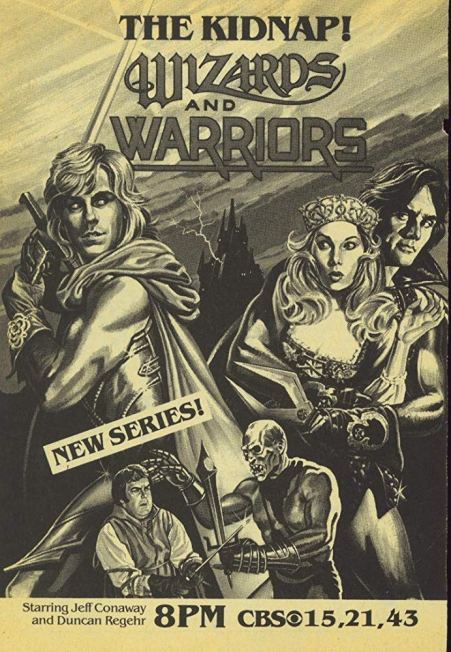
Throwback Thursday: “Wizards and Warriors” (1983)!

I suppose that “Wizards and Warriors” was what passed for “Game of Thrones” in 1983.  Except it was cheesy as hell (which of course meant that I loved it as a fourth grader), and it didn’t last longer than eight episodes.

It was CBS’ mid-season replacement for my beloved “Bring ‘Em Back Alive” (the Bruce Boxleitner retro adventure series that I’ve written about here previously), which was cancelled due to low ratings.  “Wizards and Warriors” ran in its 8 PM time slot, and then itself was cancelled due to low ratings, so it never saw a second season.  (I believe both shows were competing with NBC’s ratings juggernaut, “The A-Team,” which every kid in the world loved except me.  I was weird.)

“Wizards and Warriors” was really just an obvious effort to capitalize on the popularity of the “Dungeons & Dragons” role-playing game.  The show was campy stuff.  The pilot episode, which you can watch in its entirety over at dailymotion, was entitled “The Unicorn of Death.”  It dealt with a time-bomb hidden inside a princess’ birthday present, which strikes me as a pretty surprising plot for a sword-and-sorcery program.

It had a cast that went on to better things, though.  One was Julia Duffy, of “Newheart” (1982-1990) fame.  Another was “Grease” (1978) veteran Jeff Conaway, who most 80’s kids will remember from “Taxi” (1978-1983).  The dastardly villain of “Wizards and Warriors” was played by the terrific character actor Duncan Regehr, a “that guy” actor who popped up in a lot of genre roles in the 80’s and 90’s.  Here’s the thing about Regehr — I want him to be a real-life bad guy.  He’s got an absolutely sly, suave, villainous face and manner — and his name just sounds like a villain’s name.  If he’d left acting to commit a series of high-profile crimes in the real world, that would be wickedly, awesomely meta.


MV5BZWIyMzdlMmYtMTUzOS00ZTMzLWEzMGMtZDVmMmNlNjBkNGZlXkEyXkFqcGdeQXVyNjExODE1MDc@._V1_SY1000_CR0,0,691,1000_AL_

7e9d9a4f308d3f8f5f52f13e9e8bacbd


10 classic movies that I will never fully understand the appeal of:

Because I can’t sleep, and you’ve been dying to know.  Here they are, in no particular order:

1) “Memento” (2000)
2) “Fight Club” (1999)
3) “American Psycho” (2000)
4) “Rosemary’s Baby” (1968)
5) “The Rocky Horror Picture Show” (1975)
6) “Monty Python and the Holy Grail” (1975)
7) “Natural Born Killers” (1994)
8) Lucio Fulci’s “Zombi” (alternately titled “Zombi 2,” 1979)
9) “Fast Times at Ridgemont High” (1982)
10) “The Big Chill” (1983)

And … worst of all … I’m kinda on the fence about the first two “The Evil Dead” films (1981, 1987), Stanley Kubrick’s “A Clockwork Orange” (1971) and John Carpenter’s original “Halloween” (1978).   I am hanging my head in shame here over those last two.  I know Kubrick’s film is considered a masterpiece.  I saw it twice when I was a college student (once in a psychology class!), soooo … maybe I just wasn’t mature enough to grasp it?  Mea culpa, people.

I left “Citizen Kane” (1941) and “Ben Hur” (1959) off the list, because I haven’t seen them in their entirety.  I was nonplussed enough to turn those off after 40 minutes or so, but I’m weird about never saying I dislike a movie unless I watch the whole thing.  You can add 1979’s “Phantasm” to this category too.

I know, I know … there’s nothing wrong with any of these films (except “Fast Times at Ridgemont High,” of course, which is terrible).  There are just basic ingredients in them that I somehow fail to appreciate.

Now one of you needs to e-mail me a cure for insomnia.


51jojzqpkPL (1)

A review of “Pet Sematary” (2019)

“Pet Sematary” (2019) is an unnecessary remake, but still a decent one.  I personally prefer the flamboyant 1989 film adaptation of Stephen King’s novel; it was more garish and stylish, if a little campy.  (And its flashback sequences involving one character’s deceased sister are priceless horror fare.)  But this sleeker, more restrained update is nonetheless still made and sometimes pretty scary.  I’d rate it an 8 out of 10.

The writing and directing are generally good, even if certain jump scares were so heavy-handed that they were nearly laughable.  (The script wisely capitalizes on the universal, existential dread of mortality, as the first film did.)  There are few new bells and whistles here; the 2019 film instead tries to distinguish itself with a key variation in the plot of King’s eponymous 1983 book.  (I won’t describe it here, as I’m not certain whether it is a spoiler.  But this change isn’t “shocking,” as The New York Times’ headline proclaims; it’s simply a basic story alteration.)

The cast is roundly quite good.  A surprise standout for me was Amy Seimetz, who plays the mother of the story’s troubled Creed family with surprising power and nuance.  She’s a damned excellent actress.  And I was surprised to learn that I failed to recognize her as one of the doomed spacefarers  from 2017’s “Alien: Covenant” — another role that required her to portray apprehension and panic.

There were two possible nitpicks that occurred to me as I watched “Pet Sematary,” but these probably aren’t the fault of the filmmakers, as they likely stem from the literary source material.  (I read the book several times, but I was a young teenager when I did so.)  As an adult, I am only a fuzzy on two story elements:

  1. How is the character of Victor Pascow (played here by Obssa Ahmed) able to offer help to the troubled Creed family?  Can anyone in his circumstances do so?  Might others step forward as well?  Why should Pascow be uniquely motivated?  (I am again trying to keep this review spoiler free.)
  2. Why is the mother’s traumatic childhood a factor in the story’s present?  It’s … mostly tangential, right?  It is a compelling character element, and portrayed beautifully by Seimetz.  But I don’t fully understand how it seems to affect what transpires before us.

One final note — I’ve seen a few people on the Internet compare John Lithgow’s performance to that of Fred Gwynne in the 1989 film.  (They both play the character of Jud, the family’s elderly neighbor.)  Lithgow is predictably wonderful here — especially when Jud is showing kindness to the young daughter (played charmingly by Jete Laurence).  But Gwynne was better, because he was so perfectly cast.  It was a role that he was born to play.


MV5BMjUyNjg1ODIwMl5BMl5BanBnXkFtZTgwNjMyOTYzNzM@._V1_SY1000_CR0,0,640,1000_AL_

Throwback Thursday: “Laverne and Shirley” (1976-1983)

Rest in Peace, Penny Marshall.

This is one of only a handful of TV shows that I can remember watching as a tot in the late 1970’s.  “Laverne and Shirley” (1976-1983) was the kind of of thing I’d see in my older sisters’ room.  My Dad and older brother watched war movies, westerns and monster movies, but my two sisters preferred considerably lighter fare.  Two that they watched a lot at the time, if I recall, were this show and “Donnie & Marie” (1976-1979) — about the scariest thing you could find playing on their black-and-white TV was “The Hardy Boys/Nancy Drew Mysteries” (1977-1979). (One of my sisters had a crush on actor Shaun Cassidy; I think there was a poster of him in their room.)

I loved “Laverne and Shirley” when I was that young.  Lenny and Squiggy were my favorite highlight of any episode, even if I was sometimes confused about whether they were meant to be “good guys” or “bad guys.”  I was in kindergarten, and not altogether bright, and I thought that men who wore black leather jackets (Fonzie notwithstanding) were usually “bad guys.”  I also remember thinking that hippies and motorcyclists were the same group of “bad guys” because they disobeyed God or something … my confusion at the time resulted from some vaguely moraled born-again Christian comic books I’d happened across somewhere.

I also remember recognizing “Laverne and Shirley” as being related to another show that a lot of kids back then loved — “Happy Days” (1974-1984), of which it was a spin-off.  This might have been the first time in my life that I was aware of two live-action television properties occupying the same fictional universe; I’d already seen it happen in the movies with the various incarnations of “King Kong” and “Godzilla.”

Here’s what makes me feel old — for both “Laverne and Shirley” and “Happy Days,” I probably watched a lot of the episodes when they were first broadcast, and not just in re-runs (although “Happy Days” was also played in syndication endlessly throughout the 1980’s — it remained a fixture of daytime television).

And I only just realized writing this that Lenny was played by the priceless Michael McKean.  As an adult, I know him primarily from his brilliant turns in “This Is Spinal Tap” (1984) and “The X-Files” (1998-2018).  He’s 71 now.  Wow.


Throwback Thursday: “Movie Monsters From Outer Space,” 1983

This was another book during my grade-school days that really fed my excitement about monsters — Jerry A. Young’s 1983 children’s book, “Movie Monsters From Outer Space.”  (Why does the author’s name sound so much like a pseudonym to me?)

I’m sure it’s obscure by now.  If memory serves, this was another title I ordered from those classroom bulletins put out by Scholastic Book Clubs.  (I was in the third grade, I think.)  It gave kids a brief, fun run-down of a bunch of space-based baddies — those are the Cylons from the original “Battlestar Galactica” (1978) on the cover.

It featured a bunch of older B-movies too.  I remember really wanting to see “Forbidden Planet” (1956) after seeing a picture of its monster there.

I also seem to remember reading about Ridley Scott’s original “Alien” (1979), although I suppose that I could be recalling another book.  (It would be odd if Scott’s masterpiece were described here, because it was … kinda not for kids.)


51vNHayotEL._SX340_BO1,204,203,200_


d53a39702c7db300584e2bcf0c167bf5


Throwback Thursday: “Rappin’ Rodney” (1983)!

Rodney Dangerfield actually was pretty damn funny, even if I was too young to appreciate his humor when I was a kid.  Not everything he touched turned to gold … I seem to remember a cheesy movie or two.  But this 1983 single was great.  It’s catchy, and its humor still holds up today.

There are a couple of 80’s-tastic cameos in the video, too.  One is Pat Benatar as the leather-clad prison executioner.  (Totally not my thing.)  The other Saturday Night Live’s chain smoking priest, “Father Guido Sarducci” (Don Novello).


“Fast Times at Ridgemont High” (1982) is actually slow and will leave you feeling low.

“Fast Times at Ridgemont High” (1982) is a pop-culture sacred cow that needs to be skewered.  I’d rate it a 2 out of 10 for being a surprisingly inept and poorly scripted 1980’s “classic.”

I just don’t understand the fervent popular reverence for this movie among people in my age bracket.  It was a minor legend when I was growing up.  I was a fourth grader in 1982, and gradeschool boys could be divided into two groups: 1) those who had seen the “Phoebe Cates pool scene” and 2) those who had not, but wished they had.  When I mentioned on social media a couple of months ago this year that I’d never actually gotten around to seeing this movie, my friends were roundly astonished.

Why do they think this film is indispensable viewing?  Maybe there’s something I’m missing.  I’m tempted to group “Fast Times at Ridgemont High” together with other beloved 80’s films that just don’t resonate with me — like the understandably campy “Tron” (1982) or the unexpectedly sleep-inducing “The Big Chill” (1983).  (I couldn’t even finish the latter.)  But I can’t compare, because I know those movies are objectively good in a lot of ways, even if they weren’t to my taste.

Nor am I squeamish about raunchy sex comedies.  (C’mon.)  I pretty fondly remember “Porky’s” (1981), “Porky’s II: The Next Day” (1983), and “Revenge of the Nerds” (1984).  I mentioned “Porky’s” to the friend with whom I watched “Fast Times” — I told her that it wasn’t highbrow entertainment, but I still remember it being crudely, blasphemously funny.

This movie was just a thinly scripted small collection of vignettes, with no overall plot outside of teenagers having sexual encounters that are … awkward and bluntly sad, for the most part.  (Sean Penn’s character does drugs.)  The dialogue is terrible.  None of the characters are likable — even the story’s nerdy, well-meaning protagonist is grating.

I didn’t really laugh once at anything the director intended — I only laughed at the haircuts and the clothes.  I just can’t believe that the screenwriter here was Cameron Crowe, who also wrote what is possibly my favorite movie of all time — the widely but unfairly maligned “Vanilla Sky” (2001).  (Crowe apparently adapted the screenplay from a novel he wrote.)

There is some enjoyment to be had in watching Penn’s stoner character.  It was fun seeing a well known serious actor in an early comedic role.  Penn is a decent character actor, and it looks like he was having fun.  I do get why kids in the 80’s found him funny.

It’s also fun seeing the handful of other young actors who would go on to great careers (Judge Reinhold is always funny) but, again, this is something that the filmmakers can’t take credit for.

Hey, if you want a slice-of-life dramatic comedy about teenagers in the 1980’s, then go rent “The Breakfast Club” (1985).  It wasn’t perfect, but it was damn good movie that tackled many of the same issues as this movie, but with intelligence and effective humor.  Or, try the oddball “Ferris Bueller’s Day Off” (1986).  Both movies portray teenagers in the 80’s who are smart, likable and emphathetic, in varying degrees.  I myself went to high school in the 1980’s, and I assure you they were around.


fast-times-at-ridgemont-high-poster