So I’m introducing a dear friend tonight to “28 Days Later” (2002). It is possibly my favorite horror film of all time, maybe even narrowly beating out “Aliens” (1986), “Alien 3” (1992), John Carpenter’s “The Thing” (1982), the Sutherland-tacular 1978 version of “Invasion of the Body Snatchers,” and George A. Romero’s first three “Dead” films (1968, 1978, 1985). (Whenever “Star Wars” fans refer to their “Holy Trilogy,” I muse inwardly that those last three are its equivalent for zombie horror fans.)
My friend thinks it’s funny that I refer to “28 Days Later” as “my sacred cow.” I’ll be crestfallen if she does not like it, and I told her as much. And that’s weird for me … I usually don’t feel let down when someone doesn’t enjoy the same books, movies or music that I do. Not everything is for everyone. Art would lose its mystique if it weren’t subjective. If all art appealed to all people, it would lose all its appeal altogether.
Part of me feels, unconsciously perhaps, that “28 Days Later” is the kind of film that “redeems” the horror genre (even though no genre needs such redemption — if art is well made or if it affects people, then it’s just fine).
Most comic book fans of my generation can tell you how people can occasionally roll their eyes at their favorite medium. (Comics have far greater mainstream acceptance today than when I started reading them in the 1990’s.) For horror fans, it’s sometimes worse. Horror is a genre that is easily pathologized — and sometimes with good reason, because a portion of what it produces is indeed cheap or exploitative. I wish I could accurately describe for you the looks I’ve gotten when acquaintances find out that I’m a horror fan. They aren’t charitable.
“28 Days Later” and movies like it are so good that they elevate horror to a level that demands respect from the uninitiated. It is an intrinsically excellent film — it just happens to have a sci-f-/horror plot setup and setting. It’s beautifully directed by Danny Boyle, it’s perfectly scored and it’s masterfully performed by its cast — most notably by Cillian Murphy and Brendan Gleeson.
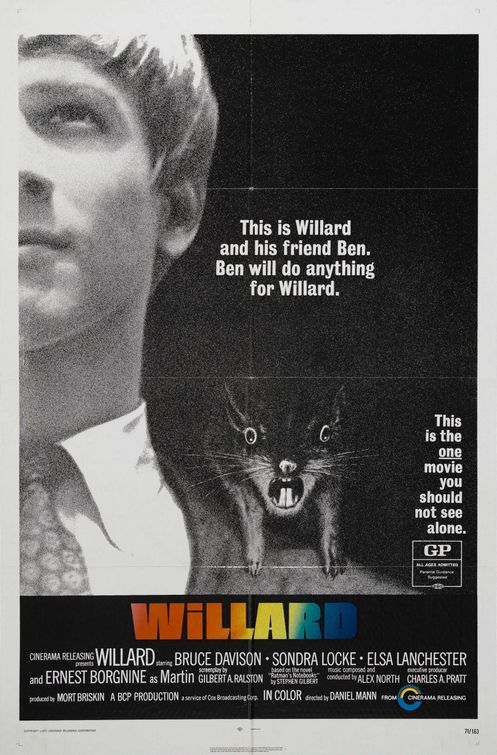
“Willard” (1971) and its sequel, “Ben” (1972), were another pair of 1970’s movies that got plenty of airtime on 1980’s television. I read both books when I was a kid too.
First I picked up Stephen Gilbert’s Ratman’s Notebooks at a yard sale, because that’s how you found cool horror books during summer vacations when you were too young to drive. (Sometimes adults had few compunctions about what they sold to minors too. I bought a vampire book in gradeschool that was full of nude photos, for some reason, and that led to what I’m sure was an interesting conversation between my parents and the neighbor-proprietor down the street.)
Anyway, I absolutely loved Ratman’s Notebooks (despite its lamentable absence of nude photos) and I finished it in a day or two. The novelization of the “Ben” film by Gilbert A. Ralston was somewhat less impressive, but I still enjoyed it.
If you’re a comics fan, like I am, then it might occur you that “Willard” and his army of trained rats seem to inspire a villain in Batman’s rogue’s gallery — Ratcatcher. Ratcatcher has been a minor league villain since he debuted in DC Comics in 1988, but he’s a pretty neat bad guy when placed in the hands of the right writer.
I feel certain that anyone will recognize Ernest Borgnine in the first trailer below– his face and voice are impossible to confuse with those of another man. If the disaffected, spooky, eponymous Willard looks familiar to you, that’s none other than a young Bruce Davison. He’s a good actor who’s been in a lot of films, but I think a plurality of my friends will know him as Senator Kelly from the first two “X-Men” movies (2000, 2003).
You’ll note the presence of flamethrowers in the trailer for “Ben.” Flamethrowers were a staple of 70’s and 80’s horror films; it was just part of the zeitgeist. They were handy for heroes fighting any nigh-unstoppable nonhuman baddie — think of “The Swarm” (1978), “The Thing” (1982), “C.H.U.D.” (1984), “Aliens” (1986), and “The Blob” (1988), for example. Hell, 1980’s “The Exterminator” featured a vigilante using a flamethrower to kill criminals. It was a weird time.
I swear this spider was as long as my thumb. I could have put my shoe or maybe a quarter next to it for scale, but I don’t want to stick any part of my body near this thing, and I don’t want to subsidize its hellish agenda. (I did kinda zoom out so that you can compare it to the size of the curb.)
What does it eat?! Birds?! Why does it appear to have racing stripes?!
To quote the immortal Ellen Ripley, I say we take off and nuke the site from orbit. It’s the only way to be sure.
Update: someone is trying to persuade me that this is a “garden spider,” and that they are quite harmless. I’m not sure I buy that.
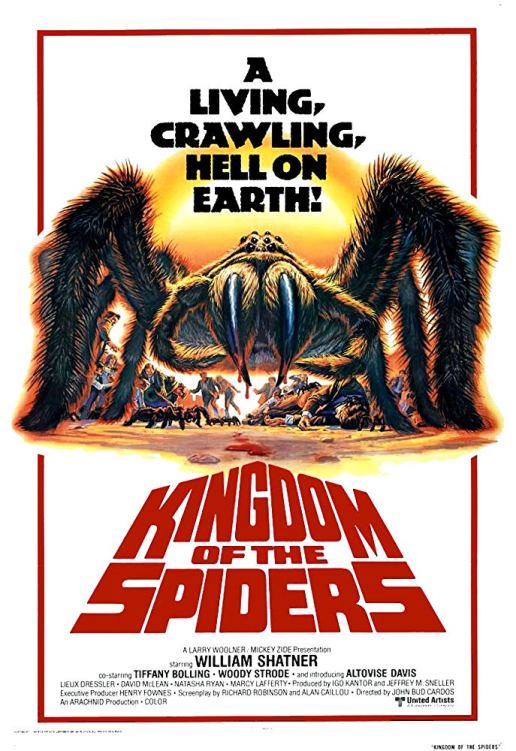
“Kingdom of the Spiders” (1977) was yet another 70’s bug-apocalypse flick that aired from time to time on 1980’s television. As I recall, this one was kinda good … or at least it was scary enough to impress me as a grade-school kid. The movie wisely made use of a truly frightening adversary (and used live tarantulas for filming). And it had the kind of jarring, open-ended final scene that I hadn’t seen before for a sci-fi/horror film.
The only thing that detracted from its creep-factor was the presence of William Shatner as the lead. It wasn’t that Shatner did a poor job with the role — it was just that he was indelibly linked in my young mind to his iconic role in the original “Star Trek” (1966-1969). I simply couldn’t get past the idea that Captain Kirk was an ordinary veterinarian; it took me out of the movie. I’m willing to bet that Shatner was helming the cop drama “T.J. Hooker” (1982-1986) at around the time that I saw “Kingdom of the Spiders,” but that was a show I didn’t watch.
Anyway, if you want to catch the flick in its entirety, you can find the whole thing over at Youtube right here.
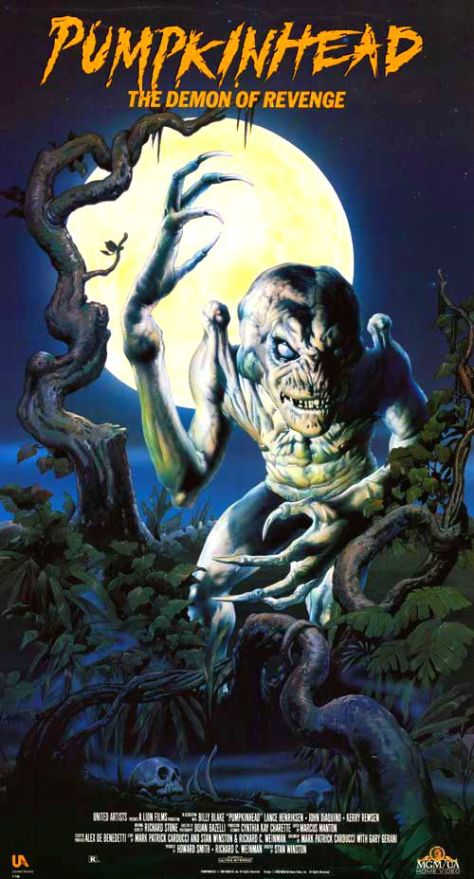
Until last night, I’d never actually seen 1988’s “Pumpkinhead” — even though I occasionally joked online about its inspired, iconic titular monster. I was predictably pleased by the movie’s creature effects, but even more disappointed than I thought I’d be by the film’s overall quality. I’d rate the film a 7 out of 10, based on my own enjoyment of it — but I’m a horror fan who loves monsters and who’s typically forgiving of 80’s cheese. If you haven’t seen “Pumpkinhead,” I suspect you’ll finds its flaws a little more egregious than I did.
The film’s strengths are its fantastic monster, designed by legendary visual effects master Stan Winston, and its interesting story concept. It’s easy to see why the sneering, towering golem here inspired a cult fanbase — complete with sequels, videogames and comic books. (Yes, horror movie pedants, I realize that Pumpkinhead is technically a demon-infused and magically mutilated corpse, and not a golem. Whatever.)
This is Winston’s first turn as a director, too … and it seems to me that his genius apparently didn’t quite extend to this larger role. “Pumpkinhead” feels cobbled together, even by 80’s-movie standards, with poor writing, acting and editing throughout. The presence of Lance Henriksen improves matters somewhat, as does an adolescent Brian Bremer in the role of “Bunt.”. (Bremer looks to be about 13 or 14 years old, but he easily outshines his adult co-stars. His surprisingly relaxed performance might be the equal of Henriksen’s. The latter is usually as good as we expect, but even he actually flubs a line here and there. He’s a long way from his brilliant turn as the “Bishop” android in the classic “Aliens” two years prior.)
All things considered, I’m not sure I would actually recommend “Pumpkinhead.”
It’s true what they say about “Godzilla: King of the Monsters” (2019) — its script is almost completely brainless. It’s got about as much depth as the old “G.I. Joe” cartoon (1983-1986) that played after school when we were kids.
But I’d be lying to you if I said I didn’t enjoy this. And I’m sure you know why — the big-budget, big-MONSTER special effects. They were spectacular — and sometimes they approached being unexpectedly beautiful. (It’s hard to explain here, but our eyes are treated to more than skyscraper-tall brawls between “titans.” We get a light show too — thanks to some confusing, thinly scripted, but nonetheless dazzling energy-based monster powers. It was really damned good.)
Add to this a generally excellent cast, and you might be able to forgive the screenplay for insulting your intelligence. I know that most people would name Ken Watanabe as the actor who truly classes up the joint. And there’s plenty of truth to that, but I myself would name Charles Dance as the movie’s biggest standout. The man’s craft is goddam Shakespearean, and I think he’s equal of the likes of Patrick Stewart or Ian McKellen. And I’d like to think that his throwaway line, “Long live the King,” was at least partly a fan-service reference to what I’m guessing is his best known role — Tywin Lannister on HBO’s “Game of Thrones” (2011-2019).
Based on my own enjoyment, I’d rate this movie an 8 out of 10 — with the caveat that I’m a kid at heart when it comes to giant monsters. If you’re the same way, then “Godzilla: King of the Monsters” might just become a guilty pleasure that you return to more than once.
Legit question for rural Australians — how do I kill the 30 to 50 feral hogs that run into my yard within 3 to 5 mins while my small kids play?
If you’re anything like me, you’re endlessly regaled by all the viral jokes this past week referencing “30 to 50 feral hogs.” (And if you’re nothing like me, then you’re an intelligent adult and I congratulate you. But you can google the new trope, which I have paraphrased above, if you want to. It is the very height of preposterous predatory animal political humor.)
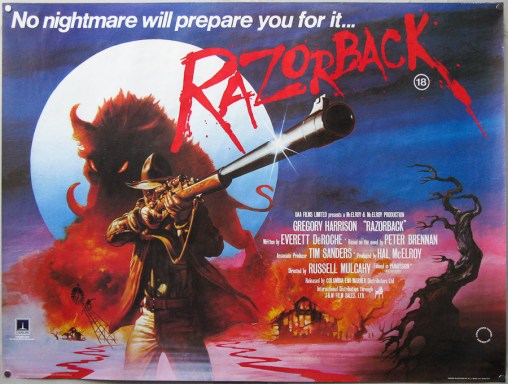
The jokes made me remember this little disappointment from the 1980’s — the Aussies’ own feral hog horror movie, 1984’s somewhat lethargic “Razorback.” If memory serves, I rented this sometime around 1986, I suppose. I got it on VHS from my nearest shopping center’s sole mom-and-pop video store, before Blockbuster Video’s invasion reached my area.
There are people out there who fondly remember “Razorback.” You can find some nice compliments about it over at Rotten Tomatoes. People enjoy its “atmosphere.” People like Gregory Harrison a lot.
I didn’t like it. Sure, it had a pretty neat electronic score that seemed trippy and cool to me as a young high school student. But that was its only redeeming quality. It started off with its depressing plot setup, which you can see in the first video below — the titular wild boar absconds with a baby boy. (The boar also thoughtfully burns the child’s house down as it departs, to underscore that fact that it is an asshole.)
The rest of the movie is boring, because it’s yet another one of those monster movies where you never get to see much of the monster — right up until the movie’s poorly lit climax, which takes place in a slaughterhouse, I think? Which is supposed to be ironic or something? Don’t quote me on this stuff; 1986 was a long time ago. For comparison, think of the legion zombie “thrillers” always available on Netflix where the zombies are always outside, and the movie just follows the indoors arguments among three very-much-alive people inside a windowless warehouse. I want to invoke the inevitable “wild bore movie” pun, but I’m holding back, because my friends tell me that they have enough of that sort of thing.
I used my own money to rent “Razorback,” probably earned from either my confusing stint at McDonald’s (they just didn’t get me there) or my summer job cleaning boats and lobster traps. (I lived on an island, people.) I remember being slightly disgruntled that I’d wasted my hard-earned cash.
Honestly, though, I was a credulous kid when it came to a movie’s marketing. When I read the back of the VHS boxes, I took things at face value. I also had my heart set on something called “The Alien’s Deadly Spawn” (1983), which I realize now was just a no-budget early mockbuster ripping off Ridley Scott’s “Alien” (1979). (It was always out. I finally caught snatches of it on Youtube this past spring, and it looks pretty unwatchable.)
If you’re acquainted with this blog at all, then you’re already aware of the sheer reverence I have for Ridley Scott’s “Blade Runner” (1982). So I won’t belabor that subject yet again in order to note Rutger Hauer’s passing this past Friday.
Hauer was a prolific actor, and his fans can remember him fondly from any number of roles. Below are the trailers for my three favorites.
The first is 1986’s “The Hitcher,” which might have been the first modern, adult horror film that I truly loved. (This is leaving aside Alfred Hitchcock’s 1963 “The Birds” and various monster movies aimed at kids.) I’m a little concerned that the trailer below misrepresents the movie, though. “The Hitcher” aspired to be a serious film, and was truly a great horror-thriller, in my opinion. It was moody, atmospheric, thoughtful and methodically paced (although it didn’t lack blood and violence either). It was far better than the 80’s action-horror boilerplate movie that the trailer seems to depict.
Hauer was terrifying. (If you are wondering, that is indeed C. Thomas Howell and Jennifer Jason Leigh costarring. And if you watch the trailer very closely, you can see Jeffrey DeMunn — who contemporary audiences will recognize as Dale from “The Walking Dead.”)
The second is movie is 1985’s “Ladyhawke,” which saw Hauer co-star with none other than Matthew Broderick and Michelle Pfeiffer. It had far more mainstream appeal, and it reliably kicks up nostalgia every time it’s mentioned on social media. (Seriously, go try it.)
The third is one that far fewer people will remember –1989’s “Blind Fury,” which rode the tail end of the decade’s martial arts craze. It was zany stuff, and it didn’t hold back on the 80’s-era cheese, but it had a lot of heart and was surprisingly earnest. Some of the action sequences were damned impressive too. (And if you were a nut for 80’s ninja movies, you’ll of course recognize Sho Kosugi as the acrobatic villain here.)
I’ve seen things you people wouldn’t believe. Attack ships on fire off the shoulder of Orion. I watched C-beams glitter in the dark near the Tannhäuser Gate. All those moments will be lost in time, like tears in rain. Time to die.
— Rutger Hauer’s closing soliloquy in “Blade Runner” (1982), Ridley Scott’s seminal adaptation of Philip K. Dick’s 1968 science fiction novel, “Do Androids Dream of Electric Sheep.” The actor co-wrote the speech that appears in the movie.
Hauer died Friday at age 75. The news of his passing was reported today.
His role in “Blade Runner” will always define him in my mind. But I also grew up seeing him in “Ladyhawke” (1985), “The Hitcher” (1986) and “Blind Fury” (1989); and later was pleased to discover him in “Batman Begins” and “Sin City” (2005). Believe it or not, it was “The Hitcher” and not “Blade Runner” that first made me love Hauer’s performances. I was still in early high school when I saw both films. The former was among the first horror movies I truly loved, and I wasn’t yet mature enough to fully appreciate the latter.
Hauer was Knight in the Dutch Order of the Netherlands Lion.
What an amazing artist, whose creativity in his craft brought so much enjoyment to others.






 Eric Robert Nolan, Author