Tag Archives: Eric Robert Nolan

More old-time radio — 47 hours of science fiction classics

What a find!  A poet I admire passed this along to me, and it was too good not to share — 47 hours of science fiction radio classics that Open Culture recently added to its Spotify page.  You’ve got to be a Spotify member to hear these, but signing up is free and easy.  (Spotify also makes it easy to reset your password if you’ve forgotten it, as I did.)

Right at the top of the list is Orson Welles’ famous/infamous 1938 broadcast of his radio adaptation of H.G. Wells’ “War of the Worlds.”  (Yes, this the show that made people believe that martians were actually invading.  How’s that for “fake news?”)

Welles’ broadcast was actually the first classic radio I’d ever heard, when I was a kid in the 1980’s.  I’d gotten it on a pair of cassette tapes for either Christmas or my birthday, along with an adaptation of Edgar Allan Poe’s “The Tell-Tale Heart.”  If those strike you as weird presents, I was a weird kid.

I loved those tapes — the Poe recording was so good it genuinely scared me.  (The narrator really nailed it.)  If I happen across that online, I’ll be sure to post it here.


DP-Orson-Welles-Broadcast-Hysteria-War-of-the-Worlds-Detroit-Institute-of-Arts

Old-time radio horror shows (because I need another nerdy hobby)

So I’ve discovered a fun and easily accessible treatment for insomnia, and it’s also an interesting diversion for a horror fan looking for a change of pace.  There are no small number of horror and suspense radio shows from the 1930’s, 40’s and 50’s on Youtube.  (They actually do have a significant online fandom.)

The programs are typically 30 to 40 minutes long, and the audio-only stories make you feel like you’re reading a book before bedtime (which for many people is a perfect treatment for sleeplessness).

The horror is a bit mild compared with modern films or TV shows, of course.  But it’s still fun hearing what people found spooky before the days of television.  It’s even better if the recording contains the original radio ads, which are even weirder than you might expect.

I started one last night that was narrated by the legendary Peter Lorre, and I know that Vincent Price starred in a slew of them.


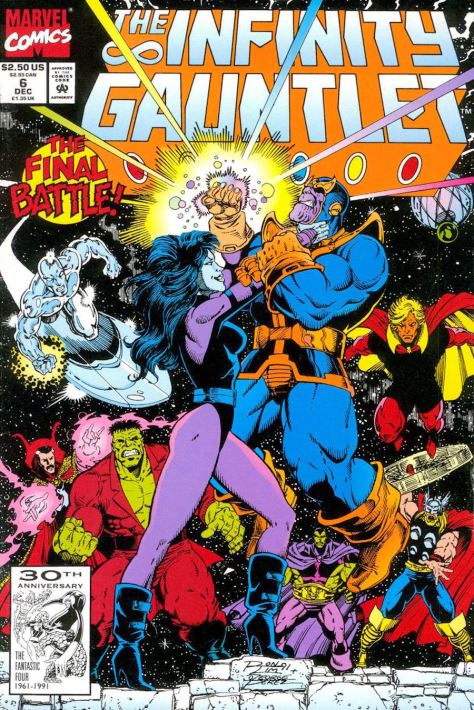
Throwback Thursday: Marvel Comics’ “The Infinity Gauntlet” (1991)

My buddies and I have “Avengers” fever.  We can barely wait to see “Avengers: Infinity War,” which opens tonight, and answer some burning questions.  I myself want to know how the relatively humble Captain America can deflect a blow from Thanos’ omnipotence-granting Infinity Gauntlet (as depicted in the trailer).  Meanwhile, a pal of mine insists it’s possible that some iteration of the Venom alien symbiote will make an appearance — even though that character is owned separately by Sony Pictures.  (I’m inclined to think that this is wishful thinking.)

I was actually around for the 1991 debut of “The Infinity Gauntlet” — the six-issue 1991 crossover series upon which this movie is based.  (“The Infinity War” was actually a sequel comic crossover that Marvel released a year later.)  An upperclassman upstairs in my sophomore dorm lent it to me, and it pretty much blew my mind.  I had only recently discovered that the characters owned by the “big two” comic book companies inhabited shared universes.  (DC Comics has released its own universe-wide crossover series at about the same time — “Armageddon 2001,” a series I still love, despite other fans’ contempt for it.)  I had read a lot of comic books growing up, but they were usually war comics or horror comics; superheroes had always seemed lame to me when I was a kid.

“The Infinity Gauntlet” was thick stuff, as comics went.  The sheer number of characters involved (and an abundance of cosmic characters) made it a little hard to follow for a reader new to Marvel.  (DC’s major characters were fewer, more familiar and easier to understand.)

But it was still a load of fun.  I still think it’s messed up what Thanos did to poor goddam Wolverine, who’d skillfully gotten the drop on him at first.


Infinity_Gauntlet_Vol_1_1_001

screen-shot-2012-05-22-at-12-58-25-pm

tumblr_nhcsooD6te1rg2hh5o1_1280

The-Infinity-Gauntlet_006_Vol1991_Marvel__ComiClash

Neon Nerd Nolan reads you Shakespeare! (Sonnet 29)

When, in disgrace with fortune and men’s eyes,
I all alone beweep my outcast state,
And trouble deaf heaven with my bootless cries,
And look upon myself and curse my fate,
Wishing me like to one more rich in hope,
Featured like him, like him with friends possessed,
Desiring this man’s art and that man’s scope,
With what I most enjoy contented least;
Yet in these thoughts myself almost despising,
Haply I think on thee, and then my state,
(Like to the lark at break of day arising
From sullen earth) sings hymns at heaven’s gate;
For thy sweet love remembered such wealth brings
That then I scorn to change my state with kings.


Neon Nerd Nolan Recites Shakespeare!

William Shakespeare’s Sonnet 30

(For Emily)  🙂

When to the sessions of sweet silent thought
I summon up remembrance of things past,
I sigh the lack of many a thing I sought,
And with old woes new wail my dear time’s waste:
Then can I drown an eye, unus’d to flow,
For precious friends hid in death’s dateless night,
And weep afresh love’s long since cancell’d woe,
And moan th’ expense of many a vanish’d sight;
Then can I grieve at grievances foregone,
And heavily from woe to woe tell o’er
The sad account of fore-bemoaned moan,
Which I new pay as if not paid before.
But if the while I think on thee, dear friend,
All losses are restor’d, and sorrows end.


I have come here to berry Caesar …

… not to praise him.

(Facebook friends, Roanokers, countrymen … lend me some money.)

20180413_151143

First sonnet of Dante Alighieri’s “La Vita Nuova,” translated by Dante Gabriel Rossetti

This is me reading Dante Gabriel Rosetti’s stylized translation of “La Vita Nuova,” by Dante Alighieri.


To every heart which the sweet pain doth move,

And unto which these words may now be brought

For true interpretation and kind thought,

Be greeting in our Lord’s name, which is Love.

Of those long hours wherein the stars, above,

Wake and keep watch, the third was almost nought,

When Love was shown me with such terrors fraught

As may not carelessly be spoken of.

He seemed like one who is full of joy, and had

My heart within his hand, and on his arm

My lady, with a mantle round her, slept;

Whom (having wakened her) anon he made

To eat that heart; she ate, as fearing harm.

Then he went out; and as he went, he wept.


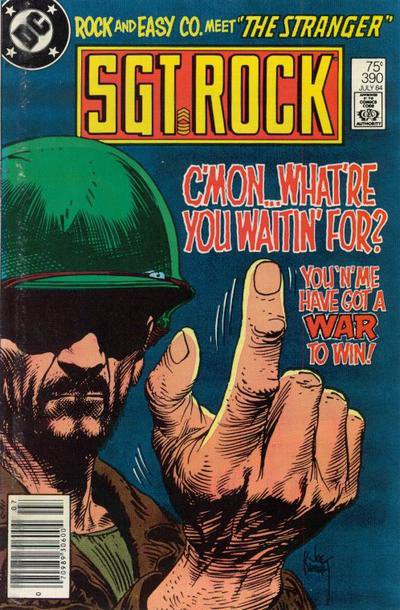
Throwback Thursday: 1980’s “Sgt. Rock!”

DC Comics’ “Sgt. Rock” was far harder stuff than the “G.I Joe” comics and toys that are more often associated with the 1980’s.  They were the darkest and most violent comic books I read when I was a young kid, except maybe for the various “Conan” books.  Hasbro relaunched “G.I. Joe” in 1982 concurrently with its toy line, and it was a famously kid-safe (and lucrative) franchise.  “Sgt. Rock,” in contrast, consisted of brutal stories that focused on the horrors of war — it was really more of a cultural holdover from the comics of the prior two decades.  (The title began as “Our Army at War” in 1959.)

I loved these comics — especially the larger “annuals” with lengthier stories.  Nothing was better than “Sgt. Rock” and Reese’s Peanut Butter Cups.  What occasionally puzzled me as a second-grader was that none of the other boys I knew seemed to be reading them — although a lot of other kids certainly hopped on the “G. I. Joe” bandwagon.

The last one pictured below, from 1981, was my favorite.  If memory serves, it was the first one I ever owned.


Sgt._Rock_Vol_1_377

SgtRock390

Sgt._Rock_Vol_1_374

Sgt._Rock_Annual_Vol_1_2

Sgt._Rock_Annual_Vol_1_3

Sgt._Rock_Vol_1_356

More flora announcing spring.

Roanoke, Virginia, April 2018.


20180410_171154

20180411_152115

20180411_152201

20180410_171332 (1)

20180410_171308

20180410_171133

An excerpt from the first sonnet of “La Vita Nuova,” by Dante Alighieri (read by Eric Robert Nolan)

This is not the complete sonnet. Neither is it necessarily the best translation of Dante’s original words.  It is merely one of the more direct and literal translations that one can find online (and it’s therefore easy to read). Fans of Ridley Scott’s “Hannibal” (2000) might recognize this as being featured in the film.