Tag Archives: review

A short review of the Season 4 premiere of “The Strain”

[THIS REVIEW CONTAINS SPOILERS FOR PAST SEASONS OF “THE STRAIN.”]  I love “The Strain.”  It’s weird, it’s wacky, it’s usually creepy, and the screenwriters seem to want to throw in everything but the kitchen sink in order to please horror fans.  It’s also the most ambitious horror show on television — it endeavors to depict nothing short of an entire vampire apocalypse, from its inception back in Season 1 to what appears to be a complete victory by the monsters at the start of its fourth (and apparently final) season.  Only the outstanding “Fear the Walking Dead” has attempted something like that.  And although “Fear” is the better show, it can’t match “The Strain’s” epic storytelling goals and its level of detail.

The writers’ energetic efforts almost always pay off.  Part of “The Strain’s” appeal is that you never know how far they’ll go.  And they do push the envelope so creatively that they sometimes hit upon ideas and story points that are grotesque and darkly creative.  I’m still enjoying this show even after I predicted back in Season 1 that the plot-driving creatures themselves would grow boring after our repeated exposure to them.  (I’m happy to be proven wrong.)

Regrettably, the Season 4 premiere suggests that the writers are now reaching too far, too fast.  It continued the show’s pattern of brave creative choices, but it was sloppy.  There were enormous changes in story and setting with insufficient exposition.  We jump nine months forward from the close of last season, when a nuclear explosion devastates New York, and our heroes are scattered.  We’re offered little information about how our protagonists arrived at their respective new junctures, and that is forgivable.  (It’s a convention of serialized storytelling like this that things can be explained in subsequent episodes.)  But the enormous changes in the overall milieu left me a little confused.

Following the nuclear conquest of New York last season, why would Philadelphia and other cities also be ruled by the vampires?  I understand that the nuclear winter is to blame for this, because the bad guys can move about by day.  But would a single bomb cause a sufficient nuclear winter to affect the entire Eastern Seaboard?  (Yes, I am aware that I am illustrating my ignorance of this subject.)

Or … is it the entire continent that’s affected, or the entire northern hemisphere?  Have other cities been bombed or not?  Why are the vampires seeking out more nuclear devices?  (We are given confusing information about these things through new story elements and dialogue.)  Furthermore, why is Vasiliy Fet (the likable Kevin Durand) trying get his hands on a nuke on behalf of the human resistance?  Is he planning on nuking an entire city, with both vampires and their human slaves?  If he neutralizes “The Master” in the remains of New York City, will it be worth it?

These are important plot and story elements that left me scratching my head.  What’s more, the season opener was further marred by some pretty spotty scripting and direction.  (The action sequence at the end was poorly done.)

The episode was still fun enough.  I’d rate it a 7 out of 10.  I’m just surprised that an episode that seems so hastily developed served as the season’s opener.


A few quick words on the “Game of Thrones” Season 7 premiere.

The premiere of Season 7 of “Game of Thrones” was damned good … enough for me to give it a 9 out of 10.  (You know you’re enjoying a TV show when you are riveted to the screen.)

The dialogue and character development for this show is always first-rate, and the acting often is.  Last night was no exception — the exchange between Littlefinger (Aidan Gillen) and Sansa Stark (Sophie Turner), for example, was priceless.

The glimpse of The Night King’s wight army, however brief, should please any horror fan.  I watch a lot of horror movies, and I’m a tough fan to please.  Yet I am still surprised at how this fantasy show continues to succeed in scaring me.  It’s impressive.  If the leaked script for Season 7 is accurate, then the bad guys in the final episode ought to be damned frightening.

I will reiterate a very minor longstanding quibble that I have had with “Game of Thrones” as someone who has not read the books.  This story seems to attach tremendous dramatic emphasis to the movement and arrival of groups of people.  I do understand the need for this, and its appeal — the logistics are part of George R.R. Martin’s world-building, and they bring detail and a sense of realism.  There are times, however, when I feel like Daenerys’ defining character trait is that she … goes places.  (Look!  Now her army is here!)

I won’t say much more for fear of spoilers — this is a show where even mentioning a character’s name can suggest a chapter in his or her character arc.  (I will say that I loved the opening segment, even if I was understandably puzzled at first.)

This is great TV.


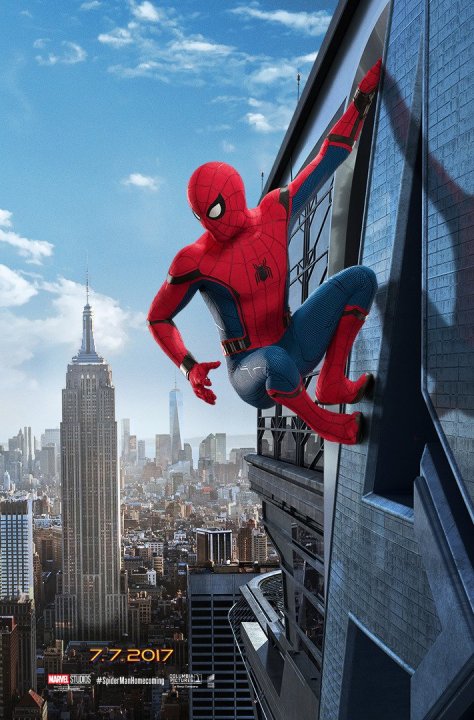
A review of “Spider-Man: Homecoming” (2017)

“Spider-Man: Homecoming” (2017) isn’t a bad movie.  To the contrary, it’s a very good one — I would even rate it a 9 out of 10, if a little reluctantly.

The action, humor, surprises and special effects are all top-notch; it’s got a slew of fun Easter eggs and great continuity within the Marvel Cinematic Universe; and Michael Keaton hits it out of the park as the story’s villain.  (As Ed Harris did recently with HBO’s “Westworld,” the sublimely likable Keaton really surprised me with how he could become so intimidating.)  Furthermore, the screenwriters wisely omit another redundant re-telling of the web-slinger’s origin.  (Even a die-hard fan like me is sick of seeing or reading about it.)

I think your enjoyment of this movie might vary according to what you want Spider-Man to be.  This isn’t a movie in which Peter Parker or his alter ego stand out as his own man (despite its plot resolution’s heavy-handed efforts to tell us that).  I submit that it’s fairly undistinguished as a standalone superhero film —  it feels like an ancillary, companion film to the “Avengers” movies, including last year’s de facto installment, “Captain America: Civil War.”  Indeed, fan-favorite Tony Stark is “Spider-Man: Homecoming’s” most significant supporting character — far more than any of the many friends, family, love interests or villains that have long inhabited the iconic hero’s mythos.  Peter’s primary motivation throughout the movie is his desire to become an Avenger, like a normal kid would aspire to the varsity football team.  Many of his powers stem from a ultra-high-tech costume designed and given to him by Iron Man; it even has an advanced A.I. that is a femme fatale equivalent of J.A.R.V.I.S.  (Fun fact: that alluring voice belongs to none other than the alluring Jennifer Connelly.  The actress is the wife of Paul Bettany, who is the voice of J.A.R.V.I.S. and then the actor portraying The Vision.  And Connelly herself played the love interest of 1991’s mostly forgotten “The Rocketeer,” a World War II-era hero with the a similar character concept to Iron Man.)

I was a big fan of Spider-Man in the 1990’s, and, believe me, the ol’ web-head did just fine with his own powers, intelligence and character — and without any sort of “internship” with Iron Man, either metaphorically or otherwise.  He was also a far more popular character with readers.  I was buying comics regularly between 1991 and 1996 — while Spider-Man books and merchandise were everywhere, I don’t think I ever remember seeing an “Iron Man” comic on the racks at my local comic shop.  I kept thinking inwardly of Spider-Man during this movie as “Iron Man Jr.,” and, for me, that wasn’t a good thing.

I also found myself musing during the film that this felt like “Spider-Man Lite.”  While “Spider-Man: Homecoming” was fun, it doesn’t have the depth, character development or gravitas of the Sam Raimi trilogy.  (Yes, I even liked the third one, despite its bizarre flaws.)  I know that critics are praising the movie’s lighter tone, and I realize the need to avoid a simple rehash of the Raimi films.  (Nobody would want that; we can rightfully expect more from the excellent MCU.)  I actually prefer the Raimi films, though.  While Tom Holland might be the better Peter Parker (Tobey Maguire was a strange casting choice), the Raimi movies were more … heartfelt.  They were an earnest exploration of the Spider-Man of the comics, and they felt … truer.   “Homecoming,” in contrast, is yet another cool installment in the “Avengers” series.  “Spider Man 2” came out 13 years ago, and I can still remember how that movie made me feel — not to mention how its sheer quality vindicated “comic book movies” like no other film before it.  This new movie will not be memorable that way.

Anyway, although my criticisms above are obviously lengthy, please know that this is only because I love the source material so much — and we comic book fans have a tendency to analyze.  I certainly enjoyed the movie, and I’d cheerfully recommend it.  (Note my rating.)  The MCU continues to entertain with quality movies; its consistency, even with its expanding group of ongoing Netflix series, is kind of astonishing.

Go see this.  You’ll have fun.


Spider-Man2

A few quick words on “The Rogue Cut” of “X-Men: Days of Future Past”

If you are a die-hard “X-Men” fan, then I do recommend checking out Bryan Singer’s non-canonical “The Rogue Cut” of “X-Men: Days of Future Past.”  You might enjoy it just for its novelty — it actually is a very different version of the original movie.  It has a lot of scenes that are either entirely new or shot and edited quite differently.  (The most notable difference, obviously, is an entire subplot concerning the rescue of Anna Paquin’s Rogue, which was deleted from the 2014 theatrical release.)

I get the sense that this will come across as a better film to “X-Men” purists.  There is greater attention to a multitude of characters, far more character interaction, and greater detail about the apocalyptic future segments.  (I myself was happy to finally figure out why the dystopian mutants were housed in such a strange looking building.  It turns out they were hiding in a Chinese temple as part of an ongoing global evasion strategy.)  “The Rogue Cut” also has greater continuity with more of the prior films — it feels integral to the films’ ongoing mythos, and less like a standalone adventure.

But “The Rogue Cut” might not be better at pleasing general audiences.  It clocks in at just under two and a half hours, and the overall result did feel far slower to me.  There is a reason why movies are edited down — their unabridged versions have problems with pacing that really can affect the average viewer’s enjoyment.

I will also point out that this version of the film fails to rectify what I’ll reiterate is the theatrical version’s biggest story flaw — why would the shape-shifting Mystique be the key to developing the Sentinels power-stealing technology.  Why not the power-stealing Rogue herself?

Anyway … speaking of what is canon and what is not, there is a damned interesting fan theory floating around about the “X-Men” movies following this year’s release of “Logan.”  That movie stood out for many reasons, but two in particular are relevant here.  The first is the radical change in its tone and storytelling, which makes it feel like it takes place in “the real world.”  The second is its odd, apparently meta-fictional inclusion of the “X-Men” comics themselves within the story.  (Copies of the comic books are discussed by the characters, and even serve as an important plot element; Wolverine complains that they are horribly inaccurate.)

Many fans are having fun wondering if there has, in fact, been only one canonical “X-Men” movie — and that is “Logan” itself.  The brutal, subdued reality of “Logan” alone is “the real world” of the X-Men; all of the fantastical prior films (which occasionally contradict one another anyway) are merely the stories inside the last movie’s comic books.  I thought that was pretty damned clever.


newcut2_by_joseelizondo-d901c11

A short review of “Mr. Jones” (2013)

Right up until its final act, “Mr. Jones” (2013) amazed me by how good it was.  Here was a creative, thoughtful and extremely frightening found-footage horror movie.  It was so damned good that I was surprised that I hadn’t heard about it before.

The story idea was fresh and interesting — a young couple moves to an isolated forest cabin, only to discover that a mysterious neighbor is “Mr. Jones,” a legendary anonymous folk artist.  This hermit produces grotesque artworks — “scarecrows,” totems and dreamcatchers that he then mails to apparently random recipients around the world.  Not all of them are pleased with their macabre gifts, and their benefactor’s identity and motivations become the stuff of urban legends.  (Try to imagine H.R. Giger with a modus operandi like Banksy.)  There is a lot more going on here than a cliche yarn about a supernatural bogeyman.

The script is smart, the story is well developed, and the tension builds slowly and effectively as the tale unfolds for our two protagonists.  My only quibble is that the couple does incredibly stupid things, and are cheerfully curious about discoveries that should scare the hell out of them.  But that is a failing of so many horror films that I decided not to let it bother me.

Then the movie loses its way.  I’m disappointed to share here that this otherwise great film suffers because of its disjointed, meandering and consequently frustrating climax.  It’s too long, it’s too confusing, and it spends far too much time repeating redundant shots and scare-moments.

We see one character, for example, pursued by multiple adversaries … repeatedly.  Well, these adversaries stop being scary when the viewer eventually arrives at the conclusion that either A.)  they can’t catch this person or B.)  they can’t hurt this person.

At another point, a character must do something urgent, but receives contradictory instructions from different sources.  This plot development could have been damned unnerving in the context of our story, but it’s nearly lost in a confusing barrage of repetitive images and sounds.  Writer-director Karl Mueller strives to immerse the viewer in a kind of surreal “nightmare.”  But he makes a mistake that is common for surreal horror films — portraying confused and disoriented characters does not always require the viewer to be confused and disoriented.  A shorter, sparser, cleaner script would have saved what might have been a classic.

Oh, well.  This movie was still fun enough.  Again … much of it is quite excellent.  And another viewer might not be as turned off by its conclusion as I was.  I still recommend “Mr. Jones,” if a little reluctantly.  I’d rate it a 7 out of 10.


Mr-Jones-Poster1

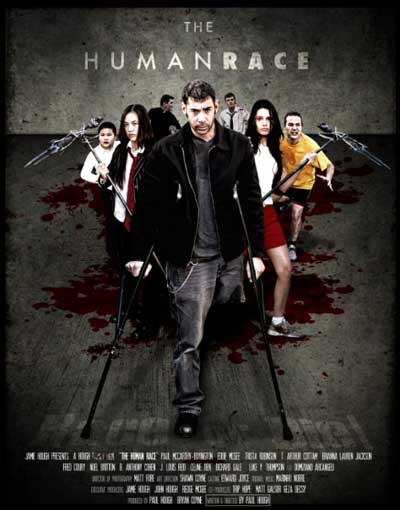
A short review of “The Human Race” (2013)

“The Human Race” (2013) isn’t really the under-recognized gem that I was led to believe it was — it’s actually mediocre in some ways.  The dialogue is downright bad, the acting is mostly below average, and the limited special effects budget definitely shows.

It … still held my attention, though, thanks to a devilish story concept and some brutal plot turns.  (Eighty diverse strangers are mysteriously transported to an isolated location, where powerful unseen entities force them to eliminate one another in a “race” to the death.)  I do realize that there have been a spate of low-budget, “Saw”-inspired movies like this, and that this kind of story device should be familiar to horror movie fans by now.

But there is some pathologically wicked story development here — consider, for example, that contenders include an elderly man, a pregnant woman and a veteran who has had a leg amputated.  And while several contenders make heroic choices, several others take a sociopathic glee in eliminating their opponents.  Writer-director Paul Hough might be terrible at writing dialogue, but he does know how to craft a surreal horror story with some horrific and unexpected turns.  (Yeesh.)

There is also a standout performance by Trista Robinson as a secondary character.  (She is the more tenacious half of a deaf couple who are teleported and forced to compete.)  In a film with little admirable acting, she still plays her role with skill and intensity.  This is a talented actress.

All in all, this is a flawed low-budget film that is still decent fare for a horror fan.  I’d rate it a 7 out of 10.


The-Human-Race-2013-Movie-Paul-Hough-8

A few quick words on “47 Meters Down” (2017)

Yes, “47 Meters Down” is silly in places, and I don’t think it will ever be held up as an example to students of good screenwriting.  But I can’t slam any horror-thriller that scared and entertained me.  And the sharks here (which were surprisingly well rendered by CGI) made me jump a few times.  Furthermore, there are a couple of surprises late in the story, and I thought that one of them was wonderfully well executed.

This movie actually reminds me a little of last year’s “The Shallows.”  Neither movie is 1975’s “Jaws,” but neither pretends to be.  They’re both perfectly serviceable monster movies that present horror movie fans with a great way to kick off the summer.

I’d rate this film an 8 out of 10 for being a fun, if forgettable, shark flick.


poster-large

A short review of the premiere of “The Mist” (2017)

I couldn’t help but feel just slightly disappointed by the premiere of “The Mist” (2017).  It wasn’t bad … it just wasn’t as amazing as its trailer made it look.  I’d rate it a 7 out of 10.

The first episode’s horror elements felt rote, rushed and cheesy.  The pre-credits teaser was nearly campy.  Director Adam Bernstein just isn’t Frank Darabont.  (Curiously, each episode seems to be helmed by a different director.)  And what seems like “The Mist’s” milquetoast main protagonist is played somewhat anemically by Morgan Spector.

Still, the show displays some promise.  Instead of rushing straight into its otherworldly-monster MacGuffin, it goes to great lengths to set up some interesting human drama, and it mostly succeeds.  Besides Spector’s ostensibly likable Dad, the characters felt fresh and interesting.  (And regarding that human drama?  I strongly suspect the individual accused of the crime here is not the actual perpetrator.  That’s what the clues are telling me, anyway.  It would be devilishly clever, I think, if his accuser turned out to be the one guilty.)  “The Mist’s” attention to characters here is something of which I think Stephen King would approve.

The show also seems pretty ambitious.  It places its diversity of characters in a number of locations throughout its small-town setting, and a couple are embroiled in some kind of interesting conflict even before the titular mist arrives.  For just a single episode, it feels tightly plotted.

Anyway, if you’re curious about what the mist really is … there is an explanation in King’s source material — and I’m not talking about only the vague allusions in the novella of the same name.  Die-hard King fans know it was further described in his “The Dark Tower” series.  It’s been named as “todash space” by the denizens of one of King’s many worlds — it’s a monster-filled limbo that falls between myriad parallel universes: http://stephenking.wikia.com/wiki/Todash_space.


17917318_1630442733637084_5273923078462957098_o


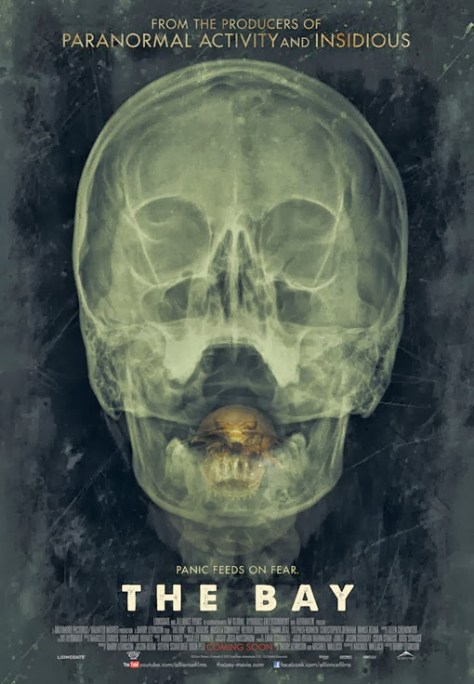
A short review of “The Bay” (2012)

“The Bay” (2012) deserves credit for its effort to give viewers a detailed and well developed, found-footage science fiction-horror movie.  In depicting a brutal parasitic infection eradicating a small coastal town, writers Barry Levinson and Michael Wallach appear familiar with the basics of epidemiology and public health.  And they make nice use of a time-honored sci-fi standby — pollutants causing small organisms to mutate into large ones.

Levinson and Wallach are ambitious too.  “The Bay” follows a number of intertwining narratives winding through the entire town,  making use of more than a dozen actors and innumerable extras.  Some of those actors are quite good — especially those portraying emergency professionals, like the local emergency room doctor, the staff for the Centers for Disease Control and the bureaucrat from the Department of Homeland Security.  I think a story with this scope, and with this many characters, would have made a fine ecological techno-thriller novel.  The filmmakers really do serve up a thoughtful, serious cautionary tale that is sometimes frightening.

Despite its strengths, however, “The Bay” is still encumbered by some noticeable flaws.  There’s little structure to it, the pacing feels off, and we follow so many characters that it is hard for the viewer to get to know any one of them.  There is a news reporter whose point of view serves as a framing device, but she’s performed with little energy by the main actress, and her character isn’t scripted to be terribly likable to begin with.  Parts of the film feel redundant, too.  Levinson (who is also the director here) keeps replaying footage and key dialogue, and it’s a poor choice.

All things considered, I’d rate “The Bay” a 7 out of 10.


TheBay

A short review for the pilot of “The Last Ship” (2014)

So I finally got around to checking out “The Last Ship” (2014), and while the pilot didn’t immediately have me hooked, it seems like a decent show.  I’d rate it an 8 out of 10, and I’ll probably continue watching it.

I was surprised I’d heard so little about this program … it’s a big-budget, post-apocalyptic military science fiction series, but none of my fellow horror or sci-fi nerds mentioned having seen it.

The plot setup seems like something that would please horror fans — a virus eradicates 80 percent of the world’s population, and a lone American naval vessel elects to remain at sea.  (They’re fortunate enough to be carrying a civilian virologist who was tasked by the fallen United States government to develop a vaccine.)  And there are hints that the show’s writers would do well scripting a frightening TV series — there are a couple of nice flourishes for a serialized horror show right here in the pilot.

But the story’s horror elements are minimized in favor of a more mainstream, safe-for-general-audiences techno-thriller.  And that’s not a bad thing, because it succeeds as a such.  The show is based on a 1988 novel by William Brinkley, and it’s produced in cooperation with the United States Navy.  (The destroyers U.S.S. Halsey and the U.S.S. Dewey stand in for the fictional U.S.S. Nathan James.)  It seems smartly scripted with respect to both virology and how the military works.  I’m barely literate in either of those subjects, but what I watched seemed coolly authentic, and that entertained me and held my attention. So while I might not recommend this to fellow “The Walking Dead” fans, I’d definitely recommend it to fans of Tom Clancy.

The directing is pretty good, the story moves along quite quickly, and the action scenes in the pilot are surprisingly ambitious and effective for a TV show.

The acting, I suppose, is average — though it’s always fun seeing Adam Baldwin on screen, and the square-jawed Eric Dane seems well cast and shows promise as the ship’s commanding officer.

The dialogue and character interaction are average at best.  This isn’t high art when it comes to human storytelling.  There are some pretty predictable character tropes, and a few exchanges are so cheesily melodramatic that they nearly insult the viewer’s intelligence.  Dane’s commander faces off, for example, against a beautiful, independent, female scientist who doesn’t like following orders … gee, I wonder if we’ll see any romantic tension there?

Still, this looks like a good enough show, if its pilot is any indication.  The good outweighs the bad, and I’m glad I heard about it.


The_Last_Ship_Season_1_poster